
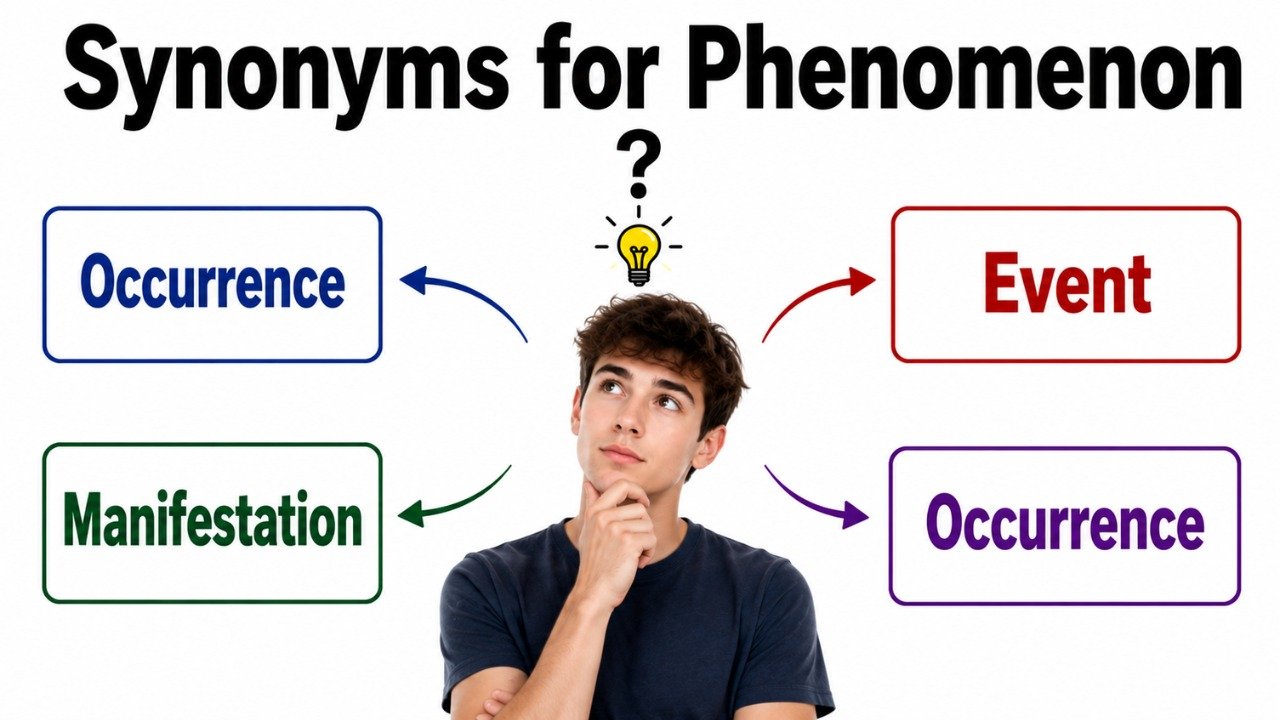
Quick Answer: The best synonyms for phenomenon include occurrence, event, happening, manifestation, development, trend, spectacle, wonder, anomaly, and sensation. Use occurrence for something that takes place, event for an organized or important happening, and manifestation for a visible sign of an idea, condition, or force. Trend works best for a growing social pattern, while anomaly describes something unusual. Spectacle and wonder suit impressive sights, and sensation can describe a person, product, or event that attracts widespread attention.
Pronunciation and Word Details
Word: Phenomenon.
Pronunciation: /fəˈnɒmɪnən/.
Part of Speech: Noun.
Meaning: An observable event, fact, situation, or person that is unusual, important, or worthy of attention.
US Pronunciation:
UK Pronunciation:
What Does “Phenomenon” Mean?
A phenomenon is something that can be observed, experienced, studied, or recognized as important or unusual.
Phenomenon is a singular noun. Its standard plural form is phenomena. The word can describe a natural event, a scientific fact, a social development, an unusual situation, or an exceptionally talented person.
In scientific writing, a phenomenon is an observable fact or process that researchers try to understand. Weather changes, magnetic attraction, light reflection, and human behavior can all be studied as phenomena.
In general writing, the word may describe something remarkable or surprising.
Example: The sudden change in public opinion became a cultural phenomenon.
It may also describe an exceptionally successful or talented person.
Example: The young musician was considered a phenomenon because of her extraordinary ability.
The meaning of phenomenon changes slightly according to the sentence. It may refer to something neutral and observable, something strange and unexplained, or something highly impressive.
Meaning, Tone, and Context of “Phenomenon”
Phenomenon usually has a neutral, formal, academic, or technical tone. It is commonly used in science, sociology, psychology, history, economics, education, journalism, and cultural discussions.
In academic writing, phenomenon often refers to something that can be examined or studied.
Example: Researchers investigated the phenomenon of memory loss under extreme stress.
In scientific contexts, it refers to an observable event, process, or effect.
Example: Lightning is a natural phenomenon caused by electrical activity in the atmosphere.
In social or cultural discussions, it describes a widespread development or pattern.
Example: The rapid growth of remote learning became a global phenomenon.
In everyday conversation, phenomenon can sound more formal than words such as event, happening, or trend. Speakers often use it when they want to emphasize that something is remarkable, widespread, or difficult to explain.
It can also have a strongly positive tone when it describes an exceptionally talented person.
Example: The athlete became a sporting phenomenon before reaching adulthood.
The word is not always emotional. In technical writing, it may simply describe an observable fact without suggesting that it is impressive or unusual.
When and How to Use “Phenomenon”
For Natural Events
Use phenomenon for an event or process that occurs in nature and can be observed or studied.
Example: The northern lights are a fascinating natural phenomenon.
For Scientific Observation
Use phenomenon when discussing a fact, effect, reaction, or process examined through scientific study.
Example: Scientists are studying the phenomenon of animals sensing environmental changes.
For Social Developments
Use phenomenon for a widespread pattern that affects communities, cultures, or societies.
Example: Urban migration has become a significant social phenomenon.
For Cultural Trends
Use phenomenon when an idea, style, work, or activity becomes widely recognized and influential.
Example: The dance developed from a local tradition into an international phenomenon.
For Unusual Situations
Use phenomenon when something is surprising, rare, strange, or difficult to explain.
Example: The unexplained lights became a local phenomenon.
For Impressive Success
Use phenomenon for a person, performance, or creation that achieves exceptional success.
Example: The young writer became a literary phenomenon after her first novel.
For Academic Analysis
Use phenomenon when examining the causes, effects, or characteristics of a subject.
Example: The essay explores the phenomenon of group decision making.
For Visible Signs
Use phenomenon when something represents the visible effect of a deeper condition, force, or idea.
Example: Rising sea levels are a visible phenomenon connected with long term environmental change.
Best Synonyms for Phenomenon
Occurrence
Synonym: Something that happens or exists in a particular place or time.
Example: Heavy rainfall is a common occurrence during the season.
Event
Synonym: An important, planned, or noticeable happening.
Example: The discovery was a major event in scientific history.
Happening
Synonym: Something that takes place, especially an interesting or unusual incident.
Example: The strange happening attracted attention from nearby residents.
Manifestation
Synonym: A visible sign or expression of an idea, condition, emotion, or force.
Example: The protest was a manifestation of public frustration.
Development
Synonym: A new situation, change, or stage in a continuing process.
Example: The discovery represents an important development in medical research.
Trend
Synonym: A general direction in which behavior, style, or opinion is changing.
Example: Flexible working is a growing employment trend.
Spectacle
Synonym: An impressive or unusual sight that attracts attention.
Example: The meteor shower created a breathtaking spectacle.
Wonder
Synonym: Something that causes admiration, surprise, or amazement.
Example: The ancient structure remains an architectural wonder.
Anomaly
Synonym: Something that differs from what is normal, expected, or common.
Example: The unusually high temperature was treated as an anomaly.
Sensation
Synonym: A person, performance, product, or event that creates great excitement and attention.
Example: The young singer became an international sensation.
50 Synonyms for Phenomenon with Short Meanings
- Occurrence: Something that happens or exists.
- Event: An important or noticeable happening.
- Happening: Something that takes place.
- Fact: Something known or observed to be true.
- Incident: A particular event, often unusual or noteworthy.
- Episode: A separate event within a longer series.
- Case: A particular example of a situation.
- Instance: A specific example or occurrence.
- Situation: A set of conditions existing at a particular time.
- Circumstance: A fact or condition connected with an event.
- Development: A new event, change, or stage.
- Process: A series of actions or natural changes.
- Condition: A state that exists and can be observed.
- Pattern: A repeated or recognizable form of behavior.
- Trend: A general direction of change or development.
- Movement: A developing social, cultural, or political activity.
- Change: A movement from one condition to another.
- Emergence: The process of appearing or becoming important.
- Appearance: The act of becoming visible or noticeable.
- Manifestation: A visible sign of something deeper.
- Expression: A visible or noticeable representation of an idea.
- Display: A noticeable presentation or visible showing.
- Exhibition: A public or impressive display.
- Spectacle: An unusual or impressive sight.
- Show: A visible presentation intended to attract attention.
- Wonder: Something that produces admiration or amazement.
- Marvel: A person or thing that causes great surprise.
- Rarity: Something uncommon or rarely seen.
- Anomaly: Something that differs from the expected pattern.
- Oddity: A strange or unusual person, object, or event.
- Curiosity: Something unusual that attracts interest.
- Sensation: Something that creates widespread excitement.
- Attraction: Something that draws attention or interest.
- Landmark: An important event or achievement.
- Breakthrough: A major discovery or advance.
- Effect: A noticeable result produced by a cause.
- Reaction: A response caused by an action or condition.
- Response: An action or change caused by something else.
- Result: Something produced by an action or process.
- Consequence: An outcome caused by an earlier event.
- Outcome: The final result of an event or process.
- Reality: Something that exists or happens in real life.
- Actuality: The true state of a situation.
- Experience: An event that someone directly observes or feels.
- Observation: Something noticed through careful attention.
- Feature: A noticeable or important characteristic.
- Characteristic: A recognizable quality of something.
- Prodigy: A person with exceptional natural talent.
- Genius: A person with extraordinary intellectual or creative ability.
- Standout: A person or thing that is noticeably exceptional.
Read Also:
Synonyms for Showcase

Synonyms for Phenomenon by Context
When Phenomenon Means an Observable Occurrence
Occurrence, event, happening, incident, instance, episode, and case work well when phenomenon refers to something that takes place.
Occurrence is the most neutral alternative. Event often suggests importance, while incident may suggest something unexpected or problematic.
Example: The unusual occurrence was recorded by several observers.
Example: The event changed how researchers understood the process.
Example: This case demonstrates how quickly the condition can develop.
When Phenomenon Means a Natural or Scientific Process
Process, effect, reaction, condition, manifestation, observation, and development are useful in scientific or technical contexts.
Process emphasizes a series of changes. Effect focuses on a result, while manifestation describes a visible sign of an underlying cause.
Example: Evaporation is a natural process involving the change of liquid into vapor.
Example: The warming effect was strongest in enclosed spaces.
Example: The discoloration was a manifestation of chemical change.
When Phenomenon Means Something Unusual
Anomaly, rarity, oddity, curiosity, wonder, and marvel are useful when something differs from normal expectations.
Anomaly is suitable for formal analysis. Oddity is less formal and may sound slightly critical. Wonder and marvel express admiration.
Example: The unexpected result was considered an anomaly.
Example: Snow in the warm region was a rare curiosity.
Example: The cave is regarded as a natural wonder.
When Phenomenon Means an Impressive Sight
Spectacle, display, exhibition, show, attraction, wonder, and marvel work when the subject is visually impressive.
Spectacle suggests a dramatic sight. Display emphasizes presentation, while attraction refers to something that draws visitors or attention.
Example: The fireworks created a colorful spectacle above the city.
Example: The flowers produced an impressive display throughout the garden.
Example: The waterfall is the main natural attraction in the area.
When Phenomenon Means a Widespread Trend
Trend, movement, pattern, development, emergence, sensation, and change work when phenomenon describes widespread social or cultural activity.
Trend describes a general direction. Movement usually involves shared beliefs or goals. Sensation emphasizes rapid popularity and public excitement.
Example: Minimalist living has become a growing trend.
Example: The campaign developed into a national movement.
Example: The performance became an immediate sensation.
When Phenomenon Means an Exceptional Person
Prodigy, genius, standout, sensation, wonder, and marvel can describe a highly talented or successful person.
Prodigy is especially suitable for a young person with exceptional ability. Genius focuses on intellectual or creative ability. Sensation emphasizes public attention and popularity.
Example: The child was considered a musical prodigy.
Example: The inventor was regarded as a creative genius.
Example: The new player became the standout of the competition.
Another Word for Phenomenon
The best general replacement for phenomenon is occurrence. It works when referring to something that happens, appears, or can be observed. However, the strongest alternative depends on whether the subject is scientific, unusual, widespread, impressive, or related to a talented person.
Original: The sudden temperature drop was an unusual phenomenon.
Better Option: The sudden temperature drop was an unusual occurrence.
Original: The popularity of the new style became a worldwide phenomenon.
Better Option: The popularity of the new style became a worldwide trend.
Original: The colorful lights created a remarkable phenomenon in the sky.
Better Option: The colorful lights created a remarkable spectacle in the sky.
Original: The young mathematician was an academic phenomenon.
Better Option: The young mathematician was an academic prodigy.
When Not to Use “Phenomenon”
Do not use phenomenon when a simpler and more precise word would communicate the meaning more clearly. The word can sound vague when the writer does not explain what kind of event, process, or change is being discussed.
When Describing an Ordinary Event
Phenomenon may sound unnecessarily formal when referring to a simple everyday happening.
Weak: Missing the bus was an unfortunate phenomenon.
Better: Missing the bus was an unfortunate event.
When Referring to a Specific Accident
Incident is usually clearer when discussing a particular accident, conflict, or problem.
Weak: The safety phenomenon was reported to the manager.
Better: The safety incident was reported to the manager.
When Discussing a Continuing Pattern
Trend or pattern is more accurate when the subject involves repeated behavior or gradual change.
Weak: The increase in online study is a growing phenomenon.
Better: The increase in online study is a growing trend.
When Describing a Visible Sign
Manifestation is more precise when something is evidence of a deeper emotion, condition, or problem.
Weak: His silence was a phenomenon of his disappointment.
Better: His silence was a manifestation of his disappointment.
When Describing a Rare Difference
Anomaly is clearer when a result differs from an established pattern.
Weak: The unusually low reading was a phenomenon in the data.
Better: The unusually low reading was an anomaly in the data.
When Repetition Weakens the Paragraph
Using phenomenon repeatedly can make academic writing sound vague and monotonous.
Weak: The phenomenon affected society, and the phenomenon continued to influence public behavior.
Better: The development affected society, and the trend continued to influence public behavior.
Words Commonly Confused With Phenomenon
Phenomenon vs Event: A phenomenon is something observable, notable, or worthy of study. An event is simply something that happens and may be planned, accidental, ordinary, or important.
Phenomenon vs Occurrence: Phenomenon often suggests importance, interest, or scientific relevance. Occurrence is a neutral word for anything that happens.
Phenomenon vs Anomaly: A phenomenon may be normal or unusual. An anomaly specifically differs from an expected pattern or standard.
Phenomenon vs Trend: A phenomenon may be a single event, process, person, or widespread development. A trend is a general direction of change over time.
Phenomenon vs Manifestation: A phenomenon is something observed. A manifestation is the visible expression or sign of an underlying condition, belief, force, or emotion.
Phenomenon vs Fact: A phenomenon is an observable event or condition. A fact is information known or accepted as true.
Phenomenon vs Spectacle: A phenomenon can be scientific, social, natural, or personal. A spectacle is mainly an impressive, dramatic, or unusual sight.
Phenomenon vs Sensation: A phenomenon can be any significant observable subject. A sensation is something or someone that creates strong public excitement.
Which Synonym Should You Choose?
Choose occurrence when you need a neutral word for something that happens.
Choose event for an important, organized, historical, or noticeable happening.
Choose incident for a specific accident, conflict, or unexpected situation.
Choose manifestation when describing the visible sign of an emotion, condition, belief, or force.
Choose process when explaining a series of scientific, biological, or natural changes.
Choose effect when focusing on the result produced by a cause.
Choose anomaly when a result or observation differs from an expected pattern.
Choose trend when discussing a general direction in behavior, culture, fashion, business, or public opinion.
Choose movement when people are united by a shared social, cultural, or political goal.
Choose spectacle when describing a dramatic or visually impressive sight.
Choose wonder or marvel when the subject causes admiration and amazement.
Choose sensation when a person, performance, or product receives sudden widespread attention.
Choose prodigy when describing a young person with exceptional natural ability.
Choose development in reports, essays, and professional emails when discussing a new change or stage in a continuing situation.
Choose happening in casual speech when a formal word such as phenomenon would sound unnatural.
Real Life Examples of “Phenomenon” in Sentences
Original: The sudden increase in housing costs is a worrying economic phenomenon.
Better Option: The sudden increase in housing costs is a worrying economic trend.
Original: The researchers observed a strange phenomenon during the experiment.
Better Option: The researchers observed a strange reaction during the experiment.
Original: The rainbow is a natural phenomenon caused by light and water.
Better Option: The rainbow is a natural effect caused by light and water.
Original: The young athlete became a national phenomenon.
Better Option: The young athlete became a national sensation.
Original: The unexplained sound remained a local phenomenon for several months.
Better Option: The unexplained sound remained a local mystery for several months.
Original: The spread of flexible employment is a modern phenomenon.
Better Option: The spread of flexible employment is a modern development.
Original: The flashing lights created a beautiful phenomenon above the lake.
Better Option: The flashing lights created a beautiful spectacle above the lake.
Original: The unexpected test result was an unusual phenomenon.
Better Option: The unexpected test result was an unusual anomaly.
Original: The child was considered a musical phenomenon.
Better Option: The child was considered a musical prodigy.
Original: The researchers wanted to understand the phenomenon of social isolation.
Better Option: The researchers wanted to understand the pattern of social isolation.
Synonym Groups and Usage Differences
Occurrence Group
Occurrence, event, happening, incident, episode, case, and instance all describe something that takes place.
Occurrence is neutral. Event may be planned or important. Incident often suggests a problem. Episode describes one part of a longer series. Case and instance introduce specific examples.
Example: This occurrence was the first recorded instance of the behavior in the region.
Scientific Process Group
Process, effect, reaction, response, condition, manifestation, and observation are useful in academic and scientific writing.
Process emphasizes stages. Effect and result describe outcomes. Reaction and response show how something changes after a cause. Manifestation identifies a visible sign.
Example: The color change was a visible manifestation of the chemical reaction.
Change and Development Group
Development, change, emergence, movement, trend, and pattern describe something growing or changing over time.
Development is broad and formal. Emergence focuses on something beginning to appear. Trend describes direction, while pattern emphasizes repetition.
Example: The emergence of the pattern represented an important development in the study.
Unusual Event Group
Anomaly, rarity, oddity, and curiosity describe something uncommon.
Anomaly is formal and analytical. Rarity emphasizes how uncommon something is. Oddity can sound informal or mildly negative. Curiosity suggests something unusual that attracts interest.
Example: The scientist examined the anomaly because such a result was a rarity.
Impressive Sight Group
Spectacle, display, exhibition, show, wonder, and marvel describe something visually or emotionally impressive.
Spectacle is dramatic. Display and exhibition involve presentation. Wonder and marvel express admiration.
Example: The lights produced a spectacle that visitors described as a natural wonder.
Public Attention Group
Sensation, attraction, standout, landmark, and breakthrough describe something that gains attention or importance.
Sensation emphasizes excitement. Attraction draws interest. Landmark describes historical importance. Breakthrough refers to major progress or discovery.
Example: The discovery became a scientific sensation and a landmark in medical research.
Exceptional Person Group
Prodigy, genius, sensation, standout, wonder, and marvel may describe a highly talented individual.
Prodigy usually refers to exceptional ability at a young age. Genius highlights intellectual or creative power. Standout compares one person favorably with others.
Example: The young artist was a prodigy who quickly became the standout of the exhibition.
Antonyms of Phenomenon
Phenomenon does not have one exact antonym in every context. The appropriate opposite depends on whether the word refers to an occurrence, unusual event, visible effect, widespread trend, or remarkable person.
Nonoccurrence: The failure of an expected event to happen.
Absence: The state of not being present or observable.
Normality: The state of being usual or expected.
Commonness: The quality of being ordinary or frequently found.
Regularity: Behavior that follows an expected pattern.
Insignificance: A lack of importance or noticeable influence.
Obscurity: The state of being unknown or receiving little attention.
Invisibility: The condition of not being visible or easily observed.
Ordinariness: The quality of being normal and unremarkable.
Unknown Person: Someone who has not gained public attention or recognition.
Comparison: Phenomenon vs Related Words
Phenomenon vs Occurrence
Phenomenon suggests that something is observable, significant, unusual, or worthy of study. Occurrence simply means something that happens.
Example With Phenomenon: Researchers are studying the phenomenon of sudden memory recovery.
Example With Occurrence: Power cuts are a common occurrence during severe storms.
Phenomenon vs Event
Phenomenon may describe a natural process, social pattern, remarkable person, or observed fact. Event usually refers to a particular happening at a specific time.
Example With Phenomenon: Migration is a complex social phenomenon.
Example With Event: The annual migration event attracts many observers.
Phenomenon vs Anomaly
Phenomenon is broad and does not always suggest abnormality. Anomaly specifically refers to something that differs from what is expected.
Example With Phenomenon: The researchers studied the phenomenon of changing sleep patterns.
Example With Anomaly: One result was excluded because it appeared to be an anomaly.
Phenomenon vs Manifestation
Phenomenon refers to what is observed. Manifestation emphasizes that the observable sign represents something deeper.
Example With Phenomenon: The rapid spread of the behavior is a social phenomenon.
Example With Manifestation: The behavior may be a manifestation of anxiety.
Phenomenon vs Trend
Phenomenon can refer to a single event or a continuing pattern. Trend specifically describes a general direction of change over time.
Example With Phenomenon: The popularity of shared workspaces is a modern phenomenon.
Example With Trend: The report identifies a growing trend toward shared workspaces.
Phenomenon vs Spectacle
Phenomenon is neutral and may be scientific or abstract. Spectacle describes something visually dramatic or impressive.
Example With Phenomenon: The eclipse is a natural phenomenon.
Example With Spectacle: The eclipse created an unforgettable spectacle.
Phenomenon vs Sensation
Phenomenon is a broad term for something notable or observable. Sensation refers to something that produces widespread excitement or attention.
Example With Phenomenon: The singer became a cultural phenomenon.
Example With Sensation: The singer became an international sensation within a year.
Common Phrases and Expressions With Phenomenon
Natural Phenomenon: An observable event or process that occurs in nature.
Social Phenomenon: A pattern, event, or behavior that develops within society.
Cultural Phenomenon: An idea, activity, person, or creation that strongly influences culture.
Global Phenomenon: Something that occurs or becomes important in many parts of the world.
Rare Phenomenon: An event or condition that does not happen often.
Observed Phenomenon: An event or effect that has been noticed or recorded.
Physical Phenomenon: An observable event involving matter, energy, motion, or physical forces.
Psychological Phenomenon: A pattern or process connected with thoughts, emotions, or behavior.
Unexplained Phenomenon: An event or condition whose cause is not yet understood.
Widespread Phenomenon: Something that affects many people, places, or situations.
Common Mistakes to Avoid
Using the Wrong Plural Form
The singular form is phenomenon. The standard plural form is phenomena, not phenomenons.
Incorrect: Several strange phenomenons were recorded.
Correct: Several strange phenomena were recorded.
Confusing Phenomenon and Phenomena
Use phenomenon when referring to one event, process, person, or observable fact. Use phenomena when referring to more than one.
Incorrect: This phenomena requires further research.
Correct: This phenomenon requires further research.
Using Phenomenon for Every Event
Not every ordinary happening needs to be called a phenomenon. Event, occurrence, or incident may sound clearer and more natural.
Unnatural: The meeting was an interesting phenomenon.
Natural: The meeting was an interesting event.
Choosing an Overly Dramatic Synonym
Spectacle, marvel, wonder, and sensation carry strong emotional meanings. Do not use them for neutral scientific observations unless the sentence genuinely expresses amazement.
Weak: The minor change in pressure was a spectacle.
Better: The minor change in pressure was an observable effect.
Confusing a Phenomenon With Its Cause
A phenomenon is usually the event, fact, process, or effect being observed. It is not necessarily the force that caused it.
Unclear: Heat was the phenomenon that caused the metal to expand.
Better: Metal expansion was the phenomenon caused by heat.
Repeating the Word Too Often
Repeated use of phenomenon can make a paragraph sound vague. Replace it with a more specific word when the meaning becomes clear.
Repetitive: The phenomenon was studied because the phenomenon affected several groups.
Improved: The phenomenon was studied because the trend affected several groups.
Using an Inaccurate Synonym
Synonyms are not interchangeable in every sentence. Anomaly suggests abnormality, trend suggests gradual direction, and manifestation suggests a visible sign.
Incorrect: The festival became an international anomaly.
Correct: The festival became an international sensation.
Using Vague Descriptions
Explain what makes the phenomenon important, unusual, measurable, or worthy of attention.
Vague: The study examined an interesting phenomenon.
Clear: The study examined the sudden decline in concentration after prolonged mental activity.
Conclusion
The best synonyms for phenomenon depend on what the word describes. Occurrence and event suit general happenings, while process, effect, and manifestation work well in scientific or academic contexts. Trend and movement describe widespread social change. Anomaly and rarity emphasize unusual results, while spectacle, wonder, and marvel express visual admiration. Sensation, prodigy, and standout can describe exceptional people. Understanding these differences will help you use synonyms for phenomenon accurately in essays, reports, conversations, and professional writing.
FAQs About Synonyms for Phenomenon
What Is the Best Synonym for Phenomenon?
Occurrence is the best general synonym. Event, manifestation, trend, anomaly, or sensation may be better in more specific contexts.
Is Event a Synonym for Phenomenon?
Yes. Event is a suitable synonym when phenomenon refers to something that happens. However, phenomenon often sounds more scientific, important, or unusual.
What Is the Plural of Phenomenon?
The correct plural is phenomena.
Singular: This phenomenon is unusual.
Plural: These phenomena are unusual.
Can Phenomenon Describe a Person?
Yes. Phenomenon can describe someone with exceptional talent, success, or influence.
Example: The young athlete became a sporting phenomenon.
Is Phenomenon a Formal Word?
Phenomenon is generally neutral to formal. It is especially common in scientific, academic, technical, and analytical writing.
What Is the Difference Between a Phenomenon and an Anomaly?
A phenomenon is any observable event, fact, or process. An anomaly is a result or occurrence that differs from what is normal or expected.
Which Synonym Is Best for Scientific Writing?
Occurrence, process, effect, reaction, manifestation, observation, and condition are strong choices. The best word depends on what researchers are observing or measuring.
