
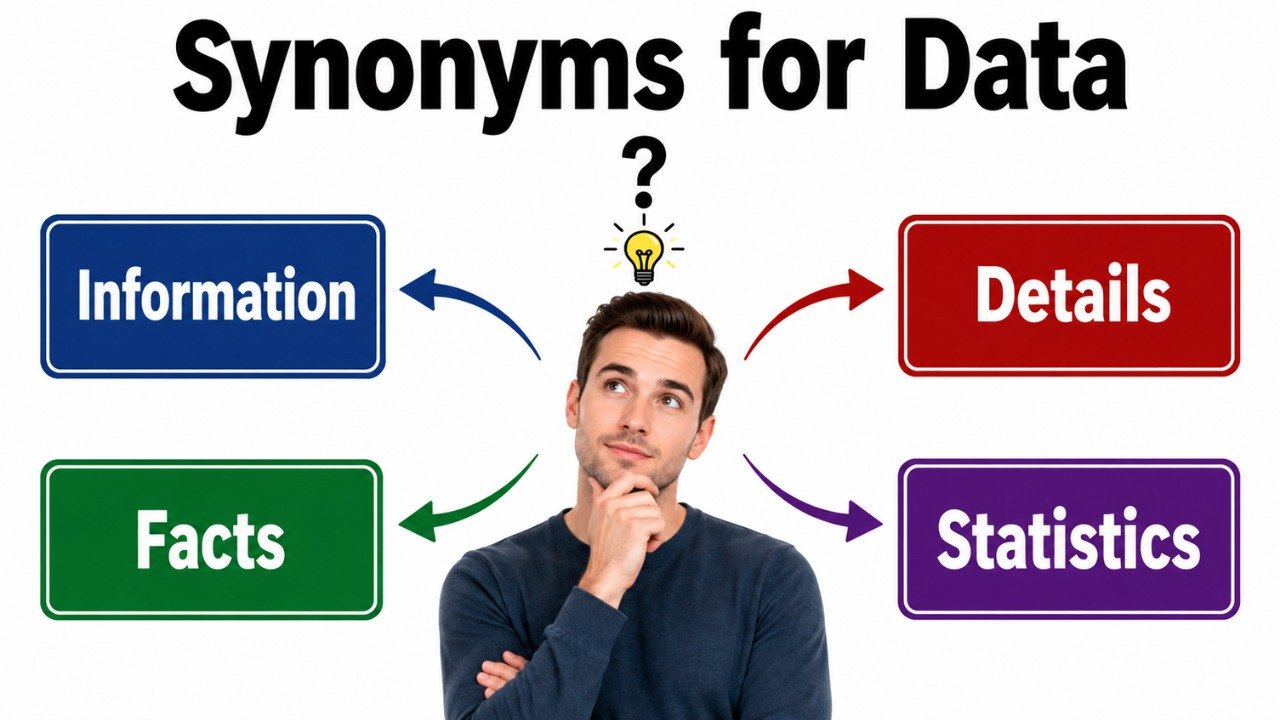
Quick Answer: The best synonyms for data include information, facts, figures, statistics, records, evidence, findings, measurements, observations, and details. Use information as the broadest replacement in everyday and formal writing. Facts works for verified statements, while figures and statistics are best for numerical content. Evidence suits arguments, investigations, and research. Findings describes results from a study, measurements refers to recorded quantities, and records works well for stored historical, medical, business, or administrative information.
Pronunciation and Word Details
Word: Data.
Pronunciation: /ˈdeɪtə/ or /ˈdætə/.
Part of Speech: Noun.
Meaning: Facts, figures, observations, or measurements collected for reference, analysis, or decision making.
US Pronunciation:
UK Pronunciation:
What Does “Data” Mean?
Data means facts, figures, observations, measurements, or other pieces of information collected for analysis, reference, communication, or decision making.
Data is a noun. It may describe numbers in a report, answers from a survey, measurements from an experiment, details stored in a computer, or observations recorded during research.
Traditionally, data is the plural form of datum. In modern English, however, data is also commonly treated as a mass noun, especially in business, technology, and everyday communication.
Traditional Plural Use: The data are consistent with the earlier findings.
Modern Mass Noun Use: The data is stored securely.
Both forms appear in current usage. Formal scientific writing may prefer the plural verb, while general and technical writing often treats data as singular.
Data can be numerical or descriptive. Numerical data includes counts, percentages, measurements, and scores. Descriptive data includes written responses, categories, observations, images, and recorded characteristics.
Research Context: The researchers collected data from two hundred participants.
Business Context: The team used sales data to plan the next quarter.
Technology Context: The application stores user data in an encrypted file.
Medical Context: The report contains patient data and test results.
Everyday Context: We need more data before making a decision.
The meaning of data depends on what was collected, how it was organized, and why it is being used.
Meaning, Tone, and Context of “Data”
Data has a neutral, factual, analytical, and often technical tone. It is widely used in academic, scientific, professional, medical, financial, administrative, and technological writing.
The word usually suggests that information has been collected in a structured or purposeful way. It may refer to raw material that has not yet been interpreted or to organized information used to support a conclusion.
Neutral Tone: Data usually presents information without emotion or personal judgment.
Example: The data shows how attendance changed during the year.
Formal Tone: Data is common in reports, essays, research papers, policies, and professional documents.
Example: The report summarizes the available economic data.
Academic Tone: Researchers use data when describing observations, measurements, survey answers, and experimental results.
Example: The study analyzed data from several age groups.
Technical Tone: In computing, data refers to information stored, processed, transferred, or displayed electronically.
Example: The system processes large amounts of data every hour.
Business Tone: Organizations use data to evaluate performance, understand customers, measure results, and support planning.
Example: The manager reviewed the monthly performance data.
Conversational Tone: Data also appears in ordinary speech when people discuss evidence or available information.
Example: We do not have enough data to answer that question confidently.
Data is usually more formal than information. Information can refer to any useful knowledge or details, while data often suggests material that can be recorded, measured, organized, or analyzed.
When and How to Use “Data”
For Research
Use data when discussing information collected through experiments, surveys, interviews, observation, or testing.
Example: The researchers collected data through interviews and written questionnaires.
For Numerical Information
Use data when referring to numbers, percentages, totals, measurements, or calculated values.
Example: The financial data revealed a steady increase in expenses.
For Survey Responses
Use data for answers gathered from participants through forms, polls, or questionnaires.
Example: The survey data included responses from five hundred residents.
For Scientific Measurements
Use data when recording quantities such as temperature, speed, weight, distance, or time.
Example: The temperature data was recorded every thirty minutes.
For Business Decisions
Use data when facts and figures guide planning, budgeting, marketing, or performance evaluation.
Example: The team used customer data to improve the service.
For Computer Information
Use data for digital content stored or processed by computers and electronic systems.
Example: The device transfers data to a secure storage system.
For Historical Records
Use data when referring to information collected over a period of time.
Example: Historical data helped the analysts identify seasonal patterns.
For Evidence
Use data when collected information supports or challenges an argument, theory, or conclusion.
Example: The available data supports the proposed explanation.
For Personal Information
Use data when discussing stored details about an individual, such as a name, contact information, account activity, or preferences.
Example: The form explains how personal data will be handled.
For Performance Measurement
Use data when evaluating progress, quality, productivity, attendance, or results.
Example: The performance data showed improvement in every department.
Best Synonyms for Data
Information
Synonym: Facts or details communicated, collected, or learned about a subject.
Example: The guide provides useful information about the application process.
Facts
Synonym: Statements or details that can be shown to be true.
Example: The investigation focused on the facts of the case.
Figures
Synonym: Numerical values, amounts, or calculations.
Example: The latest sales figures exceeded expectations.
Statistics
Synonym: Numerical information collected and organized for analysis.
Example: The report includes statistics on employment and education.
Records
Synonym: Stored information documenting events, activities, people, or transactions.
Example: The office keeps detailed attendance records.
Evidence
Synonym: Information that supports or challenges a claim or conclusion.
Example: The evidence suggests that the method was effective.
Findings
Synonym: Results or conclusions discovered through research or investigation.
Example: The findings were presented in the final report.
Measurements
Synonym: Recorded amounts, sizes, quantities, or values.
Example: The technician checked the measurements before completing the design.
Observations
Synonym: Information recorded after watching, examining, or noticing something.
Example: The researcher wrote down her observations after each session.
Details
Synonym: Specific pieces of information about a subject, person, or event.
Example: The document contains important details about the project.
50 Synonyms for Data with Short Meanings
- Information: Facts or details communicated or collected about a subject.
- Facts: Verified statements or pieces of knowledge.
- Figures: Numerical amounts, values, or totals.
- Statistics: Numerical information organized for analysis.
- Records: Stored accounts of events, people, or activities.
- Details: Specific pieces of information.
- Evidence: Information used to support or challenge a claim.
- Findings: Results discovered through research or investigation.
- Results: Outcomes produced by an activity, test, or process.
- Measurements: Recorded quantities, sizes, or values.
- Observations: Information gained through watching or examining.
- Readings: Values shown by an instrument or measuring device.
- Values: Numerical or descriptive quantities assigned to items.
- Metrics: Standards or measurements used to evaluate performance.
- Indicators: Signs or measurements that reveal a condition or trend.
- Inputs: Information entered into a system or process.
- Outputs: Information produced by a system or process.
- Entries: Individual items recorded in a list, file, or database.
- Variables: Characteristics or values that can change.
- Parameters: Defined limits, conditions, or values in a system.
- Attributes: Qualities or characteristics recorded about something.
- Samples: Selected portions used to represent a larger group.
- Responses: Answers or reactions collected from participants.
- Answers: Information given in reply to questions.
- Scores: Numerical results from tests, ratings, or evaluations.
- Counts: Numbers showing how many items are present.
- Totals: Complete amounts produced by addition.
- Estimates: Approximate values based on available information.
- Calculations: Numerical results produced through mathematical work.
- Tabulations: Information arranged and counted in tables.
- Reports: Organized accounts of facts, activities, or findings.
- Documentation: Written or recorded material that provides evidence or explanation.
- Logs: Sequential records of events, actions, or system activity.
- Archives: Collections of records preserved for future reference.
- Files: Stored collections of related information.
- Datasets: Organized collections of related data.
- Databases: Structured systems used to store and retrieve information.
- Metadata: Information that describes other information.
- Telemetry: Measurements sent automatically from a remote system.
- Signals: Transmitted information carrying a message or measurement.
- Traces: Recorded signs left by actions, events, or processes.
- Intelligence: Collected information used for planning or decision making.
- Knowledge: Information understood through learning or experience.
- Particulars: Individual facts or specific details.
- Specifics: Precise details about a subject.
- Proof: Information that establishes or supports a conclusion.
- Benchmarks: Reference values used for comparison or evaluation.
- Demographics: Statistical information about populations or groups.
- Survey Returns: Completed answers received from survey participants.
- Source Material: Original information used for analysis, writing, or research.
Read Also:
Synonyms for Aware

Synonyms for Data by Context
When Data Means General Information
When data refers broadly to facts or details about a topic, useful alternatives include information, facts, details, particulars, specifics, and knowledge.
Information: The broadest and most natural replacement in general writing.
Example: The website provides information about local services.
Facts: Best when the material is verified and objective.
Example: The report presents the facts without personal opinion.
Details: Best when referring to smaller, specific pieces of information.
Example: Please send the details of the meeting.
Particulars: A formal word for exact or individual details.
Example: The form asks for particulars about previous employment.
Specifics: Best when greater precision is needed.
Example: We need the specifics before approving the plan.
When Data Means Numbers
When data refers mainly to numerical content, use figures, statistics, values, counts, totals, scores, or calculations.
Figures: Best for financial, business, and performance numbers.
Example: The latest revenue figures appear in the report.
Statistics: Best for numerical information collected and analyzed as a group.
Example: The statistics reveal a change in household spending.
Values: Best for quantities assigned to variables or fields.
Example: Enter the correct values in each column.
Counts: Best for the number of people, objects, or events.
Example: The attendance counts increased during the final week.
Totals: Best for complete amounts created by adding values.
Example: The monthly totals were higher than expected.
Scores: Best for tests, ratings, assessments, and evaluations.
Example: The students compared their test scores.
When Data Means Research Results
When data comes from a study, investigation, or experiment, suitable alternatives include findings, results, evidence, observations, responses, and samples.
Findings: Best for discoveries or conclusions reported after analysis.
Example: The findings suggest that the program improved attendance.
Results: Best for the outcomes of an experiment, test, or process.
Example: The test results were reviewed by the research team.
Evidence: Best when the information supports or challenges a claim.
Example: The evidence supports the original explanation.
Observations: Best for notes recorded while watching or examining something.
Example: Her observations were entered into the research log.
Responses: Best for answers provided by participants.
Example: The researchers grouped the responses by age.
Samples: Best for selected portions representing a larger population or material.
Example: The laboratory tested several water samples.
When Data Means Measurements
When data consists of recorded quantities, use measurements, readings, values, metrics, indicators, or telemetry.
Measurements: Best for size, distance, weight, temperature, and other quantities.
Example: The engineer checked the measurements twice.
Readings: Best for values shown by instruments or devices.
Example: The pressure readings remained stable.
Metrics: Best for values used to evaluate performance or progress.
Example: The team reviewed customer satisfaction metrics.
Indicators: Best for values that reveal a trend, condition, or change.
Example: Several indicators pointed to economic improvement.
Telemetry: Best for measurements transmitted automatically from equipment.
Example: The system sends telemetry to the control center.
When Data Means Stored Records
When data refers to stored information, use records, files, documentation, logs, archives, databases, or entries.
Records: Best for official or historical stored information.
Example: The hospital keeps patient records securely.
Files: Best for collections of stored digital or physical information.
Example: The employee organized the files by date.
Documentation: Best for explanatory or supporting written material.
Example: The documentation explains how the system operates.
Logs: Best for sequential records of events, activity, or system changes.
Example: The technician reviewed the security logs.
Archives: Best for older records preserved for reference.
Example: The original letters are kept in the archives.
Entries: Best for individual items added to a record or system.
Example: Several entries were missing from the register.
When Data Means Digital Information
When data is processed or stored electronically, useful alternatives include inputs, outputs, files, datasets, databases, metadata, signals, and traces.
Inputs: Information supplied to a program, machine, or process.
Example: The program checks the inputs before beginning the calculation.
Outputs: Information produced by a system.
Example: The outputs were displayed in a table.
Datasets: Organized collections of related information.
Example: The analyst combined two datasets for comparison.
Databases: Structured systems for storing and retrieving information.
Example: The records are stored in a searchable database.
Metadata: Information describing the source, format, date, owner, or structure of other information.
Example: The image metadata included the date and file size.
Signals: Information transmitted through electrical, radio, or digital systems.
Example: The device converts the signals into readable values.
When Data Means Evidence
When data is used to prove, evaluate, or support a position, suitable alternatives include evidence, proof, facts, documentation, findings, and testimony.
Evidence: The best general term for information supporting a claim.
Example: The evidence was strong enough to justify further action.
Proof: Best when information establishes something more conclusively.
Example: The receipt provided proof of payment.
Documentation: Best for written material supporting a claim or transaction.
Example: Applicants must provide documentation of their qualifications.
Findings: Best for evidence discovered through research or investigation.
Example: The findings challenged the earlier assumption.
When Data Means Business Intelligence
When collected information supports planning and decision making, use intelligence, metrics, indicators, reports, benchmarks, or figures.
Intelligence: Best for collected information used strategically.
Example: The market intelligence helped the team understand demand.
Metrics: Best for measuring performance.
Example: The report tracks several productivity metrics.
Benchmarks: Best for reference values used to compare results.
Example: The company compared its performance with industry benchmarks.
Reports: Best for organized summaries of information and analysis.
Example: The monthly reports identified several areas for improvement.
When Data Means Population Information
When data describes groups of people, use demographics, statistics, survey returns, responses, or population figures.
Demographics: Best for characteristics such as age, location, education, or household size.
Example: The audience demographics changed during the year.
Population Figures: Best for numerical information about a group or region.
Example: The latest population figures show steady growth.
Survey Returns: Best for completed questionnaires received from participants.
Example: The team reviewed all survey returns before writing the report.
Another Word for Data
Information is usually the best single replacement for data because it is broad, clear, and natural in both formal and everyday English.
However, information is not always the most precise alternative. Use statistics for analyzed numbers, figures for financial or numerical values, evidence for material supporting a claim, findings for research discoveries, and records for stored information.
Original: The report contains data about household spending.
Better Option: The report contains information about household spending.
Original: The manager reviewed the monthly sales data.
Better Option: The manager reviewed the monthly sales figures.
Original: The study produced useful data about sleep patterns.
Better Option: The study produced useful findings about sleep patterns.
Original: The claim is supported by scientific data.
Better Option: The claim is supported by scientific evidence.
When Not to Use “Data”
Data is a useful word, but it can sound vague when the sentence does not explain what kind of information is being discussed.
When the Information Is Clearly Numerical
Use figures, statistics, totals, or percentages when the exact type of numerical information matters.
Weak: The report includes data about annual income.
Better: The report includes annual income figures.
When Referring to Research Conclusions
Data refers to the collected material, while findings refers to what researchers discovered after analyzing it.
Weak: The data of the study were surprising.
Better: The findings of the study were surprising.
When Referring to Legal Support
Evidence or documentation may be more precise when information is used to prove a legal or factual claim.
Weak: The applicant provided data showing ownership.
Better: The applicant provided documentation showing ownership.
When Referring to Simple Personal Details
Information often sounds more natural than data in ordinary conversation.
Weak: Please send me your contact data.
Better: Please send me your contact information.
When Referring to Stored Historical Material
Records or archives may identify the material more clearly.
Weak: The office keeps old employee data.
Better: The office keeps old employee records.
When Referring to Instrument Values
Readings or measurements are more specific.
Weak: The device produced unusual data.
Better: The device produced unusual readings.
When Data Sounds Too Technical
In casual conversation, information, facts, numbers, or details may sound more natural.
Weak: I need more data about the dinner plans.
Better: I need more details about the dinner plans.
When the Source Is Unclear
Avoid using data as if all collected information is automatically accurate or trustworthy.
Weak: The data proves the conclusion.
Better: The verified evidence strongly supports the conclusion.
Data can be incomplete, inaccurate, outdated, or poorly collected. The sentence should not claim more certainty than the material can provide.
Words Commonly Confused With Data
Data vs Information: Data is collected material such as facts, values, or observations. Information is data that has been organized, explained, or made useful in context.
Data vs Facts: Data may include measurements, estimates, responses, and observations. Facts are statements accepted as true or verified.
Data vs Statistics: Data includes raw numbers and nonnumerical information. Statistics usually refers to numerical information that has been collected, summarized, or analyzed.
Data vs Evidence: Data is collected information. Evidence is information used specifically to support or challenge a claim.
Data vs Findings: Data is what researchers collect. Findings are the patterns, results, or conclusions discovered after analysis.
Data vs Results: Data may be collected before, during, or after a process. Results are the outcomes produced by the process.
Data vs Records: Data is a broad term for collected information. Records are stored accounts of particular events, people, or transactions.
Data vs Database: Data is the information itself. A database is an organized system used to store, manage, and retrieve that information.
Data vs Dataset: Data is a general term. A dataset is a specific organized collection of related data.
Data vs Metadata: Data contains the main information. Metadata describes that information, such as its source, date, format, or size.
Data vs Knowledge: Data consists of collected facts or values. Knowledge develops when information is understood and connected with experience or meaning.
Data vs Intelligence: Data is raw or organized information. Intelligence is information interpreted and used for planning or strategic decisions.
Which Synonym Should You Choose?
Choose information for general writing, ordinary conversation, instructions, emails, and broad explanations.
Choose facts when emphasizing truth, verification, and objectivity.
Choose figures for financial statements, sales reports, budgets, totals, and numerical comparisons.
Choose statistics for numerical patterns, population studies, research summaries, and formal reports.
Choose records for medical, educational, employment, financial, historical, or administrative information stored over time.
Choose details when asking for or providing specific information in conversation or correspondence.
Choose evidence when information supports an argument, investigation, explanation, or conclusion.
Choose findings when discussing discoveries produced by research or analysis.
Choose results when referring to the outcome of a test, experiment, examination, or process.
Choose measurements for quantities such as height, weight, temperature, time, speed, or distance.
Choose observations for information recorded through watching, examining, or monitoring.
Choose readings for values displayed by instruments, sensors, or measuring devices.
Choose metrics for performance measurement in business, technology, marketing, and operations.
Choose indicators when values reveal a condition, direction, or trend.
Choose inputs for information entered into a computer, machine, formula, or process.
Choose outputs for information produced by a system, calculation, or program.
Choose entries for individual records added to a list, table, form, or database.
Choose responses for answers received from survey participants, interviewees, or customers.
Choose scores for tests, assessments, ratings, and evaluations.
Choose estimates when the values are approximate rather than exact.
Choose documentation when written material proves, explains, or supports something.
Choose logs for chronological records of activity, events, errors, or system changes.
Choose archives for older records stored for historical or future reference.
Choose dataset for a specific organized collection used in analysis.
Choose database for the structured system that stores and manages information.
Choose metadata for information describing another file, record, or dataset.
Choose demographics for statistical information about a population or audience.
Choose intelligence when information has been interpreted for strategic planning.
Real Life Examples of “Data” in Sentences
Original: The manager reviewed the sales data before the meeting.
Better Option: The manager reviewed the sales figures before the meeting.
Original: The researchers collected data from classroom observations.
Better Option: The researchers collected observations from several classrooms.
Original: The report presents data about local employment.
Better Option: The report presents statistics about local employment.
Original: The device stores data from each test.
Better Option: The device stores readings from each test.
Original: We need more data before making a final decision.
Better Option: We need more information before making a final decision.
Original: The data supports the researcher’s explanation.
Better Option: The evidence supports the researcher’s explanation.
Original: The hospital updated the patient data.
Better Option: The hospital updated the patient records.
Original: The survey data showed high customer satisfaction.
Better Option: The survey responses showed high customer satisfaction.
Original: The study’s data was presented at the meeting.
Better Option: The study’s findings were presented at the meeting.
Original: The computer processed the data in a few seconds.
Better Option: The computer processed the inputs in a few seconds.
Synonym Groups and Usage Differences
General Information Group
This group includes information, facts, details, particulars, specifics, and knowledge.
Information is the broadest alternative. Facts emphasizes truth. Details refers to smaller pieces of information. Particulars and specifics emphasize precision. Knowledge suggests information that has been understood.
Example: The guide provides detailed information about the registration process.
Numerical Group
This group includes figures, statistics, values, counts, totals, scores, estimates, and calculations.
Figures is common in business and finance. Statistics refers to numerical information organized for analysis. Values are individual quantities. Counts and totals describe amounts. Scores suit tests and ratings. Estimates are approximate.
Example: The final figures showed a twelve percent increase in attendance.
Research Group
This group includes findings, results, evidence, observations, samples, responses, and survey returns.
Findings are discoveries produced through analysis. Results are outcomes. Evidence supports conclusions. Observations are recorded through examination. Samples represent a larger group. Responses and survey returns are answers from participants.
Example: The research findings were consistent across all three groups.
Measurement Group
This group includes measurements, readings, metrics, indicators, values, and telemetry.
Measurements describe recorded quantities. Readings come from instruments. Metrics evaluate performance. Indicators reveal conditions or trends. Telemetry is transmitted automatically from equipment.
Example: The technician compared the latest readings with the normal range.
Record Keeping Group
This group includes records, files, documentation, logs, archives, reports, and entries.
Records store information about events or people. Files contain related material. Documentation explains or proves something. Logs track activity in sequence. Archives preserve older records. Entries are individual recorded items.
Example: The administrator corrected several entries in the attendance records.
Computing Group
This group includes inputs, outputs, datasets, databases, metadata, signals, and traces.
Inputs enter a system. Outputs leave a system. Datasets are organized collections. Databases store and retrieve information. Metadata describes files or records. Signals transmit information. Traces are recorded signs of activity.
Example: The program converts the inputs into a readable output.
Evidence Group
This group includes evidence, proof, documentation, facts, findings, and source material.
Evidence is the broadest term for material supporting a claim. Proof suggests stronger certainty. Documentation provides written support. Facts are verified details. Findings are discovered through analysis. Source material is original content used for study.
Example: The receipts provided clear proof of the transaction.
Business Analysis Group
This group includes intelligence, metrics, benchmarks, indicators, reports, and figures.
Intelligence is interpreted information used for strategy. Metrics measure performance. Benchmarks allow comparison. Indicators show direction or condition. Reports organize results. Figures provide numerical values.
Example: The team compared its results with established benchmarks.
Antonyms of Data
Data does not have one exact opposite because it refers to collected information. Its conceptual opposites describe missing, false, uncertain, or unsupported information.
Ignorance: A lack of knowledge or information.
Uncertainty: A lack of confidence caused by incomplete information.
Misinformation: Incorrect information shared as if it were accurate.
Disinformation: False information deliberately created or spread to mislead.
Speculation: Ideas or conclusions formed without sufficient evidence.
Assumption: Something accepted without complete proof.
Opinion: A personal belief that may not be supported by evidence.
Guesswork: Conclusions based on guesses rather than reliable information.
Impression: A belief formed from limited observation.
Rumor: Unverified information passed between people.
Fiction: Invented material rather than factual information.
Falsehood: A statement that is not true.
Omission: Information that has been left out.
Secrecy: The act of keeping information hidden.
Absence of Evidence: A situation in which supporting information is unavailable.
Data Gap: Missing information needed for analysis or understanding.
Comparison: Data vs Related Words
Data vs Information
Data consists of collected facts, measurements, or observations. Information is data that has been organized or explained so that it becomes meaningful.
Example With Data: The survey produced a large amount of data.
Example With Information: The report turned the survey results into useful information.
Data vs Facts
Data can include estimates, opinions, categories, and measurements. Facts are verified statements about reality.
Example With Data: The interview data included personal responses.
Example With Facts: The investigator confirmed the facts before writing the report.
Data vs Statistics
Data can be numerical or descriptive. Statistics usually consists of numerical data summarized or analyzed to reveal patterns.
Example With Data: The study collected written answers and numerical data.
Example With Statistics: The statistics showed that attendance increased by ten percent.
Data vs Evidence
Data is collected information. Evidence is information selected or interpreted to support or challenge a claim.
Example With Data: The researchers gathered data from several experiments.
Example With Evidence: The evidence supported the new explanation.
Data vs Findings
Data is collected before or during analysis. Findings are the important results discovered after the data has been examined.
Example With Data: The team entered the raw data into a table.
Example With Findings: The findings revealed a clear difference between the groups.
Data vs Results
Data may include every recorded value or response. Results are the final outcomes of a test, process, or investigation.
Example With Data: The device recorded data throughout the test.
Example With Results: The final results were available the next morning.
Data vs Records
Data is a broad term for collected information. Records are stored accounts connected to specific people, events, or activities.
Example With Data: The department analyzes attendance data.
Example With Records: The school keeps attendance records for every student.
Data vs Details
Data often sounds technical or analytical. Details is more conversational and refers to specific information about a topic.
Example With Data: The system stores customer data.
Example With Details: Please send me the details of your request.
Data vs Database
Data is the content being stored. A database is the organized structure that holds and manages that content.
Example With Data: The employee corrected the data.
Example With Database: The employee updated the database.
Data vs Dataset
Data is a general or collective term. A dataset is one defined collection of related information.
Example With Data: The researchers collected data for three years.
Example With Dataset: The final dataset contained ten thousand entries.
Data vs Metadata
Data is the main content. Metadata gives descriptive information about that content.
Example With Data: The photograph is part of the research data.
Example With Metadata: The metadata records when the photograph was created.
Data vs Knowledge
Data consists of collected material. Knowledge comes from understanding and applying information.
Example With Data: The report contains data about water use.
Example With Knowledge: Experience gave the farmer practical knowledge about water use.
Common Phrases and Expressions With “Data”
Raw Data: Information collected before cleaning, organizing, or analysis.
Example: The analyst reviewed the raw data for missing values.
Personal Data: Information connected to an identifiable individual.
Example: The organization limits access to personal data.
Research Data: Information collected or produced during a study.
Example: The research data was organized by participant group.
Survey Data: Answers and measurements gathered through a survey.
Example: The survey data showed a change in customer preferences.
Historical Data: Information collected during previous periods.
Example: Historical data helped the team identify seasonal patterns.
Numerical Data: Information expressed through numbers.
Example: The report combines numerical data with written comments.
Data Collection: The process of gathering facts, measurements, responses, or observations.
Example: Data collection continued for six weeks.
Data Analysis: The process of examining information to discover patterns or conclusions.
Example: Data analysis revealed a difference between the two groups.
Data Entry: The process of adding information to a file, form, or computer system.
Example: The assistant completed the data entry before the deadline.
Data Source: The person, document, system, or process from which information comes.
Example: Each data source was checked for accuracy.
Common Mistakes to Avoid
Using Data as a Vague Word
Explain what kind of data you mean whenever the context is not obvious.
Vague: The team reviewed the data.
Better: The team reviewed the quarterly sales figures.
Confusing Data With Information
Data is often the collected material. Information is the meaning produced after that material is organized or interpreted.
Unclear: The raw information was entered into the table.
Better: The raw data was entered into the table.
Confusing Data With Findings
Researchers collect data and report findings.
Incorrect: The researchers collected findings through interviews.
Better: The researchers collected data through interviews and later reported their findings.
Using Data When Statistics Is More Precise
Use statistics when discussing numerical summaries or patterns.
Weak: The data shows that sixty percent of participants agreed.
Better: The statistics show that sixty percent of participants agreed.
Assuming Data Is Always Accurate
Collected information may contain errors, omissions, bias, or outdated values. Describe its reliability carefully.
Overstated: The data proves the method always works.
Better: The available evidence suggests that the method was effective in this study.
Ignoring Singular and Plural Agreement
In traditional formal usage, data is plural.
Traditional: The data are reliable.
In modern general and technical English, data is often treated as a singular mass noun.
Modern: The data is stored securely.
Choose one style and use it consistently throughout the document.
Using Datas as a Plural
Data already functions as a plural form or a collective mass noun. Datas is not standard in ordinary English.
Incorrect: The report compares several datas.
Better: The report compares several datasets.
Using Less Data in Highly Formal Writing
Data is often treated as a mass noun, so less data is common. When emphasizing individual pieces or records, fewer data points may be more precise.
General: The smaller study produced less data.
Specific: The smaller study produced fewer data points.
Confusing Dataset With Database
A dataset is a collection used for analysis. A database is a structured system that may contain many tables, records, or datasets.
Incorrect: We installed a dataset to manage customer accounts.
Better: We installed a database to manage customer accounts.
Repeating Data Too Often
Use precise alternatives such as figures, records, findings, responses, measurements, or information where appropriate.
Repetitive: The data team collected data and used the data to prepare a data report.
Better: The research team collected survey responses and used the findings to prepare a report.
Using Unnatural Phrases
Some expressions sound overly technical in ordinary conversation.
Unnatural: Send me the data about the party.
Better: Send me the details about the party.
Failing to Identify the Source
Information is more useful when readers know where it came from and how it was collected.
Weak: The data shows that satisfaction increased.
Better: The customer survey results show that satisfaction increased.
Conclusion
The best synonyms for data depend on the type and purpose of the information. Information is the broadest replacement, while facts emphasizes truth and figures or statistics suits numerical content. Evidence supports claims, findings summarizes research discoveries, and measurements or readings identifies recorded quantities. Records, files, and logs work for stored material, while datasets and databases suit computing contexts. Choosing a precise alternative makes writing clearer, more natural, and easier for readers to understand.
FAQs About Synonyms for Data
What Is the Best Synonym for Data?
Information is the best general synonym for data. A more precise alternative may be better when the material consists of numbers, evidence, measurements, or stored records.
What Is Another Word for Data in Research?
Findings, results, evidence, observations, measurements, responses, and research material are useful alternatives. The correct choice depends on whether the information has already been analyzed.
What Is Another Word for Numerical Data?
Figures, statistics, values, measurements, counts, totals, scores, and metrics are suitable alternatives for numerical data.
Are Data and Information the Same?
Not completely. Data usually refers to collected facts, values, or observations. Information is data that has been organized, explained, or placed in a useful context.
Should Data Use Is or Are?
Traditional formal usage treats data as plural and uses are. Modern business, technical, and everyday English often treats data as a mass noun and uses is. Consistency is important.
What Is the Singular Form of Data?
Datum is the traditional singular form. In modern usage, people often say a data point, a value, a record, or an observation instead.
What Is the Opposite of Data?
Data has no single exact antonym. Conceptual opposites include ignorance, uncertainty, misinformation, speculation, guesswork, and absence of evidence.
