
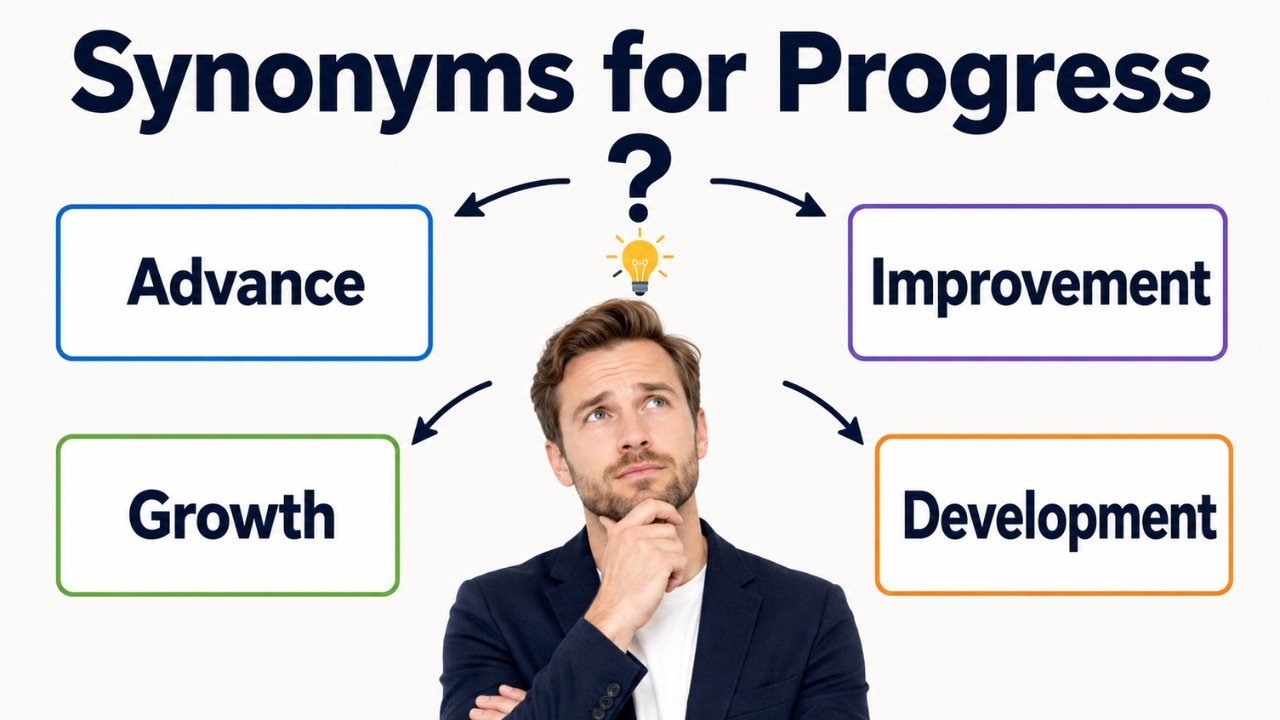
Quick Answer: The best synonyms for progress include advancement, development, improvement, growth, headway, evolution, achievement, momentum, breakthrough, and forward movement. Use advancement in formal or professional writing, development for gradual change, improvement for better quality, growth for increased ability or size, headway for movement toward a difficult goal, and achievement for a completed result. Momentum emphasizes increasing speed, while breakthrough describes major progress after difficulty.
Pronunciation and Word Details
Word: Progress.
Pronunciation: /ˈprɑːɡres/ as a noun and /prəˈɡres/ as a verb.
Part of Speech: Noun and verb.
Meaning: Movement toward a better, more advanced, or completed state.
US Pronunciation:
UK Pronunciation:
What Does “Progress” Mean?
Progress means movement toward a goal, improvement in a situation, or development into a more advanced condition. It can function as both a noun and a verb.
As a noun, progress refers to improvement or forward movement.
Example: The students made impressive progress in reading.
As a verb, progress means to move forward, improve, or develop over time.
Example: The construction project is progressing according to schedule.
Progress can describe personal improvement, academic learning, business development, scientific discovery, physical recovery, social change, or the completion of a task. Its exact meaning depends on what is moving forward and how that movement is measured.
Meaning, Tone, and Context of “Progress”
Progress has a neutral and generally positive tone. It suggests that a person, project, condition, or process is moving in a useful direction.
The word is common in formal, academic, professional, technical, and conversational English. It can describe small improvements as well as major achievements.
In professional writing, progress often refers to measurable results, completed tasks, or movement toward an objective.
Example: The report outlines the progress made during the first quarter.
In education, it describes improvement in knowledge, skills, or performance.
Example: Her writing progress became noticeable after regular practice.
In health and recovery contexts, it describes positive changes in strength, movement, or general condition.
Example: He is making steady progress during rehabilitation.
In casual conversation, progress can simply mean that something is going better than before.
Example: We are finally making progress with the repairs.
Although progress is usually positive, it does not always mean that a goal has been completed. A person can make progress while still having a significant amount of work left to do.
When and How to Use “Progress”
For Movement Toward a Goal
Use progress when someone is getting closer to completing an objective.
Example: The team made progress toward finishing the project.
For Personal Improvement
Use progress when a person develops a skill, habit, ability, or positive quality.
Example: She has made excellent progress in public speaking.
For Academic Development
Use progress to describe increasing knowledge, stronger performance, or improved understanding.
Example: His teacher was pleased with his progress in mathematics.
For Professional Development
Use progress when describing career advancement, completed responsibilities, or improved workplace performance.
Example: The manager reviewed the employee’s progress during the meeting.
For Projects and Tasks
Use progress to show that work has started and is moving toward completion.
Example: Construction is progressing faster than expected.
For Recovery
Use progress when a person’s physical condition, emotional state, or general ability is improving.
Example: The patient continues to make steady progress.
For Social or Technical Change
Use progress for improvements in technology, knowledge, systems, or society.
Example: Recent research has contributed to progress in medical treatment.
For Measurable Results
Use progress when improvement can be observed through numbers, completed stages, or visible changes.
Example: Monthly tests help teachers measure student progress.
Best Synonyms for Progress
Advancement: Forward movement into a better, higher, or more developed position.
Example: The new research represents an important advancement in the field.
Development: Gradual growth or change into a more complete state.
Example: The development of her leadership skills took several years.
Improvement: A change that makes something better than it was before.
Example: There has been a noticeable improvement in customer service.
Growth: An increase in size, strength, ability, knowledge, or success.
Example: The course encouraged personal and professional growth.
Headway: Noticeable movement toward completing something difficult.
Example: After several delays, the workers finally made headway.
Evolution: Slow and continuous development over time.
Example: The design shows the evolution of the artist’s style.
Achievement: A successful result gained through effort.
Example: Completing the training program was a major achievement.
Momentum: Increasing energy, speed, or strength in a process.
Example: The campaign gained momentum after the first successful event.
Breakthrough: A major development that overcomes an obstacle.
Example: The discovery was an important scientific breakthrough.
Forward Movement: Movement toward a goal, solution, or better condition.
Example: Cooperation created forward movement in the negotiations.
50 Synonyms for Progress with Short Meanings
- Advancement: Movement toward a higher or better position.
- Development: Gradual change toward a more complete state.
- Improvement: A change that makes something better.
- Growth: An increase in size, ability, strength, or success.
- Headway: Movement toward completing a difficult task.
- Movement: Change from one position or stage to another.
- Evolution: Gradual development over an extended period.
- Progression: Continuous movement through stages.
- Achievement: A successful result gained through effort.
- Success: The accomplishment of a goal or purpose.
- Gain: An increase or improvement in value, ability, or results.
- Betterment: The process of improving a condition.
- Breakthrough: A major advance after difficulty or delay.
- Expansion: Growth in size, range, influence, or activity.
- Maturation: Development toward a complete or advanced state.
- Rise: Movement toward a higher level or position.
- Stride: A significant step toward improvement.
- Step: One stage in a longer process.
- Milestone: An important stage in development or achievement.
- Accomplishment: Something successfully completed.
- Refinement: Improvement through careful correction or adjustment.
- Enhancement: A change that increases quality or value.
- Upgrade: An improvement to a better or newer condition.
- Promotion: Movement to a higher position or rank.
- Ascent: Upward movement toward a higher level.
- Increase: Growth in amount, number, strength, or quality.
- Acceleration: An increase in the speed of progress.
- Momentum: Increasing force or speed in development.
- Transformation: A major change in form, condition, or character.
- Transition: Movement from one stage or condition to another.
- Change: A shift from a previous state.
- Flourishing: Developing successfully and strongly.
- Strengthening: Becoming stronger, more effective, or more stable.
- Optimization: Making something as effective as possible.
- Modernization: Updating something with newer methods or systems.
- Innovation: The introduction of a useful new idea or method.
- Recovery: A return to a healthier or stronger condition.
- Restoration: The process of returning something to a good state.
- Learning: The development of knowledge or ability.
- Mastery: Advanced knowledge or control of a skill.
- Productivity: Effective completion of useful work.
- Completion: The act of finishing a task or process.
- Continuation: The act of carrying something forward.
- Proceeding: Continuing toward the next stage.
- Advance: To move forward or become more developed.
- Move Forward: To continue toward a goal or solution.
- Improve: To become better in quality or condition.
- Develop: To grow into a more advanced state.
- Grow: To increase in ability, size, strength, or success.
- Prosper: To develop successfully and achieve positive results.
Read Also:
Synonyms for Greedy

Synonyms for Progress by Context
When Progress Means Improvement
Improvement is the strongest synonym when something becomes better in quality, condition, performance, or usefulness.
Useful alternatives include betterment, enhancement, refinement, strengthening, and optimization.
Example With Progress: The student showed progress in written communication.
Example With Improvement: The student showed improvement in written communication.
Example With Enhancement: The training led to an enhancement of the team’s communication skills.
When Progress Means Forward Movement
Advancement, headway, forward movement, proceeding, and movement are useful when someone or something is moving toward a goal.
Example With Progress: We are making progress on the new building.
Example With Headway: We are making headway on the new building.
Example With Advancement: The project’s advancement depends on receiving final approval.
Headway is especially useful when progress has been difficult or slow.
When Progress Means Development
Development, evolution, maturation, transformation, and growth describe gradual change over time.
Example With Progress: The child’s language progress was impressive.
Example With Development: The child’s language development was impressive.
Example With Growth: The child showed strong growth in vocabulary and comprehension.
Development is common in education, psychology, technology, business, and personal learning.
When Progress Means Success
Achievement, accomplishment, success, gain, and milestone are useful when progress produces a clear result.
Example With Progress: Completing the first stage was important progress.
Example With Achievement: Completing the first stage was an important achievement.
Example With Milestone: Completing the first stage was an important milestone.
Achievement describes a successful result, while progress can describe movement before the final result is reached.
When Progress Means Increasing Speed
Momentum, acceleration, stride, and rapid development describe progress that is becoming faster or stronger.
Example With Progress: The project made faster progress after the new workers arrived.
Example With Momentum: The project gained momentum after the new workers arrived.
Example With Acceleration: The additional support caused an acceleration in the project’s development.
When Progress Means Career Movement
Advancement, promotion, growth, rise, and ascent can describe movement toward a better professional position.
Example With Progress: She made considerable progress in her career.
Example With Advancement: She achieved considerable advancement in her career.
Example With Promotion: Her promotion reflected years of strong performance.
When Progress Means Recovery
Recovery, restoration, strengthening, improvement, and healing can describe movement toward a healthier condition.
Example With Progress: He is making good progress after the injury.
Example With Recovery: He is making a good recovery after the injury.
Example With Improvement: His doctors have noticed considerable improvement.
Another Word for Progress
Advancement is often the best single replacement for progress because it communicates forward movement toward a better or more developed position. However, the most accurate alternative depends on the context.
Use improvement when quality becomes better, development when change happens gradually, headway when movement follows difficulty, and achievement when a clear result has been completed.
Original: The company has made progress in reducing waste.
Better Option: The company has made significant improvements in reducing waste.
Original: The student’s progress has been consistent.
Better Option: The student’s development has been consistent.
Original: We finally made progress with the investigation.
Better Option: We finally made headway with the investigation.
Original: Finishing the first stage was meaningful progress.
Better Option: Finishing the first stage was a meaningful achievement.
When Not to Use “Progress”
Progress is useful, but it can become vague when the reader needs to know what specifically changed. A more precise synonym may communicate the result more clearly.
When the Improvement Is Specific
Use improvement when something has clearly become better.
Weak: The service department made progress.
Better: The service department improved its response time and accuracy.
When a Goal Has Been Completed
Progress usually suggests movement toward completion rather than completion itself. Use achievement, accomplishment, or success for a finished result.
Weak: Winning the competition was great progress.
Better: Winning the competition was a major achievement.
When Describing Gradual Growth
Development may sound more natural when discussing skills, abilities, systems, or long term change.
Weak: The progress of the new training system took several months.
Better: The development of the new training system took several months.
When Describing a Major Discovery
Use breakthrough or advancement when the change is important and significant.
Weak: The discovery was useful progress in medical research.
Better: The discovery was a major breakthrough in medical research.
When the Sentence Is Repetitive
Repeated use of progress can make writing sound mechanical.
Weak: The progress report showed that progress was being made in every area of progress.
Better: The report showed measurable improvement and steady advancement in every area.
When Movement Is Negative
Progress normally suggests positive or useful movement. Do not use it for harmful changes unless the meaning is clearly ironic or negative.
Weak: The damage made progress throughout the building.
Better: The damage spread throughout the building.
Words Commonly Confused With Progress
Progress vs Process: Progress means movement toward improvement or completion. Process means a series of actions used to achieve a result.
Example With Progress: The team is making progress toward the deadline.
Example With Process: The team follows a careful review process.
Progress vs Improvement: Progress is movement toward a goal, while improvement specifically means becoming better. Progress can occur without a dramatic increase in quality.
Example With Progress: We completed three stages of the project.
Example With Improvement: The final design is clearer and more effective.
Progress vs Development: Progress focuses on forward movement, while development emphasizes gradual growth or change over time.
Example With Progress: Her progress toward certification is encouraging.
Example With Development: Her professional development includes training and practical experience.
Progress vs Success: Progress means movement toward a desired result. Success means that the desired result has been achieved.
Example With Progress: The business is gaining more customers each month.
Example With Success: The business reached its annual sales target.
Progress vs Achievement: Progress may be incomplete, while an achievement is a completed and meaningful result.
Example With Progress: Passing the first test showed progress.
Example With Achievement: Completing the entire course was a major achievement.
Progress vs Advancement: Progress is a broad term for forward movement. Advancement often sounds more formal and may suggest movement to a higher level.
Example With Progress: The research team reported steady progress.
Example With Advancement: The new discovery was an important scientific advancement.
Which Synonym Should You Choose?
Choose advancement for formal writing about education, careers, science, technology, or professional growth.
Choose development when describing gradual change in a person, skill, project, system, or idea.
Choose improvement when something has become better in quality, accuracy, condition, or performance.
Choose growth when describing an increase in knowledge, ability, strength, size, income, or success.
Choose headway when progress has been difficult, delayed, or dependent on solving a problem.
Choose achievement when a goal or important stage has been completed successfully.
Choose milestone for an important point in a longer journey or process.
Choose momentum when progress is increasing in speed, energy, or support.
Choose breakthrough when a major obstacle has been overcome.
Choose evolution when development occurs gradually through several stages.
Choose enhancement when a feature, service, design, or quality has been improved.
Choose recovery when progress involves returning to health, strength, stability, or normal activity.
Choose refinement when improvement comes through small, careful adjustments.
Choose transformation when the change is major and affects the entire condition, structure, or character of something.
Choose forward movement in general explanations when you want to emphasize continued movement toward a goal.
Real Life Examples of “Progress” in Sentences
Original: The student is making progress in reading.
Better Option: The student is showing noticeable improvement in reading.
Original: We made progress on the project this week.
Better Option: We achieved significant headway on the project this week.
Original: Her progress as a manager has been impressive.
Better Option: Her professional development as a manager has been impressive.
Original: The patient is making steady progress.
Better Option: The patient is experiencing a steady recovery.
Original: The researchers reported progress in their investigation.
Better Option: The researchers reported an important advancement in their investigation.
Original: Completing the first chapter was good progress.
Better Option: Completing the first chapter was an encouraging milestone.
Original: The company has made progress in customer service.
Better Option: The company has achieved measurable improvement in customer service.
Original: Negotiations are progressing slowly.
Better Option: Negotiations are moving forward slowly.
Original: The campaign began to make progress after the meeting.
Better Option: The campaign began to gain momentum after the meeting.
Original: The new method represents progress in the field.
Better Option: The new method represents a major breakthrough in the field.
Synonym Groups and Usage Differences
Forward Movement Group
This group includes advancement, headway, movement, progression, proceeding, and forward movement.
These words emphasize movement toward a goal or next stage. Headway is particularly suitable when the task is difficult.
Example: The investigators made headway after receiving new information.
Improvement Group
This group includes improvement, betterment, enhancement, refinement, strengthening, and optimization.
These alternatives focus on making something better in quality, condition, usefulness, or effectiveness.
Example: Careful editing led to a significant improvement in the report.
Development Group
This group includes development, growth, evolution, maturation, expansion, and transformation.
These words describe gradual or substantial change over time. Development is neutral, while transformation suggests a much larger change.
Example: The program supports the development of practical workplace skills.
Achievement Group
This group includes achievement, accomplishment, success, milestone, gain, and breakthrough.
These words describe results that have already been reached. A milestone is one important stage, while a breakthrough is a major advance after difficulty.
Example: Completing the first year was an important milestone.
Speed and Energy Group
This group includes momentum, acceleration, stride, rise, and ascent.
These words emphasize increasing speed, strength, or upward movement.
Example: The project gained momentum once the funding was approved.
Career Group
This group includes advancement, promotion, rise, growth, and ascent.
These alternatives describe movement toward a higher professional position or increased responsibility.
Example: Additional training can support career advancement.
Recovery Group
This group includes recovery, restoration, strengthening, improvement, and healing.
These words describe movement toward health, stability, or a previous good condition.
Example: Regular exercise supported her physical recovery.
Change Group
This group includes change, transition, transformation, modernization, innovation, and evolution.
These words describe movement from one condition to another. Transition is often neutral, while modernization and innovation suggest newer methods or ideas.
Example: The organization is undergoing a major transformation.
Antonyms of Progress
The opposite of progress depends on whether progress means improvement, forward movement, development, or success.
Decline: A movement toward a worse or lower condition.
Regression: A return to an earlier or less developed state.
Deterioration: A gradual worsening in quality or condition.
Setback: A problem that delays or reverses improvement.
Stagnation: A lack of movement, growth, or development.
Failure: The inability to achieve a desired result.
Delay: A period in which movement or completion is postponed.
Retreat: Movement away from an advanced position.
Reversal: A change back to an earlier direction or condition.
Worsening: A change that makes something less effective or desirable.
Standstill: A condition in which no movement occurs.
Inaction: A lack of activity or effort.
Loss: A reduction in value, ability, position, or success.
Weakening: The process of becoming less strong or effective.
Collapse: A sudden and serious failure or decline.
Comparison: Progress vs Related Words
Progress vs Advancement
Progress is a general word for movement toward a goal or better condition. Advancement is more formal and often describes movement to a higher level in a career, field, system, or area of knowledge.
Example With Progress: The student has made progress in science.
Example With Advancement: The research represents an advancement in scientific knowledge.
Progress vs Improvement
Progress means moving forward, while improvement means becoming better. A project can make progress by completing stages even when the quality remains unchanged.
Example With Progress: The team completed half of the assigned work.
Example With Improvement: The revised work is clearer and more accurate.
Progress vs Development
Progress focuses on movement toward an objective. Development focuses on the process of growing or becoming more complete.
Example With Progress: She is making progress toward becoming a qualified designer.
Example With Development: Her creative development is visible in her recent work.
Progress vs Growth
Progress can describe any useful forward movement. Growth usually describes an increase in size, strength, skill, knowledge, or success.
Example With Progress: The organization made progress toward its environmental goals.
Example With Growth: The organization experienced strong growth in membership.
Progress vs Headway
Progress is broad and neutral. Headway usually refers to noticeable progress after difficulty or delay.
Example With Progress: The workers made progress during the morning.
Example With Headway: The workers finally made headway after solving the equipment problem.
Progress vs Achievement
Progress refers to movement toward success. Achievement refers to a completed goal or successful result.
Example With Progress: Passing the practice test showed progress.
Example With Achievement: Earning the final qualification was a major achievement.
Progress vs Momentum
Progress describes forward movement. Momentum describes progress that is becoming stronger or faster.
Example With Progress: The campaign is making progress.
Example With Momentum: The campaign is gaining momentum.
Progress vs Breakthrough
Progress may be gradual or minor. A breakthrough is a major advance that solves an important problem or removes an obstacle.
Example With Progress: The research team reported steady progress.
Example With Breakthrough: The research team announced a major breakthrough.
Common Phrases and Expressions With “Progress”
Make Progress: Move closer to a goal or improve a situation.
Example: Daily practice will help you make progress.
Show Progress: Demonstrate visible or measurable improvement.
Example: The student began to show progress after receiving extra support.
Steady Progress: Continuous and consistent movement forward.
Example: The repairs are continuing at a steady pace.
Significant Progress: Important or noticeable forward movement.
Example: The team made significant progress during the week.
Rapid Progress: Improvement or movement that happens quickly.
Example: She made rapid progress after joining the advanced class.
Slow Progress: Improvement that occurs gradually or with difficulty.
Example: The investigation is making slow progress.
Measurable Progress: Improvement that can be demonstrated with evidence or results.
Example: The monthly figures indicate measurable progress.
Progress Report: A document or statement describing completed work and current results.
Example: The manager requested a progress report on Friday.
Work in Progress: Something that has been started but is not yet finished.
Example: The design is still a work in progress.
Progress Toward a Goal: Movement that brings someone closer to a specific objective.
Example: Regular saving represents progress toward her financial goal.
Common Mistakes to Avoid
Using Progress for a Completed Result
Progress generally refers to movement toward completion. Use achievement or accomplishment when the goal has already been reached.
Incorrect: Graduating from university was excellent progress.
Better: Graduating from university was an excellent achievement.
Confusing Progress With Process
Progress means improvement or forward movement. Process means a series of actions or stages.
Incorrect: We followed the progress carefully to complete the task.
Better: We followed the process carefully to complete the task.
Repeating Progress Too Often
Using the same word several times in one paragraph can make the writing sound weak.
Repetitive: The progress report showed progress in every area, and the manager praised the progress.
Better: The report showed improvement in every area, and the manager praised the team’s advancement.
Choosing an Overly Formal Synonym
Advancement may sound unnatural in casual conversation.
Unnatural: I made advancement in cleaning my room.
Better: I made progress in cleaning my room.
Using Achievement Before the Goal Is Complete
Achievement usually refers to something completed successfully.
Incorrect: The team’s unfinished work is a major achievement.
Better: The team’s unfinished work shows considerable progress.
Using Breakthrough for a Small Improvement
Breakthrough describes a major development, not a minor change.
Weak Choice: Correcting one spelling error was a breakthrough.
Better: Correcting the spelling error was a small improvement.
Using Growth for Every Type of Progress
Growth works best for increases in size, ability, knowledge, strength, or success. It may not suit a task that is simply moving toward completion.
Unnatural: We achieved growth in painting the wall.
Better: We made progress in painting the wall.
Making Progress Too Vague
Explain what changed whenever the reader needs specific information.
Vague: The department made progress.
Better: The department reduced processing time and completed three delayed projects.
Conclusion
The best synonyms for progress depend on the type of movement or improvement being described. Advancement works well in formal writing, development suits gradual change, improvement emphasizes better quality, and growth describes increased ability or success. Headway is useful after difficulty, while achievement and milestone describe completed results. Momentum suggests increasing speed, and breakthrough identifies a major advance. Choosing accurate synonyms for progress makes sentences clearer, more specific, and better suited to professional, academic, and everyday communication.
FAQs About Synonyms for Progress
What Is the Best Synonym for Progress?
Advancement is one of the best general synonyms for progress. Improvement, development, growth, and headway may be more accurate in particular contexts.
What Is a Formal Synonym for Progress?
Advancement is a strong formal synonym. Development, progression, enhancement, and evolution also work well in professional or academic writing.
What Is Another Word for Making Progress?
Making headway, advancing, improving, developing, moving forward, and gaining momentum are natural alternatives.
Is Improvement the Same as Progress?
Not completely. Improvement means becoming better, while progress means moving toward a goal or more advanced condition.
What Is a Synonym for Slow Progress?
Gradual development, steady movement, slow advancement, and gradual improvement can describe slow progress.
What Is a Synonym for Major Progress?
Breakthrough, significant advancement, major development, transformation, and important achievement can describe major progress.
What Is the Opposite of Progress?
Common opposites include decline, regression, deterioration, stagnation, setback, failure, and reversal.
