
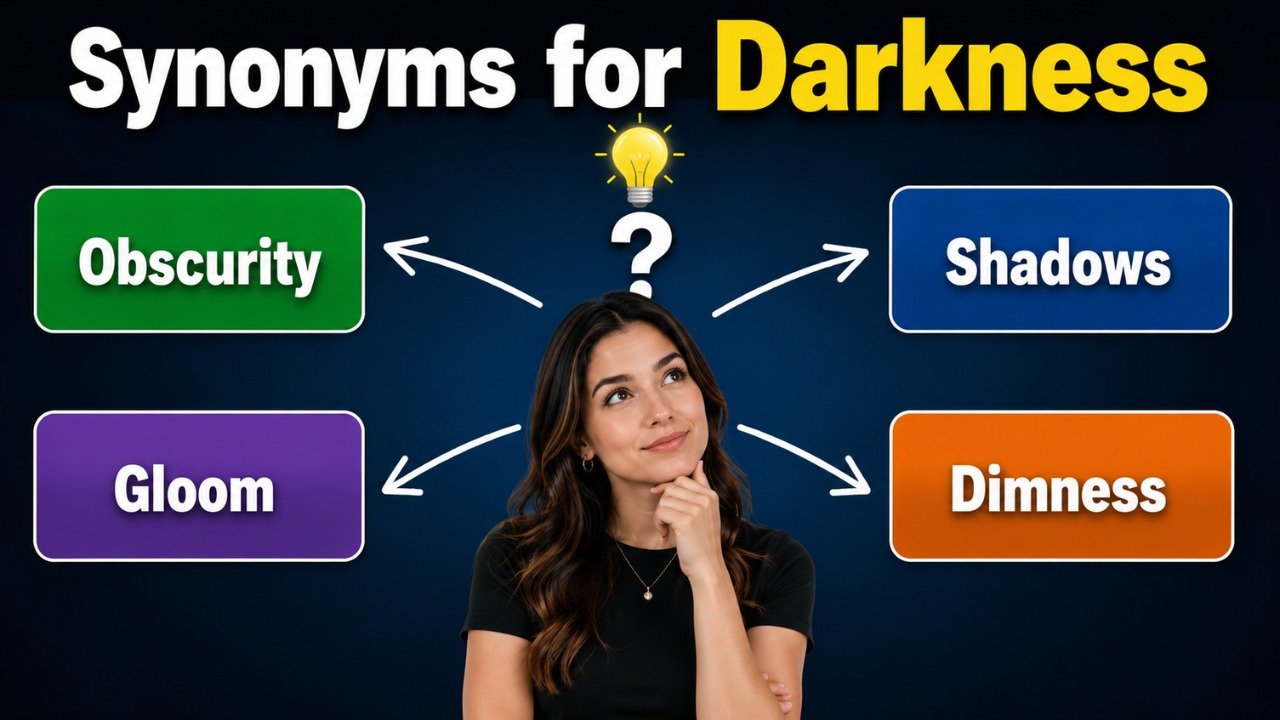
Quick Answer: The best synonyms for darkness include gloom, blackness, dimness, shadow, obscurity, murk, shade, night, bleakness, and lightlessness. Use blackness for a complete absence of light, dimness for weak lighting, and shadow for an area where light is blocked. Gloom works for both dark surroundings and sadness. Obscurity is best for formal writing about unclear or hidden information, while bleakness and despair describe emotional darkness. Evil and wickedness may replace darkness when the word has a moral meaning.
Pronunciation and Word Details
Word: Darkness.
Pronunciation: /ˈdɑːrknəs/
Part of Speech: Noun.
Meaning: The state of having little or no light, or a figurative state involving sadness, evil, secrecy, or lack of knowledge.
US Pronunciation:
UK Pronunciation:
What Does “Darkness” Mean?
Darkness means the state in which little or no light is present. It is an uncountable noun that can describe a physical environment, an emotional condition, an unknown situation, or a morally troubling quality.
In its literal meaning, darkness describes a place where light is absent or extremely weak.
Example: The room was filled with darkness after the electricity went out.
Darkness can also describe nighttime or the period after daylight has disappeared.
Example: The travelers returned before darkness covered the valley.
In emotional writing, darkness may represent sadness, despair, fear, loneliness, or hopelessness.
Example: She slowly found hope after a long period of emotional darkness.
In moral or literary contexts, darkness can represent evil, corruption, cruelty, or destructive behavior.
Example: The story explores the struggle between goodness and darkness.
The word can also refer to ignorance, secrecy, confusion, or something that remains unknown.
Example: The investigation remained in darkness until new evidence appeared.
Meaning, Tone, and Context of “Darkness”
Darkness is a neutral word when it describes the absence of light. It becomes emotional, dramatic, symbolic, or literary when it describes sadness, evil, uncertainty, or fear.
Neutral Tone: Darkness filled the room when the lights were turned off.
Conversational Tone: We reached the house before darkness.
Emotional Tone: He struggled to escape the darkness of grief.
Literary Tone: A deep darkness settled over the silent forest.
Symbolic Tone: The novel presents knowledge as light and ignorance as darkness.
Moral Tone: The hero refused to surrender to the darkness within him.
Academic Tone: Darkness can function as a symbol of uncertainty, danger, or lack of knowledge in literature.
Technical Context: Researchers measured how the animals behaved during periods of complete darkness.
The word is common in everyday conversation, descriptions of weather and places, creative writing, literature, psychology, philosophy, religion, and discussions of human behavior.
Writers should choose a more specific synonym when they want to identify the exact type of darkness. Dimness suggests weak light, blackness suggests complete darkness, gloom adds sadness or heaviness, and obscurity suggests that something is hidden or difficult to understand.
When and How to Use “Darkness”
For the Absence of Light
Use darkness when a place has little or no visible light.
Example: The hikers used flashlights to move through the darkness.
For Nighttime
Darkness can describe the period after sunset when daylight has disappeared.
Example: The children returned home before darkness fell.
For a Poorly Lit Place
Use darkness when the lighting is so weak that objects are difficult to see.
Example: Her eyes gradually adjusted to the darkness of the hallway.
For an Emotional Condition
Darkness can represent sadness, grief, depression, loneliness, or despair.
Example: Support from her family helped her move beyond the darkness of loss.
For Fear or Danger
Use darkness to create a sense of uncertainty, threat, fear, or hidden danger.
Example: Strange sounds came from the darkness beyond the trees.
For Evil or Immorality
Darkness may symbolize cruelty, corruption, wickedness, or destructive intentions.
Example: The character must choose between compassion and darkness.
For Lack of Knowledge
Use darkness figuratively when facts, answers, or understanding are missing.
Example: The new evidence brought the hidden events out of darkness.
For Secrecy
Darkness can suggest that an action is concealed or performed without public knowledge.
Example: The agreement was made in darkness and kept from the community.
For Mystery
Use darkness when something is unknown, confusing, or impossible to explain.
Example: Much of the ancient settlement remains hidden in darkness.
For Creative Emphasis
Darkness is useful in storytelling when a writer wants to create atmosphere, suspense, sadness, or symbolic contrast.
Example: Darkness gathered around the abandoned house as the storm approached.
Best Synonyms for Darkness
Gloom
Synonym: A state of poor light, sadness, or emotional heaviness.
Example: Gloom filled the empty room on the rainy afternoon.
Blackness
Synonym: Complete or nearly complete darkness.
Example: The cave disappeared into total blackness.
Dimness
Synonym: A condition in which the light is weak rather than completely absent.
Example: The dimness of the restaurant created a calm atmosphere.
Shadow
Synonym: A dark area created when an object blocks light.
Example: The cat rested in the shadow of the tree.
Obscurity
Synonym: A state of being hidden, unclear, unknown, or difficult to see.
Example: The path disappeared into obscurity beneath the thick trees.
Murk
Synonym: Thick darkness that makes seeing difficult.
Example: A single lantern glowed through the murk.
Shade
Synonym: An area protected from direct light.
Example: The travelers rested in the shade of a large tree.
Lightlessness
Synonym: The complete absence of light.
Example: The lightlessness of the underground chamber made movement difficult.
Bleakness
Synonym: A dark emotional quality involving hopelessness, coldness, or lack of comfort.
Example: The bleakness of the story reflects the character’s despair.
Night
Synonym: The period of darkness between evening and morning.
Example: The village became quiet as night covered the hills.
50 Synonyms for Darkness with Short Meanings
- Gloom: Weak light combined with sadness or heaviness.
- Blackness: Complete or intense absence of light.
- Dimness: A state of having only weak light.
- Shadow: A dark area created by blocked light.
- Shade: An area protected from direct light.
- Obscurity: A state of being hidden, unclear, or unknown.
- Murk: Thick and unpleasant darkness.
- Murkiness: A dark or unclear condition.
- Lightlessness: The complete absence of light.
- Shadowiness: The quality of being filled with shadows.
- Duskiness: A state of partial or fading darkness.
- Semidarkness: A condition between brightness and complete darkness.
- Night: The period when daylight is absent.
- Nighttime: The hours between evening and morning.
- Dusk: The fading light after sunset.
- Twilight: The soft light before night or before sunrise.
- Nightfall: The time when evening darkness begins.
- Midnight: The middle of the night.
- Pitch Blackness: Darkness in which nothing can be seen.
- Tenebrosity: Deep darkness, especially in literary writing.
- Opacity: A condition that prevents light from passing through.
- Cloudiness: A dark or unclear condition caused by clouds or haze.
- Obscuration: The act or condition of hiding something from view.
- Eclipse: A temporary darkening caused by one object blocking another.
- Concealment: The state of being hidden from view or knowledge.
- Secrecy: The condition of keeping something hidden.
- Mystery: Something unknown or difficult to explain.
- Uncertainty: A lack of clear knowledge or confidence.
- The Unknown: Something not understood or discovered.
- Ignorance: A lack of knowledge or awareness.
- Unawareness: The state of not knowing something.
- Confusion: A lack of clear understanding.
- Blindness: An inability to see or understand.
- Incomprehension: An inability to understand something.
- Evil: Deep moral wrongness or harmful intent.
- Wickedness: Deliberate immoral or cruel behavior.
- Malevolence: A desire to cause harm.
- Corruption: Dishonest or morally damaged behavior.
- Depravity: Extreme moral corruption.
- Sinfulness: The quality of behaving immorally.
- Gloominess: A dark, sad, or depressing quality.
- Bleakness: A lack of warmth, hope, or comfort.
- Sadness: An emotional state of unhappiness.
- Sorrow: Deep sadness caused by loss or pain.
- Melancholy: A quiet and lasting sadness.
- Despair: A complete loss of hope.
- Hopelessness: The belief that improvement is impossible.
- Grimness: A serious, harsh, or threatening quality.
- Somberness: A serious, dark, or sad mood.
- Foreboding: A feeling that something bad may happen.
Read Also:
Synonyms for Persistent

Synonyms for Darkness by Context
When Darkness Means No Light
Blackness and lightlessness are the strongest alternatives when light is completely absent. Pitch blackness adds greater emphasis.
Useful Synonyms: Blackness, lightlessness, pitch blackness, tenebrosity.
Example With Darkness: The cave was surrounded by complete darkness.
Example With Blackness: The cave was surrounded by complete blackness.
When Darkness Means Weak Light
Dimness and semidarkness are better when some light remains visible.
Useful Synonyms: Dimness, semidarkness, duskiness, shadowiness.
Example With Darkness: The darkness of the room made reading difficult.
Example With Dimness: The dimness of the room made reading difficult.
When Darkness Means a Dark Area
Shadow and shade describe specific places where direct light is blocked.
Useful Synonyms: Shadow, shade, obscurity, murk.
Example With Darkness: A figure stood in the darkness beside the doorway.
Example With Shadow: A figure stood in the shadow beside the doorway.
When Darkness Means Night
Night, nighttime, dusk, twilight, and nightfall describe particular periods without daylight.
Useful Synonyms: Night, nighttime, dusk, twilight, nightfall.
Example With Darkness: The streets became quiet after darkness arrived.
Example With Nightfall: The streets became quiet after nightfall.
When Darkness Means Sadness
Gloom, melancholy, sorrow, and bleakness describe emotional heaviness.
Useful Synonyms: Gloom, melancholy, sorrow, bleakness, sadness.
Example With Darkness: A sense of darkness remained after the painful goodbye.
Example With Melancholy: A sense of melancholy remained after the painful goodbye.
When Darkness Means Loss of Hope
Despair and hopelessness are more specific when darkness represents the belief that a situation cannot improve.
Useful Synonyms: Despair, hopelessness, bleakness, grimness.
Example With Darkness: The failure pushed him into emotional darkness.
Example With Despair: The failure pushed him into despair.
When Darkness Means Evil
Evil, wickedness, corruption, and malevolence work when darkness has a moral meaning.
Useful Synonyms: Evil, wickedness, corruption, malevolence, depravity.
Example With Darkness: The story shows the hero resisting darkness.
Example With Evil: The story shows the hero resisting evil.
When Darkness Means Lack of Knowledge
Ignorance, confusion, incomprehension, and unawareness are clearer when darkness represents a lack of understanding.
Useful Synonyms: Ignorance, confusion, unawareness, incomprehension.
Example With Darkness: The community remained in darkness about the decision.
Example With Ignorance: The community remained in ignorance about the decision.
When Darkness Means Something Hidden
Obscurity, concealment, secrecy, and mystery work when information or actions are hidden.
Useful Synonyms: Obscurity, concealment, secrecy, mystery.
Example With Darkness: The reason for the sudden change remained in darkness.
Example With Obscurity: The reason for the sudden change remained in obscurity.
When Darkness Creates Fear
Foreboding, menace, grimness, and murk can create a threatening or frightening atmosphere.
Useful Synonyms: Foreboding, menace, grimness, murk.
Example With Darkness: The darkness beyond the gate made everyone uneasy.
Example With Foreboding: A sense of foreboding beyond the gate made everyone uneasy.
Another Word for Darkness
Gloom is one of the best general replacements for darkness because it can describe both weak lighting and a sad atmosphere. However, the best alternative depends on context.
Use blackness for complete darkness, dimness for weak light, shadow for blocked light, obscurity for hidden information, and despair for emotional darkness.
Original: The tunnel disappeared into darkness.
Better Option: The tunnel disappeared into blackness.
Original: Darkness filled the poorly lit room.
Better Option: Dimness filled the poorly lit room.
Original: The reason for the decision remained in darkness.
Better Option: The reason for the decision remained in obscurity.
Original: She struggled through a period of emotional darkness.
Better Option: She struggled through a period of despair.
When Not to Use “Darkness”
Darkness can become vague when the reader needs to know whether the sentence describes weak light, complete blackness, sadness, evil, secrecy, or confusion.
When Some Light Is Present
Dimness is more accurate when a place is poorly lit but not completely dark.
Weak: The darkness of the lamp lit room made reading difficult.
Better: The dimness of the lamp lit room made reading difficult.
When a Specific Shadow Is Meant
Use shadow when light is blocked in one particular area.
Weak: The dog slept in the darkness beneath the tree.
Better: The dog slept in the shade beneath the tree.
When Describing Nighttime
Night or nightfall often sounds more natural when referring to a time of day.
Weak: We began our journey after the darkness arrived.
Better: We began our journey after nightfall.
When Discussing Missing Information
Obscurity, uncertainty, or ignorance may communicate the meaning more clearly.
Weak: The details of the agreement remained in darkness.
Better: The details of the agreement remained in obscurity.
When Describing Sadness
Use sadness, sorrow, melancholy, or despair when the emotional state should be clear.
Weak: He experienced darkness after losing his friend.
Better: He experienced deep sorrow after losing his friend.
When the Word Sounds Too Dramatic
Darkness may sound overly emotional in practical or neutral writing.
Weak: The office was thrown into darkness because one bulb stopped working.
Better: The office became dim because one bulb stopped working.
When Moral Meaning Is Intended
Use evil, cruelty, corruption, or wickedness when the moral problem should be stated directly.
Weak: The report exposed the darkness within the organization.
Better: The report exposed the corruption within the organization.
When Darkness Is Repeated
Replace repeated uses with more precise nouns or restructure the sentence.
Weak: Darkness filled the room, and the darkness made the hallway frightening.
Better: Blackness filled the room, making the shadowy hallway frightening.
Words Commonly Confused With Darkness
Darkness vs Dark: Darkness is a noun, while dark is usually an adjective or noun. The room was dark describes the room, while darkness filled the room names the condition.
Darkness vs Blackness: Darkness means little or no light. Blackness usually suggests complete darkness or an intense black appearance.
Darkness vs Dimness: Darkness may mean no light, while dimness means that some weak light is still present.
Darkness vs Shadow: Darkness can fill an entire area. A shadow is a particular dark shape or space created when light is blocked.
Darkness vs Shade: Shade is an area protected from direct light and may still be bright enough to see clearly. Darkness suggests much less light.
Darkness vs Gloom: Darkness mainly describes a lack of light. Gloom often combines weak light with sadness, heaviness, or an unpleasant mood.
Darkness vs Murk: Murk is thick, unclear darkness that makes seeing difficult. It may also suggest fog, smoke, or dirty air.
Darkness vs Obscurity: Darkness usually relates to light. Obscurity relates to something being hidden, unknown, unclear, or difficult to understand.
Darkness vs Night: Darkness is a condition. Night is the period between evening and morning when the sky is normally dark.
Darkness vs Dusk: Darkness may be complete, while dusk is the period of fading light just after sunset.
Darkness vs Evil: Darkness can symbolize evil, but the words are not always interchangeable. Darkness may simply describe a room with no light.
Darkness vs Despair: Darkness can suggest emotional pain in a broad way. Despair specifically means a complete or serious loss of hope.
Which Synonym Should You Choose?
Choose blackness when describing a place where almost no light is visible.
Choose lightlessness when emphasizing the total absence of light in formal or descriptive writing.
Choose dimness when a room, street, or area has weak lighting rather than complete darkness.
Choose shadow when an object blocks light and creates a dark shape or area.
Choose shade when describing protection from direct sunlight.
Choose gloom when the setting is both dark and emotionally heavy.
Choose murk when the darkness is thick, unclear, unpleasant, or mixed with fog or smoke.
Choose night when referring to the ordinary period between evening and morning.
Choose dusk when referring to the fading light immediately after sunset.
Choose twilight when describing the soft period of light between day and night.
Choose nightfall when describing the moment when evening darkness begins.
Choose obscurity in essays, reports, and formal writing when information remains hidden or unclear.
Choose uncertainty when the main meaning is doubt rather than physical darkness.
Choose ignorance when someone lacks necessary knowledge.
Choose mystery when something cannot yet be understood or explained.
Choose secrecy when information or an action is intentionally hidden.
Choose melancholy when describing a quiet, thoughtful, and lasting sadness.
Choose sorrow when darkness represents pain caused by loss.
Choose despair when a person has lost hope.
Choose bleakness when the atmosphere feels cold, empty, discouraging, or hopeless.
Choose evil when darkness represents serious moral wrongdoing.
Choose corruption when the moral darkness involves dishonesty or abuse of power.
Choose malevolence when the meaning involves a deliberate desire to harm others.
Choose foreboding in creative writing when darkness creates the feeling that something bad is approaching.
Real Life Examples of “Darkness” in Sentences
Original: The hikers moved carefully through the darkness.
Better Option: The hikers moved carefully through the blackness.
Original: The darkness of the room made the words difficult to read.
Better Option: The dimness of the room made the words difficult to read.
Original: The child stood in the darkness behind the curtain.
Better Option: The child stood in the shadow behind the curtain.
Original: The village became quiet when darkness arrived.
Better Option: The village became quiet when nightfall arrived.
Original: A feeling of darkness filled the empty house.
Better Option: A feeling of gloom filled the empty house.
Original: She eventually overcame the darkness caused by her disappointment.
Better Option: She eventually overcame the despair caused by her disappointment.
Original: The true reason for the decision remained in darkness.
Better Option: The true reason for the decision remained in obscurity.
Original: The book examines the conflict between kindness and darkness.
Better Option: The book examines the conflict between kindness and evil.
Original: The public was kept in darkness about the new policy.
Better Option: The public was kept in ignorance about the new policy.
Original: Strange movements appeared in the darkness near the fence.
Better Option: Strange movements appeared in the shadows near the fence.
Synonym Groups and Usage Differences
Absence of Light Group
Blackness, lightlessness, pitch blackness, and tenebrosity describe a strong or complete absence of light.
Blackness is the most natural choice in everyday writing. Lightlessness sounds more formal. Pitch blackness adds emphasis. Tenebrosity is rare and literary.
Example: The underground chamber was filled with complete blackness.
Weak Light Group
Dimness, semidarkness, duskiness, and shadowiness describe places where some light remains.
Dimness is the clearest everyday choice. Semidarkness describes a condition between light and complete darkness. Duskiness may describe fading or muted light.
Example: The dimness of the hallway made the door numbers difficult to read.
Shadow Group
Shadow, shade, obscurity, and murk describe dark areas or places that are difficult to see.
Shadow usually results from blocked light. Shade offers protection from direct sunlight. Murk suggests thick and unclear darkness.
Example: A small animal moved through the shadows.
Night Group
Night, nighttime, dusk, twilight, nightfall, and midnight relate to different periods without full daylight.
Dusk and twilight describe transitions. Nightfall describes the beginning of night. Midnight identifies a specific point in the night.
Example: The temperature dropped quickly after nightfall.
Emotional Darkness Group
Gloom, sadness, sorrow, melancholy, despair, hopelessness, and bleakness describe emotional pain.
Gloom is broad and atmospheric. Sorrow is linked to loss. Melancholy is quiet sadness. Despair and hopelessness involve a loss of hope.
Example: A sense of melancholy remained after the final conversation.
Moral Darkness Group
Evil, wickedness, malevolence, corruption, depravity, and sinfulness describe moral wrongdoing.
Evil is the broadest term. Corruption often involves dishonest systems or authority. Malevolence means the desire to harm. Depravity suggests extreme moral damage.
Example: The investigation revealed widespread corruption.
Knowledge and Understanding Group
Ignorance, unawareness, confusion, blindness, and incomprehension describe a lack of knowledge or understanding.
Ignorance means knowledge is missing. Unawareness means someone does not know that something exists. Confusion suggests unclear thinking.
Example: Clear instructions prevented confusion among the participants.
Secrecy and Mystery Group
Obscurity, concealment, secrecy, mystery, uncertainty, and the unknown relate to hidden or unexplained matters.
Secrecy is intentional. Mystery may not be intentional. Obscurity means something is difficult to see, understand, or discover.
Example: The origin of the object remains a mystery.
Threatening Atmosphere Group
Foreboding, grimness, murk, and gloom create feelings of danger, fear, or approaching trouble.
Foreboding focuses on an expected danger. Grimness suggests harsh seriousness. Gloom combines darkness with emotional heaviness.
Example: A sense of foreboding spread through the silent house.
Antonyms of Darkness
Darkness has several opposites because it can refer to light, emotion, knowledge, morality, or secrecy.
Light: The natural or artificial energy that makes objects visible.
Brightness: A strong and clear amount of light.
Illumination: Light provided to a place or greater understanding of a subject.
Radiance: Bright and shining light.
Daylight: Natural light during the day.
Sunlight: Light produced by the sun.
Clarity: The quality of being clear and easy to understand.
Knowledge: Information and understanding gained through learning or experience.
Awareness: Knowledge that something exists or is happening.
Understanding: The ability to comprehend meaning or information.
Transparency: Openness and freedom from secrecy.
Openness: A willingness to share information honestly.
Hope: Confidence that something good may happen.
Optimism: A tendency to expect positive outcomes.
Joy: A strong feeling of happiness.
Goodness: Moral virtue and kindness.
Honesty: Truthful and fair behavior.
Purity: Freedom from corruption or moral wrongdoing.
Comparison: Darkness vs Related Words
Darkness vs Gloom
Darkness describes little or no light. Gloom adds a feeling of sadness, discomfort, or emotional heaviness.
Example With Darkness: Darkness covered the garden after sunset.
Example With Gloom: Gloom filled the garden on the cold and rainy afternoon.
Darkness vs Blackness
Darkness can have different degrees. Blackness usually suggests total or intense darkness.
Example With Darkness: Her eyes adjusted slowly to the darkness.
Example With Blackness: The unlit tunnel disappeared into blackness.
Darkness vs Dimness
Darkness may mean light is completely absent. Dimness means that some weak light remains.
Example With Darkness: Complete darkness filled the underground room.
Example With Dimness: The dimness of the lamp created a peaceful atmosphere.
Darkness vs Shadow
Darkness is a general condition. A shadow is created when an object prevents light from reaching a surface.
Example With Darkness: Darkness covered the entire field.
Example With Shadow: The tree cast a long shadow across the field.
Darkness vs Shade
Darkness suggests very little light. Shade is a cooler area protected from direct sunlight and may still be clearly visible.
Example With Darkness: The basement remained in darkness.
Example With Shade: We rested in the shade beneath the trees.
Darkness vs Murk
Darkness is a broad term. Murk describes thick, unclear, or unpleasant darkness.
Example With Darkness: The travelers continued through the darkness.
Example With Murk: The boat moved slowly through the murk.
Darkness vs Obscurity
Darkness usually relates to physical light. Obscurity often relates to information, visibility, fame, or understanding.
Example With Darkness: The room was covered in darkness.
Example With Obscurity: The truth remained hidden in obscurity.
Darkness vs Night
Darkness is a condition that may occur at any time. Night is a specific period between evening and morning.
Example With Darkness: Closing the shutters filled the room with darkness.
Example With Night: The streets became quiet during the night.
Darkness vs Despair
Darkness may symbolically suggest emotional suffering. Despair directly means the loss of hope.
Example With Darkness: He struggled through a period of emotional darkness.
Example With Despair: He felt despair after receiving the disappointing news.
Darkness vs Evil
Darkness can be literal or symbolic. Evil specifically refers to serious moral wrongdoing or harmful intent.
Example With Darkness: Darkness filled the cave.
Example With Evil: The character fought against evil and cruelty.
Common Phrases and Expressions With “Darkness”
Complete Darkness: A condition in which no light is visible.
Example: The room was left in complete darkness.
Total Darkness: The complete absence of visible light.
Example: Total darkness surrounded the campsite.
Deep Darkness: Very strong darkness that is difficult to see through.
Example: The road disappeared into deep darkness.
Darkness Falls: Evening arrives and daylight disappears.
Example: We should reach the village before darkness falls.
Cover of Darkness: The concealment provided by nighttime.
Example: The animals left their shelter under the cover of darkness.
Plunged Into Darkness: Suddenly left without light.
Example: The building was plunged into darkness during the storm.
Fear of Darkness: Anxiety or fear caused by being in dark places.
Example: The child gradually overcame her fear of darkness.
Darkness Within: Hidden sadness, anger, cruelty, or evil inside a person.
Example: The story examines the character’s struggle with the darkness within.
Hours of Darkness: The period between sunset and sunrise.
Example: The gates remain locked during the hours of darkness.
From Darkness Into Light: A movement from difficulty, ignorance, or despair toward hope and understanding.
Example: Education helped the community move from darkness into light.
Common Mistakes to Avoid
Treating Every Synonym as Interchangeable
Not every synonym for darkness describes the same condition.
Blackness suggests complete darkness. Dimness means weak light. Shadow describes blocked light. Gloom adds emotional heaviness.
Incorrect: The room had a cheerful gloom.
Better: The room had a gentle dimness.
Confusing Darkness With Dark
Darkness is a noun. Dark is commonly an adjective.
Incorrect: The hallway was darkness.
Correct: The hallway was dark.
Correct: Darkness filled the hallway.
Using Darkness When Dimness Is More Accurate
Do not describe a weakly lit place as completely dark unless that meaning is intended.
Weak: The darkness of the reading lamp was relaxing.
Better: The dimness of the reading lamp was relaxing.
Using Shadow for Complete Darkness
A shadow is normally a particular area created by blocked light.
Weak: The entire cave was filled with one shadow.
Better: The entire cave was filled with darkness.
Confusing Gloom With Ordinary Darkness
Gloom often carries sadness or discomfort. It may sound too emotional in a neutral description.
Weak: The storage room had practical gloom.
Better: The storage room had limited lighting.
Overusing Figurative Darkness
Repeated references to emotional darkness can make writing sound overly dramatic.
Repetitive: Darkness entered his thoughts, darkness filled his heart, and darkness controlled his day.
Improved: Grief affected his thoughts, weakened his hope, and made each day difficult.
Using Darkness Vaguely
Make it clear whether the word refers to light, emotion, morality, secrecy, or knowledge.
Vague: The report revealed darkness.
Clear: The report revealed serious corruption.
Confusing Obscurity With Darkness
Obscurity usually refers to something hidden, unknown, or unclear rather than simply unlit.
Incorrect: We switched on a lamp to remove the obscurity.
Better: We switched on a lamp to remove the darkness.
Using Darkness as a Countable Noun
Darkness is normally uncountable and does not usually take a plural form.
Incorrect: Several darknesses covered the room.
Correct: Several dark shadows covered the room.
Using Unnatural Intensifiers
Avoid combinations that repeat the same meaning.
Weak: Completely total darkness surrounded us.
Better: Total darkness surrounded us.
Conclusion
The best synonyms for darkness depend on whether the word describes missing light, nighttime, sadness, evil, secrecy, or lack of knowledge. Blackness and lightlessness suit complete darkness, while dimness describes weak light. Gloom and melancholy create an emotional tone, and despair expresses lost hope. Obscurity works for hidden information, while evil and corruption fit moral contexts. When choosing among synonyms for darkness, select the alternative that clearly matches the physical, emotional, symbolic, or formal meaning of the sentence.
FAQs About Synonyms for Darkness
What Is the Best Synonym for Darkness?
Gloom is a useful general synonym, but blackness is better for complete darkness and dimness is better when some light remains.
What Is a Formal Synonym for Darkness?
Obscurity is a formal choice when something is hidden or unclear. Lightlessness is a formal term for the complete absence of light.
What Is a Poetic Word for Darkness?
Tenebrosity, gloom, shadow, night, and blackness can create a poetic or literary feeling.
What Is the Difference Between Darkness and Gloom?
Darkness describes little or no light. Gloom often combines weak light with sadness, discomfort, or emotional heaviness.
Can Darkness Mean Sadness?
Yes. Darkness can figuratively describe grief, sadness, despair, loneliness, or emotional pain.
What Is the Opposite of Darkness?
Light is the most direct opposite. Other antonyms include brightness, illumination, clarity, hope, knowledge, and goodness.
Is Darkness a Countable or Uncountable Noun?
Darkness is normally an uncountable noun. Writers usually say darkness rather than a darkness or several darknesses.
