
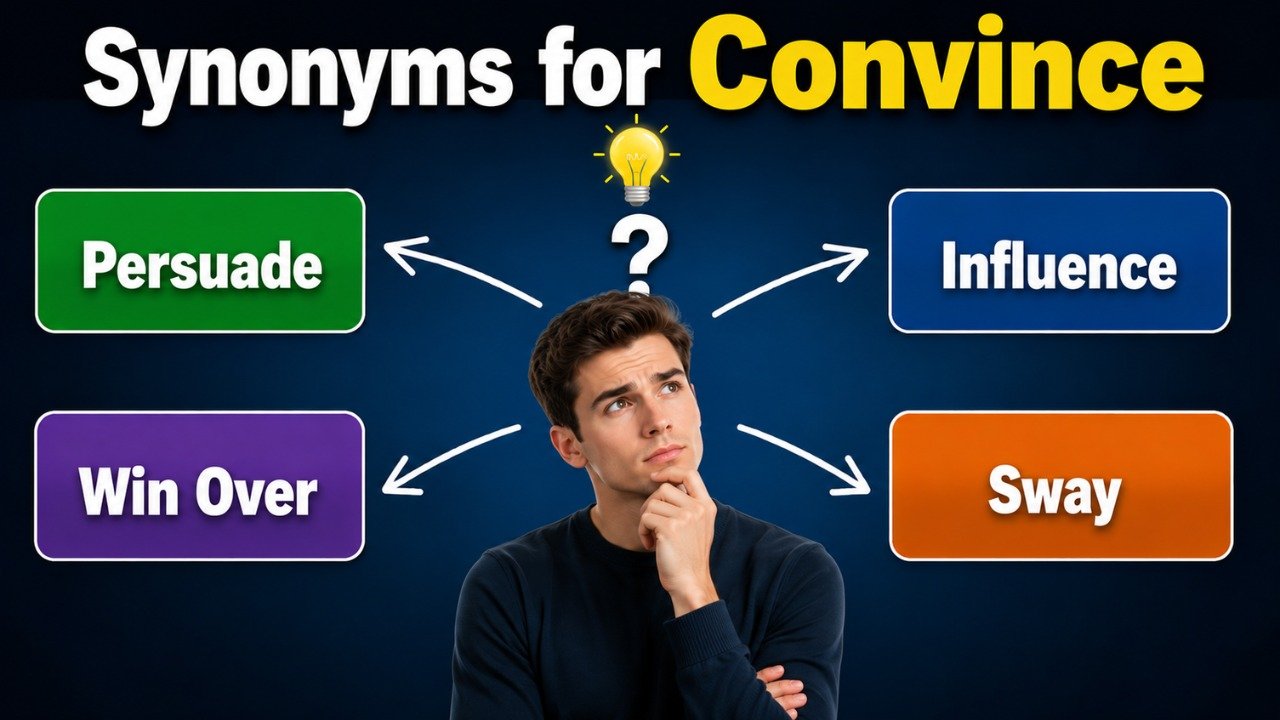
Quick Answer: The best synonyms for convince include persuade, influence, sway, win over, bring around, assure, reassure, prove, demonstrate, and induce. Use persuade when someone is encouraged to take action, influence when opinions or behavior are affected gradually, and sway when a decision changes because of an argument or emotional appeal. Win over and bring around are natural in casual conversation. Use assure or reassure to remove doubt, while prove and demonstrate work best when evidence makes someone accept that something is true.
Pronunciation and Word Details
Word: Convince.
Pronunciation: /kənˈvɪns/
Part of Speech: Verb.
Meaning: To make someone believe that something is true or agree to a particular idea or action.
US Pronunciation:
UK Pronunciation:
What Does “Convince” Mean?
Convince means to make someone believe, accept, or feel certain that something is true. It can also mean causing someone to agree with an opinion, decision, or course of action.
Convince is a verb. It usually takes a person or group as its object.
Example: The evidence convinced the committee that the plan was practical.
In this sentence, the evidence caused the committee to believe that the plan was practical.
Convince can also describe persuasion that leads someone toward an action.
Example: She convinced her brother to attend the meeting.
Here, she persuaded her brother to do something.
The word is frequently followed by that, of, or to.
With That: He convinced me that the information was accurate.
With Of: She convinced the audience of the need for change.
With To: They convinced us to consider another option.
Convince can refer to logical proof, emotional persuasion, personal reassurance, or repeated discussion. The exact meaning depends on what causes the other person to believe or agree.
Meaning, Tone, and Context of “Convince”
Convince is a neutral and widely used word. It appears naturally in formal writing, academic discussion, professional communication, and casual conversation.
In formal contexts, convince often describes the effect of evidence, research, reasoning, or a structured argument.
Formal Example: The results convinced the researchers that further testing was necessary.
In everyday conversation, it can describe one person changing another person’s opinion or encouraging an action.
Conversational Example: I finally convinced him to give the idea a chance.
Convince can have a logical tone when facts or evidence are involved.
Logical Example: The detailed records convinced the manager that the complaint was valid.
It can also have an emotional tone when trust, fear, hope, or personal connection affects someone’s decision.
Emotional Example: Her honesty convinced him to trust her again.
The word is usually polite and neutral, but it may sound forceful when someone repeatedly tries to change another person’s mind.
Forceful Example: They kept trying to convince her after she had already refused.
In academic and professional writing, convince is useful when discussing arguments, findings, evidence, decisions, and beliefs. However, prove, demonstrate, establish, or substantiate may be more precise when objective evidence is the main focus.
When and How to Use “Convince”
For Changing an Opinion
Use convince when an argument, explanation, or discussion causes someone to adopt a different view.
Example: The presentation convinced several members to support the proposal.
For Making Someone Believe Something
Use convince when facts, evidence, or reasoning cause someone to accept a statement as true.
Example: The photographs convinced the investigators that the damage had occurred earlier.
For Encouraging an Action
Use convince when one person successfully encourages another person to do something.
Example: She convinced her friend to apply for the position.
For Gaining Support
Use convince when a speaker, leader, or writer causes people to support an idea, plan, or cause.
Example: The team must convince the board that the project deserves additional funding.
For Removing Doubt
Use convince when an explanation makes someone feel certain instead of doubtful.
Example: His calm response convinced me that the situation was under control.
For Proving a Point
Use convince when evidence supports a claim strongly enough to make someone accept it.
Example: The test results convinced the doctor that a different approach was needed.
For Resolving Disagreement
Use convince when discussion helps people reach agreement after holding different opinions.
Example: She convinced her colleagues that a shorter schedule would be more practical.
For Building Trust
Use convince when words or actions make someone believe that a person is honest, capable, or reliable.
Example: His consistent performance convinced the clients that they could depend on him.
Best Synonyms for Convince
Persuade
Synonym: To cause someone to agree with an idea or take a particular action.
Example: She persuaded the group to reconsider its original decision.
Influence
Synonym: To affect someone’s thoughts, choices, or behavior.
Example: The positive reviews influenced him to try the new method.
Sway
Synonym: To change someone’s opinion or decision through argument or emotional appeal.
Example: Her final explanation swayed several undecided voters.
Win Over
Synonym: To gain someone’s support, approval, or affection.
Example: His patience eventually won over the doubtful members of the team.
Bring Around
Synonym: To persuade someone to accept an opinion that was previously rejected.
Example: We eventually brought her around to our point of view.
Assure
Synonym: To tell someone confidently that something is true or will happen.
Example: He assured the client that the work would be completed carefully.
Reassure
Synonym: To reduce someone’s fear, doubt, or uncertainty.
Example: The clear instructions reassured everyone that the process was safe.
Prove
Synonym: To show through evidence that something is true.
Example: The documents proved that the payment had already been made.
Demonstrate
Synonym: To show clearly through evidence, explanation, or example.
Example: The results demonstrated that the new process was more efficient.
Induce
Synonym: To cause or persuade someone to take an action, often through reasoning or an incentive.
Example: The discount induced more customers to place an early order.
50 Synonyms for Convince with Short Meanings
- Persuade: Cause someone to agree or take action.
- Influence: Affect someone’s opinion, choice, or behavior.
- Sway: Change someone’s decision or point of view.
- Win Over: Gain someone’s support or approval.
- Bring Around: Lead someone to accept a different opinion.
- Talk Into: Persuade someone to do something through conversation.
- Reason With: Use logic to influence someone’s decision.
- Appeal To: Use reasons or emotions that attract someone’s support.
- Prevail Upon: Successfully persuade someone after continued effort.
- Induce: Cause someone to act through persuasion or incentive.
- Encourage: Give someone confidence or motivation to act.
- Urge: Strongly advise or encourage someone to do something.
- Motivate: Give someone a reason or desire to act.
- Prompt: Cause or encourage an action or response.
- Inspire: Fill someone with the desire or confidence to act.
- Move: Affect someone emotionally enough to influence action.
- Lead: Guide someone toward a belief, choice, or action.
- Impel: Strongly drive someone toward an action.
- Compel: Force or strongly pressure someone to act.
- Press: Urge someone firmly to make a decision.
- Pressure: Push someone toward agreement or action.
- Coax: Gently persuade someone through patience or kindness.
- Cajole: Persuade through praise, friendliness, or repeated requests.
- Entice: Attract someone toward an action by offering something appealing.
- Tempt: Encourage someone through desire or attraction.
- Lure: Draw someone toward an action through an attractive offer.
- Assure: State something confidently to create belief.
- Reassure: Restore confidence and remove fear or doubt.
- Satisfy: Remove doubt by providing enough proof or explanation.
- Prove: Establish that something is true through evidence.
- Demonstrate: Show clearly that a claim or idea is valid.
- Establish: Confirm the truth of something with reliable support.
- Show: Make a fact or conclusion clear.
- Verify: Confirm that something is true or accurate.
- Confirm: Provide support that removes uncertainty.
- Substantiate: Support a statement with facts or evidence.
- Validate: Show that an idea, claim, or feeling is reasonable.
- Make Certain: Remove uncertainty and create confidence.
- Remove Doubt: Make someone feel sure about something.
- Gain Belief: Cause someone to accept an idea as true.
- Earn Trust: Cause someone to believe in your honesty or reliability.
- Change Someone’s Mind: Cause a person to adopt a different opinion.
- Get Through To: Make someone understand or accept an important point.
- Make a Case To: Present reasons intended to gain agreement.
- Argue Into: Persuade through discussion or reasoning.
- Plead With: Make an emotional or urgent request.
- Enlist: Gain someone’s support or participation.
- Recruit: Persuade someone to join a group, effort, or activity.
- Convert: Cause someone to adopt a different belief or opinion.
- Secure Agreement: Successfully obtain acceptance or approval.
Read Also:
Synonyms for Darkness

Synonyms for Convince by Context
When Convince Means Persuade Someone to Act
Persuade, talk into, induce, encourage, urge, motivate, prompt, and prevail upon work when someone is led toward an action.
Persuade is the most direct and neutral alternative. Talk into sounds casual, while induce is more formal. Urge suggests strong advice, but it does not always mean the person agrees.
Example With Convince: She convinced him to attend the training session.
Example With Persuade: She persuaded him to attend the training session.
Example With Talk Into: She talked him into attending the training session.
When Convince Means Change an Opinion
Sway, influence, bring around, win over, change someone’s mind, and convert describe a shift in belief or viewpoint.
Sway often suggests that a particular argument changes a decision. Bring around is conversational and usually describes gradual persuasion. Convert is stronger because it suggests a major change in belief.
Example With Convince: The final argument convinced her to support the proposal.
Example With Sway: The final argument swayed her in favor of the proposal.
Example With Bring Around: The final argument brought her around to supporting the proposal.
When Convince Means Prove Something Is True
Prove, demonstrate, establish, substantiate, confirm, verify, and show are suitable when evidence causes belief.
Prove is strongest because it suggests that the truth has been established. Demonstrate is common in reports and academic writing. Substantiate means supporting a statement with evidence.
Example With Convince: The records convinced us that the account was accurate.
Example With Prove: The records proved that the account was accurate.
Example With Substantiate: The records substantiated the claim that the account was accurate.
When Convince Means Remove Doubt
Assure, reassure, satisfy, make certain, remove doubt, and earn trust work when the main goal is confidence rather than action.
Assure usually involves a confident statement. Reassure is better when a person is worried or uncertain. Satisfy often means providing enough evidence to answer a concern.
Example With Convince: The explanation convinced me that no information had been lost.
Example With Assure: The explanation assured me that no information had been lost.
Example With Reassure: The explanation reassured me that no information had been lost.
When Convince Means Gain Support
Win over, enlist, recruit, appeal to, make a case to, and secure agreement describe gaining cooperation, approval, or participation.
Win over emphasizes turning doubt into approval. Enlist means gaining active support, while recruit usually involves joining a group or organized effort.
Example With Convince: The organizer convinced several volunteers to support the event.
Example With Enlist: The organizer enlisted several volunteers to support the event.
Example With Recruit: The organizer recruited several volunteers for the event.
When Convince Involves Gentle Persuasion
Coax, cajole, encourage, appeal to, and reason with describe persuasion that avoids direct force.
Coax suggests patience and kindness. Cajole may involve praise or friendly pressure. Reason with emphasizes logic and calm discussion.
Example With Convince: He convinced the child to try the unfamiliar food.
Example With Coax: He coaxed the child into trying the unfamiliar food.
Example With Reason With: He reasoned with the child about trying the unfamiliar food.
When Convince Involves Strong Pressure
Press, pressure, impel, compel, and urge describe stronger forms of influence.
These words are not always exact synonyms. Compel often suggests force or necessity rather than willing agreement. Pressure may carry a negative tone because it can suggest that someone’s choice is not completely free.
Example With Convince: They convinced him to sign the agreement immediately.
Example With Press: They pressed him to sign the agreement immediately.
Example With Pressure: They pressured him into signing the agreement immediately.
Another Word for Convince
The best general replacement for convince is persuade when the goal is to change someone’s opinion or encourage an action. However, the best alternative depends on the context.
Use prove when evidence establishes truth, reassure when fear or doubt must be removed, sway when a decision changes, and win over when someone gradually gains another person’s support.
Original: She convinced the manager to approve the revised schedule.
Better Option: She persuaded the manager to approve the revised schedule.
Original: The evidence convinced the committee that the report was accurate.
Better Option: The evidence proved to the committee that the report was accurate.
Original: His calm explanation convinced the worried customer that the issue was minor.
Better Option: His calm explanation reassured the worried customer that the issue was minor.
Original: The speaker convinced several doubtful listeners.
Better Option: The speaker won over several doubtful listeners.
When Not to Use “Convince”
Do not use convince when a more precise word can show whether the person accepted proof, changed an opinion, felt reassured, or acted because of pressure.
When Evidence Establishes a Fact
Use prove, demonstrate, establish, or substantiate when the main focus is objective evidence rather than personal persuasion.
Weak: The results convinced that the method was effective.
Better: The results demonstrated that the method was effective.
Convince normally requires a person or group as an object.
Correct: The results convinced the researchers that the method was effective.
When Someone Is Simply Encouraged
Encourage may be more accurate when the person receives support but has not necessarily changed an opinion.
Weak: Her teacher convinced her to continue practicing.
Better: Her teacher encouraged her to continue practicing.
When Someone Is Forced
Do not use convince when the person has no genuine choice. Use compel, force, or pressure instead.
Weak: The rule convinced employees to submit the form.
Better: The rule compelled employees to submit the form.
When Fear or Worry Is Removed
Reassure is more precise when the purpose is to make someone feel calm and safe.
Weak: The nurse convinced the patient that the procedure would be simple.
Better: The nurse reassured the patient that the procedure would be simple.
When Someone Gradually Gains Approval
Win over may sound more natural when trust or support develops over time.
Weak: His kindness convinced the entire team.
Better: His kindness won over the entire team.
When the Sentence Is Repetitive
Repeating convince can make a paragraph sound dull and imprecise.
Weak: She convinced the group with evidence, and then she convinced the manager with a detailed explanation.
Better: She persuaded the group with evidence and reassured the manager with a detailed explanation.
When No Person Is Identified
Convince usually refers to someone who becomes persuaded or certain. Demonstrate or show may work better if no person is mentioned.
Weak: The experiment convinced the importance of careful measurement.
Better: The experiment demonstrated the importance of careful measurement.
Words Commonly Confused With Convince
Convince vs Persuade: Convince often focuses on making someone believe something. Persuade often focuses on leading someone to take action. In modern usage, both can describe changing a person’s mind or encouraging action.
Convince vs Influence: Convince usually suggests a successful and noticeable change in belief. Influence may affect someone gradually without producing complete agreement.
Convince vs Assure: Convince means causing someone to believe through argument or evidence. Assure means confidently telling someone that something is true.
Convince vs Reassure: Convince creates belief or agreement. Reassure specifically removes worry, fear, or doubt.
Convince vs Prove: Convince describes the effect on a person. Prove describes the successful establishment of truth through evidence.
Convince vs Demonstrate: Convince focuses on the person who accepts an idea. Demonstrate focuses on clearly showing how or why something is true.
Convince vs Compel: Convince involves belief or willing agreement. Compel involves force, necessity, authority, or strong pressure.
Convince vs Coax: Convince is neutral and may involve logic or evidence. Coax suggests gentle, patient, or friendly persuasion.
Convince vs Sway: Convince can refer to belief, certainty, or action. Sway usually refers to changing an opinion, preference, vote, or decision.
Convince vs Convert: Convince may change one decision or belief. Convert suggests a broader or more lasting change in viewpoint, loyalty, or belief.
Which Synonym Should You Choose?
Choose persuade when someone is encouraged to agree or take an action.
Choose influence when a person’s thoughts or behavior are affected gradually.
Choose sway when an argument or emotional appeal changes a decision.
Choose win over when someone gradually gains another person’s approval or support.
Choose bring around in casual speech when someone eventually accepts a previously rejected idea.
Choose assure when giving a confident statement intended to create certainty.
Choose reassure when removing fear, anxiety, or doubt.
Choose prove when strong evidence establishes that something is true.
Choose demonstrate in reports, essays, research, or formal explanations when results clearly show a conclusion.
Choose substantiate in academic or professional writing when evidence supports a claim.
Choose establish when facts confirm a conclusion, relationship, or principle.
Choose coax when gentle patience helps someone agree to an action.
Choose encourage when offering confidence or support without necessarily changing a belief.
Choose urge when strongly advising someone to act.
Choose induce in formal writing when an incentive or condition causes an action.
Choose press or pressure when the persuasion is firm, uncomfortable, or possibly unfair.
Choose compel when authority, force, or necessity leaves little choice.
Choose enlist when gaining someone’s active support for a project or cause.
Choose recruit when persuading someone to join an organization, team, or activity.
Choose convert when someone adopts a significantly different belief or position.
Real Life Examples of “Convince” in Sentences
Original: She convinced her parents to let her attend the course.
Better Option: She persuaded her parents to let her attend the course.
Original: The final report convinced the directors that changes were necessary.
Better Option: The final report demonstrated to the directors that changes were necessary.
Original: His explanation convinced me that the mistake was accidental.
Better Option: His explanation assured me that the mistake was accidental.
Original: The speaker convinced several undecided members.
Better Option: The speaker swayed several undecided members.
Original: We convinced the client after several detailed meetings.
Better Option: We won over the client after several detailed meetings.
Original: She convinced the child to finish the meal.
Better Option: She coaxed the child into finishing the meal.
Original: The documents convinced the investigator that the statement was true.
Better Option: The documents substantiated the statement for the investigator.
Original: He convinced his colleagues to support the new policy.
Better Option: He brought his colleagues around to supporting the new policy.
Original: The manager convinced the staff to complete the training.
Better Option: The manager urged the staff to complete the training.
Original: Her calm voice convinced everyone that the situation was manageable.
Better Option: Her calm voice reassured everyone that the situation was manageable.
Synonym Groups and Usage Differences
Direct Persuasion Group
Persuade, talk into, bring around, prevail upon, and change someone’s mind describe direct attempts to gain agreement.
Persuade is the most neutral choice. Talk into is casual and often refers to an action. Prevail upon is formal and suggests repeated effort.
Example: She persuaded the committee to review the proposal again.
Opinion and Decision Group
Influence, sway, win over, lead, and convert describe a change in viewpoint, preference, or decision.
Influence may be gradual and incomplete. Sway suggests a particular decision changes. Convert suggests a deeper transformation.
Example: The final comparison swayed several members in favor of the plan.
Evidence and Proof Group
Prove, demonstrate, establish, substantiate, verify, confirm, validate, and show focus on facts or evidence.
These words are especially useful in essays, reports, research, investigations, and professional explanations.
Example: The data demonstrated that the updated process reduced errors.
Trust and Reassurance Group
Assure, reassure, satisfy, remove doubt, make certain, and earn trust describe the creation of confidence.
Assure often involves a confident statement. Reassure is emotionally supportive. Satisfy means providing enough information to answer a concern.
Example: The clear explanation reassured the customer that the information was secure.
Gentle Encouragement Group
Encourage, coax, cajole, appeal to, motivate, and inspire describe persuasion through support, friendliness, patience, or emotion.
Encourage is positive and neutral. Coax is gentle. Cajole may suggest repeated praise or flattering language.
Example: Her mentor encouraged her to submit the application.
Incentive and Attraction Group
Induce, entice, tempt, and lure describe persuasion through an attractive benefit, reward, or opportunity.
Entice is often neutral or positive. Tempt may suggest desire overcoming judgment. Lure can imply deception or danger.
Example: The flexible schedule enticed more candidates to apply.
Strong Pressure Group
Urge, press, pressure, impel, and compel describe stronger forces that lead to action.
Urge can be helpful and sincere. Pressure often sounds uncomfortable. Compel suggests that the person has little or no practical choice.
Example: The approaching deadline compelled the team to make a quick decision.
Support and Participation Group
Enlist, recruit, secure agreement, gain support, and win over describe bringing people into a plan, group, or shared effort.
Enlist emphasizes active help. Recruit usually means joining a group. Secure agreement is formal and results focused.
Example: The coordinator enlisted local volunteers to assist with the event.
Antonyms of Convince
The opposite of convince depends on whether the word refers to belief, agreement, confidence, or action.
Dissuade: Persuade someone not to take an action.
Discourage: Reduce someone’s confidence or desire to act.
Deter: Prevent an action by creating fear, doubt, or difficulty.
Confuse: Make someone uncertain instead of clear and convinced.
Mislead: Cause someone to form a false belief.
Deceive: Deliberately cause someone to believe something untrue.
Disprove: Show that a statement or claim is false.
Refute: Prove that an argument or belief is incorrect.
Contradict: State or show the opposite of a claim.
Unsettle: Make someone feel doubtful, nervous, or uncertain.
Alienate: Cause someone to lose sympathy, trust, or support.
Repel: Cause rejection instead of attraction or agreement.
Doubt: Feel uncertain about whether something is true.
Question: Express uncertainty about a claim or conclusion.
Resist: Refuse to accept persuasion or pressure.
Reject: Refuse to accept an idea, claim, or proposal.
Oppose: Act or argue against an idea or plan.
Undermine: Weaken confidence in an argument, person, or belief.
Comparison: Convince vs Related Words
Convince vs Persuade
Convince usually emphasizes belief or certainty, while persuade commonly emphasizes action or agreement. However, both words often overlap in modern English.
Example With Convince: The evidence convinced her that the claim was true.
Example With Persuade: The evidence persuaded her to change her decision.
Convince vs Influence
Convince suggests a clear result. Influence means affecting someone, but the effect may be gradual, indirect, or incomplete.
Example With Convince: His explanation convinced me to support the proposal.
Example With Influence: His explanation influenced how I viewed the proposal.
Convince vs Sway
Convince has a broad meaning that includes belief and action. Sway usually refers to changing an opinion, vote, preference, or decision.
Example With Convince: The report convinced the committee that action was needed.
Example With Sway: The report swayed the committee in favor of immediate action.
Convince vs Assure
Convince involves reasons, evidence, or persuasion. Assure involves a confident statement intended to create certainty.
Example With Convince: The detailed records convinced us that the process was reliable.
Example With Assure: The manager assured us that the process was reliable.
Convince vs Reassure
Convince changes belief or creates certainty. Reassure removes fear, concern, or doubt.
Example With Convince: The explanation convinced him that the decision was reasonable.
Example With Reassure: The explanation reassured him that the decision would not create unnecessary risk.
Convince vs Prove
Convince describes what happens in a person’s mind. Prove describes what evidence establishes as true.
Example With Convince: The results convinced the reviewers that the method worked.
Example With Prove: The results proved that the method worked.
Convince vs Demonstrate
Convince focuses on gaining belief. Demonstrate focuses on showing something clearly through facts, actions, or examples.
Example With Convince: The presentation convinced the audience that the product was useful.
Example With Demonstrate: The presentation demonstrated how the product could be used.
Convince vs Coax
Convince can involve logic, evidence, or discussion. Coax suggests gentle persuasion, patience, or friendly encouragement.
Example With Convince: She convinced him to explain the problem.
Example With Coax: She coaxed him into explaining the problem.
Convince vs Compel
Convince allows the person to accept a belief or action voluntarily. Compel suggests force, authority, necessity, or strong pressure.
Example With Convince: The argument convinced them to revise the policy.
Example With Compel: The new regulation compelled them to revise the policy.
Convince vs Win Over
Convince may happen through a single strong argument. Win over often suggests gradually gaining trust, affection, approval, or support.
Example With Convince: The evidence convinced the doubtful manager.
Example With Win Over: Her reliability gradually won over the doubtful manager.
Common Phrases and Expressions With “Convince”
Convince Someone: Cause a person to believe or agree.
Convince Someone That: Cause a person to accept a statement as true.
Convince Someone Of Something: Make a person believe in the truth or value of something.
Convince Someone To Act: Persuade a person to take a particular action.
Convince Yourself: Make yourself accept or believe something.
Hard to Convince: Unwilling to accept an idea without strong evidence.
Easy to Convince: Willing to accept suggestions or arguments quickly.
Fully Convinced: Completely certain that something is true or correct.
Remain Unconvinced: Continue to doubt or reject an argument.
Convince Someone Otherwise: Cause a person to abandon an existing belief.
Common Mistakes to Avoid
Forgetting the Person Being Convinced
Convince usually needs a person or group as its object.
Incorrect: The evidence convinced that the claim was false.
Correct: The evidence convinced the committee that the claim was false.
If no person is mentioned, prove, show, or demonstrate may be more natural.
Better: The evidence demonstrated that the claim was false.
Confusing Convince With Persuade
Convince often focuses on belief, while persuade often focuses on action.
Natural: She convinced me that the plan was sensible.
Natural: She persuaded me to support the plan.
Convince someone to do something is also common, but persuade may be more precise when the sentence emphasizes action.
Using Convince When Someone Was Forced
A person is not truly convinced when authority, threats, or unavoidable circumstances remove free choice.
Unclear: The penalty convinced everyone to obey the rule.
Clearer: The penalty compelled everyone to obey the rule.
Confusing Convince With Assure
Assure involves confidently telling someone that something is true. Convince involves causing belief through reasons, evidence, or persuasion.
Incorrect Choice: He convinced me that everything would be fine, but offered no explanation.
More Precise: He assured me that everything would be fine.
Confusing Convince With Reassure
Reassure should be used when fear or anxiety is being reduced.
Less Precise: Her calm voice convinced the frightened child.
Better: Her calm voice reassured the frightened child.
Choosing a Synonym With the Wrong Strength
Coax suggests gentle persuasion, while pressure and compel are much stronger. Do not use them as though they have the same tone.
Gentle: She coaxed him into sharing his concerns.
Forceful: The circumstances compelled him to respond.
Using Unnatural Prepositions
Use convince someone of something, convince someone that something is true, or convince someone to do something.
Correct: She convinced the panel of her ability.
Correct: She convinced the panel that she was qualified.
Correct: She convinced the panel to reconsider its decision.
Repeating Convince Too Often
Use synonyms to make the intended meaning clearer.
Repetitive: The report convinced the manager, and the manager convinced the team.
Improved: The report persuaded the manager, who then won over the team.
Assuming Persuasion Was Successful
Convince implies a successful result. Try to convince does not guarantee success.
Successful: She convinced him to attend.
Uncertain Result: She tried to convince him to attend.
Using Vague Evidence
A sentence should explain what caused the person to become convinced.
Vague: Something convinced her that the plan would work.
Clear: The successful trial convinced her that the plan would work.
Conclusion
Synonyms for convince include persuade, influence, sway, win over, assure, reassure, prove, demonstrate, and induce. Persuade is best when encouraging an action, while sway and bring around describe a changed opinion. Prove, establish, and substantiate suit evidence based writing. Assure and reassure remove uncertainty or fear, while coax suggests gentle persuasion. Stronger words such as pressure and compel should be used carefully because they may imply limited choice. Selecting the right alternative makes your meaning clearer, more precise, and more natural.
FAQs About Synonyms for Convince
What Is the Best Synonym for Convince?
Persuade is the best general synonym for convince. However, prove, reassure, influence, or sway may be better depending on the context.
Is Persuade the Same as Convince?
The words are closely related. Convince often focuses on belief, while persuade often focuses on action or agreement.
What Is a Formal Synonym for Convince?
Persuade, demonstrate, establish, substantiate, induce, and prevail upon are useful formal alternatives.
What Is a Casual Synonym for Convince?
Talk into, bring around, win over, and get through to are natural choices in casual conversation.
What Word Means Convince With Evidence?
Prove, demonstrate, establish, substantiate, and verify are suitable when facts or evidence create belief.
What Word Means Gently Convince Someone?
Coax is the best word for gentle persuasion. Encourage, appeal to, and reason with may also fit.
What Is the Opposite of Convince?
Dissuade is the clearest opposite when someone is persuaded not to act. Reject, resist, doubt, deter, and discourage are other possible antonyms.
