
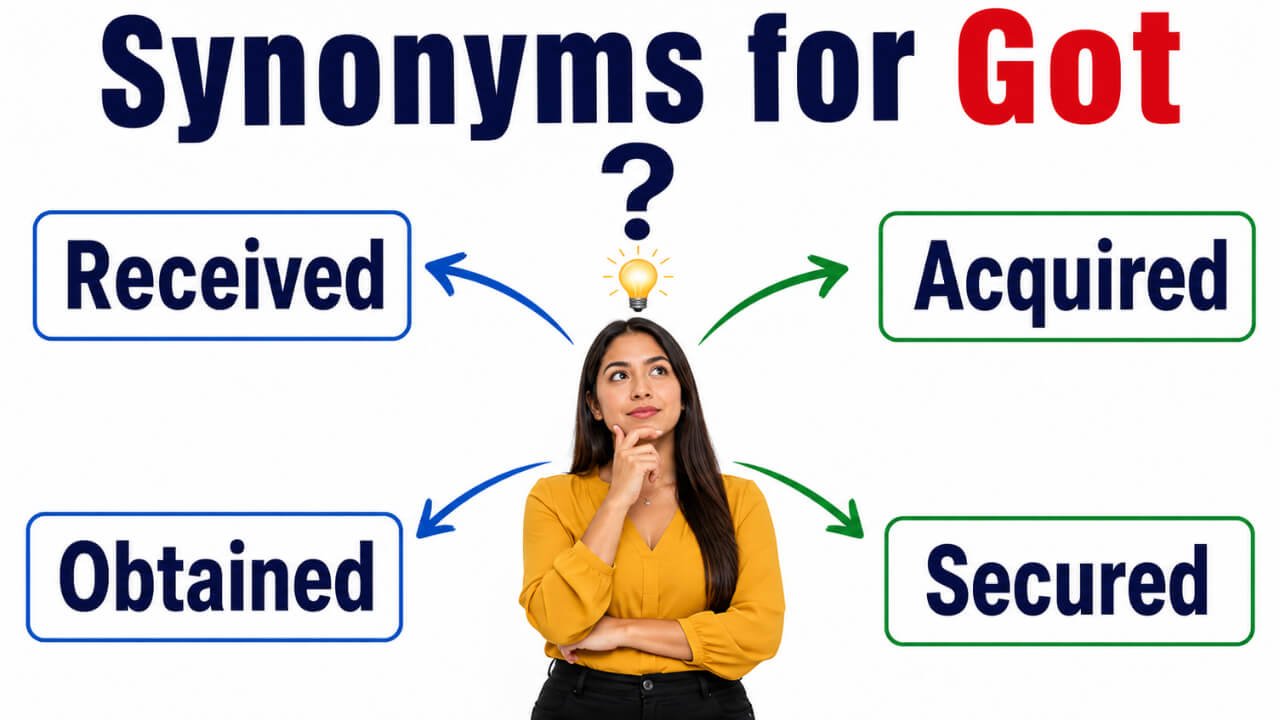
Quick Answer: Synonyms for got include received, obtained, acquired, gained, earned, bought, understood, became, reached, and experienced. Use received when something was given or delivered, obtained for formal writing about gaining something, and acquired for skills, knowledge, or possessions. Choose earned for rewards gained through effort, bought for purchases, understood for ideas, became for changes in condition, reached for destinations or goals, and experienced for feelings, events, or situations.
Pronunciation and Word Details
Word: Got
Pronunciation: /ɡɑːt/ in American English and /ɡɒt/ in British English
Part of Speech: Verb, past tense and past participle form of get
Meaning: Got means received, obtained, understood, became, reached, experienced, or caused something, depending on the sentence.
US Pronunciation:
UK Pronunciation:
What Does “Got” Mean?
Got is the past tense of get and can mean received, obtained, understood, became, reached, possessed, experienced, or caused something to happen.
It is a highly flexible verb with several meanings. The correct interpretation depends on the words around it and the overall sentence context.
Receiving Something: She got a message this morning.
Here, got means received.
Obtaining Something: He got permission to leave early.
In this sentence, got means obtained or secured.
Buying Something: We got a new table for the kitchen.
Here, got means bought or purchased.
Understanding Something: I finally got the joke.
In this example, got means understood.
Becoming Something: The weather got colder after sunset.
Here, got means became.
Reaching Somewhere: They got home before dark.
In this sentence, got means reached or arrived at.
Experiencing Something: She got a headache during the journey.
Here, got means developed or experienced.
Possessing Something: He has got enough time to finish.
In this construction, has got means has or possesses.
Causing an Action: She got him to explain the problem.
Here, got means persuaded or caused.
Because got has many meanings, replacing it with a precise synonym can make writing clearer. A specific verb often tells the reader exactly what happened without requiring additional context.
Meaning, Tone, and Context of “Got”
Got has a neutral and conversational tone. It is extremely common in everyday speech, informal messages, personal writing, stories, and casual explanations.
The word is not rude or incorrect, but it can sound vague when used repeatedly. In essays, reports, instructions, professional emails, and formal documents, a more precise verb may communicate the intended meaning better.
Casual Context: I got your message.
More Precise Context: I received your message.
Both sentences are correct. The second sounds more formal and specific.
Got can also create an emotional or immediate tone in conversation.
Excited Tone: I got the job!
Concerned Tone: She got sick during the trip.
Confused Tone: I never got what he meant.
Frustrated Tone: We got stuck in traffic again.
In academic writing, verbs such as obtained, acquired, understood, developed, reached, and achieved are usually stronger because they describe the action more accurately.
Less Precise: The researchers got useful results.
More Precise: The researchers obtained useful results.
In storytelling, got may sound natural because it reflects ordinary speech and keeps the language simple.
Narrative Example: He got out of bed, got dressed, and got to work early.
However, repeated use can make the sentence flat.
Improved Example: He climbed out of bed, dressed quickly, and arrived at work early.
Got is also used differently in certain perfect verb forms. In many American English contexts, gotten is used as the past participle when the meaning involves becoming or obtaining.
Example: She has gotten much better at writing.
Got is commonly retained when the meaning involves possession.
Example: She has got a new notebook.
In many British English contexts, got is widely used as both the past tense and past participle. Writers should remain consistent with the language style they are using.
When and How to Use “Got”
Use got when the sentence is informal, the meaning is clear, and a conversational tone is suitable. Choose a more exact synonym when clarity, professionalism, or detail is important.
For Receiving Something: Use got when someone was given, sent, or delivered something.
Example: I got your letter yesterday.
For Obtaining Something: Use got when someone succeeded in gaining something.
Example: She got approval for the new plan.
For Buying Something: Use got when someone purchased an item.
Example: They got a new sofa last weekend.
For Earning Something: Use got when someone received a reward, grade, payment, or opportunity through effort.
Example: He got the highest score in the class.
For Understanding Something: Use got when someone understood an idea, explanation, joke, or instruction.
Example: I got the main point after reading it twice.
For Becoming Something: Use got before an adjective to describe a change in condition.
Example: The room got quiet when the speaker entered.
For Reaching a Place: Use got when someone arrived somewhere.
Example: We got to the station before noon.
For Experiencing a Condition: Use got when someone developed an illness, feeling, reaction, or problem.
Example: She got nervous before the interview.
For Catching Something: Use got when someone caught an illness, animal, object, or person.
Example: He got a cold during the winter.
For Persuading Someone: Use got when one person caused or persuaded another person to act.
Example: She got the children to clean their room.
For Preparing Something: Use got when someone made something ready.
Example: He got dinner ready before the guests arrived.
For Possession: Use have got when someone owns, holds, or possesses something.
Example: We have got enough food for everyone.
For Obligation: Use have got to in informal speech to express necessity.
Example: I have got to finish this work today.
In more formal writing, must, need to, or have to may be better choices.
Formal Example: I must finish this work today.
Best Synonyms for Got
Received
Synonym: Was given, sent, or delivered something.
Example: She received an invitation to the ceremony.
Received is the best alternative when something comes from another person, organization, or source.
Obtained
Synonym: Successfully gained or secured something.
Example: He obtained permission to enter the building.
Obtained works well in formal writing, reports, applications, research, and official communication.
Acquired
Synonym: Gained a possession, skill, habit, or piece of knowledge over time.
Example: She acquired valuable experience during the project.
Acquired is useful for abilities, knowledge, property, habits, and long term development.
Earned
Synonym: Gained something through work, effort, ability, or achievement.
Example: He earned the respect of his colleagues.
Earned is the strongest choice for money, praise, trust, rewards, grades, and recognition.
Bought
Synonym: Purchased something by paying money for it.
Example: They bought fresh vegetables at the market.
Bought is more exact than got when a purchase is being described.
Understood
Synonym: Comprehended the meaning of an idea, statement, or explanation.
Example: I understood the instructions after the second explanation.
Use understood when got refers to mental comprehension.
Became
Synonym: Changed into a new state, condition, or identity.
Example: The sky became darker as the storm approached.
Became is a clear replacement when got appears before an adjective or description.
Reached
Synonym: Arrived at a place, level, stage, or goal.
Example: We reached the hotel before midnight.
Reached works for destinations, conclusions, agreements, targets, and stages of progress.
Experienced
Synonym: Went through an event, emotion, condition, or situation.
Example: She experienced sudden pain in her shoulder.
Experienced is useful in formal descriptions of feelings, problems, reactions, and events.
Secured
Synonym: Successfully obtained something valuable, necessary, or difficult to gain.
Example: The team secured enough funding to continue the project.
Secured emphasizes achievement, effort, protection, or competition.
50 Synonyms for Got with Short Meanings
- Received: Was given or sent something.
- Obtained: Successfully gained something.
- Acquired: Came to possess or develop something.
- Gained: Increased or received a benefit.
- Secured: Successfully obtained something valuable.
- Earned: Received something through effort or achievement.
- Won: Gained something through competition or success.
- Collected: Gathered or picked up something.
- Accepted: Willingly received or agreed to take something.
- Inherited: Received property, money, or qualities from another person.
- Bought: Paid money to own something.
- Purchased: Bought something in a formal sense.
- Ordered: Requested something to be supplied or delivered.
- Picked Up: Collected, learned, or obtained something informally.
- Fetched: Went somewhere and brought something back.
- Retrieved: Found and brought something back.
- Found: Discovered something after looking or by chance.
- Discovered: Became aware of something previously unknown.
- Located: Found the position or place of something.
- Caught: Captured, received, or became affected by something.
- Captured: Successfully caught or took control of something.
- Contracted: Became affected by an illness or condition.
- Developed: Began to have a condition, quality, or skill.
- Experienced: Went through an event, feeling, or condition.
- Suffered: Experienced something painful or unpleasant.
- Had: Possessed or experienced something.
- Possessed: Owned or held something.
- Owned: Had something as personal property.
- Held: Possessed, carried, or kept something.
- Understood: Comprehended an idea or message.
- Grasped: Understood something clearly.
- Comprehended: Fully understood a meaning or concept.
- Realized: Became aware of a fact or truth.
- Recognized: Identified or understood something previously known.
- Learned: Gained knowledge or information.
- Heard: Received information through speech or sound.
- Became: Changed into a new state or condition.
- Grew: Gradually became a certain way.
- Turned: Changed into a different state.
- Felt: Experienced a physical or emotional condition.
- Reached: Arrived at a place, stage, or result.
- Arrived: Came to a destination.
- Entered: Came into a place, state, or situation.
- Achieved: Successfully reached a desired result.
- Attained: Reached a level, goal, or position.
- Managed: Succeeded in doing something difficult.
- Persuaded: Caused someone to act through reasoning.
- Convinced: Made someone believe or agree.
- Caused: Made something happen.
- Prepared: Made something ready for use or action.
Read Also:
Synonyms for Same
Synonyms for Got by Context
When Got Means Received
When got means that something was given, sent, delivered, or communicated, the best alternatives are received, accepted, collected, inherited, and heard.
Example With Got: I got a reply this morning.
Example With Received: I received a reply this morning.
Received is often the clearest choice in professional or formal communication.
Example: She received helpful feedback from her teacher.
Use accepted when someone willingly agrees to take something.
Example: He accepted the award with gratitude.
Use inherited for money, property, characteristics, or responsibilities passed down from another person.
Example: She inherited a collection of old books.
When Got Means Obtained
When someone gains something through effort, planning, permission, or opportunity, use obtained, acquired, secured, gained, or attained.
Example With Got: She got access to the private records.
Example With Obtained: She obtained access to the private records.
Obtained is neutral and formal. Secured suggests that the thing was difficult, important, or competitive.
Example: He secured a place in the training program.
Acquired often describes knowledge, skills, habits, possessions, and qualities gained over time.
Example: She acquired strong leadership skills.
When Got Means Bought
When got refers to paying for something, use bought or purchased. These words remove uncertainty and clearly describe a transaction.
Example With Got: We got a new dining table.
Example With Bought: We bought a new dining table.
Bought is natural in both speech and writing. Purchased sounds more formal and may suit business records, reports, or official descriptions.
Example: The office purchased new equipment.
Ordered is appropriate when the item was requested for later delivery.
Example: They ordered several chairs for the meeting room.
When Got Means Earned
When got describes a result gained through work, performance, ability, or achievement, use earned, won, achieved, gained, or attained.
Example With Got: She got first place in the contest.
Example With Won: She won first place in the contest.
Earned emphasizes deserving the result through effort.
Example: He earned a promotion through consistent performance.
Achieved is best for goals, outcomes, standards, and measurable results.
Example: The group achieved its annual target.
When Got Means Understood
When got refers to understanding an idea, message, joke, explanation, or instruction, use understood, grasped, comprehended, realized, or recognized.
Example With Got: I got what you were trying to say.
Example With Understood: I understood what you were trying to say.
Grasped suggests that someone understood an idea clearly, especially after difficulty.
Example: She finally grasped the main concept.
Realized describes becoming aware of a fact or truth.
Example: He realized that the door was unlocked.
When Got Means Became
When got appears before an adjective and describes a change, use became, grew, turned, or developed.
Example With Got: The situation got worse.
Example With Became: The situation became worse.
Became is the most direct and versatile replacement. Grew suggests gradual change.
Example: She grew more confident with practice.
Turned often describes a visible or noticeable transformation.
Example: The leaves turned brown.
Developed works when a quality, condition, habit, or problem begins over time.
Example: He developed a strong interest in history.
When Got Means Reached
When got means arriving at a location, level, stage, or conclusion, choose reached, arrived, entered, attained, or achieved.
Example With Got: We got to the airport early.
Example With Reached: We reached the airport early.
Arrived is also suitable, but it is often followed by at or in.
Example: We arrived at the airport early.
Reached can also describe goals, decisions, and agreements.
Example: The two sides reached an agreement.
When Got Means Experienced
When got refers to a feeling, condition, illness, reaction, or problem, use experienced, developed, contracted, suffered, felt, or had.
Example With Got: She got a severe headache.
Example With Developed: She developed a severe headache.
Use contracted for diseases and infections.
Example: He contracted an infection during the trip.
Use felt for emotions and physical sensations.
Example: She felt nervous before the presentation.
Use experienced for formal or neutral descriptions.
Example: The region experienced heavy rainfall.
When Got Means Caught
When got refers to catching a person, animal, object, illness, or signal, use caught, captured, contracted, or received.
Example With Got: The police got the suspect.
Example With Caught: The police caught the suspect.
Captured suggests taking control after an effort or struggle.
Example: The guards captured the escaped prisoner.
For illnesses, contracted or caught may be used.
Example: She caught a cold during the journey.
When Got Means Persuaded
When got means causing someone to perform an action, use persuaded, convinced, encouraged, caused, or made.
Example With Got: She got him to apologize.
Example With Persuaded: She persuaded him to apologize.
Persuaded suggests reasoning or discussion. Convinced often emphasizes changing someone’s belief or decision.
Example: They convinced her to reconsider the offer.
Made can express force or strong causation.
Example: The loud noise made everyone turn around.
When Got Means Prepared
When got means making someone or something ready, use prepared, arranged, organized, assembled, or readied.
Example With Got: She got the room ready for the guests.
Example With Prepared: She prepared the room for the guests.
Prepared is the most natural formal replacement. Organized focuses on arranging people, objects, or plans.
Example: He organized the documents before the meeting.
Another Word for Got
The best single replacement for got depends on what the sentence means. Received is often the strongest choice when something was given, while obtained works when something was gained. Understood replaces got when referring to comprehension, and became works when describing change.
Original: I got an email about the meeting.
Better Option: I received an email about the meeting.
Original: She got permission to use the room.
Better Option: She obtained permission to use the room.
Original: He finally got the lesson.
Better Option: He finally understood the lesson.
Original: The weather got warmer in the afternoon.
Better Option: The weather became warmer in the afternoon.
A precise replacement should match the actual action. Avoid choosing a synonym simply because it appears similar. Consider whether the sentence describes receiving, buying, earning, understanding, changing, reaching, or experiencing.
When Not to Use “Got”
Do not use got when the sentence requires a precise, formal, or descriptive verb. The word may sound vague because readers must use context to determine its meaning.
Weak: The department got new information.
Better: The department received new information.
Avoid got when writing about official permission, research results, qualifications, or professional achievements.
Weak: The researcher got approval for the study.
Better: The researcher obtained approval for the study.
Do not repeat got several times in one sentence or paragraph. Repetition can make the writing sound basic and monotonous.
Weak: She got up, got dressed, got breakfast, and got to work.
Better: She rose, dressed, ate breakfast, and arrived at work.
Avoid got when a stronger verb can create a clearer image.
Weak: He got the ball from the floor.
Better: He picked up the ball from the floor.
Do not use received as a replacement when got means understood.
Weak: I received the joke after she explained it.
Better: I understood the joke after she explained it.
Do not use acquired when describing a simple purchase unless the formal tone is intentional.
Weak: I acquired a sandwich for lunch.
Better: I bought a sandwich for lunch.
Avoid became when got means received.
Weak: She became a letter yesterday.
Better: She received a letter yesterday.
Do not replace got without checking the grammar of the new verb. Different synonyms may require different prepositions or sentence structures.
Weak: We arrived the station at noon.
Better: We arrived at the station at noon.
Better: We reached the station at noon.
In formal writing, avoid have got to when must, need to, or have to would be clearer.
Weak: Employees have got to follow the safety rules.
Better: Employees must follow the safety rules.
Words Commonly Confused With Got
Got vs Received: Got has several possible meanings, while received specifically means that something was given, sent, or delivered.
Got vs Obtained: Got is conversational and broad. Obtained means successfully gaining something and often sounds more formal.
Got vs Acquired: Got can describe any form of receiving or gaining. Acquired often refers to possessions, skills, habits, knowledge, or qualities gained over time.
Got vs Earned: Got does not explain how something was gained. Earned shows that work, effort, skill, or achievement produced the result.
Got vs Bought: Got may mean received, obtained, or purchased. Bought clearly means that money was paid for something.
Got vs Understood: Got can mean comprehension in informal speech. Understood is more precise and suitable for formal writing.
Got vs Became: Got before an adjective often expresses change. Became states that change more clearly.
Got vs Reached: Got to may describe arrival. Reached directly identifies the destination or level and does not require the preposition to.
Got vs Arrived: Got to and arrived at can both describe reaching a place. Arrived is more formal and requires the correct preposition.
Got vs Had: Got may describe receiving or obtaining something. Had usually describes possession or experience.
Got vs Gotten: Got is the simple past form of get. Gotten is commonly used as a past participle in American English when describing obtaining, changing, or progressing.
Got vs Caught: Got can mean catching something in casual speech. Caught is more specific for illnesses, objects, animals, or people.
Got vs Gained: Got is general. Gained often describes an increase in knowledge, strength, support, confidence, weight, or advantage.
Got vs Secured: Got simply states possession or success. Secured suggests that effort, competition, planning, or protection was involved.
Which Synonym Should You Choose?
Choose received when something was sent, given, delivered, or communicated.
Choose obtained when writing formally about permission, information, access, approval, evidence, or resources.
Choose acquired when describing knowledge, experience, skills, habits, qualities, property, or possessions gained over time.
Choose gained when something increased, such as confidence, knowledge, support, speed, strength, or an advantage.
Choose secured when the result was valuable, competitive, necessary, or difficult to obtain.
Choose earned when effort, performance, behavior, or achievement led to the result.
Choose won for prizes, contests, elections, games, awards, and competitive opportunities.
Choose bought when money was exchanged for an item.
Choose purchased in formal records, reports, or business related descriptions of buying.
Choose understood for ideas, explanations, instructions, meanings, and messages.
Choose grasped when someone fully understands a difficult idea.
Choose realized when someone becomes aware of a truth or fact.
Choose became when describing a change in state, identity, feeling, or condition.
Choose grew when the change happened gradually.
Choose turned when the change was visible, noticeable, or dramatic.
Choose reached for destinations, goals, levels, decisions, and agreements.
Choose arrived when discussing travel or entry into a location.
Choose experienced for events, emotions, conditions, reactions, and situations in formal writing.
Choose developed when an illness, skill, quality, habit, or problem began over time.
Choose contracted when someone became infected with an illness.
Choose caught when someone captured an object, person, animal, or illness.
Choose persuaded when someone was encouraged through discussion or reasoning.
Choose convinced when someone changed another person’s opinion, belief, or decision.
Choose prepared when someone made a person, place, object, or plan ready.
In essays and reports, replace got with the most precise available verb. In everyday conversation, got is often natural and does not always require replacement.
Real Life Examples of “Got” in Sentences
Original: She got a package in the mail.
Better Option: She received a package in the mail.
Original: He got permission to leave early.
Better Option: He obtained permission to leave early.
Original: They got a new computer for the office.
Better Option: They purchased a new computer for the office.
Original: I finally got the meaning of the poem.
Better Option: I finally understood the meaning of the poem.
Original: The room got colder after sunset.
Better Option: The room became colder after sunset.
Original: We got to the hotel before midnight.
Better Option: We reached the hotel before midnight.
Original: She got valuable experience from the project.
Better Option: She gained valuable experience from the project.
Original: He got a fever during the night.
Better Option: He developed a fever during the night.
Original: The team got the support it needed.
Better Option: The team secured the support it needed.
Original: She got him to attend the meeting.
Better Option: She persuaded him to attend the meeting.
Synonym Groups and Usage Differences
Receiving Group
This group includes received, accepted, collected, inherited, and heard. These words describe something coming to a person from another source.
Example: She received a written response.
Received is the broadest formal choice. Accepted adds willingness, collected suggests picking something up, and inherited describes something passed down.
Obtaining Group
This group includes obtained, acquired, gained, secured, and attained. These verbs describe successfully getting something through action, progress, or effort.
Example: He obtained the required certificate.
Obtained suits official results. Acquired works for gradual gains, while secured emphasizes difficulty or importance.
Achievement Group
This group includes earned, won, achieved, attained, and managed. These alternatives show that a person reached a result through effort, ability, or persistence.
Example: She earned the trust of her team.
Earned focuses on deserving the result. Won relates to competition, while achieved relates to goals and standards.
Purchase Group
This group includes bought, purchased, ordered, and picked up. These words describe gaining an item through a transaction.
Example: He bought a new jacket.
Bought is natural and direct. Purchased is more formal, ordered involves requesting delivery, and picked up can describe an informal purchase.
Understanding Group
This group includes understood, grasped, comprehended, realized, recognized, and learned. These words explain different kinds of mental awareness.
Example: She grasped the idea after seeing an example.
Understood is general. Grasped suggests clear comprehension, while realized describes sudden awareness.
Change Group
This group includes became, grew, turned, and developed. These verbs replace got when a person, object, or situation changes.
Example: The child grew tired during the journey.
Became is neutral, grew shows gradual change, turned suggests a noticeable transformation, and developed describes something emerging over time.
Arrival Group
This group includes reached, arrived, entered, and attained. These verbs describe arriving at a place, level, stage, or result.
Example: They reached the village before dark.
Reached takes a direct object. Arrived usually requires at or in when a location follows.
Experience Group
This group includes experienced, felt, suffered, developed, contracted, and had. These verbs describe emotions, physical conditions, illnesses, and events.
Example: She experienced difficulty opening the door.
Experienced is neutral and formal. Suffered emphasizes pain or hardship, while contracted relates specifically to illness.
Causation Group
This group includes caused, made, persuaded, and convinced. These verbs replace got when one person or event leads to another action.
Example: The teacher persuaded the students to participate.
Persuaded involves reasoning. Made may suggest force, while caused applies to events and results.
Preparation Group
This group includes prepared, organized, arranged, and readied. These alternatives describe making something suitable for use, action, or an event.
Example: She prepared the documents for review.
Prepared is broad, organized focuses on order, and arranged emphasizes planning or placement.
Antonyms of Got
Got has many meanings, so its antonyms change according to context. An opposite may describe losing rather than obtaining, giving rather than receiving, misunderstanding rather than understanding, or remaining unchanged rather than becoming different.
Lost: No longer possessed or failed to keep something.
Gave: Transferred something to another person instead of receiving it.
Sent: Caused something to go to another person rather than receiving it.
Returned: Gave something back instead of keeping it.
Surrendered: Gave up possession or control.
Missed: Failed to catch, reach, receive, or understand something.
Failed: Did not achieve or obtain the intended result.
Forfeited: Lost a right, reward, or possession because of a rule or action.
Misunderstood: Interpreted an idea or message incorrectly.
Ignored: Chose not to recognize or respond to something.
Forgot: Failed to retain information previously learned.
Remained: Continued in the same state rather than becoming different.
Stayed: Did not move, arrive, or change.
Departed: Left a place rather than arriving there.
Avoided: Escaped or prevented an experience rather than undergoing it.
Rejected: Refused to accept something that was offered.
Released: Allowed a person, animal, or object to escape instead of catching it.
Prevented: Stopped an event from happening rather than causing it.
Example With Got: She got the opportunity.
Example With an Opposite: She lost the opportunity.
Example With Got: He got the explanation.
Example With an Opposite: He misunderstood the explanation.
Comparison: Got vs Related Words
Got vs Received
Got is broad and conversational. Received specifically states that something was given, delivered, sent, or communicated.
Example With Got: I got your message.
Example With Received: I received your message.
Received is usually better in formal emails, reports, and professional communication.
Got vs Obtained
Got can describe many actions. Obtained specifically means successfully acquiring something, often through effort or an official process.
Example With Got: She got permission to enter.
Example With Obtained: She obtained permission to enter.
Obtained sounds more formal and precise.
Got vs Acquired
Got may describe an immediate event. Acquired often suggests gaining something gradually or adding it to one’s possessions, skills, or knowledge.
Example With Got: He got some useful skills.
Example With Acquired: He acquired useful skills.
Acquired is especially effective for education, training, experience, property, and habits.
Got vs Gained
Got simply states that something was received or achieved. Gained often suggests an increase, improvement, or advantage.
Example With Got: She got more confidence.
Example With Gained: She gained more confidence.
Gained is stronger for abilities, knowledge, strength, support, and progress.
Got vs Earned
Got does not explain why someone received something. Earned shows that effort, behavior, or performance deserved the result.
Example With Got: He got their respect.
Example With Earned: He earned their respect.
Earned adds a clear sense of merit.
Got vs Bought
Got may mean bought, received, found, or obtained. Bought makes the financial transaction clear.
Example With Got: We got a new lamp.
Example With Bought: We bought a new lamp.
Use bought when payment is an important part of the meaning.
Got vs Understood
Got can informally mean understood. Understood is clearer in formal and educational contexts.
Example With Got: I got the explanation.
Example With Understood: I understood the explanation.
Got may sound more natural in casual conversation, while understood removes ambiguity.
Got vs Became
Got before an adjective often shows a change of state. Became expresses that change more directly.
Example With Got: The road got slippery.
Example With Became: The road became slippery.
Became is often preferred in formal descriptions.
Got vs Reached
Got to describes arrival in informal language. Reached directly connects the subject with the destination.
Example With Got: We got to the city at noon.
Example With Reached: We reached the city at noon.
Do not place to after reached.
Got vs Arrived
Got to and arrived at may express the same general idea, but arrived requires a suitable preposition before most locations.
Example With Got: They got to the office early.
Example With Arrived: They arrived at the office early.
Arrived often sounds more formal.
Got vs Experienced
Got may casually introduce an emotion, illness, event, or condition. Experienced offers a more exact and formal description.
Example With Got: The area got heavy rain.
Example With Experienced: The area experienced heavy rain.
Experienced is useful in reports and factual descriptions.
Got vs Had
Got often describes receiving or obtaining something. Had usually describes possession or an experience that already existed.
Example With Got: She got a new idea.
Example With Had: She had a new idea.
The first emphasizes the moment the idea appeared. The second focuses on possession of the idea.
Common Phrases and Expressions With Got
Got It: Understood a message, idea, or instruction.
Example: I got it after you showed me the diagram.
Got Better: Improved in condition, quality, or ability.
Example: Her writing got better with regular practice.
Got Worse: Declined in quality, seriousness, or condition.
Example: The weather got worse during the evening.
Got Lost: Became unable to find the correct direction.
Example: We got lost while walking through the unfamiliar area.
Got Ready: Prepared for an activity, event, or journey.
Example: She got ready for the meeting.
Got Started: Began an activity or process.
Example: We got started early in the morning.
Got Home: Reached one’s home.
Example: He got home before dinner.
Got Married: Entered into marriage.
Example: They got married in the spring.
Got Involved: Began participating in an activity or situation.
Example: She got involved in the community project.
Got Rid Of: Removed, discarded, or escaped from something unwanted.
Example: He got rid of the broken furniture.
Common Mistakes to Avoid
One common mistake is assuming that got has only one meaning. The word can refer to receiving, buying, understanding, changing, reaching, experiencing, catching, persuading, or preparing. Always identify its meaning before choosing a synonym.
Avoid using a synonym that does not fit the context.
Incorrect: She purchased a headache during the trip.
Correct: She developed a headache during the trip.
Do not replace got with received when the meaning is understood.
Incorrect: I received the lesson after the teacher explained it.
Correct: I understood the lesson after the teacher explained it.
Watch the grammar when replacing got to with reached or arrived.
Incorrect: We reached to the station.
Correct: We reached the station.
Correct: We arrived at the station.
Avoid excessive repetition in narratives and descriptions.
Repetitive: He got up, got dressed, got his bag, and got outside.
Improved: He rose, dressed, collected his bag, and stepped outside.
Do not confuse got with gotten in verb forms. Got is always the simple past form of get.
Correct: She got a new position last year.
In American English, gotten is often used as the past participle when describing change or acquisition.
Correct: She has gotten more confident.
When possession is intended, has got is common.
Correct: She has got enough time.
Avoid using got where a specific professional verb is expected.
Vague: The study got useful information.
Clear: The study produced useful information.
Do not force formal synonyms into casual sentences. Obtained and acquired may sound unnatural when discussing simple daily activities.
Unnatural: I acquired a cup of tea before work.
Natural: I got a cup of tea before work.
Precise: I bought a cup of tea before work.
Choose a synonym according to meaning, tone, grammar, and sentence purpose rather than replacing got automatically.
Conclusion
Synonyms for got vary because got can describe receiving, obtaining, buying, understanding, becoming, reaching, experiencing, and causing. Use received for delivered items or information, obtained for formal acquisition, earned for rewards, bought for purchases, and understood for comprehension. Became works for changes, reached for destinations, and experienced for events or conditions. Got remains natural in casual conversation, but a precise alternative often improves clarity, detail, and professionalism. Always identify the intended meaning before choosing a replacement.
FAQs About Synonyms for Got
What Is the Best Synonym for Got?
The best synonym depends on meaning. Received works for something delivered, obtained for something gained, and understood for an idea or message.
What Is a Formal Synonym for Got?
Obtained, acquired, received, secured, achieved, and experienced are useful formal alternatives, depending on the sentence.
What Can I Use Instead of Got in an Essay?
Use a more precise verb such as obtained, received, achieved, developed, understood, reached, or experienced.
Is Received Always a Synonym for Got?
No. Received only works when got means something was given, delivered, sent, or communicated.
What Is Another Word for Got When It Means Understood?
Understood is the clearest alternative. Grasped, comprehended, realized, and recognized may also fit particular contexts.
What Is Another Word for Got When It Means Became?
Became is the most direct replacement. Grew, turned, and developed may work when describing gradual or noticeable change.
How Can I Avoid Repeating Got?
Identify the exact meaning each time and replace it with a specific verb such as received, bought, earned, reached, understood, prepared, or experienced.
