
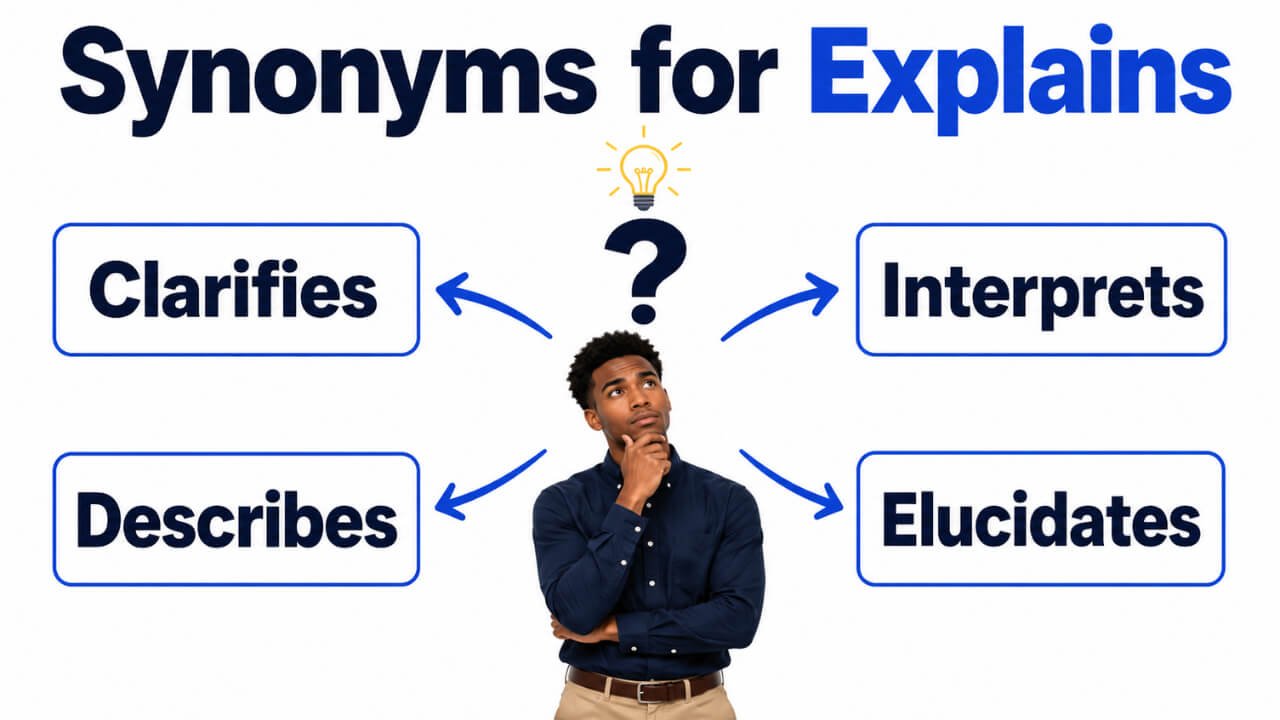
Quick Answer: The best synonyms for explains include clarifies, describes, defines, interprets, illustrates, demonstrates, outlines, details, elaborates, and justifies. Among these synonyms for explains, clarifies is best when making an idea easier to understand. Describes suits qualities or events, while defines gives an exact meaning. Demonstrates works for showing a process, illustrates supports an idea with examples, and justifies provides reasons for a decision or action.
Pronunciation and Word Details
Word: Explains
Pronunciation: /ɪkˈspleɪnz/
Part of Speech: Verb, third person singular present form of explain
Meaning: Makes an idea, reason, process, or situation clear and understandable.
US Pronunciation:
UK Pronunciation:
What Does “Explains” Mean?
Explains means makes something clear by providing information, reasons, details, or examples. It is the third person singular present form of the verb explain.
The word is commonly used after a singular subject such as he, she, it, the teacher, the author, or the report.
Example: The teacher explains the new grammar rule.
In this sentence, explains means that the teacher makes the rule easier to understand.
The word can also show that someone gives a reason for an action, describes how something works, interprets information, or accounts for an event.
Example: The report explains why sales increased.
Here, explains means provides the reason for the increase.
The exact meaning depends on the sentence. It may refer to clarification, description, instruction, interpretation, demonstration, or justification.
Meaning, Tone, and Context of “Explains”
Explains usually has a neutral and informative tone. It is appropriate in both formal and conversational language because it clearly describes the act of helping someone understand something.
In academic writing, explains often introduces an author’s discussion of a theory, cause, process, or result.
Example: The study explains how temperature affects plant growth.
In reports and professional writing, it may describe how a document presents reasons, procedures, findings, or policies.
Example: The guide explains the application process.
In conversation, explains commonly refers to someone giving details or answering a question.
Example: She explains the problem calmly.
The word may also carry a defensive tone when someone gives reasons for a mistake or decision.
Example: He explains why he missed the meeting.
Although explains is widely useful, more specific alternatives can make writing stronger. Clarifies emphasizes understanding, demonstrates emphasizes showing, and justifies emphasizes giving acceptable reasons.
When and How to Use “Explains”
For Clarification: Use explains when someone makes a confusing idea easier to understand.
Example: The instructor explains the difficult concept in simple language.
For Causes and Reasons: Use explains when someone identifies why an event, result, or situation occurred.
Example: The article explains why some materials expand when heated.
For Processes: Use explains when someone provides the steps or principles behind how something works.
Example: The manual explains how the security system operates.
For Definitions: Use explains when a speaker or writer gives the meaning of a word, phrase, or idea.
Example: The first paragraph explains the meaning of the technical term.
For Interpretation: Use explains when someone discusses what information, behavior, or evidence means.
Example: The expert explains what the test results indicate.
For Justification: Use explains when someone gives reasons for an action, choice, or opinion.
Example: She explains her decision to change the schedule.
For Instruction: Use explains when a teacher, guide, or expert helps another person learn something.
Example: The coach explains the rules before the game begins.
For Written Evidence: Use explains when a report, chart, essay, or document provides understanding.
Example: The diagram explains the movement of water through the system.
Best Synonyms for Explains
Clarifies: Makes an idea or statement easier to understand.
Example: The final paragraph clarifies the author’s main argument.
Describes: Gives information about the qualities, appearance, events, or features of something.
Example: The witness describes what happened outside the building.
Defines: States the exact meaning of a word, term, or concept.
Example: The glossary defines each scientific term.
Interprets: Explains the meaning or significance of information, evidence, or behavior.
Example: The analyst interprets the data carefully.
Illustrates: Makes an idea clearer by using an example, image, or comparison.
Example: The story illustrates the value of patience.
Demonstrates: Shows clearly how something works or proves that something is true.
Example: The instructor demonstrates how to operate the equipment.
Outlines: Presents the main points or basic structure without extensive detail.
Example: The introduction outlines the purpose of the report.
Details: Provides complete or specific information about something.
Example: The document details the responsibilities of each employee.
Elaborates: Adds further information to make an explanation more complete.
Example: The speaker elaborates on her original proposal.
Justifies: Gives reasons that support or defend an action, decision, or belief.
Example: The manager justifies the change by referring to recent results.
50 Synonyms for Explains with Short Meanings
- Clarifies: Makes something easier to understand.
- Describes: Gives information about features or events.
- Defines: States the exact meaning of something.
- Interprets: Presents the meaning of information or evidence.
- Illustrates: Makes an idea clear through examples.
- Demonstrates: Shows clearly how something works.
- Outlines: Presents the main points briefly.
- Details: Provides complete and specific information.
- Elaborates: Adds more information to an idea.
- Elucidates: Makes a difficult subject clearer.
- Expounds: Explains an idea in considerable detail.
- Accounts For: Gives the reason for something.
- Makes Clear: Removes confusion from an idea.
- Spells Out: Explains something very clearly and directly.
- Breaks Down: Divides a difficult subject into simpler parts.
- Sheds Light On: Helps people understand a confusing matter.
- Conveys: Communicates an idea or meaning.
- Communicates: Shares information with another person.
- Presents: Introduces information for consideration.
- States: Expresses information clearly in words.
- Expresses: Communicates a thought, feeling, or idea.
- Reveals: Makes previously unknown information clear.
- Shows: Makes a fact or process visible or understandable.
- Indicates: Points toward a meaning, fact, or conclusion.
- Identifies: Names or recognizes an important detail.
- Specifies: Gives exact and particular information.
- Summarizes: Presents the main points briefly.
- Paraphrases: Restates an idea in different words.
- Translates: Changes language or meaning into an understandable form.
- Decodes: Interprets information that is difficult to understand.
- Rationalizes: Offers reasons for an action or belief.
- Justifies: Provides reasons that support a decision.
- Defends: Gives arguments in support of something.
- Reasons: Uses logical thinking to present a conclusion.
- Teaches: Helps someone gain knowledge or understanding.
- Instructs: Gives information or directions for learning.
- Guides: Helps someone understand what to do.
- Informs: Provides useful facts or knowledge.
- Briefs: Gives essential information in a concise form.
- Reports: Presents facts about an event or situation.
- Narrates: Tells events in an organized sequence.
- Recounts: Describes past events in detail.
- Discusses: Examines a subject through explanation.
- Examines: Considers a subject carefully and thoroughly.
- Analyzes: Studies parts of a subject to understand it.
- Explores: Considers a subject from several perspectives.
- Addresses: Deals directly with an issue or question.
- Answers: Responds to a question or uncertainty.
- Resolves: Removes doubt or settles a question.
- Unpacks: Explains a complex subject in simpler parts.
Read Also:
Synonyms for Independent

Synonyms for Explains by Context
When Explains Means Makes Clear
Clarifies, elucidates, makes clear, sheds light on, spells out, and unpacks are useful when the purpose is to improve understanding.
Clarifies is a strong general choice for removing confusion.
Example: The revised statement clarifies the organization’s position.
Elucidates is more formal and is often used for complex academic or technical ideas.
Example: The researcher elucidates the relationship between the two variables.
Spells out has a more direct and conversational tone.
Example: The agreement spells out the responsibilities of both parties.
When Explains Means Describes
Describes, details, recounts, narrates, reports, and presents work well when someone gives information about an event, object, person, or situation.
Describes focuses on qualities or characteristics.
Example: The passage describes the landscape in vivid language.
Details emphasizes complete and specific information.
Example: The report details every stage of the investigation.
Recounts and narrates are especially useful for events presented in sequence.
Example: The witness recounts what happened that evening.
When Explains Means Shows How
Demonstrates, illustrates, shows, teaches, instructs, and guides are appropriate when explaining a method, process, or skill.
Demonstrates suggests showing something through action.
Example: The trainer demonstrates the correct exercise technique.
Illustrates often introduces an example that supports an idea.
Example: This case illustrates the importance of careful planning.
Instructs focuses on giving directions or teaching a procedure.
Example: The guide instructs readers to save their work regularly.
When Explains Means Gives a Reason
Accounts for, justifies, rationalizes, defends, answers, and reasons are useful when explains introduces causes or supporting arguments.
Accounts for is suitable for identifying why something happened.
Example: The increase in demand accounts for the higher price.
Justifies means provides acceptable reasons for a decision or action.
Example: The evidence justifies further investigation.
Rationalizes may suggest that someone is trying to make a questionable action appear reasonable.
Example: He rationalizes his mistake instead of accepting responsibility.
When Explains Means Interprets
Interprets, analyzes, decodes, translates, examines, and explores are useful when someone explains the meaning of evidence, language, behavior, or results.
Interprets focuses on meaning or significance.
Example: The critic interprets the poem as a reflection on memory.
Analyzes focuses on examining parts, patterns, or relationships.
Example: The report analyzes the factors affecting performance.
Decodes is useful for symbols, messages, signals, and difficult information.
Example: The researcher decodes the meaning of the ancient markings.
When Explains Means Gives the Main Points
Outlines, summarizes, briefs, states, specifies, and identifies work well when information is presented clearly but concisely.
Outlines gives the basic structure or major ideas.
Example: The opening section outlines the goals of the project.
Summarizes reduces a longer discussion to its essential points.
Example: The conclusion summarizes the main findings.
Specifies gives precise information rather than a broad overview.
Example: The contract specifies the payment date.
Another Word for Explains
Clarifies is often the best single replacement for explains because it directly suggests making something easier to understand. However, the strongest alternative depends on whether the sentence involves description, definition, demonstration, interpretation, or justification.
Original: The teacher explains the difficult rule.
Better Option: The teacher clarifies the difficult rule.
Original: The guide explains how to install the equipment.
Better Option: The guide demonstrates how to install the equipment.
Original: The report explains every stage of the process.
Better Option: The report details every stage of the process.
Original: The manager explains why the decision was necessary.
Better Option: The manager justifies why the decision was necessary.
When Not to Use “Explains”
Avoid explains when a more precise verb would identify how the information is presented. The word can become vague when readers need to know whether someone defines, demonstrates, summarizes, interprets, or justifies something.
Weak: The instructor explains the machine.
Better: The instructor demonstrates how the machine operates.
Do not use explains repeatedly as a reporting verb throughout an essay. Repetition can make paragraphs sound mechanical and reduce clarity.
Weak: The author explains the problem, explains its causes, and explains the solution.
Better: The author identifies the problem, analyzes its causes, and outlines the solution.
Avoid explains when the subject only mentions information without making it understandable.
Weak: The notice explains the meeting date.
Better: The notice states the meeting date.
Explains may also be too neutral when someone is defending a decision or making an excuse.
Weak: The director explains the controversial decision.
Better: The director justifies the controversial decision.
Do not use explains with a plural subject in the present tense.
Weak: The teachers explains the lesson clearly.
Better: The teachers explain the lesson clearly.
Use explains only with he, she, it, or another singular subject in the simple present tense.
Words Commonly Confused With Explains
Explains vs Clarifies: Explains provides information that creates understanding, while clarifies specifically removes confusion or uncertainty.
Explains vs Describes: Explains tells how or why something happens, while describes tells what something is like.
Explains vs Defines: Explains develops an idea through details or reasons, while defines gives its exact meaning.
Explains vs Demonstrates: Explains often uses words, while demonstrates shows a process through action, evidence, or an example.
Explains vs Illustrates: Explains gives understanding directly, while illustrates supports understanding with an example, comparison, picture, or case.
Explains vs Interprets: Explains makes information understandable, while interprets presents what information, behavior, or evidence means.
Explains vs Justifies: Explains gives information or reasons, while justifies argues that an action or decision is reasonable or correct.
Explains vs Outlines: Explains may provide complete understanding, while outlines presents only the main points or structure.
Explains vs Analyzes: Explains communicates how or why something happens, while analyzes examines its parts, causes, patterns, or relationships.
Which Synonym Should You Choose?
Choose clarifies when an idea is confusing and needs to become easier to understand.
Choose describes when writing about the qualities, appearance, condition, or events connected with something.
Choose defines when giving the exact meaning of a term, phrase, or concept.
Choose demonstrates when showing how a process, method, or skill works.
Choose illustrates when supporting an idea with an example, comparison, case, or visual element.
Choose outlines when presenting the main stages, points, or structure of a subject.
Choose details when providing complete and specific information in reports, policies, or instructions.
Choose elucidates in formal or academic writing about a difficult concept.
Choose interprets when discussing the significance of data, evidence, literature, behavior, or results.
Choose analyzes when examining causes, parts, patterns, or relationships.
Choose justifies when giving reasons that defend a decision, opinion, or action.
Choose spells out in direct or conversational language when something is explained clearly and completely.
Choose summarizes when giving only the essential points of a longer discussion.
Choose states in reports, emails, and formal communication when information is simply presented rather than explained.
Choose teaches or instructs when the purpose is to help someone learn a skill, rule, or procedure.
Real Life Examples of “Explains” in Sentences
Original: The teacher explains the grammar rule to the class.
Better Option: The teacher clarifies the grammar rule for the class.
Original: The manual explains how the device works.
Better Option: The manual describes how the device works.
Original: The speaker explains the main goals of the project.
Better Option: The speaker outlines the main goals of the project.
Original: The researcher explains the meaning of the results.
Better Option: The researcher interprets the meaning of the results.
Original: The diagram explains the water cycle.
Better Option: The diagram illustrates the water cycle.
Original: The trainer explains the correct way to lift the box.
Better Option: The trainer demonstrates the correct way to lift the box.
Original: The report explains each expense in the budget.
Better Option: The report details each expense in the budget.
Original: The manager explains why the policy was changed.
Better Option: The manager justifies why the policy was changed.
Original: The opening paragraph explains the argument briefly.
Better Option: The opening paragraph summarizes the argument briefly.
Original: The expert explains the complex process in simple steps.
Better Option: The expert breaks down the complex process into simple steps.
Synonym Groups and Usage Differences
Clarification Group
Clarifies, elucidates, makes clear, spells out, sheds light on, and unpacks belong to the clarification group. They focus on reducing confusion and making difficult ideas easier to understand.
Clarifies is neutral and widely useful. Elucidates is more formal, while unpacks is more conversational.
Example: The additional note clarifies how the rule should be applied.
Description Group
Describes, details, recounts, narrates, reports, and presents provide information about qualities, events, or situations.
Describes gives a general account, while details provides precise information. Narrates and recounts are best for events arranged in sequence.
Example: The witness recounts the events in chronological order.
Demonstration Group
Demonstrates, illustrates, shows, teaches, instructs, and guides focus on helping someone understand through examples, actions, or directions.
Demonstrates is especially useful for physical procedures. Illustrates often supports an abstract idea through an example.
Example: The chart illustrates the gradual increase in production.
Interpretation Group
Interprets, analyzes, examines, explores, decodes, and translates help readers understand meaning, significance, evidence, or structure.
Interprets focuses on meaning, while analyzes studies the separate parts of a subject.
Example: The analyst interprets the figures as evidence of steady growth.
Reason Group
Accounts for, justifies, rationalizes, defends, and reasons focus on causes or supporting arguments.
Accounts for identifies a cause. Justifies provides acceptable reasons, while rationalizes may imply a weak or questionable excuse.
Example: The unexpected delay accounts for the change in the schedule.
Summary Group
Outlines, summarizes, briefs, states, identifies, and specifies present information efficiently.
Outlines gives structure, summarizes gives essential points, and specifies provides exact details.
Example: The introduction outlines the subjects covered in the report.
Antonyms of Explains
The opposite of explains depends on whether the intended meaning is clarifies, reveals, teaches, or provides reasons.
Confuses: Makes a subject difficult to understand.
Obscures: Prevents an idea or fact from being seen clearly.
Conceals: Keeps information hidden from others.
Complicates: Makes something more difficult than necessary.
Mystifies: Causes someone to feel completely confused.
Misleads: Causes someone to believe something incorrect.
Withholds: Refuses or fails to provide information.
Distorts: Changes information so that it becomes inaccurate.
Clouds: Makes an issue less clear or certain.
Muddles: Presents information in a confused or disorganized way.
Hides: Prevents information from becoming known.
Misrepresents: Gives a false or inaccurate account of something.
Comparison: Explains vs Related Words
Explains vs Clarifies
Explains provides information about how, why, or what something means. Clarifies focuses specifically on removing doubt or confusion.
Example With Explains: The teacher explains how the formula works.
Example With Clarifies: The teacher clarifies the part of the formula that confused the students.
Explains vs Describes
Explains focuses on understanding causes, meanings, or processes. Describes focuses on appearance, qualities, conditions, or events.
Example With Explains: The scientist explains why the reaction occurs.
Example With Describes: The scientist describes the color produced by the reaction.
Explains vs Defines
Explains develops an idea through details, examples, or reasons. Defines states the exact meaning or limits of a term.
Example With Explains: The chapter explains how democracy functions.
Example With Defines: The chapter defines democracy as a system of government.
Explains vs Demonstrates
Explains often communicates through words. Demonstrates shows something through action, evidence, or a practical example.
Example With Explains: The coach explains the correct movement.
Example With Demonstrates: The coach demonstrates the correct movement.
Explains vs Illustrates
Explains gives direct information that creates understanding. Illustrates makes an idea clearer through an example, comparison, story, or image.
Example With Explains: The article explains the effects of poor planning.
Example With Illustrates: The case study illustrates the effects of poor planning.
Explains vs Interprets
Explains makes a subject understandable. Interprets gives a particular meaning to information, behavior, literature, or evidence.
Example With Explains: The report explains the test procedure.
Example With Interprets: The specialist interprets the test results.
Explains vs Justifies
Explains provides information or reasons without necessarily defending anything. Justifies provides reasons intended to prove that something is reasonable or acceptable.
Example With Explains: The manager explains why the schedule changed.
Example With Justifies: The manager justifies the schedule change by presenting evidence.
Common Phrases and Expressions With Explains
Explains Clearly: Makes an idea easy to understand.
Explains Why: Provides the reason for an event, action, or result.
Explains How: Describes a process, method, or way of doing something.
Explains the Difference: Clarifies how two or more things are not the same.
Explains the Meaning: Makes the definition or significance understandable.
Explains the Process: Describes the stages or operation of something.
Explains the Reason: Identifies the cause behind a decision or event.
Explains in Detail: Provides complete and specific information.
Explains in Simple Terms: Makes a difficult idea understandable through easy language.
Explains It All: Provides information that answers every important question.
Common Mistakes to Avoid
A frequent mistake is using explains with a plural subject. Explains belongs with a singular subject in the simple present tense.
Incorrect: The articles explains the issue clearly.
Correct: The articles explain the issue clearly.
Another mistake is using explains when the sentence requires a more precise reporting verb. A writer may define a term, outline a plan, demonstrate a process, or justify a choice rather than merely explain it.
Avoid repeating explains in every sentence of an essay or report. Use alternatives based on the exact purpose of each sentence.
Repetitive: The author explains the problem. She explains the causes and explains the possible solutions.
Improved: The author identifies the problem, analyzes its causes, and outlines possible solutions.
Do not assume that all synonyms carry the same tone. Elucidates is formal, spells out is conversational, and rationalizes may suggest a weak excuse.
Writers should also avoid vague objects after explains. State exactly what is being explained.
Vague: The guide explains everything.
Clear: The guide explains the registration requirements and payment process.
Finally, remember that explains usually needs an object or a clause. A sentence should identify the idea, reason, process, or situation being made clear.
Conclusion
Understanding synonyms for explains helps writers choose verbs that match their exact purpose. Clarifies is best for removing confusion, while describes presents qualities or events. Demonstrates shows how something works, illustrates uses examples, and outlines gives the main points. Interprets suits meanings and evidence, while justifies supports a decision with reasons. Instead of repeating explains, select a word that shows whether the subject defines, analyzes, teaches, summarizes, or makes an idea easier to understand.
FAQs About Synonyms for Explains
What is the best synonym for explains?
Clarifies is often the best general synonym because it means making something easier to understand. The ideal choice still depends on the sentence.
Is describes a synonym for explains?
Describes can replace explains when the sentence provides information about qualities, events, or conditions. It is less suitable when discussing causes or reasons.
What is a formal synonym for explains?
Elucidates, expounds, interprets, and clarifies are useful formal alternatives. Elucidates is especially suitable for complex academic ideas.
What word can replace explains in an essay?
Clarifies, demonstrates, illustrates, analyzes, outlines, states, and argues may replace explains in an essay. Choose the verb that accurately describes what the author does.
What is the difference between explains and clarifies?
Explains provides information that creates understanding. Clarifies specifically removes confusion, doubt, or ambiguity.
Can demonstrates replace explains?
Demonstrates can replace explains when someone shows a method, process, principle, or proof. It is especially useful for practical instructions and evidence.
What is the opposite of explains?
Common opposites include confuses, obscures, conceals, complicates, and misleads. The best antonym depends on whether explains means clarifies, reveals, or informs.
