
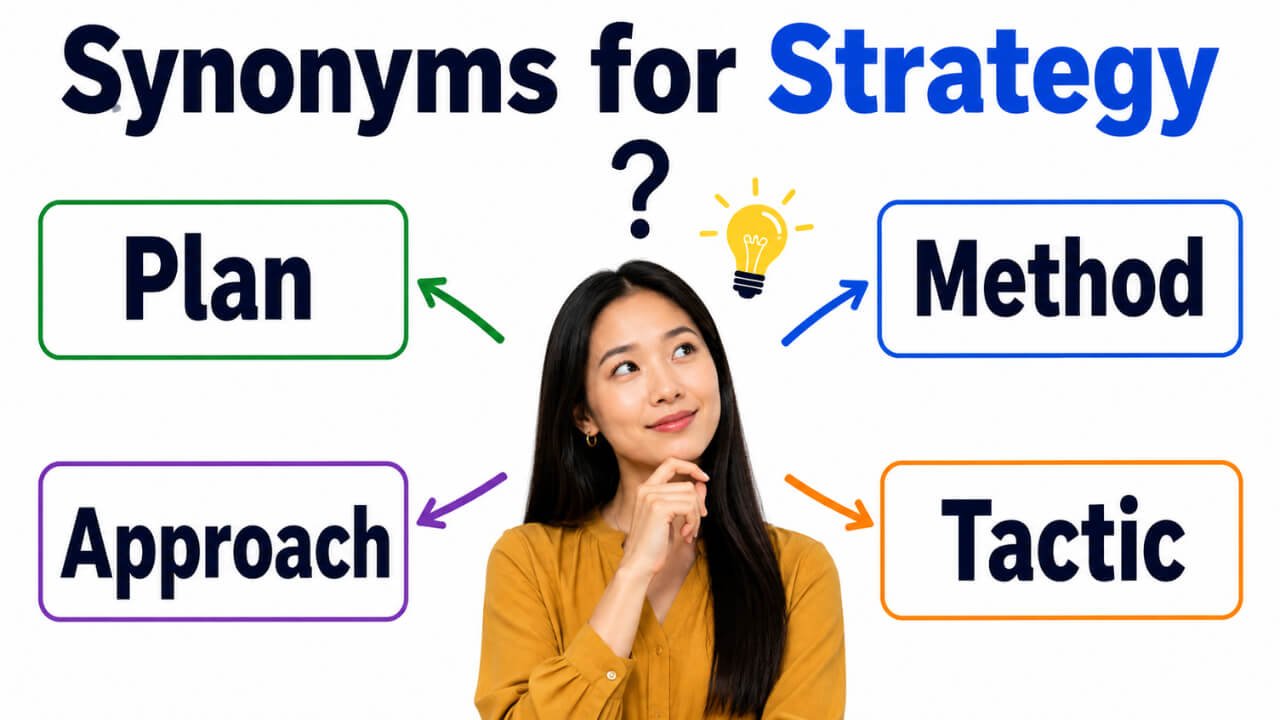
Quick Answer: The best synonyms for strategy include plan, approach, method, tactic, framework, blueprint, roadmap, policy, game plan, and course of action. Use plan for a general set of intended actions, approach for a way of handling a situation, tactic for one specific action, framework for an organized structure, and roadmap for a sequence of future steps. In formal writing, strategy, framework, policy, methodology, and course of action work well. In casual conversation, plan, approach, and game plan sound more natural.
Pronunciation and Word Details
Word: Strategy.
Pronunciation: /ˈstræt.ə.dʒi/.
Part of Speech: Noun.
Meaning: Strategy means a carefully developed plan or method for achieving a particular goal.
US Pronunciation:
UK Pronunciation:
What Does “Strategy” Mean?
Strategy means a carefully organized plan for reaching a goal, solving a problem, gaining an advantage, or managing a difficult situation. It is a noun commonly used in business, education, communication, competition, leadership, personal development, and problem solving.
A strategy usually explains the overall direction of an effort. It focuses on what someone wants to achieve and how different actions will support that result.
Planning Context: The team created a strategy for increasing customer satisfaction.
Problem Solving Context: Her strategy helped resolve the disagreement peacefully.
Learning Context: The student used a reading strategy to understand difficult passages.
Competitive Context: Their defensive strategy prevented the other side from scoring.
Strategy can describe one organized plan or several possible plans.
Singular Example: We need a strategy for completing the project.
Plural Example: The group discussed several strategies for improving performance.
The word may also describe a broad way of thinking rather than a detailed list of actions.
Example: Patience was an important part of his negotiation strategy.
Meaning, Tone, and Context of “Strategy”
Strategy is a neutral and flexible word. It can sound formal, professional, academic, technical, or conversational depending on the surrounding language.
In business and professional writing, strategy often describes a long term direction that connects goals, resources, decisions, and actions.
Example: The organization introduced a growth strategy for entering new markets.
In education, strategy refers to a useful technique or organized method for learning, teaching, reading, writing, or solving problems.
Example: Summarizing each paragraph is an effective reading strategy.
In everyday conversation, strategy can describe a practical way to complete a task or handle a challenge.
Example: My strategy is to finish the hardest work first.
In competition, games, and conflict, strategy describes a broad plan designed to create an advantage.
Example: Their strategy focused on controlling the center of the field.
The word is usually serious and purposeful. It suggests preparation, judgment, and deliberate decision making. However, it can sound vague when the writer does not explain the actual actions, priorities, or intended outcome.
When and How to Use “Strategy”
For Business Planning
Use strategy when describing an organized plan for growth, performance, competition, operations, or customer needs.
Example: The company developed a strategy for improving service quality.
For Achieving a Goal
Strategy is useful when several actions must work together to produce one result.
Example: Her savings strategy helped her prepare for future expenses.
For Solving Problems
Use the word when explaining a planned response to a challenge.
Example: The committee needs a strategy for reducing delays.
For Learning and Education
Strategy can describe a method that helps someone learn, remember, read, write, or study more effectively.
Example: Creating a summary is a useful study strategy.
For Communication
Use strategy for a planned way of presenting information or influencing understanding.
Example: Their communication strategy focused on simple and direct language.
For Competition
Strategy is appropriate when describing an overall plan for gaining an advantage.
Example: The coach changed the defensive strategy during the second half.
For Risk Management
Use strategy when discussing preparation for uncertainty, possible losses, or future difficulties.
Example: The emergency strategy included several alternative actions.
For Personal Development
Strategy can describe a structured way to improve habits, confidence, health, productivity, or decision making.
Example: Her time management strategy reduced daily stress.
Best Synonyms for Strategy
Plan
Synonym: A plan is an organized set of actions intended to achieve a goal.
Example: The team prepared a plan for completing the work before Friday.
Approach
Synonym: An approach is a particular way of dealing with a task, problem, or situation.
Example: We need a more flexible approach to customer concerns.
Method
Synonym: A method is an established or organized way of doing something.
Example: This teaching method encourages active participation.
Tactic
Synonym: A tactic is one specific action used as part of a broader strategy.
Example: Offering a free trial was an effective sales tactic.
Framework
Synonym: A framework is an organized structure that guides decisions and actions.
Example: The new framework explains how each department should evaluate risk.
Blueprint
Synonym: A blueprint is a detailed plan that shows how something will be created or achieved.
Example: The proposal provides a blueprint for future development.
Roadmap
Synonym: A roadmap is a plan that presents major steps, stages, and future priorities.
Example: The roadmap outlines the next phase of the project.
Policy
Synonym: A policy is an official principle or plan that guides repeated decisions.
Example: The school introduced a policy for handling late assignments.
Game Plan
Synonym: A game plan is an informal expression for a practical plan of action.
Example: Our game plan is to complete the research before writing the report.
Course of Action
Synonym: A course of action is a particular series of steps chosen to manage a situation.
Example: The manager recommended a cautious course of action.
50 Synonyms for Strategy with Short Meanings
- Plan: An organized set of actions for achieving a goal.
- Approach: A particular way of handling a situation.
- Method: An established way of completing a task.
- Tactic: A specific action supporting a broader goal.
- Policy: A principle that guides decisions and actions.
- Scheme: A carefully arranged plan, sometimes with a negative tone.
- Framework: A structure that organizes ideas and decisions.
- Blueprint: A detailed plan for creating or achieving something.
- Roadmap: A plan showing future stages and priorities.
- Game Plan: An informal plan for handling a challenge.
- Course of Action: A selected sequence of practical steps.
- Program: An organized series of activities designed for a purpose.
- System: A connected method of working or organizing actions.
- Formula: A reliable pattern used to produce a result.
- Playbook: A collection of planned actions for common situations.
- Design: A carefully developed arrangement or plan.
- Arrangement: An organized preparation for a particular purpose.
- Direction: The general path or purpose of an effort.
- Initiative: A planned action intended to create improvement.
- Campaign: A coordinated series of actions supporting one goal.
- Agenda: A set of priorities, goals, or planned activities.
- Vision: A clear idea of a desired future result.
- Model: A structured example used to guide decisions.
- Process: A series of actions that produces a result.
- Technique: A particular skillful way of doing something.
- Maneuver: A carefully planned movement or action.
- Stratagem: A clever plan used to gain an advantage.
- Operation: An organized activity designed for a specific purpose.
- Methodology: A formal system of methods and principles.
- Procedure: An established sequence of required actions.
- Protocol: An official set of rules or steps.
- Guideline: A recommendation that directs decisions or behavior.
- Principle: A basic belief that guides action.
- Doctrine: A formal set of ideas guiding decisions.
- Planning: The process of deciding future actions.
- Outline: A general description of intended steps.
- Solution: A way of resolving a problem.
- Pathway: A route toward a particular result.
- Route: A chosen way of reaching an objective.
- Course: A direction followed over time.
- Action Plan: A detailed list of steps for achieving a goal.
- Master Plan: A broad and detailed plan controlling smaller actions.
- Contingency Plan: An alternative plan for possible difficulties.
- Business Plan: A structured plan describing business goals and operations.
- Battle Plan: A coordinated plan for competition or conflict.
- Implementation Plan: A plan explaining how an idea will be put into action.
- Development Plan: A structured approach to growth or improvement.
- Operational Plan: A practical plan for daily activities and resources.
- Growth Plan: A plan designed to support future expansion.
- Marketing Plan: A structured approach to promoting an offer or idea.
Read Also:
Synonyms for Communicate
Synonyms for Strategy by Context
When Strategy Means an Overall Plan
Plan, blueprint, roadmap, master plan, action plan, and course of action describe organized preparation for achieving a goal.
Plan is the broadest and most natural alternative.
Example: The committee approved a plan for improving public services.
Blueprint suggests greater detail and structure.
Example: The report offers a blueprint for modernizing the facility.
Roadmap emphasizes stages, priorities, and future progress.
Example: The roadmap identifies the major steps for the next two years.
When Strategy Means a Way of Working
Approach, method, methodology, system, process, and technique describe how a task is performed.
Approach is useful when several possible ways of handling a situation exist.
Example: The teacher used a patient approach with new learners.
Method refers to an organized and repeatable way of doing something.
Example: This research method produced reliable results.
Methodology is more formal and refers to a complete system of methods.
Example: The report explains the methodology used during the study.
When Strategy Means a Specific Competitive Action
Tactic, maneuver, stratagem, move, operation, and game plan relate to competition, negotiation, or gaining an advantage.
Tactic describes one action within a larger strategy.
Example: Asking an open question was a useful negotiation tactic.
Maneuver suggests a carefully controlled move.
Example: The sudden change was a calculated political maneuver.
Stratagem often describes a clever plan involving surprise or indirect action.
Example: The retreat was a stratagem designed to draw the opponent forward.
When Strategy Means an Organized Structure
Framework, model, system, protocol, procedure, and guideline provide structure for decisions and repeated actions.
Framework organizes broad principles and responsibilities.
Example: The safety framework defines how risks should be evaluated.
Protocol describes official rules or required steps.
Example: The emergency protocol explains how staff should respond.
Procedure gives a specific order for completing a task.
Example: The procedure requires approval before payment.
When Strategy Means an Official Direction
Policy, agenda, doctrine, principle, and direction describe ideas or rules that guide future decisions.
Policy usually represents an official position or repeated practice.
Example: The organization adopted a policy of transparent communication.
Agenda refers to a set of priorities or intended outcomes.
Example: Environmental protection remained central to the development agenda.
Doctrine is more formal and often describes a complete set of guiding beliefs.
Example: The leadership doctrine emphasized responsibility and discipline.
When Strategy Means a Coordinated Effort
Campaign, program, initiative, operation, and project describe organized activities created to achieve a specific outcome.
Campaign often involves several connected actions directed toward one visible goal.
Example: The awareness campaign encouraged safer driving.
Initiative suggests a new effort intended to produce improvement.
Example: The training initiative helped employees develop new skills.
Program refers to an organized collection of continuing activities.
Example: The wellness program supported healthier daily routines.
Another Word for Strategy
Plan is the best general replacement for strategy because it is clear, natural, and suitable for most situations. However, the best alternative depends on whether the sentence describes an overall direction, a detailed structure, an official policy, a working method, or one specific action.
Original: We need a strategy for completing the project.
Better Option: We need a plan for completing the project.
Original: The organization created a strategy for future expansion.
Better Option: The organization created a roadmap for future expansion.
Original: Her strategy for teaching new vocabulary was effective.
Better Option: Her method for teaching new vocabulary was effective.
Original: Offering a discount was part of the sales strategy.
Better Option: Offering a discount was a useful sales tactic.
When Not to Use “Strategy”
Strategy may sound too broad when the sentence refers to one action, a simple routine, an official rule, or a clearly defined procedure. A more exact synonym can make the meaning easier to understand.
When Referring to One Specific Action
Use tactic when describing one action within a larger plan.
Weak: Lowering the price was our main strategy during the sale.
Better: Lowering the price was our main tactic during the sale.
When Describing a Simple Daily Routine
Method, process, or routine may sound more natural than strategy.
Weak: My morning strategy is to prepare breakfast first.
Better: My morning routine is to prepare breakfast first.
When Discussing Official Rules
Policy or protocol is clearer when the plan must guide repeated decisions.
Weak: The school has a strategy about attendance.
Better: The school has a policy about attendance.
When Explaining Required Steps
Procedure is more precise when actions must be completed in a fixed order.
Weak: Follow the payment strategy shown below.
Better: Follow the payment procedure shown below.
When the Meaning Is Too Vague
Do not use strategy without explaining the goal, priorities, or actions.
Weak: Our strategy will improve everything.
Better: Our customer service plan will reduce response times and clarify responsibilities.
When Repetition Makes Writing Unnatural
Replace repeated uses with plan, approach, method, framework, or roadmap when those words fit the intended meaning.
Weak: The strategy describes our goals, and the strategy also explains how the strategy will be implemented.
Better: The strategy describes our goals, while the implementation plan explains how they will be achieved.
Words Commonly Confused With Strategy
Strategy vs Plan: A strategy provides the overall direction for reaching a goal. A plan may include the specific tasks, dates, responsibilities, and resources needed to follow that direction.
Strategy vs Tactic: A strategy is the broad approach. A tactic is one specific action used to support it.
Strategy vs Goal: A goal is the desired result. A strategy explains how someone intends to reach that result.
Strategy vs Method: A strategy connects actions to a larger objective. A method describes a particular way of performing a task.
Strategy vs Approach: Strategy usually involves deliberate planning over time. Approach is a broader word for the way someone handles a task or situation.
Strategy vs Policy: Strategy explains how to achieve an objective. Policy establishes a rule or principle that guides repeated decisions.
Strategy vs Procedure: Strategy concerns direction and choices. Procedure describes the exact order in which steps should be completed.
Strategy vs Technique: Strategy is broad and goal focused. Technique is a specific skill or way of performing an action.
Which Synonym Should You Choose?
Choose plan when you need a clear and general alternative for strategy.
Choose approach when describing a particular way of handling a problem, person, or task.
Choose method when discussing an organized and repeatable way of doing something.
Choose tactic when referring to one specific action within a larger strategy.
Choose framework when writing about an organized structure of principles, roles, or decisions.
Choose blueprint when presenting a detailed model for future development.
Choose roadmap when explaining stages, milestones, priorities, or future progress.
Choose policy when discussing an official rule or principle that guides repeated decisions.
Choose course of action in formal writing when describing a selected response to a situation.
Choose methodology in academic reports, research writing, and technical discussions.
Choose game plan in casual conversation when describing a practical way to handle a challenge.
Choose procedure when explaining required steps in a fixed order.
Choose protocol when discussing official safety, communication, or operational rules.
Choose campaign when several coordinated activities support one public goal.
Choose initiative when describing a new organized effort intended to create change.
Choose stratagem when describing a clever plan used to gain an advantage.
Real Life Examples of “Strategy” in Sentences
Original: The manager introduced a strategy for reducing unnecessary costs.
Better Option: The manager introduced a plan for reducing unnecessary costs.
Original: Her strategy for handling complaints was calm and respectful.
Better Option: Her approach to handling complaints was calm and respectful.
Original: The teacher changed her strategy for explaining the lesson.
Better Option: The teacher changed her method for explaining the lesson.
Original: The team used a strategy of applying pressure early.
Better Option: The team used the tactic of applying pressure early.
Original: The report presents a strategy for future development.
Better Option: The report presents a roadmap for future development.
Original: The safety strategy explains how employees should respond.
Better Option: The safety protocol explains how employees should respond.
Original: The organization created a strategy for making decisions fairly.
Better Option: The organization created a framework for making decisions fairly.
Original: The new strategy will guide hiring decisions.
Better Option: The new policy will guide hiring decisions.
Original: We discussed the best strategy for dealing with the delay.
Better Option: We discussed the best course of action for dealing with the delay.
Original: His strategy was to ask questions before offering advice.
Better Option: His game plan was to ask questions before offering advice.
Synonym Groups and Usage Differences
Planning Group
Plan, roadmap, blueprint, master plan, action plan, and course of action describe preparation for a future goal.
Plan is the most general word. Blueprint suggests detail, while roadmap focuses on stages and progress.
Example: The roadmap shows how the project will move from research to completion.
Action Group
Tactic, maneuver, stratagem, move, and operation describe actions taken to influence a result.
Tactic is usually one part of a larger strategy. Stratagem suggests cleverness, while maneuver often involves careful positioning.
Example: Changing the meeting time was a useful negotiation tactic.
Method Group
Approach, method, methodology, process, system, and technique explain how work is performed.
Approach is broad and flexible. Method is more organized, while methodology sounds formal and academic.
Example: The researchers selected a methodology that matched the purpose of the study.
Structure Group
Framework, model, protocol, procedure, guideline, and playbook organize decisions and repeated actions.
Framework provides broad structure. Procedure and protocol provide more exact instructions.
Example: The framework helps managers evaluate each proposal consistently.
Direction Group
Policy, doctrine, agenda, principle, vision, and direction guide future choices.
Policy is usually official. Vision describes the desired future, while agenda identifies current priorities.
Example: The environmental policy guides all purchasing decisions.
Organized Effort Group
Campaign, program, initiative, operation, and development plan describe coordinated activities.
Campaign often has one visible objective. Program is usually broader and may continue for a longer period.
Example: The training program prepares new employees for their responsibilities.
Antonyms of Strategy
The opposite of strategy can refer to a lack of planning, direction, organization, preparation, or purposeful action.
Improvisation: Acting without a prepared plan.
Spontaneity: Responding naturally without prior organization.
Randomness: Acting without a clear pattern or purpose.
Aimlessness: Having no specific goal or direction.
Disorder: A lack of organized structure.
Confusion: An inability to understand what should be done.
Inaction: Failing to take steps toward a goal.
Negligence: Failing to plan or act with proper care.
Reaction: Responding after an event instead of preparing beforehand.
Guesswork: Making decisions without enough information or planning.
Carelessness: Acting without proper attention or preparation.
Short Sightedness: Focusing only on immediate results without considering future effects.
Comparison: Strategy vs Related Words
Strategy vs Plan
A strategy gives the overall direction and reasoning behind decisions. A plan usually explains the practical steps, schedule, and responsibilities.
Example With Strategy: Our strategy is to improve customer trust through clearer communication.
Example With Plan: Our plan includes weekly updates and faster responses.
Strategy vs Tactic
A strategy is broad and long term. A tactic is one specific action used to support the strategy.
Example With Strategy: The strategy focused on attracting younger customers.
Example With Tactic: Offering a student discount was one tactic.
Strategy vs Approach
Strategy usually connects choices to a defined objective. Approach describes the general way someone handles a situation.
Example With Strategy: Their strategy aimed to reduce delays across the entire process.
Example With Approach: Their patient approach helped calm the unhappy customer.
Strategy vs Method
Strategy focuses on achieving a larger goal. Method focuses on how a particular task is completed.
Example With Strategy: The learning strategy encouraged daily practice.
Example With Method: The repetition method helped students remember new words.
Strategy vs Policy
Strategy explains how an objective will be achieved. Policy establishes rules or principles that guide decisions.
Example With Strategy: The strategy aims to improve workplace safety.
Example With Policy: The safety policy requires protective equipment.
Strategy vs Procedure
Strategy concerns direction, priorities, and choices. Procedure explains exact steps in a particular order.
Example With Strategy: The emergency strategy prepares the organization for several possible risks.
Example With Procedure: The evacuation procedure tells employees where to go.
Strategy vs Framework
Strategy identifies the intended direction and actions. Framework provides the structure used to organize decisions and responsibilities.
Example With Strategy: The strategy focuses on responsible growth.
Example With Framework: The framework explains how growth proposals will be evaluated.
Common Phrases and Expressions With “Strategy”
Business Strategy: A plan for achieving business goals and competitive success.
Marketing Strategy: An organized approach to reaching and persuading an audience.
Growth Strategy: A plan for increasing size, reach, revenue, or influence.
Communication Strategy: A planned way of sharing information with particular audiences.
Learning Strategy: A method used to understand, remember, or apply knowledge.
Winning Strategy: A plan that is likely to produce success.
Long Term Strategy: A plan designed to achieve results over an extended period.
Exit Strategy: A plan for leaving an investment, activity, role, or difficult situation.
Risk Management Strategy: A planned way of identifying and reducing possible harm.
Implementation Strategy: A plan explaining how an idea or decision will be put into practice.
Common Mistakes to Avoid
Confusing Strategy With a Goal
A goal describes the desired result. A strategy explains how that result may be achieved.
Incorrect: Our strategy is higher customer satisfaction.
Better: Our goal is higher customer satisfaction, and our strategy is to improve response quality.
Treating One Tactic as a Complete Strategy
One action rarely explains an entire strategy.
Weak: Sending one email is our communication strategy.
Better: Sending regular updates is one tactic within our communication strategy.
Using Strategy Without Specific Details
A vague statement does not help readers understand the intended direction.
Vague: We have a strong strategy for growth.
Clearer: Our growth strategy focuses on improving service, reaching new customers, and increasing repeat purchases.
Repeating Strategy Too Frequently
Use related words when they express the meaning more precisely.
Repetitive: The strategy includes a sales strategy and a training strategy.
Improved: The overall strategy includes a sales plan and a training program.
Using Scheme Without Considering Its Tone
Scheme can mean a neutral organized plan, but it may also suggest dishonesty or secretive behavior.
Unclear: The manager introduced a scheme for employee development.
Better: The manager introduced a program for employee development.
Confusing Policy and Strategy
A policy sets a rule. A strategy organizes actions toward an objective.
Incorrect: Our strategy requires employees to wear identification cards.
Better: Our policy requires employees to wear identification cards.
Using an Unnatural Verb Combination
Avoid unnecessary expressions such as create a strategy plan or strategize a strategy.
Unnatural: We need to strategize a new strategy.
Better: We need to develop a new strategy.
Ignoring the Difference Between Singular and Plural Forms
Use strategy for one broad plan and strategies for multiple approaches or methods.
Singular: The organization needs a clear strategy.
Plural: The teacher uses several reading strategies.
Conclusion
The most useful synonyms for strategy depend on the purpose and level of detail. Use plan for a general replacement, approach for a way of handling a situation, method for an organized process, and tactic for one specific action. Framework suits structured decision making, while roadmap and blueprint describe future direction and detailed preparation. In formal writing, policy, methodology, and course of action may be more precise. Understanding these differences helps you choose clearer and more natural words for every context.
FAQs About Synonyms for Strategy
What Is the Best Synonym for Strategy?
Plan is the best general synonym for strategy. It is clear, natural, and suitable for most everyday and professional contexts.
What Is a Formal Synonym for Strategy?
Course of action, methodology, framework, policy, and strategic plan are useful formal alternatives, depending on the sentence.
What Is a Casual Word for Strategy?
Plan and game plan are natural casual alternatives. Game plan sounds especially conversational.
Are Strategy and Tactic the Same?
No. A strategy is the overall plan, while a tactic is one specific action used to support that plan.
What Is Another Word for Business Strategy?
Business plan, growth plan, commercial approach, operational plan, and roadmap can replace business strategy in suitable contexts.
Can Approach Replace Strategy?
Approach can replace strategy when describing a general way of handling a problem or task. It may not express the same level of detailed planning.
What Is the Difference Between a Plan and a Strategy?
A strategy explains the overall direction and reasoning. A plan usually describes the specific actions, schedule, responsibilities, and resources.
