
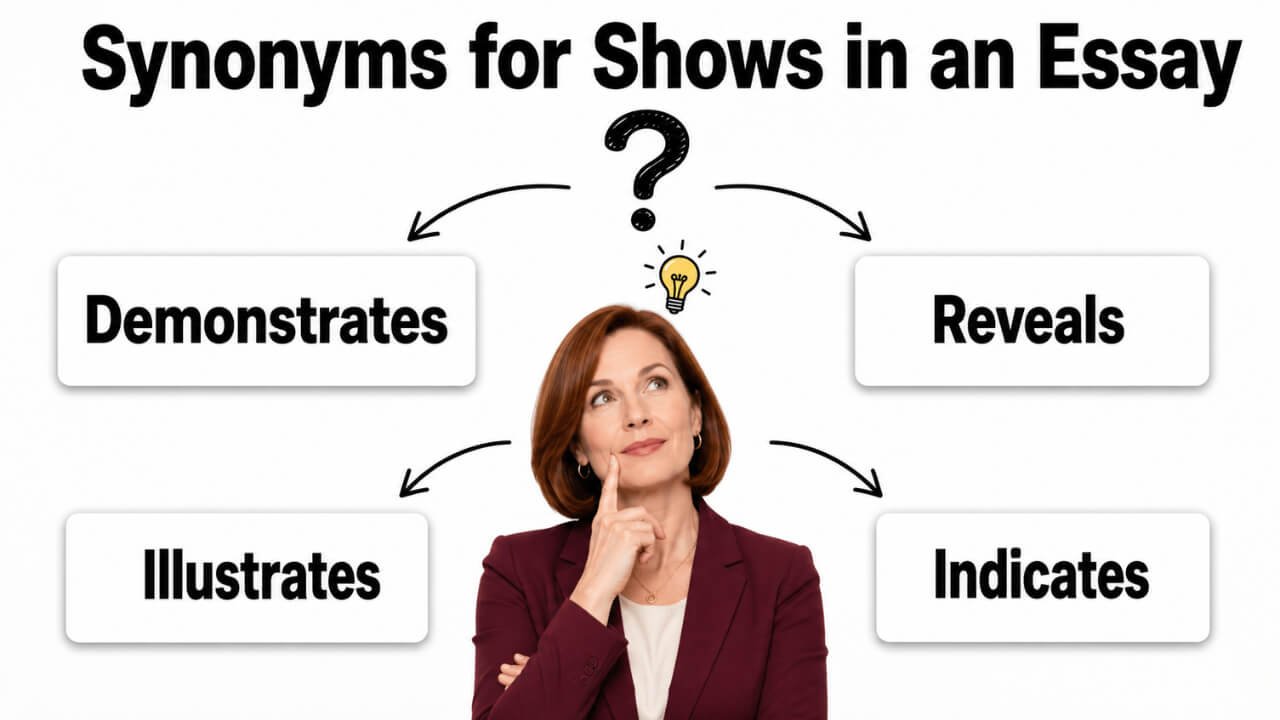
Quick Answer: The best synonyms for shows in an essay include demonstrates, illustrates, indicates, reveals, suggests, proves, highlights, emphasizes, presents, and supports. Use demonstrates for formal academic writing, illustrates when giving an example, indicates when evidence points to an idea, reveals when something becomes clear, proves when evidence is strong, and suggests when the conclusion is likely but not absolute.
Pronunciation and Word Details
Word: Shows.
Pronunciation: /ʃoʊz/.
Part of Speech: Verb.
Meaning: Shows means presents, proves, displays, indicates, or makes something clear to the reader.
US Pronunciation:
UK Pronunciation:
What Does “Shows” Mean?
Shows means makes something clear, visible, understandable, or supported by evidence. In an essay, shows is usually used as a verb to explain what a quote, example, statistic, argument, or piece of evidence proves.
The word can appear in different sentence contexts. A quote shows a character’s feelings. A statistic shows a pattern. A paragraph shows the writer’s argument. A comparison shows a difference between two ideas. In academic writing, shows is useful, but it can become repetitive if used too often.
Meaning, Tone, and Context of “Shows”
Shows is a neutral and common word. It works in casual writing, school essays, reports, and simple explanations. However, it may sound plain or repetitive in advanced academic writing if used again and again.
In essays, shows often means demonstrates, indicates, reveals, or proves. The tone depends on the strength of the evidence. Demonstrates sounds formal and confident. Suggests sounds careful and less absolute. Reveals sounds analytical. Highlights sounds useful when pointing out an important detail.
The word is common in literary analysis, research essays, argument essays, compare and contrast essays, history writing, and evidence based paragraphs.
When and How to Use “Shows”
For Evidence: Use shows when explaining what evidence proves or supports.
Example: The survey shows that many students prefer shorter study sessions.
For Analysis: Use shows when explaining the deeper meaning of a quote, event, or detail.
Example: This line shows the character’s fear of failure.
For Cause and Effect: Use shows when one detail makes a result or reason clear.
Example: The data shows how poor planning affected the project.
For Comparison: Use shows when a sentence explains a similarity or difference.
Example: The comparison shows how both writers view freedom differently.
For Emphasis: Use shows when pointing to an important part of an argument.
Example: This example shows the importance of careful decision making.
For Careful Claims: Use shows only when your evidence is strong enough. If the evidence is not certain, use suggests or indicates instead.
Example: The early evidence suggests that the policy may improve attendance.
Best Synonyms for Shows
Demonstrates: Proves or makes an idea clear through evidence.
Example: The evidence demonstrates the need for stronger rules.
Illustrates: Explains an idea by giving an example or clear picture.
Example: The quote illustrates the speaker’s loneliness.
Indicates: Points to a conclusion or possible meaning.
Example: The results indicate a rise in student confidence.
Reveals: Makes something hidden, deeper, or important clear.
Example: The scene reveals the character’s true motive.
Suggests: Points to a possible idea without claiming full certainty.
Example: The pattern suggests that income affects access to education.
Proves: Shows that something is true through strong evidence.
Example: The findings prove that the method was effective.
Highlights: Draws attention to an important point or detail.
Example: The example highlights the problem of unfair treatment.
Emphasizes: Gives special importance to an idea.
Example: The writer emphasizes the value of honesty.
Presents: Gives information, evidence, or an argument to the reader.
Example: The essay presents several reasons for the change.
Supports: Gives evidence for a claim or argument.
Example: The statistic supports the main argument of the paragraph.
50 Synonyms for Shows with Short Meanings
- Demonstrates: Makes an idea clear with evidence.
- Illustrates: Explains through an example.
- Indicates: Points to a meaning or result.
- Reveals: Makes something clear or known.
- Suggests: Points to a likely idea.
- Proves: Confirms something with strong evidence.
- Highlights: Draws attention to an important point.
- Emphasizes: Gives special importance to something.
- Presents: Gives information or an argument.
- Supports: Gives evidence for a claim.
- Confirms: Shows that something is true.
- Establishes: Proves or sets a fact clearly.
- Displays: Makes something visible or clear.
- Depicts: Describes or represents something.
- Portrays: Shows a person, idea, or situation in a certain way.
- Reflects: Shows a quality, idea, or condition.
- Conveys: Communicates a feeling, meaning, or idea.
- Expresses: Shows a thought, feeling, or view.
- Clarifies: Makes an idea easier to understand.
- Explains: Makes meaning clear.
- Exemplifies: Serves as a clear example of something.
- Represents: Stands for or shows a larger idea.
- Signifies: Means or indicates something.
- Denotes: Directly means or refers to something.
- Implies: Suggests something without saying it directly.
- Points to: Directs attention toward a conclusion.
- Points out: Identifies or makes something noticeable.
- Identifies: Names or recognizes something clearly.
- Details: Gives specific information about something.
- Outlines: Gives the main points of something.
- Documents: Records or supports something with evidence.
- Substantiates: Supports a claim with proof.
- Validates: Shows that something is reasonable or true.
- Verifies: Confirms accuracy or truth.
- Evidences: Provides evidence of something.
- Underlines: Gives strong emphasis to an idea.
- Stresses: Emphasizes importance.
- Makes clear: Helps the reader understand something.
- Makes evident: Shows something in an obvious way.
- Makes apparent: Makes something easy to notice.
- Brings out: Makes a quality or idea easier to see.
- Uncovers: Reveals something not clearly seen before.
- Exposes: Reveals a truth, problem, or hidden fact.
- Discloses: Makes information known.
- Manifests: Shows clearly through signs or actions.
- Signals: Gives a sign of something.
- Marks: Indicates a point, change, or feature.
- Traces: Shows the development or path of something.
- Maps out: Shows structure, process, or development.
- Connects to: Shows a relationship between ideas.
Read Also:
Synonyms for Eager

Synonyms for Shows by Context
When Shows Means Demonstrates Evidence
Use these synonyms when a fact, statistic, quote, or example supports an argument.
Useful Synonyms: Demonstrates, proves, confirms, establishes, substantiates.
Example: The research demonstrates that early reading improves vocabulary.
Example: The statistic confirms the seriousness of the problem.
When Shows Means Indicates a Meaning
Use these words when evidence points toward a conclusion but does not fully prove it.
Useful Synonyms: Indicates, suggests, implies, signals, points to.
Example: The character’s silence suggests deep regret.
Example: The repeated image of darkness indicates fear and uncertainty.
When Shows Means Reveals a Hidden Idea
Use these synonyms when analysis explains a deeper meaning, motive, theme, or truth.
Useful Synonyms: Reveals, exposes, uncovers, discloses, brings out.
Example: The final scene reveals the character’s real intention.
Example: The author’s word choice exposes the weakness of the argument.
When Shows Means Gives an Example
Use these alternatives when one detail helps explain a bigger idea.
Useful Synonyms: Illustrates, exemplifies, presents, depicts, represents.
Example: The story illustrates the danger of pride.
Example: The image represents the loss of innocence.
When Shows Means Emphasizes Importance
Use these synonyms when you want to draw attention to a major point.
Useful Synonyms: Highlights, emphasizes, underlines, stresses, points out.
Example: The paragraph highlights the need for equal opportunity.
Example: The conclusion stresses the importance of personal responsibility.
When Shows Means Communicates an Idea
Use these words when a text, quote, speaker, or writer expresses meaning.
Useful Synonyms: Conveys, expresses, reflects, portrays, communicates.
Example: The poem conveys a sense of quiet sadness.
Example: The narrator’s tone reflects frustration with society.
Another Word for Shows
Demonstrates is often the best single replacement for shows in an essay because it sounds formal, academic, and evidence based. However, the best alternative depends on context. Use illustrates for examples, indicates for careful claims, reveals for deeper analysis, and supports when evidence backs up a point.
Original: This quote shows that the character feels alone.
Better Option: This quote reveals that the character feels alone.
Original: The data shows a clear rise in costs.
Better Option: The data indicates a clear rise in costs.
Original: The example shows why the rule is important.
Better Option: The example illustrates why the rule is important.
Original: The evidence shows that the argument is valid.
Better Option: The evidence supports the argument.
When Not to Use “Shows”
Do not use shows too often in an essay because it can make analysis sound basic and repetitive. It is fine for simple writing, but stronger verbs usually make academic sentences clearer.
Avoid shows when the evidence is weak or uncertain. Use suggests, indicates, or implies instead. Do not use proves unless the evidence is strong enough to confirm the claim.
Weak: This quote shows that the theme is important.
Better: This quote highlights the importance of the theme.
Weak: The data shows that the policy will work for everyone.
Better: The data suggests that the policy may help many people.
Weak: The paragraph shows the writer’s opinion.
Better: The paragraph presents the writer’s opinion.
Weak: The scene shows sadness.
Better: The scene conveys sadness.
Words Commonly Confused With Shows
Shows vs Demonstrates: Shows is general, while demonstrates is stronger and more formal. Use demonstrates when evidence clearly proves or explains a point.
Shows vs Indicates: Shows can sound certain, while indicates is more careful. Use indicates when evidence points toward a conclusion but does not fully prove it.
Shows vs Proves: Shows can mean makes clear, but proves means confirms something with strong evidence. Do not use proves for weak or limited evidence.
Shows vs Suggests: Shows sounds more direct. Suggests is softer and better when the writer is making a careful interpretation.
Shows vs Reveals: Shows is broad. Reveals is better when a text uncovers a deeper meaning, hidden truth, or character motive.
Shows vs Illustrates: Shows can refer to many types of evidence. Illustrates is best when an example explains a larger idea.
Shows vs Highlights: Shows makes something clear. Highlights draws special attention to something important.
Which Synonym Should You Choose?
Choose demonstrates when writing a formal essay about strong evidence, research, or logical proof.
Choose illustrates when a quote, example, scene, or detail explains a broader idea.
Choose indicates when evidence points to a result, pattern, trend, or careful conclusion.
Choose reveals when analyzing hidden meaning, theme, motive, emotion, or character development.
Choose suggests when the claim is possible or likely but not fully proven.
Choose proves when the evidence is strong, direct, and convincing.
Choose highlights when you want to draw attention to an important point.
Choose emphasizes when the writer gives special importance to an idea.
Choose presents when introducing an argument, view, fact, or explanation.
Choose supports when evidence backs up a claim in an essay paragraph.
Real Life Examples of “Shows” in Sentences
Original: The quote shows that the speaker feels guilty.
Better Option: The quote reveals that the speaker feels guilty.
Original: The graph shows a steady increase in sales.
Better Option: The graph indicates a steady increase in sales.
Original: This example shows the danger of poor planning.
Better Option: This example illustrates the danger of poor planning.
Original: The study shows that sleep affects memory.
Better Option: The study demonstrates that sleep affects memory.
Original: The author shows the pain of losing a home.
Better Option: The author conveys the pain of losing a home.
Original: The evidence shows that the claim is reasonable.
Better Option: The evidence supports the claim.
Original: The scene shows the conflict between tradition and change.
Better Option: The scene highlights the conflict between tradition and change.
Original: The paragraph shows the main causes of pollution.
Better Option: The paragraph outlines the main causes of pollution.
Original: The character’s reaction shows fear.
Better Option: The character’s reaction signals fear.
Original: The conclusion shows the writer’s final message.
Better Option: The conclusion emphasizes the writer’s final message.
Synonym Groups and Usage Differences
Evidence Group
This group is best for facts, statistics, research, quotes, and proof in academic writing.
Synonyms: Demonstrates, proves, confirms, substantiates, supports.
Example: The evidence substantiates the claim that exercise improves focus.
Interpretation Group
This group works well when explaining meaning in literature, history, or argument analysis.
Synonyms: Reveals, suggests, implies, indicates, points to.
Example: The repeated symbol points to the theme of isolation.
Example Group
This group is useful when one detail explains or represents a larger idea.
Synonyms: Illustrates, exemplifies, depicts, represents, presents.
Example: The scene exemplifies the struggle between loyalty and ambition.
Emphasis Group
This group helps when the writer wants to stress an important idea.
Synonyms: Highlights, emphasizes, underlines, stresses, points out.
Example: The final paragraph underlines the need for fair treatment.
Communication Group
This group fits sentences about tone, emotion, message, or meaning.
Synonyms: Conveys, expresses, reflects, portrays, communicates.
Example: The speaker’s tone conveys disappointment.
Clarity Group
This group is helpful when something makes an idea easier to understand.
Synonyms: Clarifies, explains, details, outlines, makes clear.
Example: The introduction clarifies the purpose of the essay.
Antonyms of Shows
Hides: Keeps something from being seen or understood.
Conceals: Covers or keeps information private.
Obscures: Makes something unclear or difficult to understand.
Confuses: Makes meaning unclear or difficult to follow.
Withholds: Refuses to give or reveal information.
Masks: Covers the real meaning or feeling.
Suppresses: Prevents something from being shown or expressed.
Contradicts: Goes against a claim, idea, or evidence.
Disproves: Shows that something is false.
Misrepresents: Gives a false or inaccurate impression.
Comparison: Shows vs Related Words
Shows vs Demonstrates
Shows is general and simple. Demonstrates is stronger, more formal, and better for academic evidence.
Example With Shows: The results show that the method works.
Example With Demonstrates: The results demonstrate that the method works.
Shows vs Indicates
Shows sounds more certain. Indicates is better when the evidence points to a likely meaning or trend.
Example With Shows: The graph shows a change in behavior.
Example With Indicates: The graph indicates a change in behavior.
Shows vs Suggests
Shows is direct. Suggests is more careful and is useful when the evidence is open to interpretation.
Example With Shows: The quote shows that the character is angry.
Example With Suggests: The quote suggests that the character is angry.
Shows vs Reveals
Shows makes something clear. Reveals makes a hidden or deeper idea clear.
Example With Shows: The scene shows the character’s fear.
Example With Reveals: The scene reveals the character’s fear.
Shows vs Illustrates
Shows is broad. Illustrates is best when an example explains a point.
Example With Shows: This example shows the effect of greed.
Example With Illustrates: This example illustrates the effect of greed.
Shows vs Supports
Shows explains or makes clear. Supports means provides evidence for a claim.
Example With Shows: The quote shows the theme of courage.
Example With Supports: The quote supports the theme of courage.
Common Phrases and Expressions With “Shows”
Shows That: Introduces what evidence proves or explains.
Shows How: Explains a process, method, or relationship.
Shows Why: Explains the reason behind an idea or result.
Shows Evidence Of: Points to proof or signs of something.
Shows The Importance Of: Highlights why something matters.
Shows A Connection: Makes a relationship between ideas clear.
Shows A Pattern: Reveals repeated behavior, results, or details.
Shows The Difference: Makes a contrast clear.
Shows The Reader: Helps the reader understand a point.
Shows In An Essay: Refers to how evidence, examples, or analysis make an idea clear in academic writing.
Common Mistakes to Avoid
One common mistake is repeating shows in every body paragraph. This makes an essay sound simple and mechanical. Use demonstrates, illustrates, reveals, indicates, supports, or highlights to create stronger academic style.
Another mistake is using proves when the evidence only suggests an idea. Proves should be used only when the evidence is strong and direct.
Writers also confuse shows with tells. In essays, shows often explains what evidence means, while tells usually means states information directly.
Avoid vague sentences such as this shows the theme. Always explain what the evidence shows and why it matters.
Do not choose a synonym only because it sounds advanced. The best synonym must match the exact purpose of the sentence.
Conclusion
Synonyms for shows in an essay help writers make analysis clearer, stronger, and less repetitive. Use demonstrates for formal proof, illustrates for examples, indicates for careful conclusions, reveals for deeper meaning, and supports for evidence that backs a claim. Choose highlights or emphasizes when pointing to importance, and use suggests when your claim needs a cautious tone. The best replacement depends on whether your sentence explains evidence, meaning, examples, patterns, or argument support.
FAQs About Synonyms for Shows
What are the best synonyms for shows in an essay?
The best synonyms are demonstrates, illustrates, indicates, reveals, suggests, proves, highlights, emphasizes, presents, and supports.
What is a formal synonym for shows?
Demonstrates is one of the best formal synonyms for shows. It works well in academic essays, reports, and evidence based writing.
Can I use proves instead of shows?
Yes, but only when the evidence is strong enough to confirm the claim. If the evidence is not certain, use suggests or indicates.
What can I say instead of this shows?
You can write this demonstrates, this illustrates, this reveals, this indicates, this suggests, or this highlights, depending on the meaning.
Is shows a weak word in essays?
Shows is not wrong, but it can sound basic if repeated too often. Stronger verbs make essay writing more precise and academic.
Which synonym is best for literary analysis?
Reveals, suggests, conveys, portrays, and illustrates are often best for literary analysis because they explain deeper meaning, tone, character, and theme.
Which synonym is best for research essays?
Demonstrates, indicates, confirms, supports, and establishes are strong choices for research essays because they connect evidence to claims clearly.
