
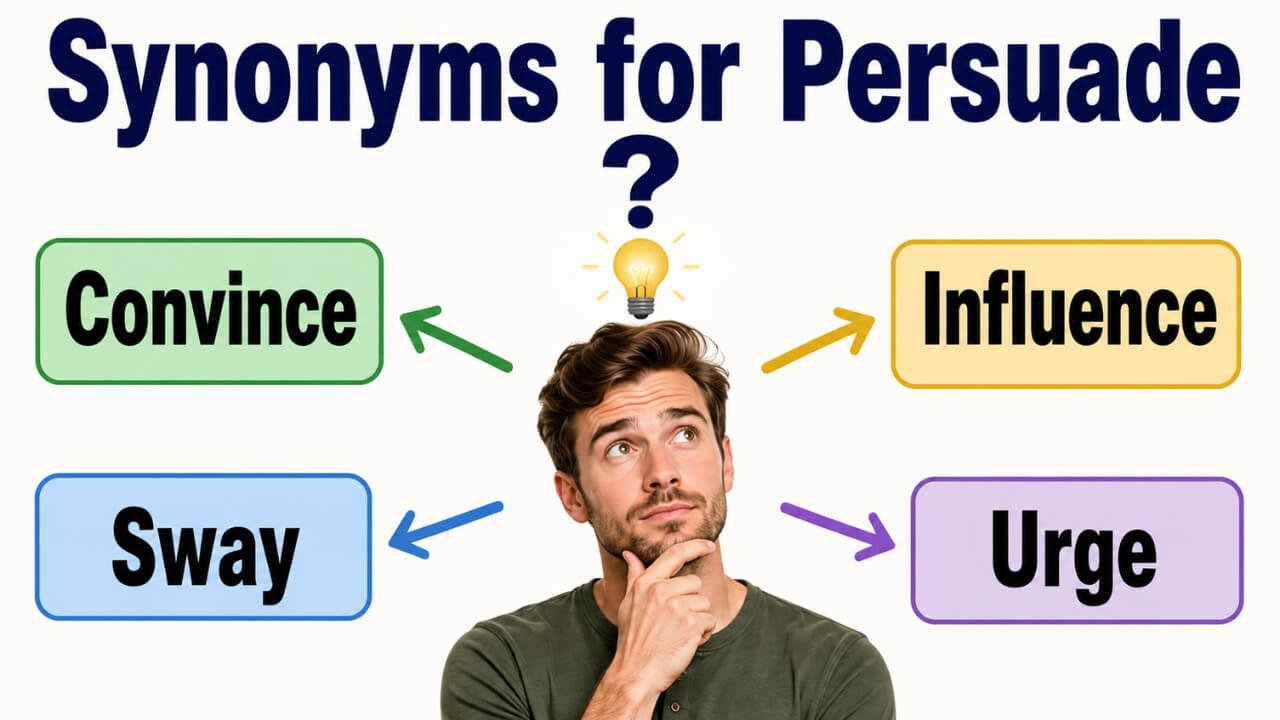
Quick Answer: Synonyms for persuade include convince, influence, sway, encourage, urge, induce, coax, win over, bring around, and prevail upon. Convince is best when changing someone’s belief through evidence or reasoning. Encourage suits supportive situations, while urge expresses strong advice. Coax suggests gentle and patient persuasion. Sway and influence describe changing an opinion, while induce is more formal and often refers to causing someone to act.
Pronunciation and Word Details
Word: Persuade.
Pronunciation: /pərˈsweɪd/
Part of Speech: Verb.
Meaning: To cause someone to believe something or take a particular action through reasoning, encouragement, or influence.
US Pronunciation:
UK Pronunciation:
What Does “Persuade” Mean?
Persuade means to cause someone to agree, believe, decide, or act by using reasons, arguments, encouragement, or emotional appeal. It is a verb commonly used when one person influences another person’s thoughts or behavior.
The word can describe changing an opinion.
Example: She persuaded the committee that the proposal was practical.
It can also describe encouraging someone to take an action.
Example: His friends persuaded him to apply for the position.
Persuade often suggests that the person had a choice. The decision usually results from discussion, evidence, reassurance, or influence rather than direct force.
The word works in formal writing, everyday conversation, business communication, academic discussion, advertising, negotiation, leadership, and personal relationships.
Meaning, Tone, and Context of “Persuade”
Persuade has a mostly neutral tone. It can sound positive, polite, logical, emotional, or slightly forceful depending on the situation.
In formal writing, persuade often describes the use of arguments, evidence, and reasoning.
Example: The researcher attempted to persuade readers with reliable evidence.
In casual conversation, it commonly means talking someone into doing something.
Example: We persuaded her to come with us.
In emotional contexts, persuasion may involve personal stories, promises, reassurance, or appeals to feelings.
Example: His sincere apology persuaded her to give him another chance.
In professional contexts, persuade can describe influencing customers, voters, employees, managers, investors, or decision makers. However, the word does not necessarily imply dishonesty or manipulation. Ethical persuasion presents honest reasons while allowing the other person to decide freely.
When and How to Use “Persuade”
For Changing an Opinion
Use persuade when someone changes another person’s opinion through explanations, facts, or arguments.
Example: The lawyer persuaded the jury to reconsider the evidence.
For Encouraging an Action
Use persuade when someone successfully encourages another person to do something.
Example: Her parents persuaded her to continue her education.
For Gaining Agreement
Persuade can describe helping people accept a proposal, idea, or plan.
Example: The manager persuaded the team to support the new schedule.
For Emotional Appeal
Use persuade when feelings, personal experiences, or emotional language influence a decision.
Example: His personal story persuaded several people to contribute.
For Formal Arguments
Persuade is useful in essays, reports, speeches, proposals, and debates that aim to influence readers.
Example: The essay attempts to persuade readers that public spaces should be protected.
For Reassurance
Persuasion can involve reducing someone’s doubts or fears.
Example: The doctor persuaded the patient that the procedure was safe.
Best Synonyms for Persuade
Convince
Synonym: Convince means to cause someone to believe that something is true or correct.
Example: The evidence convinced her that the plan could succeed.
Influence
Synonym: Influence means to affect someone’s thoughts, decisions, or behavior.
Example: Her mentor influenced her decision to study science.
Sway
Synonym: Sway means to change someone’s opinion or decision.
Example: The final presentation swayed several undecided members.
Induce
Synonym: Induce means to cause or persuade someone to take an action, often in formal contexts.
Example: The offer induced several employees to remain with the company.
Encourage
Synonym: Encourage means to give someone confidence, support, or a reason to act.
Example: Her teacher encouraged her to enter the competition.
Urge
Synonym: Urge means to strongly advise or persuade someone to act.
Example: Officials urged residents to prepare for the storm.
Coax
Synonym: Coax means to persuade someone gently and patiently.
Example: She coaxed the nervous child into joining the activity.
Win Over
Synonym: Win over means to gain someone’s approval, trust, or support.
Example: His honest approach won over the skeptical audience.
Bring Around
Synonym: Bring around means to gradually persuade someone to accept an opinion or plan.
Example: After several discussions, we brought him around to our point of view.
Prevail Upon
Synonym: Prevail upon means to persuade someone after making a serious or repeated request.
Example: They prevailed upon the director to reconsider the decision.
50 Synonyms for Persuade with Short Meanings
- Convince: Cause someone to believe or agree.
- Influence: Affect someone’s thoughts or behavior.
- Sway: Change someone’s opinion or decision.
- Induce: Cause someone to take a particular action.
- Encourage: Give support or confidence to act.
- Urge: Strongly advise someone to do something.
- Coax: Persuade gently through patience or kindness.
- Cajole: Persuade through praise, friendliness, or repeated requests.
- Entice: Attract someone by offering something appealing.
- Motivate: Give someone a reason or desire to act.
- Prompt: Cause or encourage someone to respond or act.
- Inspire: Fill someone with enthusiasm or determination.
- Move: Affect someone emotionally enough to create action.
- Win Over: Gain someone’s approval or support.
- Bring Around: Gradually change someone’s opinion.
- Talk Into: Persuade someone through conversation.
- Reason With: Use logic to influence someone.
- Prevail Upon: Persuade through serious or repeated requests.
- Appeal To: Request support by addressing feelings or values.
- Plead With: Make an emotional or urgent request.
- Press: Urge someone firmly to act.
- Pressure: Apply strong influence to obtain agreement.
- Push: Strongly encourage someone toward a decision.
- Compel: Make someone act through powerful pressure or necessity.
- Recruit: Persuade someone to join a group or cause.
- Enlist: Gain someone’s help, support, or participation.
- Rally: Bring people together in support of a cause.
- Convert: Cause someone to adopt a new belief or position.
- Charm: Gain agreement through personal appeal.
- Woo: Seek someone’s support or approval through attention.
- Tempt: Attract someone toward an action through desire.
- Lure: Draw someone toward something appealing.
- Sell: Make an idea appear attractive or valuable.
- Pitch: Present an idea in a persuasive way.
- Advocate: Publicly support an idea or course of action.
- Lobby: Attempt to influence an official decision.
- Argue: Present reasons in support of a position.
- Reassure: Remove doubts or fears through comforting words.
- Assure: Tell someone confidently that something is true.
- Advise: Recommend a suitable action.
- Counsel: Give thoughtful guidance or advice.
- Recommend: Suggest something as beneficial or suitable.
- Propose: Present an idea for consideration.
- Suggest: Introduce a possible action or idea.
- Guide: Help someone reach a decision.
- Steer: Direct someone gently toward a choice.
- Exhort: Strongly encourage someone through serious language.
- Petition: Formally request action or support.
- Solicit: Ask for support, help, or agreement.
- Negotiate: Discuss terms to reach an acceptable agreement.
Read Also:
Synonyms for Hurt

Synonyms for Persuade by Context
When Persuade Means Changing a Belief
Convince, influence, sway, convert, and bring around are useful when someone changes another person’s belief or opinion.
Convince usually focuses on belief based on evidence.
Example: The facts convinced the students that the claim was inaccurate.
Sway emphasizes a change in opinion or decision.
Example: Her final argument swayed the committee.
Convert suggests a major change in belief, loyalty, or position.
Example: The discussion converted several critics into supporters.
When Persuade Means Encouraging an Action
Encourage, urge, motivate, prompt, inspire, and induce are suitable when someone is persuaded to do something.
Encourage has a positive and supportive tone.
Example: His coach encouraged him to keep practicing.
Urge communicates stronger advice or importance.
Example: The report urged leaders to act immediately.
Induce is more formal and often refers to an action caused by an offer, condition, or influence.
Example: The discount induced customers to purchase earlier.
When Persuade Means Using Gentle Influence
Coax, cajole, charm, woo, and entice describe persuasion through patience, friendliness, praise, or attraction.
Coax is gentle and patient.
Example: She coaxed the shy student into speaking.
Cajole often involves repeated friendliness or flattering words.
Example: They cajoled him into attending the celebration.
Charm suggests gaining approval through personality.
Example: The speaker charmed the audience into supporting the idea.
When Persuade Means Applying Strong Pressure
Press, pressure, push, compel, exhort, and prevail upon express stronger forms of influence.
Press means repeatedly urging someone.
Example: Reporters pressed the official to answer the question.
Pressure can suggest uncomfortable or unfair influence.
Example: He felt pressured into accepting the offer.
Compel is much stronger than persuade because it suggests force, authority, duty, or necessity.
Example: The emergency compelled them to leave immediately.
When Persuade Means Gaining Support
Win over, recruit, enlist, rally, lobby, advocate, and solicit are useful when seeking approval or participation.
Win over means gaining someone’s trust or support.
Example: Her practical ideas won over the local residents.
Recruit and enlist involve persuading people to join or help.
Example: The organizer recruited volunteers for the project.
Lobby is commonly used when attempting to influence public or official decisions.
Example: Local groups lobbied officials to preserve the park.
Another Word for Persuade
Convince is often the best single replacement for persuade. However, the correct alternative depends on whether the sentence focuses on belief, action, emotion, support, or pressure.
Persuade usually emphasizes getting someone to do something, while convince often emphasizes getting someone to believe something.
Original: She persuaded him to accept the position.
Better Option: She encouraged him to accept the position.
Original: The evidence persuaded the panel that the claim was true.
Better Option: The evidence convinced the panel that the claim was true.
Original: His emotional speech persuaded the audience.
Better Option: His emotional speech moved the audience.
Original: Several discussions persuaded the members to support the plan.
Better Option: Several discussions won the members over to the plan.
When Not to Use “Persuade”
Do not use persuade when another word expresses the exact type or strength of influence more clearly.
Persuade may sound too general when the sentence specifically involves proof.
Weak: The scientific results persuaded the researchers that the theory was correct.
Better: The scientific results convinced the researchers that the theory was correct.
Avoid persuade when the person is simply offering support rather than attempting to change a decision.
Weak: Her teacher persuaded her to believe in her abilities.
Better: Her teacher encouraged her to believe in her abilities.
Do not use persuade when someone has no real choice. Compel, force, or require may be more accurate.
Weak: The law persuaded businesses to follow the safety rules.
Better: The law required businesses to follow the safety rules.
Avoid repeating persuade several times in the same paragraph.
Weak: She persuaded the team, persuaded the manager, and persuaded the clients to accept the plan.
Better: She convinced the team, won over the manager, and encouraged the clients to accept the plan.
Do not use strongly emotional synonyms in neutral or academic writing unless the context supports them.
Weak: The data cajoled experts into accepting the conclusion.
Better: The data convinced experts to accept the conclusion.
Words Commonly Confused With Persuade
Persuade vs Convince: Persuade traditionally focuses on causing someone to act, while convince focuses on causing someone to believe. In modern usage, convince is also commonly used before an action.
Example With Persuade: She persuaded him to apologize.
Example With Convince: She convinced him that an apology was necessary.
Persuade vs Encourage: Persuade aims to change a decision, while encourage provides confidence or support. Encouragement may not involve disagreement.
Example With Persuade: We persuaded her to join the group.
Example With Encourage: We encouraged her during the difficult project.
Persuade vs Influence: Persuade usually describes a deliberate attempt, while influence can happen indirectly or without conscious effort.
Example With Persuade: The speaker persuaded the audience to vote.
Example With Influence: Her childhood experiences influenced her career choice.
Persuade vs Compel: Persuade allows choice, while compel suggests force, authority, necessity, or intense pressure.
Example With Persuade: They persuaded him to cooperate.
Example With Compel: The court order compelled him to cooperate.
Persuade vs Advise: Persuade aims to produce agreement or action, while advise means offering guidance. Advice may be rejected without further effort.
Example With Persuade: She persuaded him to change his plans.
Example With Advise: She advised him to change his plans.
Persuade vs Manipulate: Persuade can involve honest reasoning, while manipulate often suggests hidden, unfair, or deceptive control.
Example With Persuade: The counselor persuaded him by explaining the benefits.
Example With Manipulate: The dishonest seller manipulated customers by hiding important information.
Which Synonym Should You Choose?
Choose convince when evidence, facts, or logical reasoning changes someone’s belief.
Choose influence when describing a broad or indirect effect on thoughts, choices, or behavior.
Choose sway when someone changes an opinion, vote, or decision.
Choose encourage when the tone should be supportive, positive, and gentle.
Choose urge when the advice is strong, serious, or time sensitive.
Choose coax when persuasion requires patience, kindness, or gentle repetition.
Choose induce in formal reports, academic discussions, medical contexts, or descriptions of cause and effect.
Choose win over when gaining trust, approval, or support from a doubtful person or group.
Choose bring around when someone gradually accepts an idea after discussion.
Choose motivate when creating enthusiasm, ambition, or willingness to act.
Choose compel when the action results from force, obligation, necessity, or powerful pressure rather than free persuasion.
Choose lobby when describing organized attempts to influence officials or decision makers.
Choose pitch when presenting an idea, service, proposal, or project persuasively.
Choose reassure when the main purpose is removing fear or uncertainty.
Choose advise in emails and professional communication when you are offering guidance rather than actively seeking agreement.
Real Life Examples of “Persuade” in Sentences
Original: She persuaded her brother to attend the family dinner.
Better Option: She coaxed her brother into attending the family dinner.
Original: The evidence persuaded the investigators that the witness was truthful.
Better Option: The evidence convinced the investigators that the witness was truthful.
Original: The coach persuaded the players to continue despite the setback.
Better Option: The coach motivated the players to continue despite the setback.
Original: The speaker persuaded several undecided members to support the proposal.
Better Option: The speaker swayed several undecided members to support the proposal.
Original: We persuaded the director to reconsider our request.
Better Option: We prevailed upon the director to reconsider our request.
Original: Her calm explanation persuaded the child to try again.
Better Option: Her calm explanation encouraged the child to try again.
Original: The campaign persuaded many residents to volunteer.
Better Option: The campaign inspired many residents to volunteer.
Original: He persuaded the customer that the product would meet her needs.
Better Option: He assured the customer that the product would meet her needs.
Original: They persuaded several experts to join the research team.
Better Option: They recruited several experts for the research team.
Original: The personal account persuaded the audience to make a contribution.
Better Option: The personal account moved the audience to make a contribution.
Synonym Groups and Usage Differences
Logical Persuasion Group
Convince, reason with, argue, assure, and demonstrate are useful when persuasion depends on logic, facts, or explanations.
Convince is the strongest general choice when a person accepts a belief after seeing evidence.
Example: The detailed report convinced the board that additional funding was necessary.
Reason with suggests a direct discussion intended to help someone think calmly.
Example: She tried to reason with him before he made a final decision.
Supportive Persuasion Group
Encourage, motivate, inspire, guide, and counsel have a positive and supportive tone.
These words are suitable when someone needs confidence, direction, or emotional support rather than pressure.
Example: Her mentor encouraged her to present her ideas confidently.
Motivate emphasizes creating desire or determination.
Example: The reward motivated employees to improve their performance.
Gentle Persuasion Group
Coax, cajole, charm, woo, and entice describe softer methods of persuasion.
Coax is patient and gentle, while cajole may involve praise or repeated friendly requests. Entice focuses on attraction or reward.
Example: He coaxed the hesitant puppy out from beneath the table.
Example: The special offer enticed customers to visit the store.
Strong Influence Group
Urge, press, pressure, push, exhort, and compel communicate greater intensity.
Urge is strong but can remain respectful. Pressure often suggests discomfort. Compel suggests limited choice.
Example: Doctors urged patients to seek early treatment.
Example: Financial difficulties compelled the family to move.
Support and Agreement Group
Win over, bring around, rally, recruit, enlist, and convert focus on gaining agreement, loyalty, participation, or support.
Win over is useful when people are initially doubtful.
Example: Her clear answers won over the skeptical listeners.
Rally is suitable when gathering people behind a shared cause.
Example: The leader rallied the community around the restoration project.
Antonyms of Persuade
The opposite of persuade depends on whether the sentence refers to belief, action, encouragement, or support.
Dissuade: Convince someone not to take a particular action.
Discourage: Reduce someone’s confidence or desire to act.
Deter: Prevent an action by creating doubt, fear, or difficulty.
Prevent: Stop something from happening.
Resist: Refuse to accept influence or pressure.
Oppose: Act or speak against an idea or proposal.
Reject: Refuse to accept an offer, belief, or suggestion.
Repel: Cause someone to feel dislike or avoidance.
Hinder: Make an action or decision more difficult.
Warn: Inform someone about danger in order to prevent action.
Restrain: Hold someone back from acting.
Disapprove: Express an unfavorable opinion.
Persuade: Encourages someone toward agreement or action.
Dissuade: Encourages someone away from an action.
Example: Her friends persuaded her to apply, but her doubts almost dissuaded her.
Comparison: Persuade vs Related Words
Persuade vs Convince
Persuade commonly focuses on action, while convince commonly focuses on belief. Both words can involve reasoning, evidence, or discussion.
Example With Persuade: She persuaded the manager to approve the request.
Example With Convince: She convinced the manager that the request was reasonable.
Persuade vs Influence
Persuade is usually intentional and direct. Influence can be indirect, gradual, or unconscious.
Example With Persuade: His colleague persuaded him to accept the offer.
Example With Influence: His family influenced his career interests.
Persuade vs Encourage
Persuade aims to change a choice or produce an action. Encourage gives support, courage, or confidence.
Example With Persuade: They persuaded her to speak at the event.
Example With Encourage: They encouraged her before she gave the speech.
Persuade vs Coax
Persuade is a broad term that can involve logic or emotion. Coax specifically suggests gentle, patient, or friendly persuasion.
Example With Persuade: We persuaded him to share his concerns.
Example With Coax: We coaxed him into sharing his concerns.
Persuade vs Compel
Persuade respects choice, while compel suggests that force, duty, authority, or necessity leaves little choice.
Example With Persuade: The teacher persuaded the student to revise the assignment.
Example With Compel: The school rules compelled the student to revise the assignment.
Persuade vs Manipulate
Persuasion can be open, respectful, and honest. Manipulation normally involves secretive, misleading, or unfair methods.
Example With Persuade: She persuaded the group by answering every question honestly.
Example With Manipulate: He manipulated the group by withholding essential details.
Common Phrases and Expressions With Persuade
Persuade Someone to Act: Cause a person to take a particular action.
Example: She persuaded him to seek professional advice.
Persuade Someone That Something Is True: Cause a person to accept a belief or claim.
Example: The evidence persuaded us that the account was accurate.
Try to Persuade: Make an effort to gain agreement.
Example: I tried to persuade them to consider another solution.
Difficult to Persuade: Unwilling to change an opinion or decision.
Example: The committee was difficult to persuade.
Easily Persuaded: Quick to accept another person’s suggestion.
Example: He is easily persuaded by confident speakers.
Fail to Persuade: Be unsuccessful in gaining agreement.
Example: The lawyer failed to persuade the judge.
Persuade Through Reason: Gain agreement by using logic and evidence.
Example: She persuaded the audience through reason rather than emotion.
Persuade Into Doing Something: Convince someone to take an action.
Example: His friends persuaded him into entering the competition.
Persuade Out of Doing Something: Convince someone not to take an action.
Example: We persuaded her out of making a rushed decision.
Persuade Against an Idea: Cause someone to reject a proposed action or belief.
Example: The financial report persuaded them against immediate expansion.
Common Mistakes to Avoid
One common mistake is using persuade and convince as though they always have identical meanings. Persuade often relates to action, while convince often relates to belief.
Incorrect: She persuaded me that the answer was correct.
Clearer: She convinced me that the answer was correct.
Another mistake is using the wrong sentence structure. Persuade is commonly followed by a person and an infinitive.
Correct: She persuaded him to attend.
It can also be followed by a person and a clause beginning with that.
Correct: She persuaded him that attending was worthwhile.
Avoid placing persuade directly before an action without naming the person being influenced.
Unnatural: The speech persuaded to support the proposal.
Better: The speech persuaded several members to support the proposal.
Do not use persuasion words when the action was forced.
Unclear: The rule persuaded everyone to comply.
Better: The rule required everyone to comply.
Avoid choosing an emotional synonym in an objective context.
Unnatural: The statistics charmed the researchers into accepting the result.
Better: The statistics convinced the researchers to accept the result.
Do not repeat persuade excessively. Use specific alternatives that reveal how the influence occurred.
Repetitive: She persuaded the staff, persuaded the manager, and persuaded the clients.
Improved: She encouraged the staff, convinced the manager, and won over the clients.
Be careful with talk into and persuade into. Talk into is conversational, while persuade is suitable for both formal and informal writing.
Casual: They talked me into joining the trip.
Formal: They persuaded me to participate in the trip.
Conclusion
Synonyms for persuade help writers describe different forms of influence more accurately. Convince works best for beliefs supported by evidence, while encourage and motivate suit positive support. Use urge for strong advice, coax for gentle persuasion, sway for changing an opinion, and win over for gaining approval. Induce is useful in formal contexts, while compel should be reserved for situations involving necessity or force. Choosing the right synonym makes your meaning clearer and shows whether the persuasion was logical, emotional, supportive, gradual, or forceful.
FAQs About Synonyms for Persuade
What Is the Best Synonym for Persuade?
Convince is the most common general synonym. However, encourage, influence, sway, urge, and coax may be more accurate in specific contexts.
What Is a Formal Synonym for Persuade?
Induce is a formal synonym when referring to causing an action. Prevail upon is also formal and describes persuasion through serious or repeated requests.
What Is a Gentle Synonym for Persuade?
Coax is the best gentle synonym. It suggests persuading someone patiently through kindness, reassurance, or friendly encouragement.
What Is a Stronger Word Than Persuade?
Compel is stronger because it suggests force, obligation, or necessity. Pressure and press also communicate stronger influence than persuade.
Are Persuade and Convince the Same?
They are closely related but not always identical. Persuade often focuses on causing action, while convince usually focuses on changing belief.
What Is the Opposite of Persuade?
Dissuade is the clearest opposite. It means convincing someone not to take a particular action.
Can Persuade Have a Negative Meaning?
Yes. Persuade can sound negative when it involves pressure, dishonesty, or selfish influence. The surrounding context determines whether the persuasion is helpful, neutral, or harmful.
