
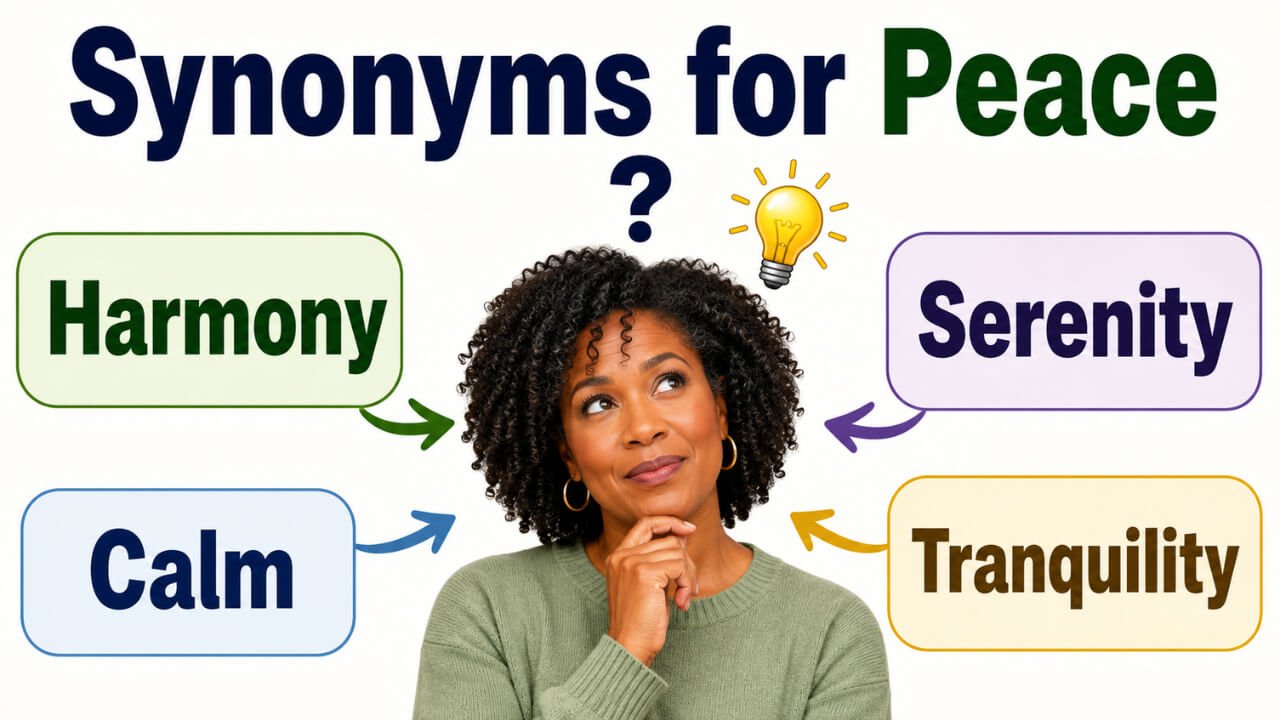
Quick Answer: The best synonyms for peace include calm, tranquility, serenity, harmony, quiet, stillness, unity, concord, order, and peacefulness. Use calm for a relaxed state, tranquility for a quiet and gentle mood, serenity for deep inner peace, harmony for good relationships, concord for formal agreement, and order when peace means social stability or the absence of conflict.
Pronunciation and Word Details
Word: Peace
Pronunciation: /piːs/
Part of Speech: Noun
Meaning: A state of calm, safety, harmony, or freedom from conflict.
US Pronunciation:
UK Pronunciation:
What Does “Peace” Mean?
Peace means a state without conflict, noise, fear, stress, or disturbance. It is a noun used to describe calm feelings, quiet places, friendly relationships, stable communities, and the absence of war or violence.
The word can describe inner feelings, such as peace of mind. It can also describe social conditions, such as peace between groups, families, or nations. In writing, peace often connects with calmness, harmony, safety, order, agreement, rest, and emotional balance.
Meaning, Tone, and Context of “Peace”
Peace is a positive, gentle, and meaningful word. It can sound emotional, spiritual, formal, political, personal, or conversational, depending on the context.
In personal writing, peace often means calmness, comfort, healing, and freedom from worry. In relationships, it means harmony, agreement, and the end of tension. In political or historical writing, it means the absence of war, violence, or public disorder.
The tone of peace is usually warm and respectful. It works well in essays, speeches, prayers, messages, personal reflections, formal reports, and everyday conversation.
When and How to Use “Peace”
For Inner Calm: Use peace when describing emotional balance, comfort, or freedom from stress.
Example: She found peace after taking time to rest and reflect.
For Quiet Places: Use peace when describing a calm environment without noise or disturbance.
Example: The garden gave him a sense of peace after a busy day.
For Relationships: Use peace when people stop arguing or choose understanding.
Example: The family worked hard to restore peace at home.
For Social Stability: Use peace when a place is safe, orderly, and free from violence.
Example: The community wanted peace after weeks of tension.
For Formal Agreement: Use peace when groups, leaders, or nations end conflict.
Example: Both sides signed an agreement to support peace.
For Comfort and Rest: Use peace when someone feels settled, safe, or emotionally relieved.
Example: A kind word brought peace to her heart.
Best Synonyms for Peace
Calm: A relaxed state without stress, noise, or strong emotion.
Example: His calm helped everyone feel safer during the difficult moment.
Tranquility: A quiet, gentle, and deeply peaceful state.
Example: The lake was full of tranquility in the early morning.
Serenity: A deep and graceful feeling of inner peace.
Example: Her face showed serenity after the prayer.
Harmony: A state of agreement, balance, and friendly connection.
Example: The team worked in harmony to complete the task.
Quiet: A state with little or no noise.
Example: She enjoyed the quiet of the empty room.
Stillness: Complete calm without movement or disturbance.
Example: The stillness of the forest made him feel relaxed.
Unity: A state of togetherness and shared purpose.
Example: The event brought unity to the whole neighborhood.
Concord: Formal agreement, harmony, or peaceful relations.
Example: The leaders spoke about concord between the two communities.
Order: A stable condition without chaos, violence, or disorder.
Example: The new rules helped restore order in the town.
Peacefulness: The quality of being calm, quiet, and free from conflict.
Example: The peacefulness of the village attracted many visitors.
50 Synonyms for Peace with Short Meanings
- Calm: A relaxed state without stress or disturbance.
- Tranquility: Deep quietness and gentle calm.
- Serenity: Inner calm and graceful emotional balance.
- Harmony: Agreement, balance, and friendly connection.
- Quiet: A state with little or no noise.
- Stillness: Calm without movement or disturbance.
- Peacefulness: The quality of being calm and undisturbed.
- Rest: A state of relief, comfort, or relaxation.
- Repose: A calm and restful state.
- Ease: Freedom from worry, pressure, or difficulty.
- Comfort: A feeling of safety, relief, and calm.
- Contentment: Quiet satisfaction and emotional peace.
- Balance: A steady and controlled state.
- Composure: Calm control of feelings.
- Equanimity: Mental calm during difficulty.
- Quietude: A peaceful and quiet condition.
- Placidity: Gentle calmness without disturbance.
- Hush: A quiet and peaceful silence.
- Silence: Complete absence of noise.
- Relaxation: Freedom from tension or pressure.
- Relief: A calmer feeling after worry ends.
- Security: A state of safety and protection.
- Safety: Freedom from danger or harm.
- Order: Stability without chaos or disorder.
- Stability: A steady and secure condition.
- Concord: Formal peace and agreement.
- Accord: Agreement between people or groups.
- Agreement: Shared understanding or accepted terms.
- Unity: Togetherness and shared purpose.
- Friendship: A warm and peaceful relationship.
- Amity: Friendly and peaceful relations.
- Goodwill: Kindness and friendly intention.
- Reconciliation: The return of friendly relations after conflict.
- Settlement: An agreement that ends a disagreement.
- Resolution: The solving of a conflict or problem.
- Truce: A temporary stop to fighting or conflict.
- Ceasefire: An agreement to stop fighting.
- Nonviolence: The choice to avoid violence.
- Coexistence: Living together without conflict.
- Understanding: Shared awareness that reduces tension.
- Cooperation: Working together peacefully.
- Friendliness: Kind and pleasant behavior.
- Gentleness: A soft and calm manner.
- Patience: Calm acceptance without anger.
- Hopefulness: A positive state that supports peace.
- Healing: Recovery from pain, conflict, or stress.
- Restfulness: A soothing and relaxed quality.
- Solace: Comfort during sadness or distress.
- Assurance: Confidence that brings calm.
- Wholeness: A complete and balanced state.
Read Also:
Synonyms For Successful

Synonyms for Peace by Context
When Peace Means Inner Calm
Use these words when peace describes a calm mind, emotional balance, or freedom from worry.
Serenity: She felt serenity after spending time alone.
Calm: His calm returned once he understood the situation.
Composure: She kept her composure during the difficult conversation.
Contentment: He lived with contentment because he valued simple things.
When Peace Means Quiet and Stillness
Use these words when peace describes a silent, gentle, or undisturbed place.
Quiet: The quiet of the room helped her focus.
Stillness: The stillness before sunrise felt refreshing.
Tranquility: The valley was known for its natural tranquility.
Quietude: He enjoyed the quietude of the countryside.
When Peace Means Harmony Between People
Use these words when peace describes friendly relations, agreement, or reduced tension.
Harmony: The neighbors lived in harmony for many years.
Unity: The project created unity among the volunteers.
Goodwill: The apology helped build goodwill between them.
Reconciliation: Their reconciliation brought peace back to the family.
When Peace Means No War or Violence
Use these words when peace describes safety, political stability, or the end of conflict.
Order: The city slowly returned to order after the unrest.
Stability: The agreement helped bring stability to the region.
Ceasefire: The ceasefire gave families a chance to return home.
Nonviolence: The movement supported nonviolence and justice.
When Peace Means Rest and Comfort
Use these words when peace describes relief, healing, or emotional comfort.
Rest: The quiet evening gave her rest after a painful week.
Relief: He felt relief when the argument finally ended.
Solace: The kind letter gave him solace.
Comfort: Her words brought comfort and peace.
Another Word for Peace
Another word for peace is calm when describing a relaxed state without stress or disturbance. However, the best alternative depends on context. Use serenity for deep inner calm, harmony for relationships, tranquility for quiet places, and stability for social or political peace.
Original: She wanted peace after a stressful week.
Better Option: She wanted calm after a stressful week.
Original: The room was full of peace.
Better Option: The room was full of tranquility.
Original: They worked together in peace.
Better Option: They worked together in harmony.
Original: The agreement helped bring peace to the area.
Better Option: The agreement helped bring stability to the area.
When Not to Use “Peace”
Do not use peace when a more specific word gives clearer meaning. The word can sound broad if the sentence does not explain whether you mean quiet, agreement, safety, emotional calm, or the absence of conflict.
Weak: The meeting ended in peace.
Better: The meeting ended in agreement after a respectful discussion.
Weak: I need peace.
Better: I need quiet so I can rest and think clearly.
Weak: The country wanted peace.
Better: The country wanted stability and freedom from violence.
Weak: She looked full of peace.
Better: She looked calm and composed.
Avoid using peace repeatedly in the same paragraph. Choose calm, serenity, harmony, quiet, stability, or reconciliation when they explain the meaning more clearly.
Words Commonly Confused With Peace
Peace vs Calm: Peace can mean inner comfort, social harmony, or freedom from conflict. Calm usually means a relaxed state without stress or strong emotion.
Peace vs Quiet: Peace may include emotional or social harmony. Quiet mainly means little or no noise.
Peace vs Serenity: Peace is broad and common. Serenity means deep, graceful, and often emotional calm.
Peace vs Harmony: Peace can describe a person, place, or society. Harmony usually describes balance and agreement between people, ideas, or parts.
Peace vs Truce: Peace can be long lasting and complete. Truce means a temporary stop to fighting or conflict.
Peace vs Stability: Peace means freedom from conflict or disturbance. Stability means a steady and secure condition.
Which Synonym Should You Choose?
Choose calm when writing about stress, emotions, pressure, or a relaxed mood.
Choose tranquility when describing a quiet place, gentle atmosphere, or soothing environment.
Choose serenity when writing about deep inner peace, emotional balance, or graceful calm.
Choose harmony when writing about relationships, teamwork, families, communities, or balanced ideas.
Choose concord when writing in a formal style about agreement or peaceful relations.
Choose quiet when the main idea is silence or low noise.
Choose stillness when describing a place or moment without movement or disturbance.
Choose stability when writing about society, politics, safety, order, or public conditions.
Choose reconciliation when people repair a relationship after conflict.
Choose truce or ceasefire when writing about a temporary stop in fighting.
Real Life Examples of “Peace” in Sentences
Original: She finally found peace after a long period of worry.
Better Option: She finally found calm after a long period of worry.
Original: The lake gave us a feeling of peace.
Better Option: The lake gave us a feeling of tranquility.
Original: The family wanted peace after many arguments.
Better Option: The family wanted harmony after many arguments.
Original: The agreement brought peace to the region.
Better Option: The agreement brought stability to the region.
Original: He sat in peace beside the window.
Better Option: He sat in quiet beside the window.
Original: Her voice gave him peace.
Better Option: Her voice gave him comfort.
Original: The two groups chose peace instead of anger.
Better Option: The two groups chose reconciliation instead of anger.
Original: The village was known for its peace.
Better Option: The village was known for its peacefulness.
Original: She handled the news with peace.
Better Option: She handled the news with composure.
Original: The talks helped create peace between the neighbors.
Better Option: The talks helped create goodwill between the neighbors.
Synonym Groups and Usage Differences
Inner Calm Group
This group is best for emotions, mental balance, healing, and personal comfort.
Synonyms: Calm, serenity, composure, equanimity, contentment.
Example: She kept her composure during a difficult moment.
Quiet Place Group
This group describes peaceful places, soft atmospheres, and calm surroundings.
Synonyms: Tranquility, quiet, stillness, quietude, placidity.
Example: The stillness of the garden helped him relax.
Relationship Harmony Group
This group works well for families, teams, communities, and friendships.
Synonyms: Harmony, unity, goodwill, amity, friendship.
Example: Their goodwill helped the group move forward without bitterness.
Conflict Ending Group
This group describes the end of arguments, fighting, or disagreement.
Synonyms: Reconciliation, settlement, resolution, truce, ceasefire.
Example: The settlement ended months of disagreement.
Safety and Order Group
This group is useful when peace means protection, social safety, or public stability.
Synonyms: Stability, order, security, safety, coexistence.
Example: The neighborhood wanted order after days of confusion.
Comfort and Rest Group
This group describes relief from pain, sadness, pressure, or emotional weight.
Synonyms: Rest, relief, comfort, solace, healing.
Example: His message gave her solace during a hard time.
Antonyms of Peace
War: Armed conflict between groups or nations.
Conflict: Serious disagreement, struggle, or opposition.
Violence: Harmful force or aggressive action.
Unrest: Public disorder, tension, or instability.
Chaos: Complete confusion or lack of order.
Disorder: A condition without structure, calm, or control.
Disturbance: Something that interrupts calm or quiet.
Tension: Mental, emotional, or social strain.
Stress: Pressure that causes worry or discomfort.
Anxiety: Nervousness, fear, or worry.
Hostility: Unfriendly or aggressive feeling.
Agitation: A restless, upset, or disturbed state.
Comparison: Peace vs Related Words
Peace vs Calm
Peace can describe emotional comfort, social harmony, and freedom from conflict. Calm usually focuses on a relaxed state without strong emotion or stress.
Example With Peace: She wanted peace after weeks of family tension.
Example With Calm: She stayed calm during the tense conversation.
Peace vs Tranquility
Peace is a broad word for calm, harmony, or safety. Tranquility usually describes a quiet, gentle, and soothing atmosphere.
Example With Peace: The home felt full of peace.
Example With Tranquility: The mountain cabin offered complete tranquility.
Peace vs Serenity
Peace can be personal, social, or political. Serenity usually means deep inner calm and emotional grace.
Example With Peace: He found peace after forgiving himself.
Example With Serenity: Her serenity helped others feel safe.
Peace vs Harmony
Peace can mean no conflict. Harmony means people, ideas, or parts work together in a balanced way.
Example With Peace: The neighbors wanted peace after the dispute.
Example With Harmony: The neighbors lived in harmony after solving the issue.
Peace vs Quiet
Peace may include emotional calm or social agreement. Quiet only means low noise or silence.
Example With Peace: The prayer gave him peace.
Example With Quiet: The library was quiet in the afternoon.
Peace vs Truce
Peace can be lasting and complete. Truce is usually temporary and means conflict has paused.
Example With Peace: The treaty created peace between the two sides.
Example With Truce: The truce allowed both sides to stop fighting for a short time.
Peace vs Reconciliation
Peace describes a calm or conflict free state. Reconciliation describes the process of repairing a relationship after disagreement.
Example With Peace: The family wanted peace at home.
Example With Reconciliation: Their reconciliation helped the family heal.
Common Phrases and Expressions With Peace
Inner Peace: Calmness inside the mind and heart.
Peace of Mind: Freedom from worry, fear, or doubt.
Peace and Quiet: A calm place or time without noise.
World Peace: Peace among nations and people across the world.
Make Peace: End an argument or accept a difficult situation.
Keep the Peace: Prevent conflict or help people stay calm.
At Peace: Feeling calm, settled, or emotionally free.
Peace Treaty: A formal agreement that ends conflict.
Peace Offering: A kind act meant to reduce tension or repair a relationship.
Rest in Peace: A respectful phrase used for someone who has died.
Common Mistakes to Avoid
One common mistake is using peace when quiet is more accurate. If you only mean no noise, quiet is clearer.
Another mistake is using peace for every calm situation. In emotional writing, serenity or calm may sound more specific. In relationship writing, harmony or reconciliation may be better.
Writers also confuse peace with truce. A truce is usually temporary, while peace can suggest a fuller and more lasting condition.
Avoid vague sentences like I want peace when the reader needs more detail. You may mean rest, safety, silence, comfort, or freedom from conflict. Choose the word that matches your exact meaning.
Conclusion
The best synonyms for peace depend on the meaning you want to express. Use calm for emotional steadiness, tranquility for quiet places, serenity for deep inner peace, harmony for relationships, and stability for social order. Words like quiet, stillness, concord, reconciliation, comfort, and peacefulness help make your writing more precise. Instead of repeating peace, choose the synonym that fits the context, tone, and message of your sentence.
FAQs About Synonyms for Peace
What is the best synonym for peace?
The best synonym for peace is calm in everyday use. For deeper emotional meaning, serenity is often stronger.
What is another word for inner peace?
Another word for inner peace is serenity. You can also use calm, composure, contentment, or equanimity.
What is a formal synonym for peace?
Formal synonyms for peace include concord, accord, stability, reconciliation, and harmony.
What is a synonym for peace and quiet?
A good synonym for peace and quiet is tranquility. Other options include stillness, quietude, silence, and calm.
What is a synonym for peace between people?
A strong synonym for peace between people is harmony. You can also use unity, goodwill, reconciliation, or amity.
What is the opposite of peace?
The opposite of peace can be war, conflict, violence, unrest, chaos, tension, or hostility, depending on the sentence.
Can peace mean silence?
Yes, peace can mean silence in some contexts, but quiet or stillness is more accurate when the main idea is no noise.
