
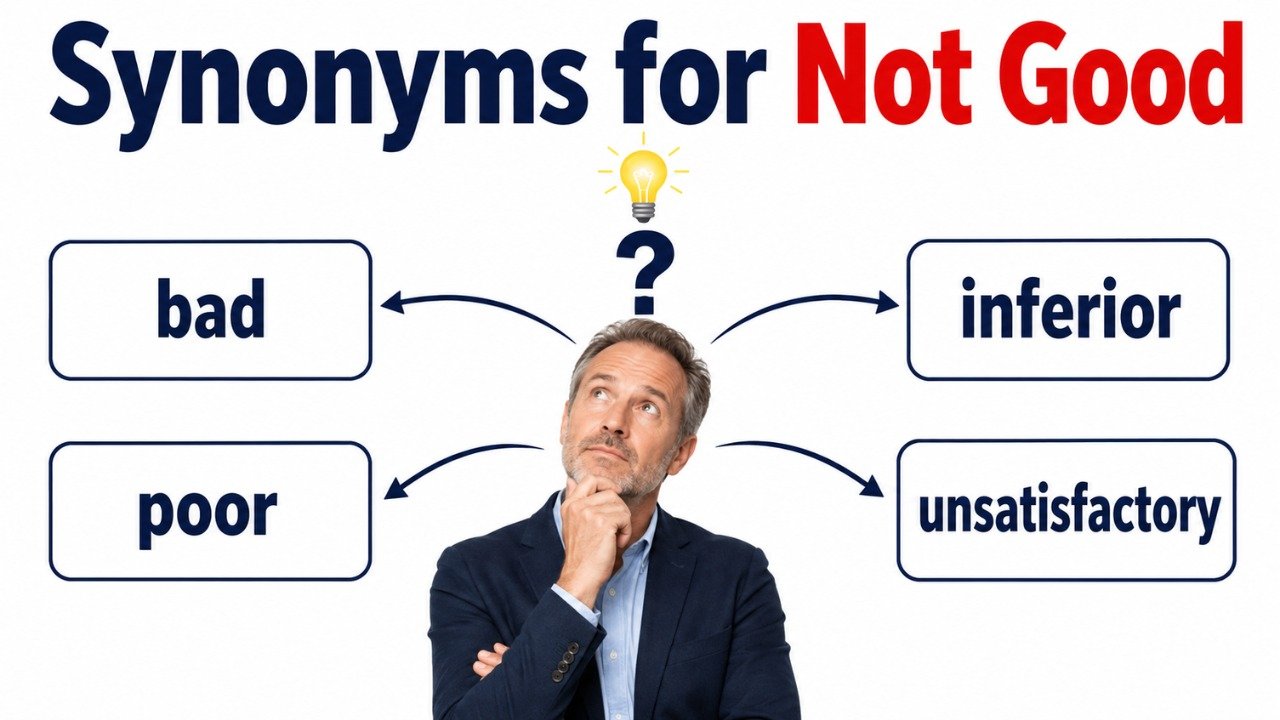
Quick Answer: Common synonyms for not good include bad, poor, inadequate, unsatisfactory, inferior, unacceptable, disappointing, ineffective, unpleasant, and flawed. The best replacement depends on context. Use poor for quality or performance, inadequate when something does not meet requirements, unsatisfactory in formal evaluations, unacceptable for standards or behavior, disappointing for unmet expectations, ineffective for results, unpleasant for experiences, and flawed when something contains weaknesses or defects.
Pronunciation and Word Details
Word: Not good
Pronunciation: /nɑːt ɡʊd/
Part of Speech: Adjective phrase
Meaning: Not satisfactory, desirable, effective, pleasant, skillful, or of acceptable quality.
US Pronunciation:
UK Pronunciation:
What Does “Not Good” Mean?
Not good means that something is below an expected level of quality, usefulness, effectiveness, correctness, desirability, or acceptability.
The phrase functions mainly as an adjective phrase. It can describe objects, situations, performances, experiences, decisions, behavior, results, health, conditions, or feelings.
In everyday conversation, not good is often a mild and flexible way to express criticism. Someone may say a meal was not good, a result was not good, or a decision was not good without specifying exactly what was wrong.
The meaning changes slightly according to context.
Quality: Not good can mean poor, inferior, or low quality.
Performance: It can mean weak, ineffective, or disappointing.
Behavior: It can mean inappropriate, unacceptable, or wrong.
Condition: It can mean unfavorable, unhealthy, or problematic.
Experience: It can mean unpleasant, disappointing, or unsatisfying.
Because not good is broad, a more specific synonym often makes writing clearer and stronger.
Meaning, Tone, and Context of “Not Good”
Not good is usually neutral to mildly negative. It is common in both casual speech and ordinary writing because it communicates dissatisfaction without always sounding harsh.
Conversational Tone: In everyday speech, not good is natural and easy to understand.
Polite Criticism: The phrase can soften criticism compared with stronger words such as terrible or dreadful.
Formal Writing: In reports, essays, evaluations, and professional communication, a more specific term such as inadequate, unsatisfactory, ineffective, or unacceptable is usually clearer.
Emotional Context: When disappointment is important, disappointing or discouraging may communicate the feeling more precisely.
Quality Context: Poor, inferior, substandard, or deficient can describe something that does not meet an expected level.
Performance Context: Weak, ineffective, unsuccessful, or underperforming may be more accurate.
The phrase is useful when the exact problem is obvious from context. When precision matters, choosing a stronger synonym improves clarity.
When and How to Use “Not Good”
For Poor Quality
Use not good when something fails to reach an expected standard but you do not need to describe the exact defect.
Example: The material is not good enough for long term use.
For Weak Performance
Use the phrase when someone or something performs below expectations.
Example: His performance during the presentation was not good.
For Unsatisfactory Results
Not good can describe results that fail to meet a goal.
Example: The final test results were not good.
For Unpleasant Experiences
Use it when an experience causes discomfort, dissatisfaction, or disappointment.
Example: Our experience at the event was not good.
For Questionable Decisions
The phrase can describe a choice that seems unwise or inappropriate.
Example: Ignoring the warning was not a good decision.
For Health or Condition
Not good may describe a condition that is concerning or unfavorable.
Example: The condition of the equipment is not good.
For Behavior
Use it to express mild criticism of conduct.
Example: Speaking to people that way is not good behavior.
For Informal Evaluation
The phrase works well when a simple judgment is enough.
Example: The first draft is not good, so it needs revision.
Best Synonyms for Not Good
Bad: Of poor quality, undesirable, harmful, or unacceptable.
Example: The weather created bad conditions for the event.
Poor: Below the expected level of quality, performance, or condition.
Example: The report received a poor evaluation.
Inadequate: Not sufficient or suitable for a particular need.
Example: The available evidence was inadequate to support the claim.
Unsatisfactory: Failing to meet expectations or required standards.
Example: The inspection produced unsatisfactory results.
Inferior: Lower in quality, value, or ability than something else.
Example: The cheaper material proved inferior in durability.
Unacceptable: Not meeting reasonable rules, expectations, or standards.
Example: The level of care was unacceptable.
Disappointing: Failing to meet hopes or expectations.
Example: The final outcome was disappointing.
Ineffective: Not producing the intended result.
Example: The original strategy was ineffective.
Unpleasant: Causing discomfort, dislike, or dissatisfaction.
Example: The conversation became unpleasant.
Flawed: Containing weaknesses, mistakes, or defects.
Example: The proposal was based on a flawed assumption.
50 Synonyms for Not Good with Short Meanings
- Bad: Poor, undesirable, or harmful.
- Poor: Below an expected standard.
- Inadequate: Not sufficient for a need.
- Unsatisfactory: Failing to meet expectations.
- Inferior: Lower in quality or value.
- Unacceptable: Not meeting required standards.
- Disappointing: Less successful than expected.
- Ineffective: Unable to produce the desired result.
- Unpleasant: Uncomfortable or disagreeable.
- Flawed: Containing errors or weaknesses.
- Weak: Lacking strength, quality, or effectiveness.
- Deficient: Lacking something necessary.
- Substandard: Below an accepted standard.
- Mediocre: Only average and not especially impressive.
- Faulty: Containing a defect or error.
- Defective: Not functioning as intended.
- Unfavorable: Not helpful, positive, or advantageous.
- Undesirable: Not wanted or preferred.
- Problematic: Creating difficulties or concerns.
- Troubling: Causing worry or concern.
- Disagreeable: Unpleasant or difficult to enjoy.
- Unappealing: Not attractive or inviting.
- Unimpressive: Failing to create a positive impression.
- Unconvincing: Failing to inspire belief or confidence.
- Unsuccessful: Not achieving the intended goal.
- Insufficient: Not enough for the purpose.
- Unsuitable: Not appropriate for a situation.
- Inappropriate: Not suitable or proper.
- Improper: Not correct or acceptable.
- Wrong: Incorrect, unsuitable, or morally unacceptable.
- Regrettable: Unfortunate and deserving regret.
- Unfortunate: Producing an undesirable result.
- Awful: Extremely unpleasant or poor.
- Terrible: Very bad in quality or experience.
- Dreadful: Extremely unpleasant or disappointing.
- Lousy: Very poor in casual language.
- Shoddy: Carelessly made or low in quality.
- Second rate: Lower than a desirable standard.
- Low quality: Made or performed below expectations.
- Poor quality: Lacking the desired standard.
- Below average: Worse than the typical level.
- Below standard: Failing to reach an expected requirement.
- Unreliable: Not consistently dependable.
- Unhelpful: Not useful or supportive.
- Unproductive: Not producing useful results.
- Unwise: Showing poor judgment.
- Harmful: Likely to cause damage or negative effects.
- Adverse: Unfavorable or damaging.
- Distressing: Causing worry, discomfort, or sadness.
- Dissatisfactory: Not providing sufficient satisfaction.
Read Also:
Synonyms for Accomplishments

Synonyms for Not Good by Context
When Not Good Means Poor Quality
When you are judging the quality of an object, service, product, piece of work, or material, poor is usually the simplest replacement.
Other useful choices include inferior, substandard, shoddy, defective, faulty, mediocre, and low quality.
Example: The construction quality was poor.
Example: The material was inferior to the original version.
Example: The workmanship appeared substandard.
When Not Good Means Insufficient
Sometimes not good means that something is not adequate for a particular requirement.
Useful synonyms include inadequate, insufficient, deficient, and unsuitable.
Example: The evidence was inadequate for a definite conclusion.
Example: The available resources were insufficient.
Example: The proposed location was unsuitable for the event.
When Not Good Means Unacceptable
For rules, behavior, performance standards, or professional expectations, unacceptable is often the strongest precise choice.
Other alternatives include inappropriate, improper, unsatisfactory, and wrong.
Example: His behavior during the meeting was unacceptable.
Example: The response was inappropriate for the situation.
Example: The final result was unsatisfactory.
When Not Good Means Ineffective
If something does not achieve its intended purpose, use ineffective rather than the vague phrase not good.
Related words include unsuccessful, weak, unproductive, and unhelpful.
Example: The original method was ineffective.
Example: The campaign proved unsuccessful.
Example: The advice was unhelpful.
When Not Good Means Disappointing
Use disappointing when something fails to meet your hopes or expectations.
Related alternatives include unimpressive, mediocre, unfortunate, and regrettable.
Example: The final performance was disappointing.
Example: The presentation was unimpressive.
Example: The outcome was unfortunate.
When Not Good Means Unpleasant
For experiences, feelings, situations, conversations, smells, tastes, or conditions, unpleasant often works better.
Other choices include disagreeable, awful, dreadful, distressing, and troubling.
Example: The journey became unpleasant because of the heat.
Example: The argument created a disagreeable atmosphere.
Example: The news was distressing.
When Not Good Means Harmful
If something may cause damage, risk, or negative consequences, harmful or adverse provides greater precision.
Example: Excessive moisture can be harmful to the material.
Example: The change had an adverse effect on performance.
Another Word for Not Good
A strong general replacement for not good is poor. It is concise, natural, and useful when discussing quality, performance, condition, or results.
However, the best alternative depends on what you actually want to communicate. Inadequate focuses on insufficiency, ineffective focuses on results, unacceptable focuses on standards, and disappointing focuses on expectations.
Original: The quality of the work was not good.
Better Option: The quality of the work was poor.
Original: The plan was not good for solving the problem.
Better Option: The plan was ineffective for solving the problem.
Original: Her explanation was not good enough.
Better Option: Her explanation was inadequate.
Original: The final result was not good.
Better Option: The final result was disappointing.
When Not to Use “Not Good”
Not good can become weak when the reader needs to know exactly what is wrong.
In detailed writing, replacing it with a precise adjective usually makes the message more informative.
When Describing Exact Quality
Weak: The material is not good.
Better: The material is inferior and wears quickly.
When Explaining Performance
Weak: The strategy was not good.
Better: The strategy was ineffective.
When Evaluating Formal Standards
Weak: The inspection result was not good.
Better: The inspection result was unsatisfactory.
When Describing Insufficient Resources
Weak: The available equipment was not good enough.
Better: The available equipment was inadequate.
When Describing Behavior
Weak: His behavior was not good.
Better: His behavior was inappropriate.
When Expressing Disappointment
Weak: The ending was not good.
Better: The ending was disappointing.
Not good is also less effective when it appears repeatedly in the same paragraph. Different synonyms can identify the exact problem while improving readability.
Words Commonly Confused With Not Good
Not Good vs Bad: Not good is often softer and less direct. Bad expresses a clearer negative judgment.
Not Good vs Poor: Poor commonly describes low quality, weak performance, or an unfavorable condition. It is usually more specific than not good.
Not Good vs Inadequate: Inadequate means insufficient for a particular requirement. Something can be generally acceptable but still inadequate for a specific purpose.
Not Good vs Unsatisfactory: Unsatisfactory means a requirement, expectation, or standard has not been met. It often sounds more formal.
Not Good vs Inferior: Inferior usually involves comparison. It suggests that something has lower quality or value than another option.
Not Good vs Ineffective: Ineffective focuses on failure to produce an intended result rather than general quality.
Not Good vs Unacceptable: Unacceptable is stronger. It suggests that something falls outside reasonable or permitted standards.
Not Good vs Disappointing: Disappointing describes the emotional effect of unmet expectations rather than necessarily proving that something is objectively poor.
Not Good vs Flawed: Flawed means something contains a weakness, mistake, or defect. A flawed idea may still contain some useful elements.
Which Synonym Should You Choose?
Choose poor when discussing low quality, weak performance, or unfavorable condition.
Choose bad when you need a simple and direct negative description in everyday conversation.
Choose inadequate when something does not provide enough quality, quantity, information, preparation, or support.
Choose unsatisfactory for evaluations, assessments, reports, inspections, results, or formal feedback.
Choose inferior when comparing something with a better option.
Choose unacceptable when discussing behavior, professional standards, requirements, or serious performance issues.
Choose disappointing when expectations were higher than the actual result.
Choose ineffective when a method, strategy, treatment, system, or action fails to achieve its purpose.
Choose unpleasant for experiences, situations, sensations, conversations, or environments.
Choose flawed when an argument, plan, process, design, or idea contains specific weaknesses.
Choose inappropriate for behavior, language, choices, clothing, timing, or actions that do not suit the situation.
Choose unfavorable in reports, analysis, evaluations, or formal discussion of conditions and results.
Real Life Examples of “Not Good” in Sentences
Original: The service at the event was not good.
Better Option: The service at the event was disappointing.
Original: His test result was not good.
Better Option: His test result was poor.
Original: The available explanation was not good enough.
Better Option: The available explanation was inadequate.
Original: This method is not good for solving the problem.
Better Option: This method is ineffective for solving the problem.
Original: The condition of the building is not good.
Better Option: The condition of the building is poor.
Original: Her behavior during the discussion was not good.
Better Option: Her behavior during the discussion was inappropriate.
Original: The final report was not good enough for approval.
Better Option: The final report was unsatisfactory for approval.
Original: The cheaper material is not as good as the original.
Better Option: The cheaper material is inferior to the original.
Original: The experience was not good for the visitors.
Better Option: The experience was unpleasant for the visitors.
Original: The proposed solution is not good because it contains several weaknesses.
Better Option: The proposed solution is flawed because it contains several weaknesses.
Synonym Groups and Usage Differences
Quality Group
Poor, inferior, mediocre, substandard, shoddy, defective, and faulty describe problems with quality.
Poor is broad, while inferior often involves comparison. Substandard means something falls below a recognized level. Shoddy suggests careless workmanship.
Example: The product received criticism for its poor quality.
Insufficiency Group
Inadequate, insufficient, deficient, and unsuitable describe something that does not meet a particular need.
Inadequate is useful when quality or quantity is not enough. Insufficient focuses more directly on quantity or amount.
Example: The available information was insufficient for a final decision.
Performance Group
Weak, ineffective, unsuccessful, unproductive, and unhelpful describe something that does not perform well.
Ineffective is especially useful when an action fails to create the intended result.
Example: The original approach was ineffective.
Standards Group
Unacceptable, unsatisfactory, inappropriate, improper, and wrong describe failures to meet standards, expectations, rules, or social norms.
Unacceptable is stronger than unsatisfactory.
Example: Repeatedly ignoring the safety instructions was unacceptable.
Disappointment Group
Disappointing, unimpressive, mediocre, regrettable, and unfortunate express dissatisfaction or unmet expectations.
Disappointing is especially useful when the result is worse than someone hoped.
Example: The final performance was disappointing.
Unpleasant Experience Group
Unpleasant, disagreeable, awful, terrible, dreadful, and distressing describe negative experiences or feelings.
Terrible and dreadful are much stronger than not good.
Example: The delay created an unpleasant experience for everyone.
Problem Group
Problematic, troubling, flawed, faulty, and defective indicate that something contains issues that may require correction.
Problematic is useful when the issue is complicated rather than completely bad.
Example: Several parts of the proposal remain problematic.
Antonyms of Not Good
The opposite of not good depends on whether you are discussing quality, performance, suitability, behavior, or results.
Good: Satisfactory, positive, or desirable.
Excellent: Extremely high in quality.
Effective: Successful in producing the intended result.
Adequate: Sufficient for a particular requirement.
Satisfactory: Meeting expectations or standards.
Acceptable: Suitable enough to be approved or permitted.
Superior: Higher in quality or value than another option.
Pleasant: Enjoyable or agreeable.
Successful: Achieving the intended result.
Appropriate: Suitable for the situation.
Favorable: Positive or advantageous.
Reliable: Consistently dependable.
Impressive: Creating admiration or a strong positive reaction.
Helpful: Providing useful assistance or benefit.
Desirable: Worth having, choosing, or experiencing.
Comparison: Not Good vs Related Words
Not Good vs Bad
Not good is often softer than bad. Speakers may choose not good when they want to criticize something without sounding overly harsh.
Example With Not Good: The first version was not good enough for publication.
Example With Bad: The first version contained several bad errors.
Not Good vs Poor
Poor is more concise and often more precise when discussing quality, performance, condition, or results.
Example With Not Good: His performance was not good.
Example With Poor: His performance was poor.
Not Good vs Inadequate
Not good expresses a general negative judgment. Inadequate specifically means that something does not meet a need or requirement.
Example With Not Good: The preparation was not good.
Example With Inadequate: The preparation was inadequate for such a difficult task.
Not Good vs Unsatisfactory
Unsatisfactory is more formal and indicates that expectations or standards have not been met.
Example With Not Good: The inspection results were not good.
Example With Unsatisfactory: The inspection results were unsatisfactory.
Not Good vs Ineffective
Ineffective specifically describes failure to produce the desired result.
Example With Not Good: The new method was not good.
Example With Ineffective: The new method was ineffective.
Not Good vs Disappointing
Disappointing focuses on expectations and emotional reaction.
Example With Not Good: The final performance was not good.
Example With Disappointing: The final performance was disappointing.
Not Good vs Unacceptable
Unacceptable expresses a stronger judgment and often relates to rules, conduct, requirements, or standards.
Example With Not Good: That behavior is not good.
Example With Unacceptable: That behavior is unacceptable.
Not Good vs Flawed
Flawed identifies particular weaknesses or defects without necessarily saying the entire thing is bad.
Example With Not Good: The argument is not good.
Example With Flawed: The argument is flawed because it relies on incomplete evidence.
Common Phrases and Expressions With Not Good
Not Good Enough: Failing to reach the necessary or desired standard.
Not Very Good: Somewhat poor or disappointing.
Not Looking Good: Appearing unlikely to produce a positive outcome.
Not Feeling Good: Feeling physically or emotionally unwell.
Not Good at Something: Lacking skill or ability in a particular activity.
Not Good for You: Potentially unhealthy, harmful, or unsuitable.
Not Good News: Information suggesting an unfavorable development.
Not a Good Idea: A choice that may lead to problems.
Not in Good Condition: Damaged, weak, worn, or poorly maintained.
Not as Good as Expected: Falling below previous hopes or expectations.
Common Mistakes to Avoid
One common mistake is using not good when a more precise word would communicate the problem more clearly.
Vague: The plan was not good.
Clearer: The plan was ineffective because it did not address the main problem.
Another mistake is choosing a synonym that is stronger than the situation requires. Terrible, dreadful, and awful express intense criticism, while poor or disappointing may be more appropriate for mild problems.
Avoid confusing inadequate with inferior. Inadequate means something is not sufficient for a particular purpose, while inferior means it is lower in quality than something else.
Do not use unacceptable when you simply mean disappointing. Unacceptable usually suggests a failure to meet an important standard.
Avoid repeating not good several times in a paragraph. Instead, identify whether the issue involves quality, effectiveness, suitability, behavior, or expectations.
Be careful with informal words such as lousy. They may sound natural in conversation but are usually unsuitable for academic, professional, or formal writing.
Also avoid replacing not good mechanically. The correct synonym must match the intended meaning of the sentence.
Conclusion
Synonyms for not good can make writing clearer by showing exactly why something is unsatisfactory. Use poor for low quality, inadequate for something insufficient, ineffective for weak results, unacceptable for failed standards, disappointing for unmet expectations, unpleasant for negative experiences, and flawed for specific weaknesses. Informal expressions such as not good work well in conversation, but precise alternatives are often stronger in reports, essays, evaluations, emails, and detailed descriptions. Choosing the right synonym helps readers understand both the problem and its seriousness.
FAQs About Synonyms for Not Good
What Is the Best Synonym for Not Good?
Poor is one of the best general synonyms because it can describe quality, performance, condition, or results. The most accurate choice still depends on context.
What Is a Formal Word for Not Good?
Unsatisfactory, inadequate, unacceptable, deficient, and substandard are useful formal alternatives. Choose the word that explains the specific problem.
What Is a Polite Way to Say Not Good?
Disappointing, less effective, unsatisfactory, or below expectations can communicate criticism without sounding unnecessarily harsh.
What Is a Stronger Word Than Not Good?
Bad, terrible, dreadful, unacceptable, or awful can express stronger criticism. Unacceptable is especially useful when rules or standards have been violated.
What Is Another Word for Not Good Quality?
Poor, inferior, substandard, shoddy, defective, and low quality are useful choices. Inferior works particularly well when making a comparison.
Can Inadequate Replace Not Good?
Yes, when something does not meet a specific requirement or provide enough support, information, quality, or resources. It should not replace not good in every context.
Is Not Good Grammatically Correct?
Yes. Not good is a grammatically correct adjective phrase. However, a more precise adjective such as poor, ineffective, inadequate, disappointing, or unacceptable may improve clarity in detailed writing.
