
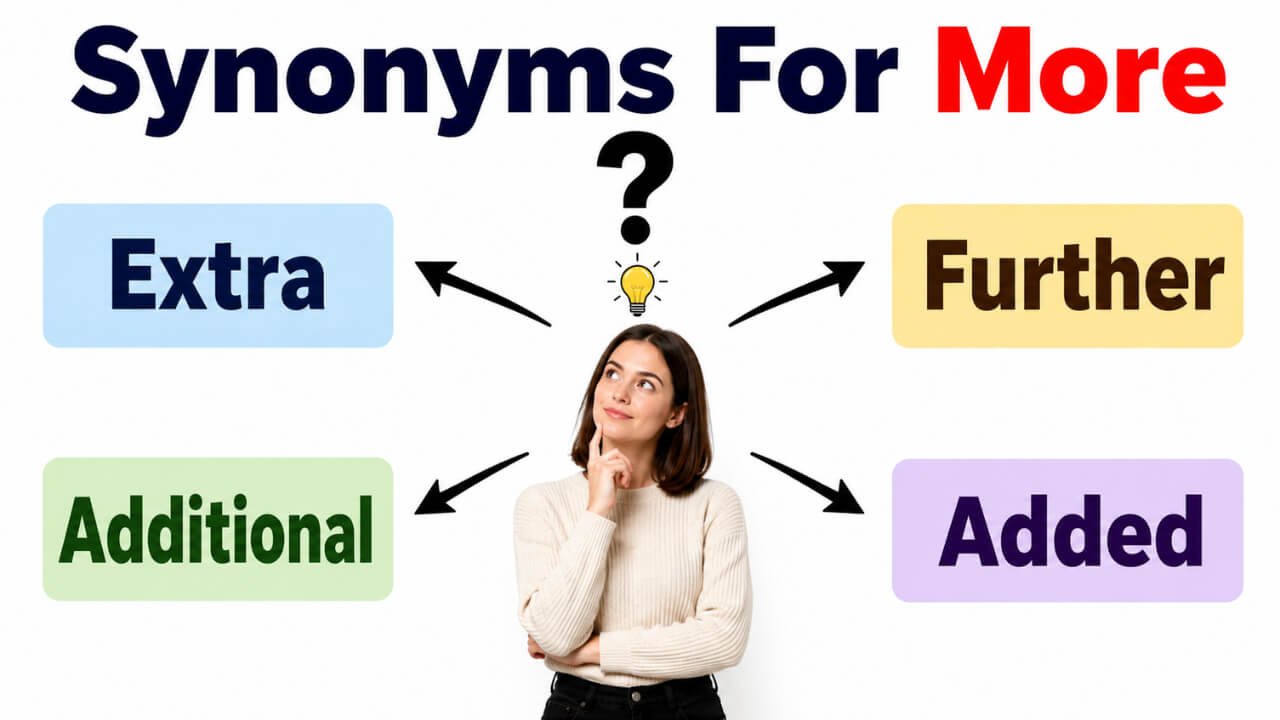
Quick Answer: The best synonyms for more include additional, extra, further, greater, increased, added, another, supplementary, higher, and larger. Use additional in formal writing, extra in casual speech, further for progress or discussion, greater for amount or degree, increased for data and reports, and another when referring to one more item, person, or example.
Pronunciation and Word Details
Word: More.
Pronunciation: /mɔːr/.
Part of Speech: Adjective, adverb, pronoun, and determiner.
Meaning: More means a greater amount, number, degree, or additional quantity of something.
US Pronunciation:
UK Pronunciation:
What Does “More” Mean?
More means a greater amount, number, degree, or extra quantity of something. It is a common English word used when comparing amounts, adding information, requesting extra items, or showing increase.
More can work as an adjective before a noun.
Example: We need more time.
It can work as an adverb before an adjective or adverb.
Example: She became more confident.
It can work as a pronoun when the noun is already understood.
Example: I want more.
It can also work as a determiner when it points to an added amount.
Example: More people joined the class.
Meaning, Tone, and Context of “More”
More is neutral, simple, and extremely common in everyday English. It is not too formal or too casual. It works in conversation, essays, emails, reports, instructions, comparisons, requests, and academic writing.
In casual speech, more sounds natural and direct.
Example: Can I have more water?
In formal writing, more is acceptable, but synonyms like additional, further, increased, greater, and supplementary can make the sentence more specific.
Example: The report requires additional evidence.
In comparisons, more often shows a higher degree.
Example: This method is more effective.
When and How to Use “More”
For Quantity: Use more when talking about a larger amount or number.
Example: We need more chairs for the guests.
For Comparison: Use more before many adjectives to compare degree or quality.
Example: This explanation is more useful than the first one.
For Addition: Use more when adding another item, idea, point, or example.
Example: I have one more question.
For Requests: Use more when asking for an extra amount.
Example: Could you give me more details?
For Emphasis: Use more when showing a stronger level of feeling, value, or importance.
Example: Her advice matters more than she realizes.
For Formal Writing: Use synonyms like additional, further, or increased when more sounds too basic.
Example: The study needs further analysis.
Best Synonyms for More
Additional: Added to what already exists.
Example: We need additional information before making a decision.
Extra: More than the usual amount.
Example: She brought extra snacks for the trip.
Further: More in amount, degree, progress, or discussion.
Example: The issue needs further review.
Greater: Larger in size, amount, degree, or importance.
Example: The project requires greater attention.
Increased: Made larger in amount, number, or level.
Example: The team reported increased demand.
Added: Included as something extra.
Example: The teacher gave added guidance before the test.
Another: One more person, thing, or example.
Example: I need another copy of the document.
Supplementary: Added to complete or improve something.
Example: The lesson includes supplementary exercises.
Higher: Greater in level, number, amount, or rank.
Example: The new plan has higher costs.
Larger: Bigger in size, number, amount, or scale.
Example: They moved to a larger office.
50 Synonyms for More with Short Meanings
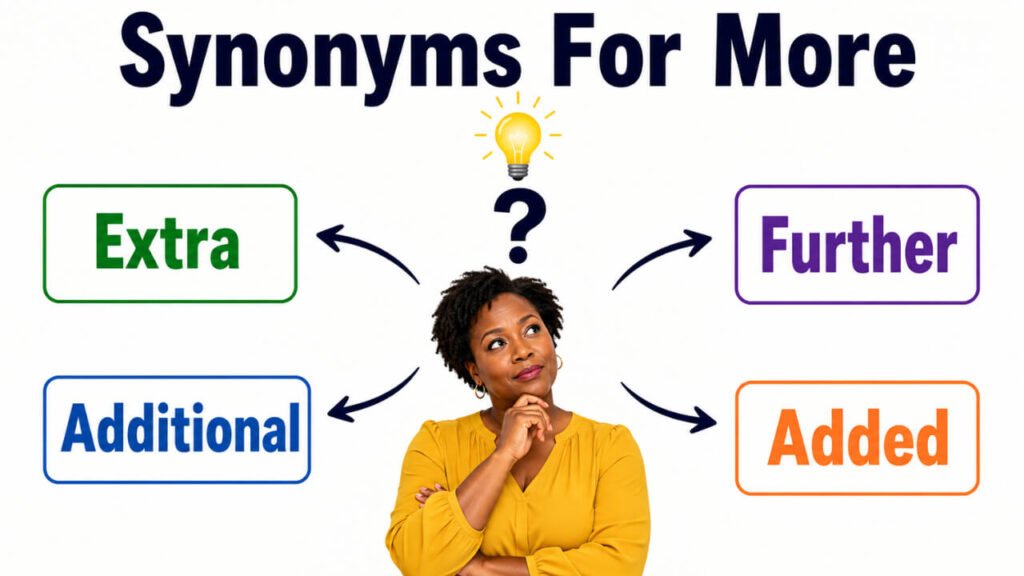
- Additional: Added to what is already there.
- Extra: More than the usual amount.
- Further: More in progress, amount, or detail.
- Greater: Larger in degree, amount, or importance.
- Increased: Made higher or larger.
- Added: Included as something extra.
- Another: One more of the same kind.
- Supplementary: Added to support or complete something.
- Higher: Greater in level, number, or amount.
- Larger: Bigger in size, amount, or scale.
- Extraordinary: More than ordinary in degree or quality.
- Expanded: Made bigger or more complete.
- Extended: Made longer in time, space, or range.
- Enhanced: Made better or stronger.
- Greater Amount: A larger quantity.
- Larger Amount: More in size or quantity.
- Bigger Amount: A greater amount in simple language.
- Added Amount: An extra quantity included later.
- Another Portion: One extra serving or share.
- Another Piece: One extra item or part.
- Another Example: One extra case or illustration.
- Another Point: One extra idea or argument.
- Further Details: Extra information.
- Further Information: Additional facts or explanation.
- Further Support: Extra help or evidence.
- Further Evidence: More proof or support.
- Further Action: Extra steps or work.
- In Addition: Also or as something extra.
- On Top Of That: Added beyond what was already mentioned.
- Besides: In addition to something else.
- Moreover: Used to add another formal point.
- Also: In addition.
- Too: Also or as well.
- As Well: Also or in addition.
- Plus: Added to something else.
- Added Value: Extra benefit or usefulness.
- Greater Number: A higher count.
- Higher Number: A larger numerical amount.
- Larger Quantity: More of something counted or measured.
- Greater Quantity: A bigger amount.
- Higher Level: A stronger or more advanced degree.
- Greater Degree: A stronger level or intensity.
- Stronger: More powerful or intense.
- Deeper: More serious, intense, or detailed.
- Fuller: More complete or developed.
- Richer: More detailed, valuable, or varied.
- Broader: Covering more range or subjects.
- Wider: Covering more space, choice, or scope.
- Numerous: Many in number.
- Plentiful: Available in a large amount.
Read Also:
Synonyms for Throughout

Synonyms for More by Context
When More Means Additional
Use these synonyms when more means something added to what already exists.
Additional: We need additional copies for the class.
Extra: Please bring extra paper for the activity.
Added: The form includes added instructions.
Supplementary: Students received supplementary reading material.
Another: I have another reason to support this idea.
When More Means Greater In Amount
Use these options when more refers to a bigger amount, number, or quantity.
Greater: The new method produced greater results.
Larger: The group needs a larger room.
Higher: The report shows higher sales.
Increased: The school noticed increased attendance.
Greater Quantity: The recipe needs a greater quantity of flour.
When More Means Further In Discussion
Use these synonyms when adding ideas, details, explanations, or evidence.
Further: The topic needs further explanation.
Moreover: The plan is simple. Moreover, it saves time.
In Addition: In addition, the results were easy to measure.
Besides: Besides cost, quality is also important.
Also: The guide also includes examples.
When More Means Stronger In Degree
Use these alternatives when more increases the intensity, quality, or level of something.
Greater: The decision requires greater care.
Stronger: She gave a stronger response this time.
Deeper: The discussion needs deeper analysis.
Higher: The job demands a higher skill level.
Enhanced: The update offers enhanced protection.
When More Means Better Or Fuller
Use these words when more suggests richer detail, fuller development, or improved quality.
Fuller: The revised answer gives a fuller explanation.
Richer: The story has richer description now.
Broader: The course gives a broader understanding.
Expanded: The article includes an expanded definition.
Enhanced: The new version gives enhanced clarity.
Another Word for More
Another word for more is additional when the meaning is extra or added. However, the best alternative depends on the sentence. Use extra for casual requests, further for details or discussion, greater for degree, increased for data, and another when you mean one more item.
Original: We need more time.
Better Option: We need additional time.
Original: Please give me more details.
Better Option: Please give me further details.
Original: The company saw more demand.
Better Option: The company saw increased demand.
Original: I want more coffee.
Better Option: I want another cup of coffee.
When Not to Use “More”
Do not use more when a clearer synonym would make your meaning stronger. More is useful, but it can sound basic if repeated too often in formal writing, academic paragraphs, reports, or professional communication.
Use additional when you mean extra information, greater when you mean a higher degree, increased when discussing numbers, and further when adding explanation.
Weak: We need more more information for the report.
Better: We need additional information for the report.
Weak: The study needs more review.
Better: The study needs further review.
Weak: The results show more growth.
Better: The results show increased growth.
Weak: She gave a more strong answer.
Better: She gave a stronger answer.
Weak: We need more better examples.
Better: We need better examples.
Words Commonly Confused With More
More vs Most: More compares two amounts, qualities, or degrees. Most shows the highest amount, quality, or degree among three or more.
More vs Additional: More is general, while additional is more formal and means added to what already exists.
More vs Further: More refers to extra amount or degree, while further often refers to extra progress, explanation, distance, or discussion.
More vs Extra: Extra means beyond the usual amount, while more simply means a greater amount.
More vs Greater: More is broader, while greater is often used for importance, degree, size, or measurable increase.
More vs Another: More can mean a greater amount, while another usually means one extra person, item, or example.
More vs Increased: More is general, while increased is often used for measured growth, data, numbers, reports, or trends.
Which Synonym Should You Choose?
Choose additional when writing formally about extra information, time, resources, support, or evidence.
Choose extra when speaking casually about added food, money, time, work, or items.
Choose further when adding explanation, discussion, review, research, or action.
Choose greater when writing about degree, importance, size, effect, value, or need.
Choose increased when writing about data, numbers, growth, demand, pressure, cost, or results.
Choose another when you mean one more item, example, person, chance, question, or copy.
Choose supplementary when something supports or completes the main thing.
Choose higher when comparing levels, prices, ranks, scores, or amounts.
Choose larger when comparing size, space, group, scale, or quantity.
Choose expanded when something becomes broader, longer, or more complete.
Real Life Examples of “More” in Sentences
Original: We need more examples for the lesson.
Better Option: We need additional examples for the lesson.
Original: She wants more time to finish the work.
Better Option: She wants extra time to finish the work.
Original: The manager asked for more details.
Better Option: The manager asked for further details.
Original: The new plan brought more success.
Better Option: The new plan brought greater success.
Original: The store had more customers this month.
Better Option: The store had increased customer traffic this month.
Original: I need more help with this task.
Better Option: I need additional support with this task.
Original: He gave more reasons for his choice.
Better Option: He gave further reasons for his choice.
Original: We should add more space between the seats.
Better Option: We should add extra space between the seats.
Original: Her answer showed more confidence.
Better Option: Her answer showed greater confidence.
Original: Please send me one more copy.
Better Option: Please send me another copy.
Synonym Groups and Usage Differences
Quantity Group
Words in this group describe a larger amount, number, or quantity.
Use: Choose additional, extra, greater, larger, or higher when talking about amounts, numbers, items, or measurements.
Example: The event needs additional chairs.
Degree Group
These synonyms show a stronger level, quality, effect, or importance.
Use: Choose greater, stronger, higher, deeper, or enhanced when comparing intensity or value.
Example: The new rule needs greater attention.
Addition Group
These words help add ideas, details, or points in writing.
Use: Choose further, moreover, also, in addition, or besides when building an argument or explanation.
Example: The proposal is affordable. Moreover, it is easy to manage.
Formal Writing Group
These synonyms work well in essays, reports, instructions, and professional writing.
Use: Choose additional, further, increased, supplementary, or expanded for a polished tone.
Example: The final section includes supplementary notes.
Casual Speech Group
These alternatives sound natural in daily conversation.
Use: Choose extra, another, plus, also, or as well in simple everyday sentences.
Example: I bought extra snacks for everyone.
Antonyms of More
Less: A smaller amount or degree.
Fewer: A smaller number of countable things.
Reduced: Made smaller in amount, size, or level.
Lower: Smaller in level, number, price, or rank.
Smaller: Less in size, amount, or scale.
Limited: Not much in amount or range.
Insufficient: Not enough for a need or purpose.
Minimal: Very small in amount or degree.
Decreased: Became smaller or lower.
Lesser: Smaller in importance, amount, or quality.
Scarce: Not available in a large amount.
Short: Not enough in supply or quantity.
Comparison: More vs Related Words
More vs Additional
More is general, while additional sounds more formal and clearly means added to what already exists.
Example With More: We need more data for the report.
Example With Additional: We need additional data for the report.
More vs Extra
More means a greater amount, while extra means beyond the usual or expected amount.
Example With More: I need more sugar.
Example With Extra: I need extra sugar in my tea.
More vs Further
More can refer to amount, while further often refers to extra detail, progress, discussion, or action.
Example With More: We need more information.
Example With Further: We need further information.
More vs Greater
More is broad and simple, while greater is stronger for degree, importance, size, or measurable effect.
Example With More: The plan needs more care.
Example With Greater: The plan needs greater care.
More vs Another
More can mean a greater amount, while another usually means one extra thing, person, or example.
Example With More: I need more paper.
Example With Another: I need another sheet of paper.
More vs Increased
More is common and general, while increased is stronger for numbers, data, reports, and growth.
Example With More: The city had more traffic.
Example With Increased: The city had increased traffic.
Common Phrases and Expressions With More
More Than: Greater than a number, amount, or limit.
More And More: Increasing gradually over time.
More Or Less: Approximately or almost.
One More: One additional thing or person.
No More: Not any longer or not any additional amount.
Much More: A greater amount or degree.
A Little More: A small additional amount.
More Often: With greater frequency.
More Likely: Having a higher chance.
More Important: Having greater value or meaning.
Common Mistakes to Avoid
Mistake One: Using more before words that already have a comparative form.
Weak: She is more smarter now.
Better: She is smarter now.
Mistake Two: Repeating more too often in one sentence.
Weak: We need more time, more help, and more information.
Better: We need additional time, extra help, and further information.
Mistake Three: Using more when another is more exact.
Weak: Please give me more copy.
Better: Please give me another copy.
Mistake Four: Using more with fewer incorrectly.
Weak: There are more fewer people today.
Better: There are fewer people today.
Mistake Five: Choosing a formal synonym in casual speech when simple more sounds natural.
Weak: Can I have supplementary rice?
Better: Can I have more rice?
Mistake Six: Using increased for non measurable ideas when greater sounds better.
Weak: She showed increased kindness.
Better: She showed greater kindness.
Conclusion
Synonyms for more help you choose clearer words for quantity, comparison, addition, and degree. Use additional for formal writing, extra for casual speech, further for details or discussion, greater for degree or importance, and increased for numbers or reports. More is useful in everyday English, but the right synonym can make your sentence more precise, polished, and natural. Always choose the word that matches the context, tone, and meaning.
FAQs About Synonyms for More
What is the best synonym for more?
Answer: The best synonym for more is additional when you mean extra, but greater, further, extra, and increased may fit better depending on context.
What is a formal synonym for more?
Answer: Formal synonyms for more include additional, further, increased, supplementary, and greater.
What is a casual synonym for more?
Answer: Casual synonyms for more include extra, another, plus, also, and as well.
Is more the same as additional?
Answer: More and additional can be similar, but additional clearly means added to what already exists and often sounds more formal.
What is the opposite of more?
Answer: Common opposites of more include less, fewer, reduced, lower, smaller, limited, and decreased.
Can I use further instead of more?
Answer: Yes, use further when talking about extra details, discussion, action, research, or progress.
What is another word for more information?
Answer: Another word for more information is additional information or further information.
