
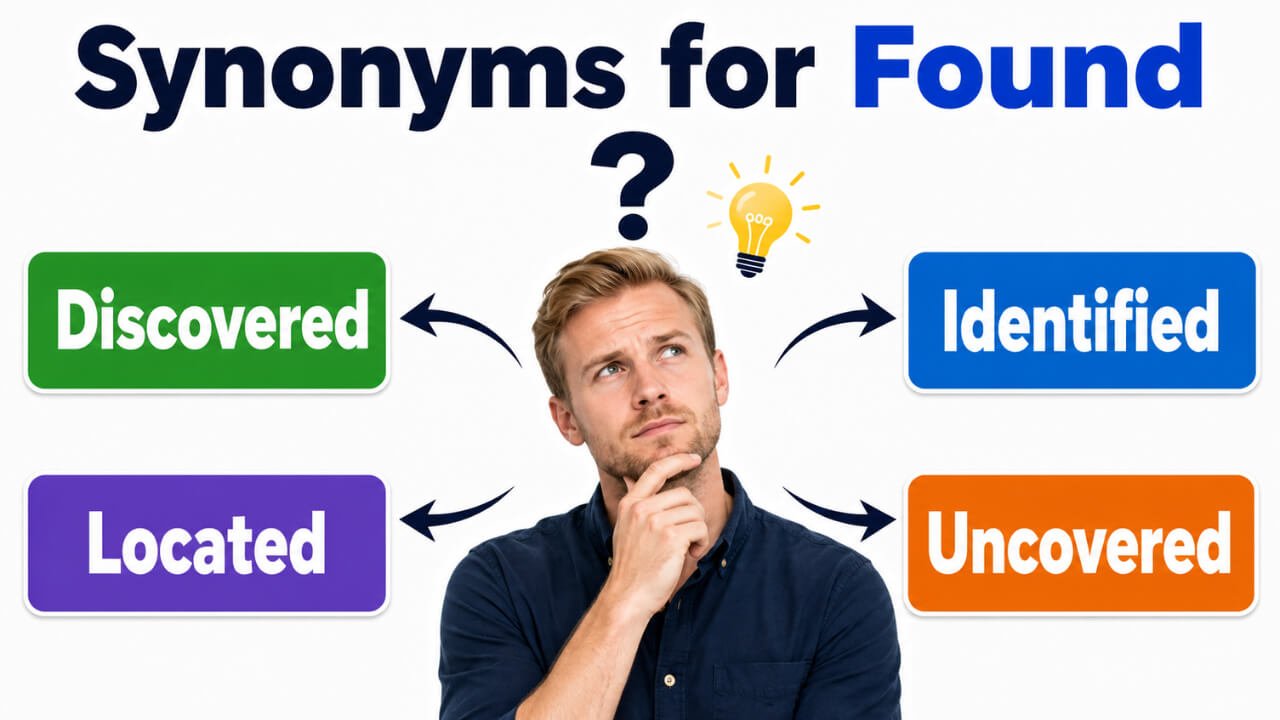
Quick Answer: Common synonyms for found include discovered, located, uncovered, identified, noticed, encountered, realized, determined, obtained, and established. Discovered is the best general replacement when something becomes known. Located works for finding a person, place, or object. Realized suits thoughts and understanding, while determined is useful in formal writing, reports, and investigations. Obtained works when someone gets something, and established applies when found means created or proven. The best synonyms for found depend on the intended meaning and sentence context.
Pronunciation and Word Details
Word: Found
Pronunciation: /faʊnd/
Part of Speech: Verb
Meaning: Found usually means discovered, located, noticed, obtained, or learned, but it can also mean established or created.
US Pronunciation:
UK Pronunciation:
What Does “Found” Mean?
Found most commonly means discovered, located, or became aware of something. It is the past tense and past participle of the verb find.
You can use found when someone discovers an object, locates a person, notices information, reaches a conclusion, obtains an opportunity, or realizes an important truth.
In the sentence “She found her keys,” the word means located. In “The researchers found a connection,” it means discovered or identified. In “He found the task difficult,” it means considered or experienced.
Found also has a separate meaning as a base verb. To found an organization, school, company, or movement means to establish or create it. This use is more formal and is commonly followed by an object.
Meaning, Tone, and Context of “Found”
Found is generally a neutral and widely understood word. It appears naturally in casual conversations, formal documents, academic writing, news reports, stories, instructions, and professional communication.
When it refers to locating an object, it sounds conversational and direct. When it describes research results, evidence, or conclusions, it can sound formal and analytical.
The emotional tone depends on what is found. Finding a lost item may suggest relief, while finding a serious problem may create concern. Finding an opportunity can express hope or excitement.
In academic or technical writing, a more precise synonym such as identified, determined, detected, or established may communicate the intended meaning more clearly.
When and How to Use “Found”
For Discovery: Use found when someone becomes aware of something that was previously unknown.
Example: The scientists found evidence of significant environmental change.
For Location: Use found when a missing person, place, or object is located.
Example: We found the missing document inside the cabinet.
For Realization: Use found when someone reaches a new understanding or conclusion.
Example: She found that regular practice improved her confidence.
For Observation: Use found when someone notices a quality, condition, or reaction.
Example: The students found the lesson easy to understand.
For Obtaining Something: Use found when someone gains an opportunity, job, solution, or source of support.
Example: He found a suitable position near his home.
For Establishing Something: Use found as a base verb when creating an organization, institution, community, or movement.
Example: They plan to found a local educational center.
Best Synonyms for Found
Discovered: Became aware of something that was previously unknown.
Example: The team discovered a more effective method.
Located: Identified the position of a person, place, or object.
Example: The officers located the missing vehicle.
Uncovered: Revealed information, evidence, or facts that had been hidden.
Example: The investigation uncovered several serious errors.
Identified: Recognized or named something accurately.
Example: The technician identified the source of the problem.
Noticed: Became aware of something through attention or observation.
Example: She noticed a small change in his expression.
Encountered: Met, experienced, or came across something unexpectedly.
Example: The travelers encountered several difficulties along the route.
Realized: Suddenly understood or became conscious of something.
Example: He realized that he had misunderstood the instructions.
Determined: Reached a conclusion after investigation or careful thought.
Example: The committee determined that further action was necessary.
Obtained: Successfully gained or received something.
Example: She obtained the information from a reliable record.
Established: Created something or proved that a fact was true.
Example: The evidence established a clear connection between the events.
50 Synonyms for Found with Short Meanings
- Discovered: Became aware of something previously unknown.
- Located: Identified where someone or something was.
- Uncovered: Revealed something hidden or secret.
- Unearthed: Discovered something through careful searching.
- Detected: Noticed the presence of something difficult to see.
- Identified: Recognized or named something correctly.
- Spotted: Saw or noticed something quickly.
- Noticed: Became aware of something through observation.
- Observed: Saw or examined something carefully.
- Encountered: Met or experienced something unexpectedly.
- Came across: Found something by chance.
- Stumbled upon: Discovered something unexpectedly.
- Recovered: Found and regained something that had been lost.
- Retrieved: Found and brought something back.
- Traced: Followed evidence until something was located.
- Tracked down: Located someone or something after searching.
- Pinpointed: Found the exact position or cause of something.
- Revealed: Made a hidden fact or detail known.
- Exposed: Uncovered something that had been concealed.
- Brought to light: Made previously hidden information known.
- Learned: Gained knowledge or information.
- Realized: Became aware of a fact or truth.
- Recognized: Identified something through previous knowledge.
- Understood: Grasped the meaning or importance of something.
- Determined: Reached a conclusion through examination.
- Concluded: Formed a final judgment after considering evidence.
- Ascertained: Found something out with certainty.
- Confirmed: Proved that something was correct or true.
- Verified: Checked and established the accuracy of something.
- Substantiated: Supported a claim with evidence.
- Proved: Demonstrated that something was true.
- Discerned: Recognized something that was not immediately clear.
- Perceived: Became aware of something through the senses or mind.
- Diagnosed: Identified the cause of a problem or condition.
- Judged: Formed an opinion after consideration.
- Obtained: Successfully gained or received something.
- Acquired: Gained possession of something.
- Secured: Successfully obtained something important.
- Gained: Received or achieved something valuable.
- Attained: Reached or achieved a desired result.
- Established: Created something or proved its truth.
- Created: Brought something new into existence.
- Formed: Created or organized something.
- Launched: Started a project, service, or organization.
- Set up: Created or arranged something for a purpose.
- Instituted: Formally introduced or established something.
- Organized: Created a structured group or system.
- Originated: Started or caused something to begin.
- Built: Developed or created something over time.
- Started: Caused an activity, organization, or process to begin.
Read Also:
Synonyms for Kids

Synonyms for Found by Context
When Found Means Discovered
Use discovered, uncovered, unearthed, revealed, or brought to light when something previously unknown becomes known.
Discovered is the most flexible choice. Uncovered often suggests investigation, while unearthed can describe information, evidence, or physical objects revealed through careful searching.
Example: The researchers discovered an unexpected pattern in the results.
Example: The review uncovered several weaknesses in the original plan.
When Found Means Located
Use located, spotted, recovered, retrieved, traced, tracked down, or pinpointed when referring to the position of a person, place, or object.
Located is formal and precise. Spotted suggests quick visual recognition. Recovered means something lost was found and regained.
Example: The search team located the missing hikers before sunset.
Example: She recovered the files from an old storage device.
When Found Means Realized
Use realized, learned, understood, recognized, perceived, or discerned when found refers to gaining knowledge or awareness.
Realized often describes a sudden understanding. Learned focuses on receiving information, while discerned suggests recognizing something subtle or difficult to notice.
Example: He realized that the instructions had been interpreted incorrectly.
Example: The manager discerned a change in the team’s attitude.
When Found Means Determined
Use determined, concluded, ascertained, confirmed, verified, substantiated, or proved when a conclusion results from evidence, testing, or investigation.
Determined is suitable for reports and formal decisions. Ascertained emphasizes certainty. Verified means that information has been checked for accuracy.
Example: The inspection determined that the structure was safe.
Example: The records confirmed that the payment had been received.
When Found Means Obtained
Use obtained, acquired, secured, gained, or attained when found describes getting something valuable, useful, or necessary.
Obtained is neutral and formal. Secured suggests effort or competition, while attained usually describes reaching a goal or standard.
Example: She obtained permission to continue the project.
Example: He secured a position with better working conditions.
When Found Means Established
Use established, created, formed, launched, instituted, organized, built, or started when found refers to beginning an organization or institution.
Established is the strongest general choice. Instituted sounds formal and often refers to systems, policies, or practices.
Example: The community established a center for adult education.
Example: The group instituted a new process for handling requests.
Another Word for Found
Discovered is usually the best single replacement for found when the sentence describes becoming aware of something new. However, the best alternative depends on whether the sentence refers to location, realization, investigation, acquisition, or creation.
Original: The researchers found a difference between the two results.
Better Option: The researchers discovered a difference between the two results.
Original: We found the missing bag near the entrance.
Better Option: We located the missing bag near the entrance.
Original: She found that the information was incorrect.
Better Option: She realized that the information was incorrect.
Original: The review found several problems in the report.
Better Option: The review identified several problems in the report.
When Not to Use “Found”
Found can sound unclear when the reader needs to know exactly how something was discovered, located, understood, or proven. Choose a more specific synonym when accuracy is important.
Avoid repeating found several times in the same paragraph. Repetition can make otherwise strong writing sound basic or monotonous.
Do not use found when you mean invented. A person may discover something that already exists, but inventing means creating something new.
Also avoid confusing found with founded. Found can be the past form of find, while founded is the past form of found when it means establish.
Weak: The study found a pattern and found several possible causes.
Better: The study identified a pattern and uncovered several possible causes.
Weak: The device was found by the engineer in 2018.
Better: The device was invented by the engineer in 2018.
Weak: They found a new organization last year.
Better: They founded a new organization last year.
Weak: The team found the exact location through detailed calculations.
Better: The team pinpointed the exact location through detailed calculations.
Words Commonly Confused With Found
Found vs Discovered: Found is broader and can refer to location, realization, or obtaining something. Discovered mainly means becoming aware of something previously unknown.
Found vs Located: Found can describe the complete act of searching successfully. Located focuses specifically on determining where something is.
Found vs Founded: Found is commonly the past tense of find. Founded is the past tense of found when it means establishing an organization or institution.
Found vs Invented: Found or discovered refers to recognizing something that already existed. Invented means creating a new object, process, or idea.
Found vs Realized: Found can introduce a conclusion, but realized emphasizes a change in someone’s understanding or awareness.
Found vs Identified: Found is general, while identified suggests recognizing, naming, or defining something accurately.
Found vs Recovered: Found means located, while recovered means located and regained after loss, theft, or damage.
Which Synonym Should You Choose?
Choose discovered when something new, hidden, or previously unknown becomes known.
Choose located when writing about the position of a person, place, document, or object.
Choose uncovered when an investigation reveals hidden facts, mistakes, or wrongdoing.
Choose identified when naming a problem, cause, person, pattern, or detail accurately.
Choose noticed in casual speech when someone becomes aware of a visible change or detail.
Choose realized when describing a new understanding, personal insight, or sudden awareness.
Choose determined in reports, essays, formal decisions, and analytical writing.
Choose verified when information, figures, records, or claims have been checked.
Choose obtained when someone receives information, permission, employment, or resources.
Choose established when something is created or when evidence proves a fact.
Choose came across in relaxed conversation when something is discovered unexpectedly.
Choose pinpointed when the exact location, cause, time, or detail has been identified.
Real Life Examples of “Found” in Sentences
Original: I found my glasses beside the bed.
Better Option: I located my glasses beside the bed.
Original: The doctor found the cause of the pain.
Better Option: The doctor identified the cause of the pain.
Original: We found an error in the final calculation.
Better Option: We detected an error in the final calculation.
Original: She found an interesting book in the attic.
Better Option: She came across an interesting book in the attic.
Original: The investigation found new evidence.
Better Option: The investigation uncovered new evidence.
Original: He found that the meeting had been canceled.
Better Option: He learned that the meeting had been canceled.
Original: The committee found the proposal impractical.
Better Option: The committee judged the proposal impractical.
Original: The researchers found the results to be accurate.
Better Option: The researchers verified the accuracy of the results.
Original: She found a solution after several attempts.
Better Option: She discovered a solution after several attempts.
Original: The community found a new support organization.
Better Option: The community established a new support organization.
Synonym Groups and Usage Differences
Discovery Group
Discovered, uncovered, unearthed, revealed, and exposed describe the process of making something unknown or hidden known.
Discovered is neutral. Uncovered suggests investigation. Unearthed often implies a long or careful search. Exposed may carry a negative tone because it often relates to wrongdoing or hidden problems.
Example: The examination uncovered weaknesses in the existing system.
Location Group
Located, spotted, recovered, retrieved, traced, tracked down, and pinpointed relate to finding the position of something.
Located is precise and neutral. Spotted is more casual and visual. Pinpointed emphasizes exactness. Retrieved suggests bringing the item back after finding it.
Example: The technician pinpointed the damaged section of the cable.
Awareness Group
Realized, learned, understood, recognized, discerned, and perceived describe mental discovery or understanding.
Realized often refers to sudden awareness. Learned means receiving new information. Discerned suggests careful judgment, while perceived can describe awareness through observation or intuition.
Example: She realized that a different approach was necessary.
Evidence Group
Determined, concluded, ascertained, confirmed, verified, substantiated, and proved describe conclusions supported by investigation or evidence.
Determined is common in formal reports. Confirmed supports an existing belief. Verified emphasizes checking, while substantiated means supplying evidence for a claim.
Example: The inspection confirmed that all safety requirements had been met.
Acquisition Group
Obtained, acquired, secured, gained, and attained describe receiving, earning, or achieving something.
Obtained is suitable for information, documents, and permission. Secured suggests effort. Gained often refers to benefits or experience. Attained usually relates to goals or standards.
Example: The applicant obtained the required documents before the deadline.
Creation Group
Established, created, formed, launched, instituted, organized, built, and started relate to the meaning of found as creating something.
Established is best for organizations and institutions. Instituted works well for rules or systems. Launched suits projects, campaigns, and new services.
Example: The residents established a volunteer group to support local families.
Antonyms of Found
The antonym of found depends on whether the word means located, discovered, understood, obtained, or established.
Lost: No longer able to be located or possessed.
Missed: Failed to notice, reach, or identify something.
Overlooked: Failed to observe an important detail.
Ignored: Deliberately gave no attention to something.
Concealed: Kept something hidden from view or knowledge.
Buried: Placed or kept something where it could not easily be found.
Unknown: Not discovered, recognized, or understood.
Misunderstood: Interpreted something incorrectly.
Misidentified: Recognized or named something incorrectly.
Disproved: Demonstrated that a claim was false.
Lost possession of: No longer had or controlled something.
Failed to obtain: Did not successfully receive or secure something.
Abolished: Officially ended a system, organization, or practice.
Dissolved: Formally closed or ended an organization or group.
Abandoned: Stopped supporting or developing something.
Comparison: Found vs Related Words
Found vs Discovered
Found has a broader meaning. It can refer to locating an item, gaining information, obtaining something, or reaching a judgment. Discovered focuses on learning about something previously unknown.
Example With Found: She found her notebook under the chair.
Example With Discovered: She discovered an important detail in the notebook.
Found vs Located
Found emphasizes the successful result of a search. Located emphasizes determining the position of something and often sounds more formal.
Example With Found: We found the missing package this morning.
Example With Located: We located the missing package in the storage area.
Found vs Identified
Found is general, while identified means recognizing or naming a person, cause, feature, or problem accurately.
Example With Found: The team found an issue in the design.
Example With Identified: The team identified a weakness in the support structure.
Found vs Realized
Found can introduce information someone learned through experience or observation. Realized focuses on becoming mentally aware of a truth.
Example With Found: She found that the route was much longer than expected.
Example With Realized: She realized that she had chosen the wrong route.
Found vs Uncovered
Found can describe any successful discovery. Uncovered suggests that information was hidden, buried, or difficult to reveal.
Example With Found: The reviewer found several incorrect figures.
Example With Uncovered: The reviewer uncovered evidence of inaccurate reporting.
Found vs Obtained
Found can mean getting something, especially an opportunity or solution. Obtained more clearly communicates that something was formally received or acquired.
Example With Found: He found a job near his home.
Example With Obtained: He obtained permission to work from home.
Found vs Established
Found usually refers to discovery when used as the past tense of find. Established can mean created an organization or proved a fact through evidence.
Example With Found: The investigation found an important connection.
Example With Established: The investigation established a clear connection between the events.
Common Phrases and Expressions With “Found”
Found Out: Learned or discovered information.
Found a Way: Discovered a method for achieving something.
Found the Answer: Discovered the correct response or solution.
Found Guilty: Officially judged responsible for an offense.
Found Innocent: Officially judged not responsible for an offense.
Found Useful: Considered something helpful or practical.
Found Missing: Discovered that a person or object was absent.
Found Common Ground: Discovered shared beliefs, goals, or interests.
Found Peace: Reached a state of emotional calm or acceptance.
Found Its Place: Became accepted or suitable within a particular setting.
Found to Be: Determined or judged to have a particular quality.
Found Wanting: Judged to be lacking or unsatisfactory.
Common Mistakes to Avoid
One common mistake is using found repeatedly when more precise verbs are available. In formal writing, vary the vocabulary according to the intended meaning. A report may identify a problem, verify a figure, uncover evidence, or determine a cause.
Another mistake is writing finded as the past tense of find. The correct past form is found.
Writers also confuse found with founded. Use found when someone locates or discovers something. Use founded when someone established an organization in the past.
Avoid replacing found with discovered in every sentence. You can discover a fact, but locate is usually more natural for a missing object. Similarly, obtained is more accurate when someone receives permission or official documents.
Do not confuse discovery with invention. A scientist discovers an existing process or fact, while an inventor creates something new.
Vague use can also weaken a sentence. Instead of saying a study found something important, explain whether it detected a pattern, identified a cause, confirmed a theory, or uncovered evidence.
Conclusion
The best synonyms for found depend on what the sentence is communicating. Use discovered for new knowledge, located for people or objects, uncovered for hidden information, and identified for specific causes or details. Realized is suitable for personal understanding, while determined and verified strengthen formal reports and research. Obtained describes receiving something, and established works for creating an organization or proving a fact. Choosing a precise alternative makes sentences clearer, more natural, and more informative for readers.
FAQs About Synonyms for Found
What Is the Best Synonym for Found?
Discovered is the best general synonym when found means becoming aware of something new. Located is better when referring to a person, place, or object.
What Is a Formal Synonym for Found?
Determined, identified, ascertained, established, and verified are strong formal alternatives. The correct choice depends on how the information was obtained.
Are Found and Discovered the Same?
They can have similar meanings, but found is broader. Discovered usually refers to learning something new, while found can also mean located, obtained, considered, or established.
What Is Another Word for Found an Object?
Located, spotted, recovered, retrieved, or tracked down can replace found when referring to an object.
What Is Another Word for Found in Research?
Identified, determined, detected, observed, confirmed, and established are suitable choices for research and academic writing.
What Is the Difference Between Found and Founded?
Found is commonly the past tense of find. Founded is the past tense of found when it means establishing an organization, institution, or movement.
Can Located Always Replace Found?
No. Located works when something has a physical or identifiable position. It does not naturally replace found when the meaning is realized, obtained, judged, or discovered through research.
