
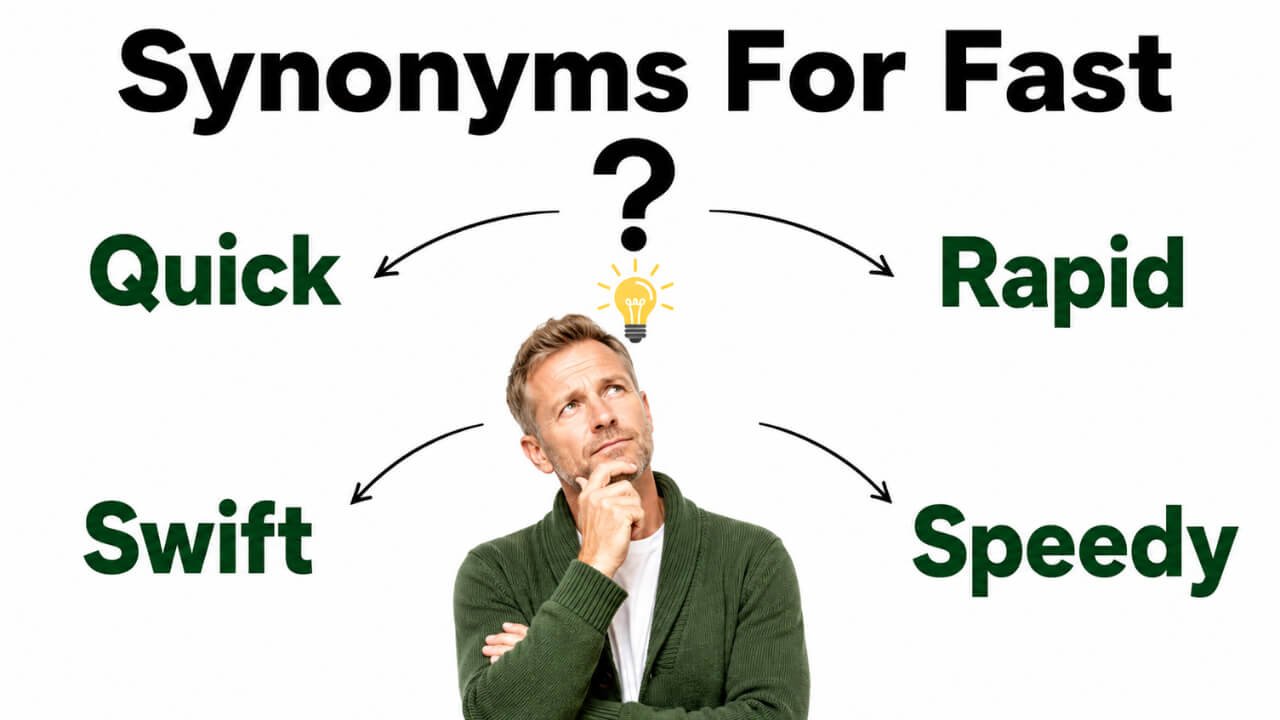
Quick Answer: The best synonyms for fast include quick, rapid, swift, speedy, brisk, prompt, nimble, hasty, accelerated, and expeditious. Use quick for everyday speech, rapid for formal or technical writing, swift for smooth movement or action, prompt for timely responses, brisk for energetic movement, and hasty when something is done too quickly without enough care.
Pronunciation and Word Details
Word: Fast
Pronunciation: /fæst/ in American English and /fɑːst/ in British English.
Part of Speech: Adjective, adverb, verb, and noun, depending on context.
Meaning: Moving, happening, or being done with great speed.
US Pronunciation:
UK Pronunciation:
What Does “Fast” Mean?
Fast means moving, happening, or being completed with speed. It is most often used as an adjective, as in “a fast car,” but it can also work as an adverb, as in “run fast.”
The word can describe movement, progress, service, learning, change, reaction, or time. In another context, fast can also mean not eating for a period of time, but when people search for synonyms for fast, they usually mean words related to speed.
Meaning, Tone, and Context of “Fast”
Fast is a common, neutral, and conversational word. It works well in everyday speech, school writing, product descriptions, instructions, and general communication.
In formal writing, words like rapid, swift, prompt, or expeditious may sound more precise. In casual speech, quick, speedy, snappy, and zippy feel more natural. In technical or performance based writing, accelerated, high speed, and rapid often fit better.
When and How to Use “Fast”
For Movement: Use fast when something moves with speed.
Example: The runner is fast on short tracks.
For Time: Use fast when something happens in a short amount of time.
Example: The meeting ended faster than expected.
For Service: Use fast when a response, delivery, or action happens quickly.
Example: The team gave a fast reply.
For Learning: Use fast when someone understands new information quickly.
Example: She is a fast learner.
For Change: Use fast when a situation develops quickly.
Example: The weather changed fast in the evening.
For Performance: Use fast when a machine, process, or system works at high speed.
Example: The new process gives fast results.
Best Synonyms for Fast
Quick: Done or happening in a short time.
Example: We need a quick answer before the meeting starts.
Rapid: Very fast, often used for change, growth, movement, or progress.
Example: The city saw rapid development over the past year.
Swift: Fast, smooth, and often graceful.
Example: The manager made a swift decision.
Speedy: Fast and efficient, often used for recovery, service, or action.
Example: We hope for a speedy recovery.
Brisk: Quick, energetic, and lively.
Example: They took a brisk walk after dinner.
Prompt: Done quickly and without delay.
Example: Thank you for your prompt response.
Nimble: Quick and light in movement or thinking.
Example: The dancer was nimble on her feet.
Hasty: Too fast and often careless.
Example: His hasty decision caused confusion.
Accelerated: Made faster or moving at a faster rate.
Example: The project moved through an accelerated schedule.
Expeditious: Formal word meaning quick, efficient, and timely.
Example: The issue requires an expeditious solution.
50 Synonyms for Fast with Short Meanings

- Quick: Happening in a short time.
- Rapid: Very fast in movement or progress.
- Swift: Fast, smooth, and direct.
- Speedy: Quick and efficient.
- Brisk: Quick with energy.
- Prompt: Done without delay.
- Immediate: Happening right away.
- Instant: Happening at once.
- Expeditious: Quick and efficient in a formal way.
- Accelerated: Made faster than usual.
- Hurried: Done quickly, often under pressure.
- Hasty: Done too quickly and sometimes carelessly.
- Rushed: Done with too much speed and not enough time.
- Fleet: Able to move very fast.
- Nimble: Quick and light in movement.
- Agile: Able to move quickly and easily.
- Spry: Energetic and quick, especially in movement.
- Lively: Full of quick energy.
- Snappy: Quick, sharp, and energetic.
- Zippy: Informal word for quick and lively.
- High speed: Moving or working at great speed.
- Fast paced: Moving quickly from one part to another.
- Quick moving: Moving with noticeable speed.
- Rapid moving: Moving or changing very quickly.
- Swift moving: Moving quickly and smoothly.
- Speeding: Moving very fast.
- Racing: Moving forward very quickly.
- Flying: Moving extremely quickly.
- Blazing: Extremely fast and powerful.
- Lightning quick: Extremely quick.
- Breakneck: Dangerously fast.
- Express: Designed to be faster than normal.
- Efficient: Done quickly with little waste.
- Time saving: Helping something happen faster.
- Quick acting: Producing results quickly.
- Fast acting: Working in a short time.
- Rapid fire: Happening quickly one after another.
- Whirlwind: Very fast and full of activity.
- Headlong: Moving fast without much caution.
- Quickly: In a fast way.
- Rapidly: At a very fast rate.
- Swiftly: In a smooth and fast way.
- Speedily: Quickly and without delay.
- Briskly: Quickly and energetically.
- Promptly: Quickly and on time.
- Hastily: Too quickly or with little care.
- Hurriedly: In a rushed way.
- At speed: Moving fast.
- In no time: Very quickly.
- In a flash: Extremely quickly.
Read Also:
Synonyms for Excellent

Synonyms for Fast by Context
When Fast Means Quick In Time
Use these synonyms when something happens soon or takes little time.
Quick: The teacher gave a quick explanation.
Speedy: The patient made a speedy recovery.
Prompt: We received a prompt reply.
Instant: The lights turned on with an instant response.
When Fast Means Rapid In Movement
Use these words when something physically moves at high speed.
Rapid: The river had a rapid current.
Swift: The bird made a swift turn.
Fleet: The athlete was fleet on the field.
Flying: The ball came flying toward the wall.
When Fast Means Efficient
Use these options when something is done quickly and well.
Expeditious: They found an expeditious way to solve the issue.
Efficient: The new method is efficient and simple.
Time saving: This approach gives a time saving result.
Express: The package was sent through express service.
When Fast Means Energetic
Use these synonyms when the speed feels lively or active.
Brisk: We had a brisk walk in the morning.
Snappy: The writer used a snappy sentence style.
Zippy: The small car felt zippy on the road.
Lively: The discussion moved at a lively pace.
When Fast Means Too Quick
Use these words when speed creates risk, carelessness, or pressure.
Hasty: A hasty reply can sound rude.
Rushed: The report looked rushed.
Hurried: His hurried explanation missed key details.
Breakneck: The team worked at a breakneck pace.
Another Word for Fast
Quick is the best single replacement for fast in most everyday sentences. It is simple, natural, and easy to understand. However, the best alternative depends on meaning. Use rapid for formal change, swift for smooth action, prompt for timely replies, and hasty when something is too quick.
Original: She gave a fast answer.
Better Option: She gave a quick answer.
Original: The company made fast progress.
Better Option: The company made rapid progress.
Original: He sent a fast reply.
Better Option: He sent a prompt reply.
Original: They made a fast decision.
Better Option: They made a swift decision.
When Not to Use “Fast”
Do not use fast when a more exact synonym gives a clearer meaning. In formal writing, rapid, prompt, swift, or expeditious may sound stronger. In careful writing, avoid repeating fast too often.
Weak: The fast worker gave a fast reply after a fast review.
Better: The efficient worker gave a prompt reply after a quick review.
Weak: The report shows fast growth.
Better: The report shows rapid growth.
Weak: She made a fast choice without thinking.
Better: She made a hasty choice without thinking.
Weak: The team needs a fast solution.
Better: The team needs an expeditious solution.
Words Commonly Confused With Fast
Fast vs Quick: Fast often describes speed in movement, while quick often describes short time. A car is fast, but a reply is usually quick.
Fast vs Rapid: Rapid sounds more formal and is often used for change, growth, progress, or movement. Fast is more general.
Fast vs Swift: Swift suggests speed with smoothness or decisiveness. Fast simply means quick in speed.
Fast vs Speedy: Speedy often sounds positive and is common with recovery, service, and results. Fast is more neutral.
Fast vs Hasty: Hasty means too fast and possibly careless. Fast does not always suggest a mistake.
Fast vs Prompt: Prompt means on time and without delay. Fast means quick, but not always timely or expected.
Fast vs Efficient: Efficient means quick with little waste. Something can be fast but still messy or wasteful.
Which Synonym Should You Choose?
Choose quick for everyday speech, simple writing, and general short time.
Choose rapid when writing about growth, change, progress, movement, data, or development.
Choose swift when describing smooth action, decisions, justice, movement, or response.
Choose speedy when writing about recovery, service, results, or completion.
Choose prompt when writing about replies, action, timing, help, or communication.
Choose brisk when describing walking, pace, business, weather, or energetic activity.
Choose hasty when something is too quick and lacks care.
Choose expeditious when formal writing needs a polished word for quick and efficient action.
Choose accelerated when something has been made faster than normal.
Choose nimble when describing quick movement, quick thinking, or flexible action.
Real Life Examples of “Fast” in Sentences
Original: The train was fast.
Better Option: The train was rapid.
Original: She gave a fast answer.
Better Option: She gave a quick answer.
Original: He made a fast decision.
Better Option: He made a swift decision.
Original: We need fast help.
Better Option: We need prompt help.
Original: The child is a fast learner.
Better Option: The child is a quick learner.
Original: The team made fast progress.
Better Option: The team made rapid progress.
Original: He walked at a fast pace.
Better Option: He walked at a brisk pace.
Original: The machine gives fast results.
Better Option: The machine gives quick acting results.
Original: They finished the task fast.
Better Option: They finished the task quickly.
Original: Her fast choice created a problem.
Better Option: Her hasty choice created a problem.
Synonym Groups and Usage Differences
Speed Group
This group describes movement or action that happens with high speed. Use rapid, swift, speedy, and high speed when the main idea is physical speed or fast progress.
Example: The cyclist made a swift turn near the finish line.
Prompt Action Group
This group describes action that happens without delay. Use prompt, immediate, instant, and expeditious when timing matters.
Example: The office gave a prompt answer to the request.
Careless Speed Group
This group shows speed with possible mistakes. Use hasty, rushed, hurried, and headlong when the action feels too quick.
Example: A hasty edit can leave grammar errors in the final draft.
Energetic Movement Group
This group describes movement with life and energy. Use brisk, zippy, snappy, and lively when the speed feels active.
Example: They kept a brisk pace during the morning walk.
Technical Speed Group
This group works well for systems, processes, machines, and performance. Use accelerated, high speed, quick acting, and rapid fire in practical or technical contexts.
Example: The process followed an accelerated timeline.
Antonyms of Fast
Slow: Moving or happening with little speed.
Sluggish: Slow and lacking energy.
Delayed: Happening later than expected.
Leisurely: Done in a relaxed and unhurried way.
Gradual: Happening slowly over time.
Unhurried: Not rushed or pressured.
Crawling: Moving extremely slowly.
Lazy: Slow or lacking effort in some contexts.
Steady: Controlled and not overly fast.
Loose: Opposite of fast when fast means fixed firmly in place.
Comparison Between Fast and Related Words
Fast vs Quick
Fast often describes speed in movement, while quick often describes short time or action.
Example With Fast: The horse is fast.
Example With Quick: She gave a quick answer.
Fast vs Rapid
Rapid is more formal than fast and is often used for growth, change, and movement.
Example With Fast: The project moved fast.
Example With Rapid: The project showed rapid progress.
Fast vs Swift
Swift suggests smooth, direct, and confident speed.
Example With Fast: He made a fast move.
Example With Swift: He made a swift move.
Fast vs Speedy
Speedy often sounds positive and helpful, especially with recovery, service, and results.
Example With Fast: I hope you get fast treatment.
Example With Speedy: I hope you have a speedy recovery.
Fast vs Hasty
Hasty means too fast and often careless, while fast is neutral.
Example With Fast: She wrote a fast note.
Example With Hasty: She made a hasty decision.
Fast vs Prompt
Prompt means done on time and without delay, especially in communication or service.
Example With Fast: He gave a fast reply.
Example With Prompt: He gave a prompt reply.
Common Phrases and Expressions With Fast
Fast Learner: Someone who understands new ideas quickly.
Fast Response: A reply or reaction that comes quickly.
Fast Pace: A speed or rhythm that moves quickly.
Fast Track: A quicker path to progress or success.
Fast Moving: Changing or moving quickly.
Fast Acting: Producing results in a short time.
Fast Results: Results that appear quickly.
Fast Asleep: Sleeping deeply, not sleeping quickly.
Hold Fast: Stay firm or keep a strong position.
Fast And Easy: Quick and simple to do.
Common Mistakes to Avoid
Repeating Fast Too Often: Use synonyms to make writing smoother and less dull.
Weak: The fast car made a fast turn on the fast road.
Better: The speedy car made a swift turn on the rapid road.
Using Fast Instead Of Prompt: For replies and communication, prompt is often clearer.
Weak: Thank you for your fast response.
Better: Thank you for your prompt response.
Using Fast Instead Of Rapid: For growth, change, and development, rapid often sounds more accurate.
Weak: The town had fast growth.
Better: The town had rapid growth.
Using Hasty As A Positive Word: Hasty often suggests carelessness, so use it only when speed creates a problem.
Weak: She made a hasty and careful plan.
Better: She made a quick and careful plan.
Ignoring Different Meanings Of Fast: Remember that fast can also mean fixed firmly or avoiding food for a period of time. Choose synonyms based on the exact meaning.
Conclusion
Synonyms for fast help you describe speed, time, movement, action, and progress with better precision. Use quick for everyday situations, rapid for formal change or growth, swift for smooth action, prompt for timely replies, and brisk for energetic movement. Choose hasty only when speed causes carelessness. The best synonym depends on whether you mean speed, efficiency, urgency, movement, or response time.
FAQs About Synonyms for Fast
What is the best synonym for fast?
The best synonym for fast is quick in most everyday contexts. It is simple, natural, and easy to use.
What is a formal synonym for fast?
A formal synonym for fast is rapid. You can also use expeditious when describing quick and efficient action.
What is another word for fast movement?
Another word for fast movement is swift. You can also use rapid, speedy, fleet, or quick moving.
What is a better word than fast for writing?
A better word depends on context. Use rapid for growth, prompt for replies, swift for decisions, and brisk for energetic pace.
Is hasty the same as fast?
No, hasty means too fast and often careless. Fast is neutral, but hasty usually suggests a lack of careful thinking.
Can fast be used as an adverb?
Yes, fast can be used as an adverb. For example, “She runs fast” is correct.
What is the opposite of fast?
The most common opposite of fast is slow. Other antonyms include sluggish, delayed, leisurely, gradual, and unhurried.
