
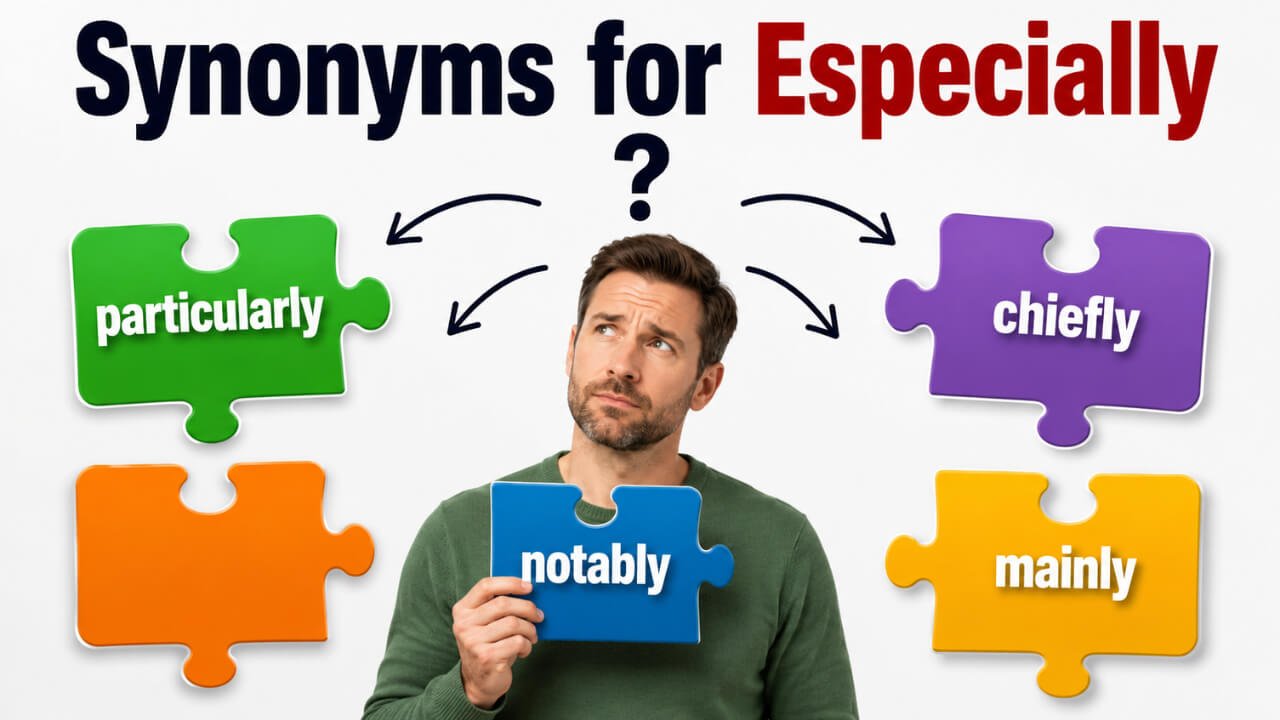
Quick Answer: Synonyms for especially include particularly, notably, specifically, chiefly, mainly, primarily, above all, in particular, most of all, and specially. Use particularly for general emphasis, notably for formal writing, specifically for exact detail, chiefly for main importance, mainly for everyday speech, primarily for reports or essays, above all for strongest emphasis, and in particular when pointing to one clear example.
Pronunciation and Word Details
Word: Especially.
Pronunciation: /ɪˈspeʃəli/.
Part of Speech: Adverb.
Meaning: Especially means more than usual, more than others, or for a particular reason, person, thing, or situation.
US Pronunciation:
UK Pronunciation:
What Does “Especially” Mean?
Direct Answer: “Especially” means particularly, mainly, or more than other things.
Especially is an adverb used to add focus, emphasis, or special importance. It often highlights one person, thing, reason, detail, or situation from a larger group. For example, “I like fruit, especially mangoes” means mangoes are a special favorite among fruits.
The word can appear before adjectives, verbs, nouns, phrases, and clauses. It is common in everyday speech, essays, instructions, reviews, and explanations. It helps readers understand what matters most in a sentence.
Meaning, Tone, and Context of “Especially”
Meaning: Especially shows that something is important, noticeable, specific, or true more than usual.
Tone: The tone is neutral, clear, polite, and natural. It works in both casual and formal writing.
Context: Especially is common in explanations, comparisons, recommendations, descriptions, opinions, and academic sentences.
Formal Use: Especially can sound natural in essays and reports, but particularly, notably, and primarily may sound more polished.
Casual Use: Especially is easy and common in everyday speech.
Emphasis Use: Especially helps point attention to the most important part of a sentence.
Specific Detail Use: Especially can introduce one clear example from a broader idea.
When and How to Use “Especially”
For Emphasis: Use especially when you want to show that one detail is more important than others.
Example: The lesson was helpful, especially for beginners.
For Specific Detail: Use especially when you want to point to a particular person, thing, or situation.
Example: Many students improved, especially those who practiced daily.
For Preference: Use especially when something is liked, needed, or valued more than other options.
Example: She enjoys reading, especially mystery stories.
For Importance: Use especially when one point deserves extra attention.
Example: Safety is important, especially during bad weather.
For Cause or Reason: Use especially when one reason is more important than others.
Example: He was tired, especially because he had worked all night.
For Comparison: Use especially when one thing stands out in a larger group.
Example: The whole team played well, especially the goalkeeper.
Best Synonyms for Especially
Particularly: More than usual or more than others.
Example: The book is particularly useful for new learners.
Notably: In a way that is important, clear, or worth noticing.
Example: Several areas improved, notably reading and writing.
Specifically: In an exact or clearly named way.
Example: The rule applies specifically to new members.
Chiefly: Mainly or most importantly.
Example: The delay was caused chiefly by heavy traffic.
Mainly: Mostly or for the most part.
Example: The class is mainly for beginners.
Primarily: Mostly, chiefly, or for the main purpose.
Example: The report focuses primarily on student progress.
Above All: More than anything else.
Example: Above all, the plan needs careful timing.
In Particular: Used to single out one person, thing, or point.
Example: I liked the design, in particular the clean layout.
Most of All: More than every other thing.
Example: She missed her family most of all.
Specially: For a particular purpose, person, or situation.
Example: The guide was specially written for young readers.
50 Synonyms for Especially with Short Meanings
- Particularly: More than usual or more than others.
- Notably: In a way worth noticing.
- Specifically: In an exact or named way.
- Chiefly: Mainly or most importantly.
- Mainly: For the most part.
- Primarily: Mostly or for the main reason.
- Above all: More than anything else.
- In particular: Used to point out one thing clearly.
- Most of all: More than all others.
- Specially: For a particular purpose or person.
- Principally: Mainly or chiefly.
- Largely: Mostly or to a great extent.
- Mostly: In the greatest amount or number.
- Predominantly: Mainly or in the largest part.
- First and foremost: Most importantly before anything else.
- More than anything: With the greatest importance or feeling.
- To a great extent: In a large degree.
- Markedly: In a clearly noticeable way.
- Noticeably: In a way that can be clearly seen.
- Significantly: In an important or meaningful way.
- Exceptionally: More than normal or unusually.
- Unusually: More than what is common.
- Extraordinarily: In a very unusual or great way.
- Distinctly: Clearly and noticeably.
- Clearly: In an obvious or easy to notice way.
- Precisely: Exactly or for a specific reason.
- Exactly: In a fully correct or specific way.
- Expressly: Clearly and for a specific purpose.
- Uniquely: In a special or one of a kind way.
- Singularly: In a noticeably unusual or special way.
- Supremely: To the highest degree.
- Eminently: Very much and in a positive way.
- Remarkably: In a way that deserves attention.
- Strikingly: In a very noticeable way.
- Impressively: In a way that stands out strongly.
- Considerably: To a large degree.
- Greatly: Very much.
- Highly: Very or to a high degree.
- Deeply: Very strongly or seriously.
- Mostly because: Mainly for the reason that.
- For the most part: Mainly or generally.
- In a special way: Differently from ordinary cases.
- More specifically: To give a clearer detail.
- More importantly: Used to add a stronger point.
- In the main: Mostly or generally.
- For one thing: Used to introduce one important reason.
- In large part: Mainly or mostly.
- As a priority: With special importance.
- With special attention: In a focused or careful way.
- With particular focus: With attention on one specific thing.
Read Also:
Synonyms for Intense
Synonyms for Especially by Context
When Especially Means Particularly
Particularly: Best for general emphasis in everyday and formal writing.
Example: This method is particularly useful for beginners.
Notably: Best when something deserves attention in a formal sentence.
Example: The results improved, notably in grammar and vocabulary.
Remarkably: Best when the detail is surprising or impressive.
Example: Her confidence grew remarkably fast.
Significantly: Best when the point has real importance or measurable value.
Example: The new system significantly reduced errors.
When Especially Means Specifically
Specifically: Best when naming an exact person, thing, detail, or purpose.
Example: The instructions apply specifically to new users.
In particular: Best when singling out one example from a larger group.
Example: I liked the chapter, in particular the final explanation.
More specifically: Best when adding a clearer or narrower detail.
Example: The article discusses grammar, more specifically sentence structure.
Expressly: Best when something is done clearly for a stated purpose.
Example: The rule was created expressly for safety.
When Especially Means Mainly
Mainly: Best for casual and clear writing.
Example: The course is mainly for advanced learners.
Chiefly: Best for formal writing about main causes or reasons.
Example: The problem was caused chiefly by poor planning.
Primarily: Best for reports, essays, and professional writing.
Example: The guide is primarily designed for students.
Principally: Best for formal writing when one cause or purpose is most important.
Example: The change was made principally to save time.
When Especially Means Above All
Above all: Best when showing the most important point.
Example: Above all, the answer must be clear.
First and foremost: Best when placing one idea before all others.
Example: First and foremost, we need accurate information.
Most of all: Best for feelings, preferences, and personal emphasis.
Example: He missed his old home most of all.
More than anything: Best for strong emotional emphasis.
Example: She wanted peace more than anything.
When Especially Means Noticeably
Markedly: Best for clear, visible, or measurable difference.
Example: His writing became markedly better.
Noticeably: Best when a change can be easily seen or felt.
Example: The room became noticeably warmer.
Distinctly: Best when something is clearly different or easy to recognize.
Example: The second version was distinctly clearer.
Strikingly: Best when something stands out strongly.
Example: The two answers were strikingly similar.
Another Word for Especially
Direct Answer: The best single word for especially is particularly because it works in most sentences without changing the meaning.
The best alternative depends on context. Use specifically for exact detail, mainly for simple everyday meaning, primarily for formal writing, notably for important observations, and above all for strongest emphasis.
Original: I enjoy outdoor activities, especially walking.
Better Option: I enjoy outdoor activities, particularly walking.
Original: The rule applies especially to new students.
Better Option: The rule applies specifically to new students.
Original: The guide is especially for beginners.
Better Option: The guide is mainly for beginners.
Original: The report focuses especially on safety.
Better Option: The report focuses primarily on safety.
When Not to Use “Especially”
Do not use especially when a more exact synonym would make the sentence clearer. Especially is useful, but it can sound repeated or vague if used too often. In formal writing, particularly, notably, primarily, or specifically may sometimes sound stronger.
Weak: The book is especially helpful, especially for students.
Better: The book is particularly helpful, especially for students.
Weak: The rule is especially for workers.
Better: The rule is specifically for workers.
Weak: The article especially discusses grammar.
Better: The article mainly discusses grammar.
Weak: The results were especially better this year.
Better: The results were significantly better this year.
Weak: She especially liked the ending most.
Better: She liked the ending most of all.
Words Commonly Confused With Especially
Especially vs Specially: Especially means particularly or more than others. Specially means for a special purpose. “I especially like tea” means tea is a special favorite. “This tea was specially made” means it was made for a specific purpose.
Especially vs Particularly: Both can mean more than usual or more than others. Particularly often sounds slightly more polished in formal writing, while especially sounds very natural in everyday speech.
Especially vs Specifically: Especially adds emphasis or focus. Specifically gives exact detail. Use specifically when you want to name something clearly.
Especially vs Mainly: Especially highlights one important part. Mainly describes the largest part or main reason.
Especially vs Primarily: Especially emphasizes one thing. Primarily means mostly or for the main purpose, often in formal writing.
Especially vs Notably: Especially can be general. Notably means something is important enough to notice or mention.
Especially vs Above All: Especially points to a notable detail. Above all shows the most important thing before everything else.
Which Synonym Should You Choose?
Choose particularly when you need the closest and most natural replacement for especially.
Choose notably when writing about important details, changes, results, or observations in formal writing.
Choose specifically when naming an exact person, reason, rule, group, or detail.
Choose chiefly when explaining the main cause, reason, or influence in a formal sentence.
Choose mainly when writing in clear everyday language about the largest part or main reason.
Choose primarily when writing reports, essays, instructions, or professional explanations.
Choose above all when one point matters more than every other point.
Choose in particular when you want to single out one example from a larger group.
Choose most of all when writing about feelings, likes, dislikes, or personal preference.
Choose specially when something is made, done, or designed for a particular purpose.
Real Life Examples of “Especially” in Sentences
Original: I like fresh fruit, especially oranges.
Better Option: I like fresh fruit, particularly oranges.
Original: This lesson is especially useful for beginners.
Better Option: This lesson is notably useful for beginners.
Original: The rule applies especially to new employees.
Better Option: The rule applies specifically to new employees.
Original: The problem happened especially because of poor timing.
Better Option: The problem happened mainly because of poor timing.
Original: The report is especially about student progress.
Better Option: The report is primarily about student progress.
Original: She loves quiet places, especially libraries.
Better Option: She loves quiet places, in particular libraries.
Original: The garden looks beautiful, especially in spring.
Better Option: The garden looks beautiful, particularly in spring.
Original: The plan needs care, especially during the final stage.
Better Option: The plan needs care, above all during the final stage.
Original: He was tired, especially after the long journey.
Better Option: He was tired, mainly after the long journey.
Original: The teacher praised everyone, especially the students who improved.
Better Option: The teacher praised everyone, notably the students who improved.
Synonym Groups and Usage Differences
Emphasis Group
Words such as particularly, notably, significantly, markedly, and remarkably add emphasis. They help show that one detail is stronger, clearer, or more important than the rest.
Example: The new method was particularly effective for slow readers.
Specific Detail Group
Words such as specifically, in particular, more specifically, and expressly point to an exact detail. Use them when readers need a clear person, purpose, rule, or example.
Example: The notice was written specifically for new members.
Main Reason Group
Words such as mainly, chiefly, primarily, principally, and largely explain the main cause, purpose, or focus. These are useful in essays, reports, and clear explanations.
Example: The delay was chiefly caused by heavy rain.
Strong Priority Group
Words such as above all, first and foremost, most of all, and more than anything show the strongest importance. They are useful when one point matters more than all others.
Example: Above all, your answer should be accurate.
Noticeable Difference Group
Words such as noticeably, distinctly, strikingly, and clearly show that something can be seen, felt, or recognized. These work well for changes, qualities, and comparisons.
Example: Her pronunciation became noticeably clearer.
Antonyms of Especially
Generally: In most cases, not with special focus.
Broadly: In a wide and general way.
Usually: In the normal or common way.
Normally: As expected or typical.
Equally: In the same amount or degree.
Ordinarily: In a regular or not special way.
Commonly: In a usual or frequent way.
Universally: In a way that applies to all.
Collectively: As a whole group, not one special part.
Indifferently: Without special interest or attention.
Casually: Without special care, focus, or emphasis.
Randomly: Without a particular reason, order, or focus.
Comparison: Especially vs Related Words
Especially vs Particularly
Especially and particularly are very close in meaning. Especially sounds natural in everyday speech, while particularly can sound slightly more formal or polished.
Example With Especially: I enjoyed the meal, especially the soup.
Example With Particularly: I enjoyed the meal, particularly the soup.
Especially vs Specifically
Especially gives emphasis. Specifically gives exact detail. Use specifically when you want to name something clearly.
Example With Especially: The class helps students, especially beginners.
Example With Specifically: The class was created specifically for beginners.
Especially vs Mainly
Especially highlights a special part. Mainly describes the largest part, main reason, or main focus.
Example With Especially: I like music, especially soft music.
Example With Mainly: I listen mainly to soft music.
Especially vs Primarily
Especially adds focus or importance. Primarily means mostly or for the main purpose, often in formal contexts.
Example With Especially: The guide is useful, especially for teachers.
Example With Primarily: The guide is primarily for teachers.
Especially vs Notably
Especially points to something with extra focus. Notably suggests the detail is important enough to mention.
Example With Especially: Several topics were difficult, especially grammar.
Example With Notably: Several topics were difficult, notably grammar.
Especially vs Specially
Especially means particularly or more than others. Specially means for a special purpose.
Example With Especially: I especially enjoy quiet mornings.
Example With Specially: The room was specially prepared for guests.
Common Phrases and Expressions With Especially
Especially Important: More important than other things.
Especially Useful: Helpful in a special or clear way.
Especially Good: Better or more pleasing than usual.
Especially True: More accurate in a certain case.
Especially Helpful: Giving extra support or value.
Especially Difficult: Harder than usual or harder than other things.
Especially When: Used to show a special situation or condition.
Especially For: Used to name the person or group that benefits most.
Especially Because: Used to show a strong or important reason.
Not Especially: Not very or not particularly.
Common Mistakes to Avoid
A common mistake is confusing especially with specially. Use especially when you mean particularly. Use specially when something is made or done for a special purpose.
Another mistake is placing especially in an unclear position. The word should be close to the idea it modifies. “I especially like grammar lessons” is clearer than “I like especially grammar lessons.”
Avoid repeating especially too often in one paragraph. Replace it with particularly, notably, mainly, primarily, or in particular when the meaning fits.
Do not use especially when specifically is needed. If you are naming an exact rule, person, or detail, specifically may be more accurate.
Avoid awkward phrases such as “especially more better.” Use “especially good,” “much better,” or “significantly better” instead.
Conclusion
Synonyms for especially help you add focus, emphasis, priority, and specific detail with better word choice. Particularly is the best general replacement, while specifically works for exact detail, mainly and chiefly explain the main reason, primarily suits formal writing, notably highlights important points, and above all gives the strongest emphasis. Choose the synonym that matches your sentence purpose so your writing stays clear, natural, and precise.
FAQs About Synonyms for Especially
What are the best synonyms for especially?
The best synonyms for especially are particularly, notably, specifically, chiefly, mainly, primarily, above all, in particular, most of all, and specially.
What is another word for especially?
Another word for especially is particularly. It is the closest general replacement and works in most everyday, academic, and formal sentences.
Is especially the same as specially?
No, especially and specially are different. Especially means particularly or more than others. Specially means for a specific purpose.
What is a formal synonym for especially?
Formal synonyms for especially include particularly, notably, primarily, chiefly, principally, and specifically. The best choice depends on the sentence.
What is a casual synonym for especially?
A casual synonym for especially is mainly, mostly, most of all, or in particular. These choices sound natural in everyday speech.
Can I use particularly instead of especially?
Yes, you can often use particularly instead of especially. For example, “I like fruit, especially apples” can become “I like fruit, particularly apples.”
What is the opposite of especially?
The opposite of especially can be generally, broadly, normally, usually, equally, ordinarily, or commonly, depending on the context.
