
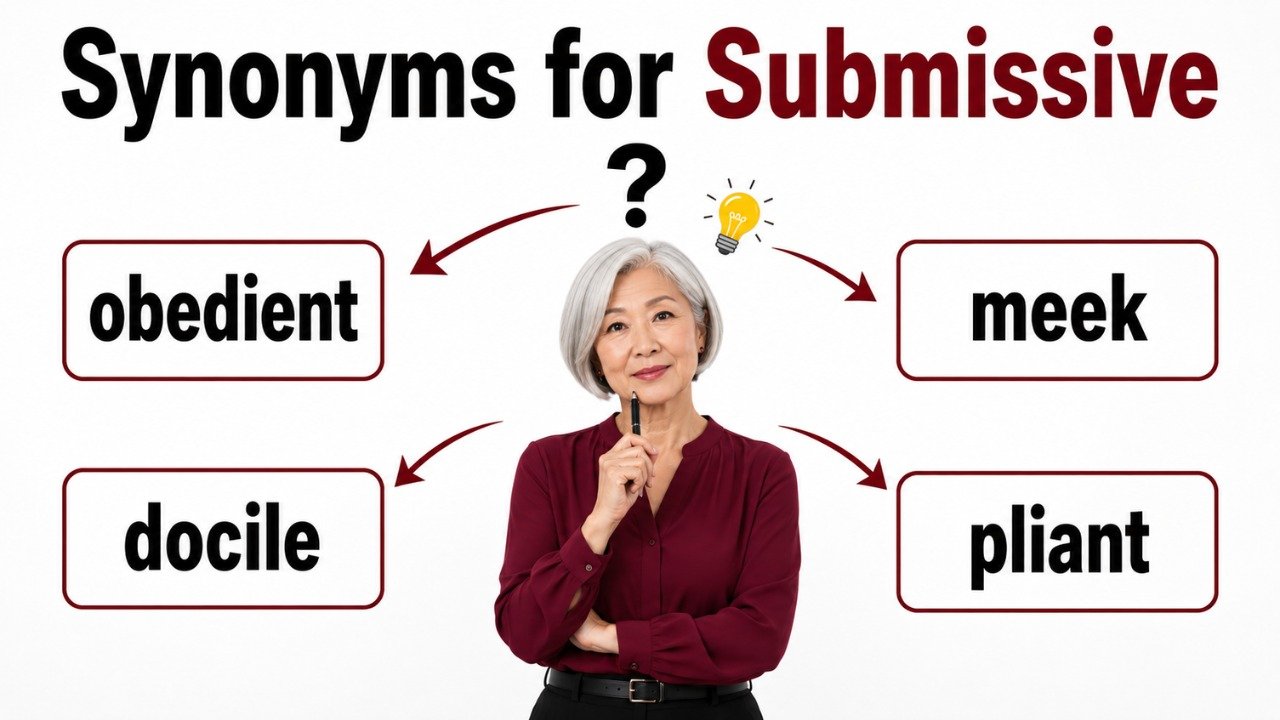
Quick Answer: Common synonyms for submissive include obedient, compliant, yielding, deferential, docile, meek, acquiescent, passive, subservient, and pliant. Among the best synonyms for submissive, use obedient when someone follows instructions, compliant when someone accepts rules or requests, deferential when showing respectful submission, yielding when giving way to another person, docile for someone easy to control, and meek for someone quiet and unlikely to resist. Subservient and servile are stronger and usually negative, while acquiescent works well when someone accepts a decision without protest.
Pronunciation and Word Details
Word: Submissive.
Pronunciation: /səbˈmɪsɪv/
Part of Speech: Adjective.
Meaning: Willing to obey, accept another person’s authority, or give way rather than resist.
US Pronunciation:
UK Pronunciation:
What Does “Submissive” Mean?
Submissive means willing to obey another person, accept authority, or avoid resisting what someone else wants.
It is an adjective used to describe a person, attitude, manner, response, position, or behavior. A submissive person may allow others to make decisions, avoid challenging authority, or readily accept instructions.
The exact meaning depends on context.
Someone may be submissive because they are naturally quiet or unassertive. In another situation, a person may act submissively because of respect for authority. The word can also describe behavior that appears overly obedient, passive, or dependent.
In “He became submissive when speaking to his supervisor,” the word suggests that he avoided challenging the other person’s authority.
In “The animal appeared calm and submissive,” it suggests little resistance or aggression.
In discussions of personal relationships or power dynamics, submissive can describe a person who willingly takes a less controlling role. In such contexts, the surrounding sentence is important because the word can describe either voluntary behavior or unwanted imbalance.
Meaning, Tone, and Context of “Submissive”
Submissive is generally neutral in dictionary meaning, but its tone often depends on the situation.
In descriptions of personality, the word may sound negative because it can suggest weakness, lack of confidence, or unwillingness to defend one’s own views.
In discussions of authority, submissive can simply describe someone who readily follows instructions or accepts another person’s leadership.
In animal behavior, the word is often descriptive rather than judgmental. It may refer to behavior that signals a lack of aggression or willingness to avoid conflict.
In formal or academic writing, submissive may appear in discussions of behavior, social roles, authority, hierarchy, psychology, communication, or interpersonal relationships.
In everyday conversation, words such as obedient, passive, meek, or compliant may sound more natural depending on the intended meaning.
Some synonyms carry stronger judgment than submissive. Servile, subservient, obsequious, and groveling usually express criticism. Deferential and respectful, by contrast, can sound positive because they emphasize respect rather than weakness.
When and How to Use “Submissive”
For Obedience: Use submissive when describing someone who readily follows another person’s instructions or authority.
Example: The new employee seemed unusually submissive during every discussion with management.
For Giving Way: Use submissive when someone consistently allows another person to decide or take control.
Example: His submissive manner made it difficult for him to express disagreement.
For Quiet Behavior: The word can describe a person who avoids confrontation and rarely challenges others.
Example: She appeared submissive in meetings even when she had strong opinions.
For Authority: Submissive can describe behavior toward a person in a position of power.
Example: His submissive response showed that he was unwilling to question the decision.
For Animal Behavior: The word can describe nonaggressive behavior that signals acceptance or avoidance of conflict.
Example: The dog lowered its body in a submissive posture.
For Social Dynamics: Submissive can describe a person who consistently accepts a less dominant role.
Example: The group expected him to remain submissive instead of challenging established roles.
For Voluntary Deference: In some situations, submissive may describe someone who willingly lets another person lead.
Example: She adopted a submissive role during the exercise and allowed her partner to direct the activity.
Best Synonyms for Submissive
Obedient: Willing to follow orders, instructions, or rules.
Example: The obedient student completed the task exactly as instructed.
Compliant: Willing to accept a request, rule, or requirement.
Example: The company needed employees who were compliant with the new procedure.
Yielding: Willing to give way instead of resisting.
Example: His yielding nature often allowed others to make the final decision.
Deferential: Showing respectful acceptance of another person’s authority, knowledge, or position.
Example: She remained deferential when speaking with the senior professor.
Docile: Quiet, easily controlled, and unlikely to resist.
Example: The once energetic animal became unusually docile.
Meek: Quiet, gentle, and unwilling to argue or resist.
Example: His meek response surprised everyone in the room.
Acquiescent: Willing to accept something without protest.
Example: The committee became acquiescent after several hours of discussion.
Passive: Not actively resisting, participating, or taking control.
Example: She remained passive while the others made every decision.
Subservient: Excessively willing to obey or serve another person.
Example: The role required cooperation, not a subservient attitude.
Pliant: Easily influenced, directed, or persuaded.
Example: The inexperienced assistant was too pliant when pressured by stronger personalities.
50 Synonyms for Submissive with Short Meanings
- Obedient: Willing to follow orders or instructions.
- Compliant: Ready to accept rules or requests.
- Yielding: Willing to give way to others.
- Deferential: Respectfully accepting another person’s authority.
- Docile: Quiet and easy to control.
- Meek: Gentle and unlikely to resist.
- Acquiescent: Accepting something without protest.
- Passive: Not actively resisting or taking control.
- Subservient: Excessively willing to obey another person.
- Pliant: Easily influenced or directed.
- Servile: Excessively eager to obey or please.
- Obsequious: Overly eager to show obedience or respect.
- Dutiful: Carefully doing what is expected or required.
- Tractable: Easy to manage or control.
- Amenable: Willing to cooperate or accept suggestions.
- Biddable: Easily instructed or persuaded.
- Cooperative: Willing to work with others and follow a shared direction.
- Agreeable: Willing to accept another person’s suggestion.
- Unassertive: Reluctant to express strong opinions or demands.
- Timid: Lacking confidence or courage in confrontation.
- Humble: Showing little pride or self importance.
- Modest: Not demanding attention or importance.
- Respectful: Showing consideration for authority or others.
- Receptive: Willing to listen to suggestions or direction.
- Malleable: Easily influenced or shaped by others.
- Manageable: Easy to direct or control.
- Tame: Not wild, aggressive, or difficult to control.
- Subdued: Quiet, restrained, or lacking resistance.
- Resigned: Accepting an unwanted situation without further resistance.
- Conciliatory: Intended to reduce conflict or disagreement.
- Nonresistant: Not opposing pressure, authority, or control.
- Unresisting: Offering little or no resistance.
- Conforming: Behaving according to accepted rules or expectations.
- Conformist: Inclined to follow established behavior or opinion.
- Dependent: Relying heavily on another person for support or direction.
- Self effacing: Avoiding attention and minimizing one’s own importance.
- Retiring: Quiet and reluctant to attract attention.
- Shy: Uncomfortable with attention or confrontation.
- Reserved: Restrained in expression or behavior.
- Supplicant: Humbly asking or appealing to someone more powerful.
- Subordinate: Lower in authority, rank, or position.
- Obliging: Willing to help or accommodate others.
- Flexible: Willing to adjust rather than insist on one’s own preference.
- Adaptable: Ready to change according to circumstances or direction.
- Mild: Gentle and not forceful in behavior.
- Gentle: Calm, kind, and not aggressive.
- Uncomplaining: Accepting difficulty without openly protesting.
- Groveling: Showing excessive submission to gain approval or favor.
- Cringing: Showing fearful or excessive submission.
- Slavish: Following another person or idea without sufficient independence.
Read Also:
Synonyms for Split

Synonyms for Submissive by Context
When Submissive Means Obedient
Obedient, compliant, dutiful, biddable, and tractable work well when the main idea is following instructions or authority.
Example: The obedient child followed every instruction given by the teacher.
Obedient is usually the clearest choice when actual orders or rules are involved. Dutiful has a more positive tone because it suggests responsibility rather than weakness.
When Submissive Means Willing to Give Way
Yielding, acquiescent, passive, amenable, and agreeable describe someone who does not strongly resist another person’s wishes.
Example: He was so yielding during negotiations that the other side controlled the discussion.
Acquiescent is particularly useful when someone accepts a decision without openly objecting.
When Submissive Means Respectful Toward Authority
Deferential, respectful, dutiful, and humble are useful when the behavior comes from respect rather than fear.
Example: She was deferential toward the judge without appearing nervous.
Deferential is often more appropriate than submissive when the behavior is polite and socially appropriate.
When Submissive Means Easy to Control
Docile, tractable, pliant, manageable, tame, and malleable emphasize how easily someone or something can be directed.
Example: The trainer described the animal as calm and docile.
Pliant and malleable may also suggest that a person is easily influenced.
When Submissive Has a Negative Meaning
Subservient, servile, obsequious, groveling, cringing, and slavish are stronger choices when criticizing excessive obedience.
Example: His obsequious behavior toward powerful officials made his colleagues uncomfortable.
These words should be used carefully because they express stronger disapproval than submissive.
When Submissive Means Quiet or Unassertive
Meek, passive, timid, reserved, mild, and unassertive can describe people who rarely challenge others.
Example: Her unassertive communication style prevented her from expressing important concerns.
Unassertive is often more precise when the real issue is difficulty expressing needs or opinions.
Another Word for Submissive
The best single replacement for submissive is often obedient, but the correct choice depends on why the person is submitting.
Use compliant for following requirements, deferential for respectful behavior, yielding for giving way, passive for lack of action, and subservient when excessive obedience is being criticized.
Original: He was submissive whenever his supervisor gave instructions.
Better Option: He was obedient whenever his supervisor gave instructions.
Original: She sounded submissive during the formal conversation.
Better Option: She sounded deferential during the formal conversation.
Original: His submissive personality allowed others to control every decision.
Better Option: His yielding personality allowed others to control every decision.
Original: The assistant behaved in an excessively submissive manner around senior staff.
Better Option: The assistant behaved in a subservient manner around senior staff.
When Not to Use “Submissive”
Avoid submissive when a more specific word can explain the behavior more accurately.
If someone is simply polite, submissive may sound unnecessarily negative. Respectful or deferential may be better.
Weak: She gave the guest a submissive greeting.
Better: She gave the guest a respectful greeting.
Do not use submissive merely because someone follows a reasonable rule.
Weak: The drivers were submissive to the safety regulations.
Better: The drivers were compliant with the safety regulations.
Avoid the word when the real meaning is quietness rather than obedience.
Weak: He was submissive and rarely spoke at parties.
Better: He was reserved and rarely spoke at parties.
Do not use submissive when describing someone who accepts a disappointing outcome because they believe further resistance is useless.
Weak: She became submissive after the final decision.
Better: She became resigned after the final decision.
Submissive can also carry implications about power and control. When those implications are not intended, choose a more precise alternative.
Words Commonly Confused With Submissive
Submissive vs Obedient: Submissive suggests a broader willingness to yield to another person’s authority, while obedient specifically emphasizes following instructions or rules.
Submissive vs Compliant: Submissive often describes personality or behavior, while compliant commonly describes following requests, requirements, standards, or regulations.
Submissive vs Passive: Submissive involves giving way to another person’s authority or control. Passive means not taking action or not actively resisting.
Submissive vs Meek: Meek emphasizes gentleness, quietness, and lack of assertiveness. Submissive emphasizes willingness to yield or obey.
Submissive vs Deferential: Deferential behavior comes from respect for another person’s position or knowledge. Submissive behavior may involve greater surrender of control.
Submissive vs Subservient: Subservient is more negative and suggests excessive obedience or willingness to serve another person.
Submissive vs Docile: Docile means easy to manage or control. It is especially common when describing animals, behavior, or temperament.
Which Synonym Should You Choose?
Choose obedient when someone directly follows orders, instructions, or rules.
Choose compliant when discussing regulations, requirements, procedures, requests, or formal expectations.
Choose deferential when someone respectfully acknowledges another person’s authority, experience, or status.
Choose yielding when someone regularly gives way during disagreements, negotiations, or decisions.
Choose docile when describing someone or something calm and easy to manage.
Choose meek when the focus is quietness, gentleness, or unwillingness to confront others.
Choose acquiescent when someone accepts a proposal or decision without protest.
Choose passive when someone does not actively participate, resist, or express an opinion.
Choose subservient when criticizing excessive obedience to someone more powerful.
Choose unassertive when someone struggles to express personal needs, opinions, or boundaries.
For essays and reports, compliant, deferential, acquiescent, passive, and unassertive are often more precise than submissive when their specific meanings fit.
For conversation, obedient, meek, passive, and yielding are usually easier to understand.
Real Life Examples of “Submissive” in Sentences
Original: He became submissive whenever the manager entered the room.
Better Option: He became deferential whenever the manager entered the room.
Original: The student was submissive and followed every instruction.
Better Option: The student was obedient and followed every instruction.
Original: Her submissive attitude prevented her from questioning the decision.
Better Option: Her unassertive attitude prevented her from questioning the decision.
Original: The animal remained submissive around the trainer.
Better Option: The animal remained docile around the trainer.
Original: He gave a submissive response and accepted the proposal.
Better Option: He gave an acquiescent response and accepted the proposal.
Original: She was submissive during every disagreement.
Better Option: She was yielding during every disagreement.
Original: The workers remained submissive to every new requirement.
Better Option: The workers remained compliant with every new requirement.
Original: His submissive behavior toward powerful people seemed excessive.
Better Option: His subservient behavior toward powerful people seemed excessive.
Original: She appeared submissive because she rarely expressed her own preferences.
Better Option: She appeared passive because she rarely expressed her own preferences.
Original: His submissive manner was mistaken for politeness.
Better Option: His deferential manner was mistaken for excessive obedience.
Synonym Groups and Usage Differences
Obedience Group
Obedient, compliant, dutiful, and biddable emphasize following instructions, rules, or expectations.
Obedient is the most general word in this group. Compliant is especially useful for formal requirements, while dutiful suggests responsible fulfillment of obligations.
Example: The dutiful assistant completed every assigned responsibility.
Deference Group
Deferential, respectful, humble, and modest focus more on attitude than direct obedience.
These words can have a positive meaning when they describe courtesy or recognition of another person’s authority.
Example: Her deferential tone showed respect for the experienced researcher.
Yielding Group
Yielding, acquiescent, amenable, agreeable, and conciliatory describe willingness to give way or cooperate.
They are useful in discussions of negotiation, decisions, and disagreement.
Example: He became more amenable after hearing the revised proposal.
Passivity Group
Passive, meek, unassertive, timid, and reserved emphasize limited resistance or self expression.
They do not always mean obedience.
Example: Her passive response allowed the conversation to move forward without her input.
Control Group
Docile, tractable, pliant, manageable, and malleable suggest that a person or thing is relatively easy to direct or influence.
Example: The trainer found the animal unusually tractable.
Excessive Submission Group
Subservient, servile, obsequious, groveling, cringing, and slavish have strongly negative meanings.
These words suggest that obedience has gone beyond ordinary politeness or cooperation.
Example: His servile behavior made the professional relationship seem unequal.
Antonyms of Submissive
The opposite of submissive changes according to whether the word refers to obedience, personality, authority, or resistance.
Dominant: Exercising control or authority over others.
Assertive: Confidently expressing opinions, needs, or rights.
Defiant: Openly resisting authority or expectations.
Rebellious: Unwilling to accept established authority or rules.
Disobedient: Refusing to follow instructions or commands.
Resistant: Opposing pressure, control, or change.
Independent: Able and willing to act without relying on another person’s direction.
Forceful: Strong and confident in expressing ideas or intentions.
Commanding: Showing authority and control.
Self assured: Confident in one’s judgment and abilities.
Strong willed: Determined to follow one’s own decisions and beliefs.
Unyielding: Refusing to give way or change position.
Comparison: Submissive vs Related Words
Submissive vs Obedient
Submissive describes a broader attitude of yielding to another person’s authority. Obedient focuses specifically on following commands or instructions.
Example With Submissive: His submissive manner allowed others to dominate the conversation.
Example With Obedient: The obedient employee followed the instructions carefully.
Submissive vs Compliant
Submissive can describe someone’s personality or relationship to authority. Compliant usually means meeting a request, rule, standard, or requirement.
Example With Submissive: She appeared submissive around senior officials.
Example With Compliant: The organization remained compliant with all required procedures.
Submissive vs Deferential
Submissive may imply surrendering control. Deferential usually indicates respectful treatment of someone with greater authority or expertise.
Example With Submissive: He remained submissive even when he strongly disagreed.
Example With Deferential: He remained deferential while expressing a different opinion.
Submissive vs Passive
Submissive behavior involves yielding to another person. Passive behavior involves limited action, participation, or resistance.
Example With Submissive: She accepted his decisions without challenging them.
Example With Passive: She listened without contributing to the discussion.
Submissive vs Meek
Submissive focuses on obedience or yielding. Meek focuses on quietness, gentleness, and lack of assertiveness.
Example With Submissive: His submissive attitude gave the leader complete control.
Example With Meek: His meek voice was difficult to hear across the room.
Submissive vs Subservient
Subservient is stronger and more critical than submissive. It usually suggests excessive obedience toward someone with greater power.
Example With Submissive: The assistant appeared submissive during the meeting.
Example With Subservient: The assistant’s subservient behavior seemed excessive and uncomfortable.
Common Phrases and Expressions With Submissive
Submissive Behavior: Conduct that shows willingness to obey or yield.
Submissive Attitude: A manner characterized by acceptance of another person’s control or authority.
Submissive Role: A position in which someone allows another person to take greater control or leadership.
Submissive Personality: A personality characterized by frequent yielding, obedience, or lack of assertiveness.
Submissive Manner: A way of behaving that appears obedient or deferential.
Submissive Response: A reaction that shows little resistance or disagreement.
Submissive Posture: Body language that communicates nonaggression, deference, or yielding.
Submissive Tone: A way of speaking that sounds unusually obedient or hesitant.
Submissive Position: A role or situation involving less authority or control.
Submissive Nature: A general tendency to give way rather than challenge others.
Common Mistakes to Avoid
One common mistake is treating every synonym for submissive as interchangeable.
Obedient does not always mean meek. Passive does not always mean compliant. Deferential does not necessarily suggest weakness. Choosing the word that matches the exact context makes writing clearer.
Another mistake is using submissive when respectful is intended. Someone who politely recognizes another person’s authority is not necessarily submissive.
Avoid overusing strong negative alternatives such as servile, groveling, obsequious, and subservient. These words communicate criticism and may change the emotional meaning of a sentence.
Writers should also distinguish between personality and behavior. A person may behave submissively in one situation without having a submissive personality.
Do not confuse passive with submissive. A passive person may simply avoid taking action, while a submissive person specifically yields to another person’s direction or authority.
Repetition can also weaken writing.
Weak: She was submissive at work, submissive in meetings, and submissive whenever someone disagreed with her.
Better: She was deferential at work, passive in meetings, and yielding whenever someone challenged her opinion.
Precise synonym choices make the meaning more informative and natural.
Conclusion
Synonyms for submissive include obedient, compliant, yielding, deferential, docile, meek, acquiescent, passive, subservient, and pliant. The best choice depends on the reason someone is yielding. Use obedient for following instructions, compliant for meeting requirements, deferential for respectful behavior, yielding for giving way, and passive for limited resistance. Stronger words such as servile and subservient add criticism. Choosing a synonym according to tone, authority, personality, and context makes your writing clearer and more accurate.
FAQs About Synonyms for Submissive
What is the best synonym for submissive?
Obedient is one of the closest general synonyms, but yielding, compliant, deferential, meek, and passive may be more accurate in particular contexts.
What is a polite synonym for submissive?
Deferential is often a more polite alternative because it emphasizes respect rather than weakness or lack of independence.
What is a negative synonym for submissive?
Subservient, servile, obsequious, groveling, and slavish are negative alternatives that suggest excessive obedience.
Are submissive and obedient the same?
Not exactly. Obedient means following instructions or commands, while submissive more broadly describes a willingness to yield to another person’s authority or control.
What is another word for a submissive personality?
Meek, passive, yielding, unassertive, or compliant may work depending on the behavior being described.
Is passive a synonym for submissive?
Passive can be a synonym in some situations, but it focuses on lack of action or resistance rather than direct obedience to another person.
What is the opposite of submissive?
Common opposites include assertive, dominant, defiant, independent, rebellious, resistant, and unyielding. The best antonym depends on the context.
