
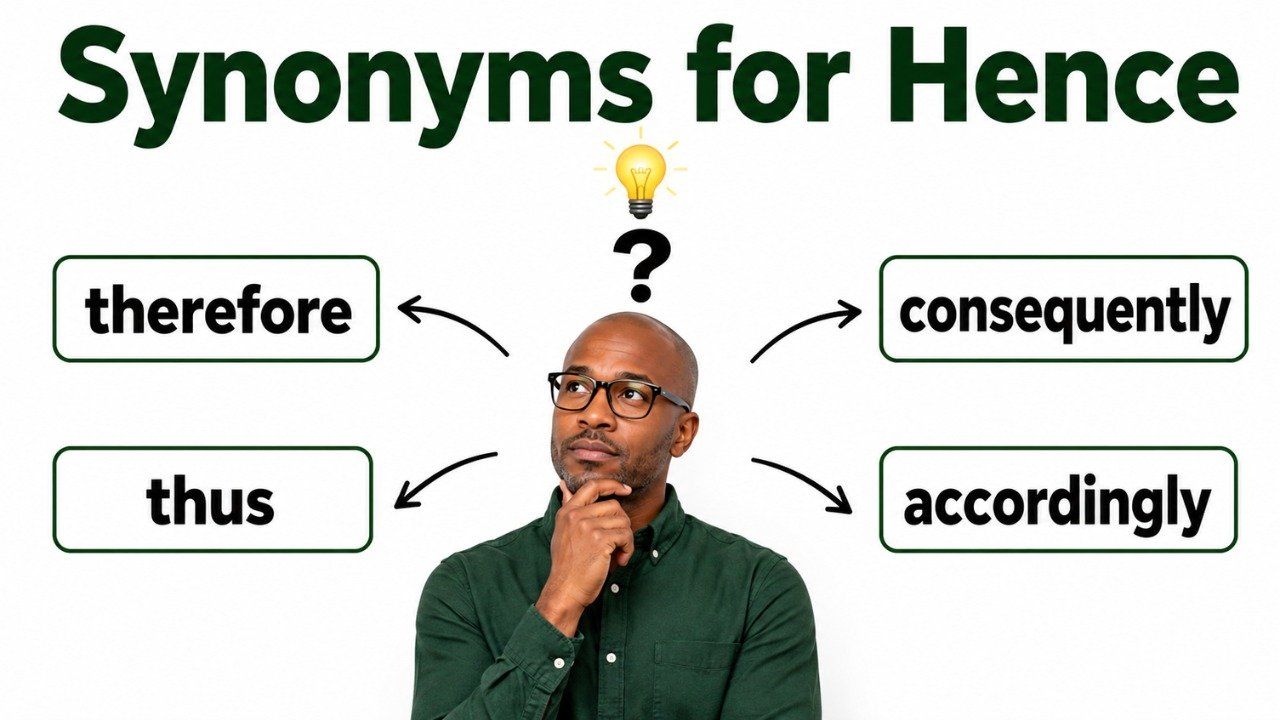
Quick Answer: Common synonyms for hence include therefore, thus, consequently, accordingly, so, as a result, for this reason, because of this, subsequently, and later. Among the best synonyms for hence, use therefore or thus in formal writing, consequently when stressing a result, accordingly when describing an appropriate response, so in casual conversation, and as a result when you want the cause and effect relationship to be especially clear. When hence refers to future time, later or from now may be better choices.
Pronunciation and Word Details
Word: Hence.
Pronunciation: /hens/.
Part of Speech: Adverb.
Meaning: Hence usually means for this reason, as a result, or from this time in the future.
US Pronunciation:
UK Pronunciation:
What Does “Hence” Mean?
Hence is an adverb that most commonly means therefore, for this reason, or as a result.
It connects a fact, situation, or cause with a conclusion or consequence. For example, if someone says, “The road was closed, hence the delay,” hence shows that the delay resulted from the road closure.
Hence also has a time meaning. In a sentence such as “Five years hence, the area may look very different,” it means five years from now.
A less common and older meaning refers to movement away from a place. In older language, hence can mean from here or away from this place. This meaning is uncommon in ordinary modern English.
The meaning of hence therefore depends on sentence context. In reasoning and explanation, it usually introduces a result. In time expressions, it points to a future period.
Meaning, Tone, and Context of “Hence”
Hence usually has a formal, neutral, and somewhat academic tone. It is common in essays, reports, explanations, arguments, analytical writing, professional communication, and carefully structured prose.
When hence means therefore, it can make a sentence sound concise and logical. Writers often use it when they want to connect a cause directly with its consequence.
In everyday conversation, however, hence can sound more formal than necessary. So is usually more natural in casual speech.
Formal Context: Hence works well when explaining conclusions, consequences, or logical relationships in structured writing.
Academic Context: It can introduce a conclusion that follows from evidence, reasoning, or previously stated information.
Professional Context: Hence can connect a situation with its practical result in reports, summaries, and formal communication.
Conversational Context: Hence is grammatically correct, but so, that is why, or because of this often sounds more natural.
Time Context: Hence can mean from now or from a specified point in time, especially in expressions such as “two months hence.”
Older Context: Hence can mean away from here, although this use is now mainly literary or historical.
When and How to Use “Hence”
For Showing a Result
Use hence when the second idea is a consequence of the first.
Example: The equipment was unavailable, hence the change in schedule.
Here, hence explains why the schedule changed.
For Drawing a Logical Conclusion
Hence can introduce a conclusion that follows naturally from evidence or reasoning.
Example: Every available seat was occupied, hence we knew the event had attracted a large audience.
The word shows that the conclusion is based on the previous fact.
For Explaining Cause and Effect
Hence is useful when you want to connect a cause with its outcome in a concise way.
Example: Demand increased rapidly, hence the need for additional supplies.
For Formal Writing
Hence is especially useful in essays, reports, academic explanations, and other formal contexts.
Example: The two results were inconsistent, hence further testing was necessary.
For Future Time
Hence can refer to a future point measured from now or another stated time.
Example: Ten years hence, the neighborhood may be completely transformed.
For Concise Explanations
Hence can replace longer expressions such as for this reason or as a result.
Example: The deadline was moved, hence the revised schedule.
For Older Spatial Meaning
In older or literary English, hence may mean away from here.
Example: The messenger was ordered to go hence immediately.
This meaning is uncommon in modern everyday writing.
Best Synonyms for Hence
Therefore
Synonym: Therefore means for that reason or as a logical result.
Example: The roads were flooded. Therefore, the journey was postponed.
Thus
Synonym: Thus means in this way or as a result and is especially useful in formal reasoning.
Example: The evidence was incomplete, thus a final decision could not be made.
Consequently
Synonym: Consequently emphasizes that one event happened because of another.
Example: Production slowed, and consequently the delivery date changed.
Accordingly
Synonym: Accordingly means as a result or in a way that suits the circumstances.
Example: The weather became severe, so the organizers adjusted the schedule accordingly.
So
Synonym: So is a common and conversational way to introduce a consequence.
Example: The store was closed, so we returned home.
As a Result
Synonym: As a result clearly introduces the outcome of an earlier event.
Example: Several roads were blocked. As a result, traffic moved slowly.
For This Reason
Synonym: For this reason directly explains that the following statement results from what came before.
Example: The information was incomplete. For this reason, the report was delayed.
Because of This
Synonym: Because of this gives a clear and natural explanation of a consequence.
Example: Temperatures dropped sharply. Because of this, the event was moved indoors.
Subsequently
Synonym: Subsequently means later or afterward and can replace hence when the meaning concerns sequence rather than direct cause.
Example: The policy was reviewed and subsequently revised.
Later
Synonym: Later is a simple alternative when hence refers to future time.
Example: Several years later, the building was completely renovated.
50 Synonyms for Hence with Short Meanings
The following words and phrases cover the major meanings of hence. Some express consequence, some indicate future time, and others fit its older spatial meaning.
- Therefore: For that reason.
- Thus: As a result or in this way.
- Consequently: As a consequence.
- Accordingly: As a result or appropriately.
- So: For that reason.
- As a result: Because of what happened.
- For this reason: Due to the stated cause.
- Because of this: As a consequence of this.
- That is why: Explaining the reason for a result.
- Which is why: Connecting a fact with its consequence.
- As a consequence: As the resulting effect.
- For that reason: Because of the previously stated fact.
- On that account: Because of that circumstance.
- Thereupon: Immediately after that or as a consequence.
- Wherefore: For what reason or therefore in older formal usage.
- Ergo: Therefore, especially in logical reasoning.
- Then: In that case or as a result.
- It follows that: Introducing a logical conclusion.
- For that cause: Because of that reason.
- Owing to this: Because of this circumstance.
- Due to this: Because of this situation.
- Resultingly: In a resulting manner, though uncommon.
- In consequence: As a result.
- In consequence of this: Because of the stated situation.
- As such: As a result of that status or condition.
- Thereby: By that means or as a result of that action.
- By consequence: As a resulting effect, though less common.
- On this basis: Because of the stated evidence or reasoning.
- From this: As a conclusion drawn from this information.
- It follows: A conclusion logically results.
- Later: At a future time.
- Afterward: At a later time.
- Afterwards: Later in time.
- Subsequently: At a later stage.
- From now: Beginning at the present time.
- From then: Beginning at the stated past or future point.
- In the future: At a later time.
- Later on: At some later point.
- After that: Following a stated event.
- Following this: Coming after the current event.
- Thereafter: After that time.
- In time: Eventually or after some period.
- Eventually: At a later stage after time passes.
- From this time: Beginning from the present point.
- From that time: Beginning from a specified point.
- Away: Toward another place.
- From here: Away from the present location.
- Away from here: Leaving the current place.
- Elsewhere: In or to another place.
- Off: Away from a place, especially in informal movement contexts.
Read Also:
Synonyms for Finished

Synonyms for Hence by Context
When Hence Means Therefore
When hence introduces a logical result, the strongest alternatives are therefore, thus, consequently, accordingly, and so.
Example With Hence: The figures were incomplete, hence no final estimate could be made.
Example With Therefore: The figures were incomplete. Therefore, no final estimate could be made.
Example With Thus: The figures were incomplete, thus preventing a final estimate.
Therefore is clear and formal. Thus is concise and academic. So is usually more conversational.
When Hence Means As a Result
When you want to emphasize a consequence rather than simply a logical conclusion, use consequently, as a result, as a consequence, or because of this.
Example With Hence: Heavy rain continued overnight, hence the flooding.
Example With As a Result: Heavy rain continued overnight. As a result, several streets flooded.
Consequently and as a result often make the relationship between two events especially clear.
When Hence Means For This Reason
For this reason, because of this, that is why, and which is why are useful when clarity matters more than concision.
Example With Hence: The information could not be confirmed, hence the cautious wording.
Example With For This Reason: The information could not be confirmed. For this reason, the wording remained cautious.
These alternatives are especially helpful for readers who may find hence overly formal.
When Hence Refers to Future Time
When hence appears after a period of time, it usually means from now or from the relevant point in time.
Useful alternatives include later, from now, subsequently, in the future, and later on.
Example With Hence: Six months hence, the project should be complete.
Example With From Now: Six months from now, the project should be complete.
From now usually sounds more natural in everyday English.
When Hence Means Away From Here
The spatial meaning of hence is mainly found in older or literary language.
Possible alternatives include away, from here, away from here, elsewhere, and off.
Example With Hence: Leave hence before nightfall.
Example With Away: Go away before nightfall.
Modern English normally prefers the simpler alternative.
Another Word for Hence
The best single replacement for hence is often therefore when hence means “for this reason.” Therefore is widely understood, works well in formal writing, and clearly introduces a conclusion.
The best alternative still depends on context. So is better in casual speech, consequently emphasizes a result, and from now works when hence refers to future time.
Original: The evidence was insufficient, hence the investigation continued.
Better Option: The evidence was insufficient. Therefore, the investigation continued.
Original: The temperature fell below freezing, hence the icy roads.
Better Option: The temperature fell below freezing. Consequently, the roads became icy.
Original: Two weeks hence, the results will be announced.
Better Option: Two weeks from now, the results will be announced.
Original: She had another appointment, hence her early departure.
Better Option: She had another appointment, which is why she left early.
When Not to Use “Hence”
Hence is useful, but it is not always the clearest or most natural choice.
When Casual Language Is Better
In everyday conversation, hence may sound unnecessarily formal.
Weak: I forgot my wallet, hence I went back home.
Better: I forgot my wallet, so I went back home.
When the Cause Needs More Explanation
Hence can make a relationship seem obvious even when the connection needs to be explained.
Weak: Sales changed, hence the new policy.
Better: Sales declined for several months. As a result, the company introduced a new policy.
When Repetition Becomes Noticeable
Using hence repeatedly in the same paragraph can make writing sound mechanical.
Weak: Costs rose, hence prices increased. Demand fell, hence production slowed.
Better: Costs rose, so prices increased. Demand then fell, and consequently production slowed.
When Future Time Should Sound Natural
In everyday language, from now is often clearer than the temporal use of hence.
Weak: Three days hence, we will meet again.
Better: Three days from now, we will meet again.
When the Meaning Could Be Ambiguous
If readers may not know whether hence refers to a consequence or future time, choose a more explicit phrase.
Weak: Several months hence, changes appeared.
Better: Several months later, the changes appeared.
Words Commonly Confused With Hence
Hence vs Therefore: Both can mean for that reason. Therefore is extremely clear in logical conclusions, while hence is slightly more compact and can also refer to future time.
Hence vs Thus: Both can introduce a result. Thus can also mean in this way, while hence does not normally carry that meaning.
Hence vs Consequently: Hence can introduce a logical conclusion, while consequently places stronger emphasis on an actual consequence or outcome.
Hence vs Accordingly: Hence means for this reason, while accordingly can also mean in a manner appropriate to the circumstances.
Hence vs So: Both can express consequence. Hence is more formal, while so is more common in everyday conversation.
Hence vs Therefore: Hence can be followed directly by a noun phrase in constructions such as “hence the delay.” Therefore is more commonly used to connect complete statements.
Hence vs Thereby: Hence explains why something follows. Thereby usually means by that action or by that means.
Hence vs Henceforth: Hence can mean therefore or from a future point. Henceforth means from this time onward.
Hence vs Thereafter: Hence may mean a specified time from now, while thereafter means after a particular event or time.
Which Synonym Should You Choose?
Choose therefore when you need a clear and formal logical conclusion.
Choose thus when writing concise academic, analytical, or explanatory sentences.
Choose consequently when you want to emphasize that one event produced another.
Choose accordingly when the result involves an action that fits the circumstances.
Choose so when speaking casually or writing in a natural conversational style.
Choose as a result when clarity is more important than brevity.
Choose for this reason when you want to make the reasoning unmistakable.
Choose because of this when explaining a consequence in straightforward language.
Choose from now when hence refers to a future point measured from the present.
Choose later or subsequently when the important idea is sequence in time rather than direct cause.
For essays and reports, therefore, thus, consequently, and as a result are usually strong choices.
For emails and professional messages, therefore, accordingly, or for this reason may sound clear and natural.
For conversation, so or that is why will usually sound less formal.
Real Life Examples of “Hence” in Sentences
Example One
Original: The train was delayed, hence our late arrival.
Better Option: The train was delayed, so we arrived late.
Example Two
Original: The instructions were unclear, hence the confusion.
Better Option: The instructions were unclear, which is why everyone became confused.
Example Three
Original: Demand increased sharply, hence the higher production target.
Better Option: Demand increased sharply. Consequently, the production target was raised.
Example Four
Original: The room receives little sunlight, hence its cooler temperature.
Better Option: The room receives little sunlight. As a result, it stays cooler.
Example Five
Original: Two months hence, the renovation should be complete.
Better Option: Two months from now, the renovation should be complete.
Example Six
Original: The evidence was incomplete, hence the cautious conclusion.
Better Option: The evidence was incomplete. Therefore, the conclusion remained cautious.
Example Seven
Original: The schedule had changed, hence our need to leave earlier.
Better Option: The schedule had changed, so we needed to leave earlier.
Example Eight
Original: Several records were missing, hence further research was required.
Better Option: Several records were missing. Thus, further research was required.
Example Nine
Original: Costs continued to rise, hence the decision to reduce unnecessary spending.
Better Option: Costs continued to rise. For this reason, unnecessary spending was reduced.
Example Ten
Original: The path was unsafe, hence visitors were asked to use another route.
Better Option: The path was unsafe. Accordingly, visitors were asked to use another route.
Synonym Groups and Usage Differences
Logical Conclusion Group
Therefore, thus, it follows, on this basis, and ergo introduce conclusions based on facts or reasoning.
These choices work especially well when one statement logically follows from another.
Example: The figures do not match. Therefore, they must be checked again.
Consequence Group
Consequently, as a result, as a consequence, and because of this emphasize an outcome produced by an earlier event.
They are useful when describing clear cause and effect relationships.
Example: Temperatures fell rapidly. Consequently, the roads became icy.
Reason Group
For this reason, for that reason, that is why, and which is why make the reason for an outcome explicit.
These alternatives are often clearer than hence in everyday writing.
Example: The application was incomplete. For this reason, it could not be processed.
Formal Connection Group
Thus, therefore, accordingly, and consequently are useful in essays, reports, explanations, and analytical writing.
They create a clear connection between ideas without sounding conversational.
Example: The available evidence was limited. Thus, the conclusion remained tentative.
Casual Result Group
So, that is why, and because of this work well in conversation and accessible writing.
They usually sound more natural than hence in ordinary speech.
Example: It started raining, so we went inside.
Future Time Group
Later, from now, subsequently, in the future, and later on can replace hence when it refers to time.
Example: Five years from now, the situation may be very different.
Older Spatial Group
Away, from here, away from here, elsewhere, and off correspond to the older spatial meaning of hence.
Example: The traveler was told to go away before nightfall.
Antonyms of Hence
Because hence has several meanings, its opposites depend on context. A word meaning therefore does not have one perfect direct antonym, but several expressions can indicate contrast, absence of consequence, or earlier time.
Antonym: Nevertheless. Introduces a contrasting result despite what was previously stated.
Antonym: However. Signals contrast rather than consequence.
Antonym: Despite this. Shows that the expected result did not occur.
Antonym: Regardless. Indicates that something happens without being affected by the previous condition.
Antonym: Previously. Refers to an earlier time rather than a future one.
Antonym: Earlier. At a time before the stated point.
Antonym: Beforehand. Before an event or specified time.
Antonym: Formerly. At an earlier period.
Antonym: Here. In this place rather than away from it.
Antonym: Hither. Toward this place in older English.
Comparison: Hence vs Related Words
Hence vs Therefore
Hence and therefore both introduce a result or conclusion. Therefore is usually more explicit, while hence can be shorter and can appear naturally before a noun phrase.
Example With Hence: The road was blocked, hence the delay.
Example With Therefore: The road was blocked. Therefore, we were delayed.
Hence vs Thus
Both words can introduce a conclusion, but thus has an additional meaning of in this way.
Example With Hence: The figures were inaccurate, hence the revised report.
Example With Thus: The figures were inaccurate, thus requiring a revised report.
Hence vs Consequently
Consequently places greater emphasis on an actual consequence produced by an event.
Hence can sometimes sound more like a concise logical connection.
Example With Hence: Temperatures dropped, hence the increased demand for heating.
Example With Consequently: Temperatures dropped sharply. Consequently, demand for heating increased.
Hence vs Accordingly
Accordingly can mean as a result, but it can also suggest that someone acted in a suitable way because of the circumstances.
Example With Hence: Conditions had changed, hence the revised plan.
Example With Accordingly: Conditions had changed, so the team revised the plan accordingly.
Hence vs So
So is the most natural choice in many casual conversations, while hence is more formal.
Example With Hence: I had another commitment, hence my early departure.
Example With So: I had another commitment, so I left early.
Hence vs Thereby
Hence explains the reason a result follows. Thereby describes the means through which a result is achieved.
Example With Hence: The entrance was blocked, hence the need for another route.
Example With Thereby: They opened another entrance, thereby improving access.
Hence vs Henceforth
Hence can mean therefore or a point in the future. Henceforth means from this time onward.
Example With Hence: Three weeks hence, the results will be available.
Example With Henceforth: Henceforth, all applications must include the required document.
Hence vs Thereafter
Hence can refer to a future interval measured from a particular point. Thereafter means after that event or time.
Example With Hence: Two years hence, the building may be complete.
Example With Thereafter: The building opened in May and remained busy thereafter.
Common Phrases and Expressions With “Hence”
Hence the Reason: Introduces the explanation for something, although often simply saying hence is enough.
Hence the Need: Shows that a situation creates a particular necessity.
Hence the Name: Explains why something has a particular name.
Hence the Term: Explains the origin or reason for a term.
Hence the Importance: Shows why something is important.
Hence the Difference: Explains why two things are not the same.
Hence the Confusion: Identifies the cause of misunderstanding.
Hence the Delay: Explains why something happened late.
Hence the Conclusion: Connects earlier reasoning with a conclusion.
Years Hence: Refers to a number of years from the present or another stated point.
Common Mistakes to Avoid
Using Hence as a Direct Substitute Everywhere
Hence cannot replace every word that expresses cause or result.
Incorrect: I stayed home hence it was raining.
Better: I stayed home because it was raining.
Because introduces the cause directly, while hence normally introduces the result.
Confusing Cause With Result
Hence should normally point toward the consequence.
Unclear: The meeting was canceled, hence the storm.
This wording may wrongly suggest that the storm resulted from the cancellation.
Better: There was a severe storm, hence the meeting was canceled.
Overusing Hence
Repeated use can make writing sound stiff.
Weak: The deadline changed, hence the schedule changed, hence the team adjusted its plans.
Better: The deadline changed, so the schedule was revised. Consequently, the team adjusted its plans.
Using Hence When So Sounds More Natural
Formal vocabulary does not automatically make a sentence better.
Weak: I was hungry, hence I made a sandwich.
Better: I was hungry, so I made a sandwich.
Confusing Hence With Henceforth
Henceforth means from now onward, not therefore.
Incorrect: The road was closed, henceforth we used another route.
Better: The road was closed, hence we used another route.
Confusing Hence With Thereby
Thereby explains the means through which something happens.
Incorrect: She added more detail, hence making the instructions clearer.
Better: She added more detail, thereby making the instructions clearer.
Using Temporal Hence Unnaturally
The time meaning of hence is correct but often sounds formal.
Formal: Six months hence, the results will be reviewed.
Natural: Six months from now, the results will be reviewed.
Adding Unnecessary Words
The expression hence the reason can sometimes be redundant because hence already communicates the idea of a reason or result.
Wordy: The office was closed, hence the reason we returned home.
Better: The office was closed, hence our return home.
Conclusion
Synonyms for hence include therefore, thus, consequently, accordingly, so, as a result, and for this reason when the word expresses a consequence or conclusion. Therefore and thus work especially well in formal writing, consequently highlights a result, and so is usually better for casual speech. When hence refers to future time, from now, later, or subsequently may be clearer. Choosing the right alternative depends on whether you are expressing logic, consequence, sequence, future time, or an older spatial meaning.
FAQs About Synonyms for Hence
What Is the Best Synonym for Hence?
The best general synonym is therefore when hence means for this reason. In casual speech, so is often more natural.
Is Hence the Same as Therefore?
They are very similar when introducing a conclusion or result. However, hence can also refer to future time, while therefore does not have that meaning.
Can I Use Thus Instead of Hence?
Yes, especially in formal or academic writing when introducing a conclusion. However, thus can also mean in this way, so the two words are not identical in every sentence.
Is Hence a Formal Word?
Yes. Hence usually sounds more formal than so, because of this, or that is why. It is common in essays, reports, and carefully structured explanations.
What Does “Three Years Hence” Mean?
It means three years from now or three years from the time being discussed.
Can Consequently Replace Hence?
Yes, when hence introduces a consequence. Consequently often places stronger emphasis on the result produced by an earlier event.
What Is a Casual Alternative to Hence?
So is usually the simplest casual alternative. That is why and because of this are also natural choices when the relationship needs to be clearer.
