
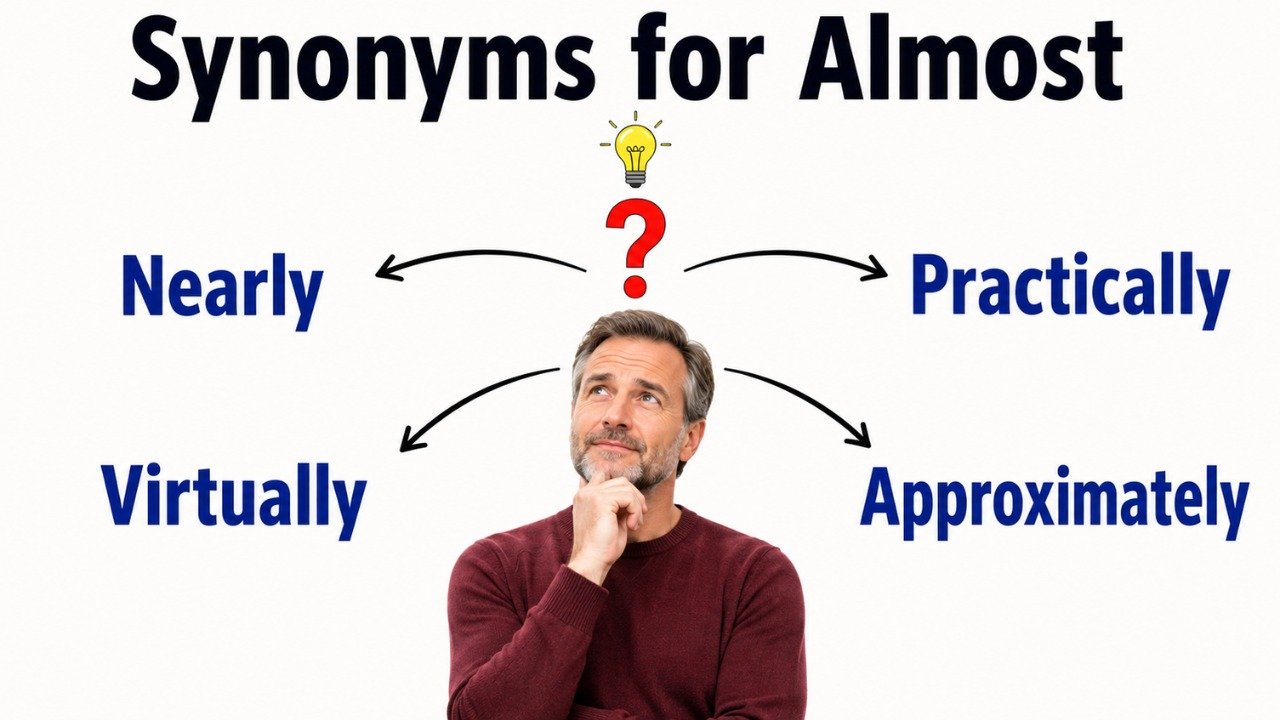
Quick Answer: The best synonyms for almost include nearly, practically, virtually, approximately, roughly, about, around, just about, close to, and all but. Among these synonyms for almost, nearly is the most natural general replacement. Use approximately or roughly for numbers and estimates, practically or virtually for strong emphasis, just about in casual speech, close to for distance or progress, and all but when something is nearly complete or certain.
Pronunciation and Word Details
Word: Almost.
Pronunciation: /ˈɔːl.moʊst/
Part of Speech: Adverb.
Meaning: Very nearly, but not completely, exactly, or entirely.
US Pronunciation:
UK Pronunciation:
What Does “Almost” Mean?
Almost means very nearly but not completely. It is mainly an adverb used when something comes close to happening, being true, reaching a number, or achieving a condition without fully doing so.
You can use almost with verbs, adjectives, numbers, quantities, time expressions, and complete situations.
With Verbs: She almost missed the train.
With Adjectives: The room was almost empty.
With Numbers: Almost fifty people attended.
With Time: It is almost noon.
With Complete Situations: We almost finished the project before dinner.
The central idea is closeness without full completion. Something described with almost is near a point, result, amount, or condition but has not completely reached it.
Meaning, Tone, and Context of “Almost”
Almost has a neutral and highly flexible tone. It works naturally in formal writing, academic writing, professional communication, casual speech, stories, descriptions, reports, and everyday conversation.
Neutral Tone: Almost does not usually express a strong emotion by itself. Its emotional effect depends on the sentence.
Conversational Use: Almost is extremely natural when describing something that nearly happened.
Example: I almost forgot my keys.
Formal Use: Almost can also appear in reports and essays, although approximately, nearly, or virtually may sometimes provide greater precision.
Example: Almost half of the participants completed the task.
Emotional Context: Almost may suggest relief, disappointment, danger, or anticipation.
Example: She almost won the competition.
Quantity Context: It can describe a number or amount that is close to another value.
Example: The journey lasted almost three hours.
Completion Context: Almost often shows that an action came close to completion.
Example: They had almost finished their work.
When and How to Use “Almost”
For Near Completion: Use almost when an action or process is close to being finished.
Example: We have almost completed the assignment.
For Events That Nearly Happened: Use almost when something came close to occurring but did not happen completely.
Example: He almost dropped the glass.
For Numbers and Amounts: Use almost before a number or quantity when the actual amount is slightly lower.
Example: Almost one hundred guests attended the event.
For Time: Use almost when a particular time is approaching.
Example: It is almost midnight.
For Conditions: Use almost before an adjective when something is close to a particular state.
Example: The bottle was almost empty.
For Similarity: Almost can show that two things are very similar but not completely identical.
Example: The two designs look almost identical.
For Strong Emphasis: Almost can make an extreme statement slightly less absolute.
Example: The task seemed almost impossible at first.
For Near Success or Failure: Use almost when someone came close to achieving or avoiding something.
Example: She almost passed the final test.
Best Synonyms for Almost
Nearly: Very close to a point, amount, condition, or result.
Example: The work is nearly finished.
Practically: So nearly true or complete that the difference seems very small.
Example: The hall was practically empty.
Virtually: Almost completely or nearly true in practical terms.
Example: The two versions are virtually identical.
Approximately: Close to an exact number or amount.
Example: Approximately two hundred people attended.
Roughly: About a particular amount without exact precision.
Example: The trip takes roughly three hours.
About: Close to a number, amount, or time.
Example: About fifty guests arrived.
Around: Approximately a particular number, amount, or time.
Example: Around thirty students joined the class.
Just About: Very nearly or approximately.
Example: We are just about finished.
Close To: Near a particular amount, condition, or result.
Example: The temperature was close to freezing.
All But: Very nearly or almost completely.
Example: The decision was all but final.
50 Synonyms for Almost with Short Meanings
- Nearly: Very close to completion or a particular point.
- Practically: Almost completely in a practical sense.
- Virtually: Nearly completely or effectively.
- Approximately: Close to an exact amount or number.
- Roughly: About an amount without exact precision.
- About: Near a number, time, or quantity.
- Around: Approximately a number, amount, or time.
- Just About: Very nearly or approximately.
- Close To: Near a particular point, condition, or amount.
- All But: Very nearly or almost completely.
- More or Less: Approximately or nearly.
- Well Nigh: Very nearly or almost completely.
- Nigh On: Nearly reaching a number, time, or condition.
- Near: Close to a point or condition.
- Nearly All: Most of something but not all.
- Nearly Complete: Close to being fully finished.
- Almost Entirely: Very close to being complete.
- Almost Completely: Nearly reaching total completion.
- For the Most Part: Mostly, though not completely.
- For All Practical Purposes: Effectively true despite a small technical difference.
- Within Reach Of: Close to achieving something.
- On the Verge Of: Very close to entering a state or situation.
- On the Brink Of: Very close to an event or major change.
- On the Point Of: Very close to doing something.
- About To: Very close to performing an action.
- Close To Being: Near a particular state or condition.
- Not Quite: Slightly less than complete or exact.
- Just Short Of: Slightly below a number, level, or result.
- A Little Short Of: Somewhat below a target or amount.
- Slightly Under: A little below a number or level.
- Barely Short Of: Missing a target by a very small amount.
- Within a Hair Of: Extremely close to an event or result.
- Within an Inch Of: Extremely close to something happening.
- Within Touching Distance Of: Very close to reaching a goal.
- Close Upon: Nearly reaching a time, number, or stage.
- Approaching: Coming close to a particular point.
- Nearing: Moving close to a time, condition, or result.
- Bordering On: Close to becoming or resembling something.
- Verging On: Very close to reaching a condition or quality.
- Just Under: Slightly below a number or amount.
- Just Shy Of: Slightly below a target or amount.
- Scarcely Short Of: Very nearly reaching a point.
- Only Just Short Of: Missing something by a small amount.
- Not Far From: Relatively close to a result or condition.
- Within Sight Of: Close to achieving a goal or finishing something.
- Close Enough To: Near enough to a standard or result.
- In the Vicinity Of: Approximately near an amount or figure.
- Something Like: Approximately a particular number or amount.
- Somewhere Around: Approximately near a number or quantity.
- In the Neighborhood Of: Approximately close to a number or amount.
Read Also:
Synonyms for Encouraging

Synonyms for Almost by Context
When Almost Means Nearly
Nearly is the strongest general synonym when something comes close to happening or becoming true.
Other useful choices include just about, close to, not quite, and well nigh.
Example: We nearly missed the opening announcement.
Example: The room was just about empty.
When Almost Refers to Numbers or Amounts
When almost introduces a number, time, distance, or quantity, useful alternatives include approximately, roughly, about, around, just under, and just shy of.
Example: Approximately eighty people attended the meeting.
Example: The journey lasted roughly five hours.
When Almost Means Practically Complete
When the difference between almost and completely is very small, practically, virtually, all but, and for all practical purposes work well.
Example: The building was virtually empty.
Example: Their agreement was all but complete.
When Almost Means About to Happen
When an event is extremely close to occurring, useful alternatives include about to, on the verge of, on the brink of, and on the point of.
Example: She was about to leave when the phone rang.
Example: The team was on the verge of winning.
When Almost Means Slightly Below
When something falls just below a target, number, or standard, use just short of, just shy of, slightly under, or not quite.
Example: Attendance was just short of one thousand.
Example: The package weighed just under ten kilograms.
When Almost Means Close to a Condition
When something nearly reaches a state or quality, useful choices include bordering on, verging on, approaching, and close to being.
Example: His excitement was bordering on disbelief.
Example: The project is close to being complete.
Another Word for Almost
Nearly is usually the best single replacement for almost because it works naturally with actions, quantities, time, conditions, and results. However, the best alternative depends on context.
Use approximately for estimated numbers, virtually for something nearly complete, and about to when an action is immediately approaching.
Original: We almost finished the report.
Better Option: We nearly finished the report.
Original: Almost two hundred guests attended.
Better Option: Approximately two hundred guests attended.
Original: The two answers were almost identical.
Better Option: The two answers were virtually identical.
Original: She almost began to cry.
Better Option: She was about to cry.
When Not to Use “Almost”
Almost is clear and versatile, but another word may be more precise in certain situations.
Do not use almost for an estimate when the number could be either above or below the stated figure. Almost normally suggests that the actual amount is slightly less.
Weak: The journey took almost four hours, possibly four hours and ten minutes.
Better: The journey took approximately four hours.
Avoid almost when describing something that has effectively become complete.
Weak: The old system is almost unused.
Better: The old system is virtually unused.
Do not overuse almost repeatedly in the same paragraph.
Weak: We almost reached the top, almost completed the route, and almost arrived before sunset.
Better: We nearly reached the top, came close to completing the route, and arrived shortly before sunset.
Avoid placing almost where its meaning becomes unclear.
Weak: She almost told everyone that she was leaving.
This could mean she nearly told everyone, or that she told nearly everyone.
Better: She nearly announced to everyone that she was leaving.
Use an exact numerical expression instead of almost when precision is essential.
Weak: The container holds almost ten liters.
Better: The container holds 9.8 liters.
Words Commonly Confused With Almost
Almost vs Nearly: Both mean very close but not complete. Nearly is often interchangeable with almost, though certain expressions sound more natural with one than the other.
Almost vs Approximately: Almost usually means slightly less than a stated amount, while approximately means close to an amount and may be slightly above or below it.
Almost vs About: About means approximately when discussing numbers or quantities. Almost suggests that the stated point has not quite been reached.
Almost vs Virtually: Almost simply indicates nearness. Virtually often means that something is effectively true despite a very small difference.
Almost vs Practically: Practically often suggests that the remaining difference is unimportant in real situations.
Almost vs Barely: Almost means something nearly happened or nearly reached a point. Barely means something happened or was achieved, but only by a very small margin.
Almost vs Just: Just can mean exactly, recently, only, or barely depending on context. It is not always a substitute for almost.
Almost vs About To: Almost can describe many forms of nearness. About to specifically means that an action or event is expected to happen very soon.
Which Synonym Should You Choose?
Choose nearly for the most flexible general replacement in formal and casual writing.
Choose approximately when writing about estimated figures, measurements, statistics, or quantities.
Choose roughly when an estimate is intentionally broad or not exact.
Choose about or around in casual speech and general writing about numbers, times, and quantities.
Choose practically when something is so close to being true that the remaining difference has little practical importance.
Choose virtually for formal writing when something is effectively complete or true.
Choose just about for relaxed conversation and informal writing.
Choose close to when describing progress, amounts, physical distance, or a condition.
Choose all but when something is nearly certain, complete, or finished.
Choose about to when an event is expected to happen immediately.
Choose on the verge of when emphasizing that an important event, change, or condition is extremely close.
Choose just short of or just shy of when a number, target, or result has not quite been reached.
For reports and essays, nearly, approximately, virtually, and roughly are often useful.
For professional emails, nearly, approximately, and close to usually sound clear and natural.
For casual conversation, almost, nearly, about, around, and just about are especially common.
For precise numerical writing, use an exact figure whenever one is available instead of relying on an approximation.
Real Life Examples of “Almost” in Sentences
Original: I almost forgot to bring the documents.
Better Option: I nearly forgot to bring the documents.
Original: Almost one hundred people attended the event.
Better Option: Approximately one hundred people attended the event.
Original: The room was almost completely silent.
Better Option: The room was virtually silent.
Original: We are almost finished with the project.
Better Option: We are just about finished with the project.
Original: She almost won the competition.
Better Option: She came close to winning the competition.
Original: It is almost six o’clock.
Better Option: It is nearly six o’clock.
Original: The temperature was almost thirty degrees.
Better Option: The temperature was just under thirty degrees.
Original: He almost fell when he stepped backward.
Better Option: He came close to falling when he stepped backward.
Original: The two paintings are almost identical.
Better Option: The two paintings are virtually identical.
Original: The team had almost reached its target.
Better Option: The team was close to reaching its target.
Synonym Groups and Usage Differences
General Nearness Group
Nearly, close to, just about, and not quite all describe something that comes close to a point without fully reaching it.
Nearly is the broadest direct substitute.
Example: The assignment is nearly complete.
Approximation Group
Approximately, roughly, about, around, somewhere around, and something like are useful when discussing estimated numbers, amounts, or times.
Approximately has the most formal tone, while about and around are more conversational.
Example: Approximately sixty people were present.
Effective Completion Group
Practically, virtually, all but, and for all practical purposes describe something that is so close to complete that the difference may have little practical importance.
Example: The building was virtually empty by evening.
Approaching Event Group
About to, on the verge of, on the brink of, and on the point of describe events that are extremely close to happening.
Example: The audience was on the verge of applauding.
Slightly Below Group
Just under, just short of, just shy of, slightly under, and not quite indicate that a number or standard has not been completely reached.
Example: The trip lasted just under four hours.
Developing Condition Group
Approaching, nearing, bordering on, and verging on describe movement toward a state, condition, or quality.
Example: The discussion was verging on an argument.
Antonyms of Almost
The opposite of almost depends on whether the sentence refers to completion, distance, certainty, or degree.
Completely: Fully and without anything missing.
Entirely: In every part or respect.
Fully: To the greatest or complete degree.
Exactly: At a precise point, amount, or condition.
Precisely: With exactness and no approximation.
Definitely: With certainty rather than near certainty.
Certainly: Without meaningful doubt.
Absolutely: Completely and without qualification.
Totally: Completely or entirely.
Far From: Not close to a particular state or result.
Nowhere Near: Very far from a condition, amount, or target.
Barely: Only just achieving something rather than failing to achieve it.
Comparison: Almost vs Related Words
Almost vs Nearly
Almost and nearly usually have the same meaning and can often replace each other.
Example With Almost: We almost reached the station before the rain began.
Example With Nearly: We nearly reached the station before the rain began.
Nearly can sometimes sound slightly more formal, but the difference is usually small.
Almost vs Approximately
Almost usually means slightly less than a particular number or amount. Approximately means close to the figure and can refer to a value slightly above or below it.
Example With Almost: Almost fifty people attended, so the total was below fifty.
Example With Approximately: Approximately fifty people attended, so the total was close to fifty.
Almost vs Practically
Almost simply describes nearness. Practically often suggests that the difference is too small to matter in ordinary circumstances.
Example With Almost: The room was almost empty.
Example With Practically: The room was practically empty.
Almost vs Virtually
Almost means nearly. Virtually adds the idea that something can be treated as complete or true in practice.
Example With Almost: The two versions are almost identical.
Example With Virtually: The two versions are virtually identical.
Almost vs Barely
Almost indicates that something did not quite happen or reach a point. Barely usually indicates that it did happen, but only by a small margin.
Example With Almost: She almost passed the exam.
Example With Barely: She barely passed the exam.
Almost vs About
Almost indicates that a point has not quite been reached. About expresses an estimate without necessarily showing whether the real value is higher or lower.
Example With Almost: Almost twenty guests arrived.
Example With About: About twenty guests arrived.
Almost vs Just About
Almost and just about are close in meaning. Just about is usually more conversational.
Example With Almost: We are almost ready.
Example With Just About: We are just about ready.
Common Phrases and Expressions With Almost
Almost Done: Very close to being finished.
Almost Finished: Near the end of an activity or process.
Almost There: Very close to reaching a destination, goal, or result.
Almost Ready: Close to being prepared.
Almost Certain: Very likely but not completely guaranteed.
Almost Impossible: Extremely difficult but not completely impossible.
Almost Identical: Very similar with only minor differences.
Almost Everyone: Nearly every person in a group.
Almost Nothing: A very small amount or quantity.
Almost Always: On nearly every occasion.
Common Mistakes to Avoid
A common mistake is using almost and approximately as if they always mean the same thing. Almost generally suggests a value slightly below a stated number, while approximately simply means close to that number.
Another error is confusing almost with barely. If someone almost passed an exam, the person did not quite pass. If someone barely passed, the person did pass, but only by a small margin.
Avoid repeating almost too often in one paragraph. Use nearly, virtually, close to, or another accurate alternative when variety improves clarity.
Be careful about word placement. Almost should appear close to the word or phrase it modifies so the reader knows exactly what was nearly true.
Avoid choosing a synonym merely because it sounds more formal. Approximately is appropriate for estimates but does not naturally replace almost in every sentence.
Do not use virtually when the meaning is simply an approximate number. Virtually is better for conditions that are nearly complete or effectively true.
Avoid vague expressions when exact information is available. If a report contains a precise measurement, use the exact figure rather than almost, roughly, or about.
Finally, remember that some alternatives are phrases rather than direct word replacements. About to, on the verge of, and just short of work only in particular grammatical contexts.
Conclusion
The best synonyms for almost depend on whether you are describing nearness, an estimate, incomplete progress, or an event that nearly happened. Nearly is the most flexible general alternative, while approximately and roughly work well with numbers. Virtually and practically emphasize near completeness, about to describes an approaching action, and just short of suits missed targets. When choosing among synonyms for almost, consider whether your sentence needs precision, casual wording, formal tone, or emphasis on how close something came to completion.
FAQs About Synonyms for Almost
What is the best synonym for almost?
Nearly is usually the best general synonym because it works naturally with actions, numbers, conditions, times, and results.
Is nearly the same as almost?
Nearly and almost are very close in meaning and are interchangeable in many sentences. Both indicate that something is close to a point but has not completely reached it.
Can approximately replace almost?
Approximately works well when discussing estimated numbers, quantities, times, or measurements. It does not work as a direct replacement in every context.
What is a formal synonym for almost?
Nearly, approximately, virtually, and practically can all work in formal writing depending on the intended meaning.
What is a casual synonym for almost?
Just about, about, around, and close to are natural choices in casual conversation.
What synonym for almost means nearly complete?
Virtually, practically, all but, and nearly complete can express the idea that something is very close to full completion.
What is the difference between almost and barely?
Almost usually means something did not quite happen, while barely means it happened or was achieved by only a very small margin.
