
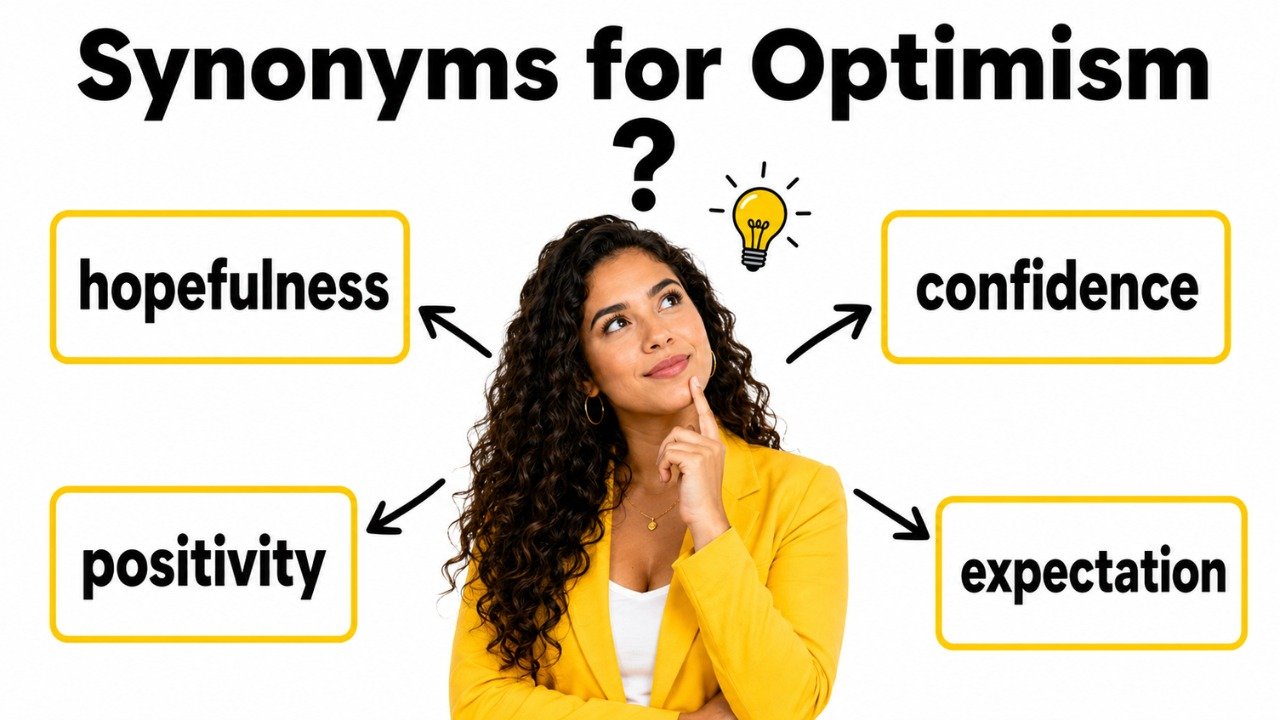
Quick Answer: The best synonyms for optimism include hopefulness, positivity, confidence, faith, assurance, cheerfulness, buoyancy, sanguineness, idealism, and expectation. Use hopefulness for a general belief that good things may happen, positivity for a constructive attitude, and confidence when success seems likely. Faith emphasizes trust without complete proof, while buoyancy and cheerfulness describe an emotionally bright mood. Sanguineness is a formal alternative, and idealism works when optimism is based on strong beliefs about how life should improve.
Pronunciation and Word Details
Word: Optimism.
Pronunciation: /ˈɒp.tɪ.mɪ.zəm/
Part of Speech: Noun.
Meaning: A hopeful attitude or belief that good results are likely to occur.
US Pronunciation:
UK Pronunciation:
What Does “Optimism” Mean?
Optimism means having hope and confidence that events will develop positively or that difficulties can be overcome.
The word is an abstract noun. It describes a belief, attitude, outlook, or emotional tendency rather than a physical object. A person may show optimism about a personal goal, a business plan, a difficult situation, or the future in general.
Optimism does not always mean ignoring problems. Healthy optimism recognizes obstacles while maintaining the belief that improvement remains possible. For example, a student may understand that an examination will be difficult but still feel optimistic because careful preparation can lead to success.
The word often appears with expressions such as cautious optimism, renewed optimism, growing optimism, and reason for optimism. These expressions show different levels or forms of positive expectation.
Meaning, Tone, and Context of “Optimism”
Optimism usually has a positive, hopeful, and encouraging tone. It suggests that a person expects favorable outcomes or believes that progress is possible.
In everyday conversation, optimism can describe someone’s attitude toward work, health, relationships, education, or future plans. It may also describe the general mood of a group or community.
In formal writing, optimism often appears in essays, reports, speeches, analysis, and professional communication. A report might describe optimism about economic improvement, while an essay might examine the relationship between optimism and resilience.
In emotional contexts, optimism suggests hope, courage, and mental strength. It can help describe a person who remains encouraged during uncertainty.
In academic or philosophical contexts, optimism may describe the belief that the world is generally improving or that good ultimately outweighs harm. In these settings, optimism can be compared with pessimism, realism, idealism, or skepticism.
The word is normally complimentary, but it can become critical when someone’s expectations are unrealistic. Expressions such as excessive optimism or blind optimism suggest that a person is overlooking genuine risks.
When and How to Use “Optimism”
For Positive Expectations: Use optimism when someone believes that a situation will produce a favorable result.
Example: Her optimism about the interview helped her remain calm and prepared.
For Difficult Situations: Use optimism when a person stays hopeful despite challenges or uncertainty.
Example: The family maintained its optimism during the difficult recovery period.
For Future Plans: Use optimism when discussing confidence in future progress, growth, or success.
Example: The team entered the new project with optimism and clear goals.
For Emotional Strength: Use optimism when describing a hopeful attitude that supports resilience.
Example: His optimism allowed him to continue after several disappointing results.
For Formal Analysis: Use optimism when explaining a positive trend, expectation, or public mood.
Example: The improved results created optimism among the researchers.
For Cautious Hope: Add words such as cautious or guarded when positive expectations still involve uncertainty.
Example: There is cautious optimism that the proposed solution will work.
For Renewed Confidence: Use renewed optimism when hope returns after doubt or disappointment.
Example: The successful trial brought renewed optimism to the entire group.
For Shared Attitudes: Use optimism to describe the hopeful mood of a community, organization, or audience.
Example: A sense of optimism spread through the community after the announcement.
Best Synonyms for Optimism
Hopefulness: A general feeling that good things are possible.
Example: Her hopefulness remained strong even after the first plan failed.
Positivity: A constructive attitude that focuses on favorable possibilities.
Example: His positivity encouraged everyone to search for a practical solution.
Confidence: A firm belief that success or improvement is likely.
Example: The early results increased the team’s confidence.
Faith: Strong trust in a person, plan, principle, or future outcome.
Example: She never lost faith in her ability to recover.
Assurance: A calm and certain belief that events will go well.
Example: He spoke with assurance about the future of the project.
Cheerfulness: A noticeably happy and encouraging emotional state.
Example: Her cheerfulness lifted the mood of the entire office.
Buoyancy: The ability to remain emotionally light, lively, and hopeful.
Example: His natural buoyancy helped him recover from disappointment.
Sanguineness: A formal word for confident hopefulness about the future.
Example: Her sanguineness about the outcome surprised the more cautious members.
Idealism: Hope based on noble beliefs about how life or society should improve.
Example: His idealism inspired him to work for meaningful change.
Expectation: A belief that something, often something favorable, is likely to happen.
Example: The strong performance created an expectation of further success.
50 Synonyms for Optimism with Short Meanings
- Hopefulness: A feeling that good results are possible.
- Positivity: A constructive and encouraging attitude.
- Confidence: Belief that success is likely.
- Faith: Trust in a person, plan, or outcome.
- Expectation: Belief that something is likely to happen.
- Assurance: Calm certainty about a positive result.
- Encouragement: Support that creates confidence and hope.
- Cheerfulness: A happy and hopeful emotional state.
- Buoyancy: The ability to remain lively and hopeful.
- Sanguineness: Formal confidence in a favorable future.
- Idealism: Hope based on noble values or possibilities.
- Enthusiasm: Energetic interest and positive feeling.
- Eagerness: Excited readiness for something positive.
- Trust: Belief that someone or something is dependable.
- Belief: Acceptance that a favorable possibility is real.
- Conviction: A firmly held belief in success or progress.
- Good Cheer: A bright and encouraging mood.
- High Spirits: A lively and cheerful emotional condition.
- Brightness: A quality of emotional hope and liveliness.
- Gladness: A feeling of happiness and positive expectation.
- Joyfulness: A state of noticeable happiness and delight.
- Uplift: A feeling of greater hope or encouragement.
- Reassurance: Comfort that reduces worry and restores confidence.
- Expectancy: An alert feeling that something positive may occur.
- Promise: A sign that future success is possible.
- Hope: A desire and belief that something good may happen.
- Positive Thinking: The habit of focusing on constructive possibilities.
- Positive Outlook: A generally favorable view of life or events.
- Bright Outlook: An expectation of a successful future.
- Rosy Outlook: A highly favorable view of future events.
- Hopeful Attitude: A manner that reflects confidence in improvement.
- Cheerful Expectation: A happy belief in a favorable result.
- Confidence in the Future: Trust that future events will go well.
- Faith in Success: Belief that an effort will achieve its goal.
- Belief in Progress: Trust that improvement can and will occur.
- Sense of Possibility: Awareness that positive options remain available.
- Can Do Spirit: A determined belief that problems can be solved.
- Forward Looking Attitude: A focus on future opportunities and improvement.
- Constructive Attitude: A practical and positive approach to difficulties.
- Upbeatness: A cheerful and encouraging emotional quality.
- Good Spirits: A happy, hopeful, and energetic mood.
- Lightheartedness: A relaxed and cheerful emotional state.
- Resilience: The ability to recover and continue with hope.
- Determination: Firm commitment supported by belief in success.
- Motivation: The desire and energy to pursue a positive goal.
- Aspiration: Hopeful desire to achieve something meaningful.
- Ambition: Strong desire and confidence to accomplish a goal.
- Encouraging Outlook: A view that suggests improvement is possible.
- Favorable Expectation: Belief that events will produce a good result.
- Trust in the Future: Confidence that future conditions will improve.
Read Also:
Synonyms for Thereby
Synonyms for Optimism by Context
When Optimism Means Hope for the Future
Hopefulness, hope, positive outlook, bright outlook, expectancy, and trust in the future work well when optimism refers to favorable expectations.
Example: Her hopefulness about the coming year encouraged her to make ambitious plans.
Hopefulness is the most natural general synonym. Bright outlook suggests that future conditions appear especially promising. Expectancy often includes a feeling of anticipation.
When Optimism Means Confidence in Success
Confidence, assurance, conviction, faith in success, and favorable expectation are suitable when optimism is supported by ability, evidence, or preparation.
Example: Careful planning gave the group confidence that the event would succeed.
Confidence is stronger and more specific than general optimism. Assurance suggests calm certainty, while conviction describes a deeply held belief.
When Optimism Means a Positive Attitude
Positivity, positive thinking, constructive attitude, forward looking attitude, and can do spirit describe a person’s approach to life or problems.
Example: Her constructive attitude helped the group focus on solutions instead of blame.
Positivity is common in everyday communication. Constructive attitude is more practical because it suggests useful action rather than positive feelings alone.
When Optimism Means a Cheerful Mood
Cheerfulness, buoyancy, good cheer, high spirits, upbeatness, and good spirits work when optimism is visible in someone’s emotional state.
Example: His buoyancy returned as soon as he received the encouraging news.
Cheerfulness describes visible happiness. Buoyancy suggests emotional energy and the ability to recover quickly.
When Optimism Means Trust or Faith
Faith, trust, belief, conviction, and reassurance are useful when optimism grows from confidence in a person, principle, or plan.
Example: Her faith in the process helped her remain patient.
Faith can exist without strong evidence. Trust usually relates to dependability, while conviction suggests a strong personal belief.
When Optimism Is Formal or Literary
Sanguineness, idealism, expectancy, assurance, and buoyancy can create a more formal or expressive tone.
Example: His sanguineness remained unchanged despite the uncertain conditions.
Sanguineness is uncommon in everyday speech but useful in formal prose. Idealism is appropriate when positive expectations come from moral principles or ambitious visions.
Another Word for Optimism
The best single replacement for optimism is usually hopefulness. It carries the same broad meaning of expecting or believing that good outcomes are possible.
However, the strongest alternative depends on context. Confidence is better when success seems likely because of evidence or preparation. Positivity describes a constructive attitude, while faith emphasizes trust even when certainty is impossible.
Original: Her optimism helped her continue after the setback.
Better Option: Her hopefulness helped her continue after the setback.
Original: The successful test increased their optimism about the design.
Better Option: The successful test increased their confidence in the design.
Original: His optimism made the discussion more productive.
Better Option: His positivity made the discussion more productive.
Original: She maintained optimism that the plan would eventually work.
Better Option: She maintained faith that the plan would eventually work.
When Not to Use “Optimism”
Do not use optimism when a more precise word can explain the source or type of positive feeling.
Confidence is usually more accurate when a person has evidence that success is likely. Cheerfulness is better when describing a visible mood. Hope is more natural when referring to one specific wish.
Avoid repeating optimism several times in the same paragraph. Replace it with hopefulness, confidence, positive outlook, or another context appropriate expression.
Do not use optimism when the attitude is unrealistic or careless unless you clearly show that limitation. In such cases, blind confidence, wishful thinking, or unrealistic expectation may communicate the intended criticism more accurately.
Weak: Her optimism about the accurate results came from checking every calculation.
Better: Her confidence in the accurate results came from checking every calculation.
Weak: His optimism was obvious because he smiled and laughed throughout the evening.
Better: His cheerfulness was obvious because he smiled and laughed throughout the evening.
Weak: She had optimism that her missing pet would return.
Better: She had hope that her missing pet would return.
Weak: The report expressed optimism, and this optimism increased the readers’ optimism.
Better: The report expressed hopefulness, which strengthened the readers’ confidence.
Weak: His optimism caused him to ignore every warning.
Better: His unrealistic confidence caused him to ignore every warning.
Words Commonly Confused With Optimism
Optimism vs Hope: Optimism is a general tendency to expect positive outcomes. Hope is often connected to one particular desire or situation.
Optimism vs Positivity: Optimism concerns expectations about what will happen. Positivity is a broader attitude that focuses on constructive thoughts and responses.
Optimism vs Confidence: Optimism may exist without strong evidence. Confidence usually comes from ability, preparation, experience, or reliable information.
Optimism vs Idealism: Optimism is the expectation that events will improve. Idealism is the belief that people or society should follow high principles or reach an excellent standard.
Optimism vs Cheerfulness: Optimism is an outlook about outcomes. Cheerfulness is a visible state of happiness or emotional brightness.
Optimism vs Faith: Optimism is a positive expectation. Faith is deeper trust that may continue even without evidence.
Optimism vs Enthusiasm: Optimism is belief in a favorable result. Enthusiasm is energetic interest or excitement about an activity or idea.
Optimism vs Resilience: Optimism is the belief that improvement is possible. Resilience is the ability to recover from difficulty and continue.
Which Synonym Should You Choose?
Choose hopefulness when you need the closest general synonym for optimism.
Choose positivity when describing a constructive mental attitude or an encouraging approach to problems.
Choose confidence when success seems likely because of preparation, evidence, experience, or ability.
Choose faith when trust remains strong despite uncertainty or limited proof.
Choose assurance when the tone should communicate calm certainty.
Choose cheerfulness when describing a visible, happy, and encouraging mood.
Choose buoyancy when emphasizing emotional energy and the ability to recover from disappointment.
Choose sanguineness in formal, literary, or academic writing when you need a sophisticated word for confident hope.
Choose idealism when optimism comes from strong moral values, ambitious visions, or beliefs about a better society.
Choose expectation when focusing on what a person thinks is likely to happen.
For essays and formal reports, hopefulness, confidence, positive outlook, and sanguineness are strong choices. For professional emails, confidence and positive outlook sound clear and measured. In casual conversation, hope, positivity, good spirits, and high hopes sound more natural.
Real Life Examples of “Optimism” in Sentences
Original: Her optimism helped her prepare for another interview.
Better Option: Her hopefulness helped her prepare for another interview.
Original: The manager expressed optimism about the new schedule.
Better Option: The manager expressed confidence in the new schedule.
Original: His optimism encouraged the team during the difficult week.
Better Option: His positivity encouraged the team during the difficult week.
Original: Their optimism returned after the first successful test.
Better Option: Their faith returned after the first successful test.
Original: She faced the unexpected delay with optimism.
Better Option: She faced the unexpected delay with a constructive attitude.
Original: The students showed optimism about the coming examination.
Better Option: The students showed hopeful expectation about the coming examination.
Original: His optimism was clear in his lively voice and warm smile.
Better Option: His cheerfulness was clear in his lively voice and warm smile.
Original: The latest results created optimism among the researchers.
Better Option: The latest results created confidence among the researchers.
Original: Her optimism about social improvement shaped her career goals.
Better Option: Her idealism about social improvement shaped her career goals.
Original: The community maintained optimism after months of uncertainty.
Better Option: The community maintained trust in the future after months of uncertainty.
Synonym Groups and Usage Differences
Hope Group
Hope, hopefulness, expectancy, high hopes, and trust in the future describe belief that good events remain possible.
Hope often relates to a specific wish. Hopefulness describes a broader emotional attitude. Expectancy adds anticipation.
Example: Their hopefulness grew as the situation gradually improved.
Confidence Group
Confidence, assurance, conviction, favorable expectation, and faith in success suggest stronger certainty about a result.
These words are appropriate when optimism is based on ability, evidence, planning, or experience.
Example: The successful practice session gave the performers confidence.
Positive Attitude Group
Positivity, positive thinking, constructive attitude, forward looking attitude, and can do spirit describe how someone approaches challenges.
These expressions focus on thought patterns and behavior rather than emotion alone.
Example: A constructive attitude helped the group identify several workable solutions.
Emotional Brightness Group
Cheerfulness, buoyancy, good cheer, upbeatness, good spirits, and high spirits describe visible emotional energy.
These words are especially useful when optimism affects a person’s voice, behavior, or mood.
Example: Her natural buoyancy made difficult conversations feel less discouraging.
Belief and Trust Group
Faith, trust, belief, conviction, and reassurance describe confidence in a person, principle, process, or outcome.
Faith can remain strong without evidence. Reassurance usually comes from information or support that reduces worry.
Example: The clear explanation gave the patients reassurance.
Formal and Literary Group
Sanguineness, idealism, buoyancy, expectancy, and assurance are useful in polished, academic, or literary writing.
Sanguineness closely matches optimism but sounds more formal. Idealism adds a sense of noble vision.
Example: Her sanguineness contrasted with the cautious tone of the report.
Purpose and Progress Group
Aspiration, ambition, motivation, determination, resilience, and belief in progress are connected to active optimism.
These words suggest that positive expectations lead to effort, persistence, or future goals.
Example: His belief in progress motivated him to continue improving the design.
Antonyms of Optimism
The clearest opposite of optimism is pessimism, which means expecting unfavorable results. Other antonyms describe different forms of lost hope, negative expectation, or emotional discouragement.
Pessimism: The expectation that events will develop badly.
Hopelessness: The belief that improvement is impossible.
Negativity: A tendency to focus on problems or unfavorable possibilities.
Despair: A complete loss of hope.
Doubt: Uncertainty about whether a positive result will occur.
Distrust: Lack of faith in a person, process, or outcome.
Cynicism: Belief that people are mainly selfish or dishonest.
Gloom: A dark, discouraged, or unhappy emotional state.
Discouragement: Reduced confidence or willingness to continue.
Defeatism: Acceptance of failure before every possibility has been tested.
Despondency: A state of deep sadness and lost hope.
Apprehension: Anxiety about a possible negative result.
Comparison: Optimism vs Related Words
Optimism vs Hope
Optimism is a general belief that events will turn out well. Hope usually focuses on a particular desired result.
Example With Optimism: Her optimism influenced the way she approached every new challenge.
Example With Hope: She held on to the hope that her application would be accepted.
Optimism vs Positivity
Optimism concerns positive expectations about the future. Positivity describes a broader constructive attitude toward thoughts, people, and situations.
Example With Optimism: His optimism about the project remained strong.
Example With Positivity: His positivity kept the discussion respectful and useful.
Optimism vs Confidence
Optimism can be based on personality or hope. Confidence is usually supported by preparation, evidence, knowledge, or skill.
Example With Optimism: She felt optimism before receiving the results.
Example With Confidence: She felt confidence after reviewing every answer carefully.
Optimism vs Idealism
Optimism is the expectation of positive results. Idealism is the pursuit of high standards or noble possibilities, sometimes without enough attention to practical limits.
Example With Optimism: His optimism led him to believe that the situation would improve.
Example With Idealism: His idealism led him to imagine a society without injustice.
Optimism vs Cheerfulness
Optimism is an outlook, while cheerfulness is an emotional mood that other people can often observe.
Example With Optimism: Her optimism remained strong during the delay.
Example With Cheerfulness: Her cheerfulness was visible in her smile and lively conversation.
Optimism vs Faith
Optimism is a positive expectation. Faith is a deeper form of trust that may not depend on evidence.
Example With Optimism: They expressed optimism that the plan would succeed.
Example With Faith: They kept faith in the plan despite several early failures.
Optimism vs Enthusiasm
Optimism is belief in a good outcome. Enthusiasm is energetic excitement about an idea, event, or activity.
Example With Optimism: His optimism made him believe the campaign could succeed.
Example With Enthusiasm: His enthusiasm made him volunteer for several important tasks.
Optimism vs Resilience
Optimism shapes expectations about the future. Resilience helps a person recover after hardship or disappointment.
Example With Optimism: Her optimism helped her believe that another opportunity would appear.
Example With Resilience: Her resilience helped her recover and apply again.
Common Phrases and Expressions With Optimism
Cautious Optimism: Hope that is balanced by an awareness of possible problems.
Guarded Optimism: Positive expectation expressed carefully because the result remains uncertain.
Renewed Optimism: Hope that returns after doubt or disappointment.
Growing Optimism: A positive expectation that becomes stronger over time.
Quiet Optimism: Calm hope that is present without dramatic expression.
Strong Optimism: A high level of confidence in a favorable outcome.
Reason for Optimism: Evidence or information that supports hope.
Source of Optimism: A person, event, or fact that creates positive expectations.
Sense of Optimism: A general feeling that improvement is possible.
Wave of Optimism: A sudden increase in hope among many people.
Mood of Optimism: A generally hopeful emotional atmosphere.
Express Optimism: To communicate confidence in a positive result.
Common Mistakes to Avoid
One common mistake is using optimism when confidence would be more precise. Optimism may come from hope, but confidence often comes from evidence, preparation, or skill.
Incorrect Choice: The verified figures gave the scientist optimism that the calculation was correct.
Improved Choice: The verified figures gave the scientist confidence that the calculation was correct.
Another mistake is treating optimism and happiness as identical. A person can feel worried or sad while still believing that the future will improve.
Avoid using optimism for every positive emotion. Cheerfulness, excitement, satisfaction, relief, and enthusiasm have different meanings.
Do not confuse optimism with idealism. Optimism expects positive results, while idealism focuses on high principles or perfect possibilities.
Avoid repetitive phrasing in essays and reports. Replacing every use of optimism with the same synonym can also sound unnatural. Select alternatives according to the intended meaning.
Repetitive: Her optimism inspired optimism in others because her optimism never weakened.
Improved: Her hopefulness inspired confidence in others because her positive outlook never weakened.
Do not use overly formal alternatives in casual sentences. Sanguineness may fit an academic essay, but it can sound unnatural in ordinary conversation.
Unnatural: I admire your sanguineness about tomorrow’s picnic.
Natural: I admire your optimism about tomorrow’s picnic.
Avoid describing careless thinking as healthy optimism. When someone ignores serious risks, unrealistic confidence, wishful thinking, or blind optimism may be more accurate.
Use the correct noun form. Optimism is the noun, optimistic is the adjective, and optimistically is the adverb.
Noun: Her optimism encouraged the group.
Adjective: She remained optimistic about the result.
Adverb: She spoke optimistically about the next stage.
Conclusion
The best synonyms for optimism depend on the kind of positive expectation you want to express. Hopefulness is the strongest general replacement, while positivity describes a constructive attitude. Confidence and assurance work when evidence supports success, and faith emphasizes trust during uncertainty. Cheerfulness and buoyancy describe emotional brightness, while sanguineness provides a formal alternative. By considering tone, context, and the source of a person’s hope, you can select natural synonyms for optimism that make your writing clearer, more precise, and more engaging.
FAQs About Synonyms for Optimism
What Is the Best Synonym for Optimism?
Hopefulness is usually the best general synonym for optimism. It communicates the belief that good results are possible without changing the original meaning significantly.
Is Positivity the Same as Optimism?
Not exactly. Optimism is the expectation that events will turn out well, while positivity is a broader constructive attitude toward thoughts, people, and situations.
What Is a Formal Synonym for Optimism?
Sanguineness is a formal synonym for optimism. Assurance, expectancy, and positive outlook may also work in professional or academic writing.
What Is a Casual Synonym for Optimism?
Hope, positivity, good spirits, and high hopes are natural choices in casual conversation. The best option depends on whether you mean an attitude, mood, or expectation.
Can Confidence Replace Optimism?
Confidence can replace optimism when a positive expectation is supported by evidence, skill, or preparation. It is less suitable when the feeling is based mainly on hope.
What Is the Opposite of Optimism?
Pessimism is the direct opposite of optimism. Other opposites include hopelessness, negativity, despair, doubt, gloom, and defeatism.
What Is the Difference Between Hope and Optimism?
Hope usually concerns one desired result, while optimism is a broader tendency to expect positive outcomes. A person may hope for one event while having an optimistic outlook on life generally.
