
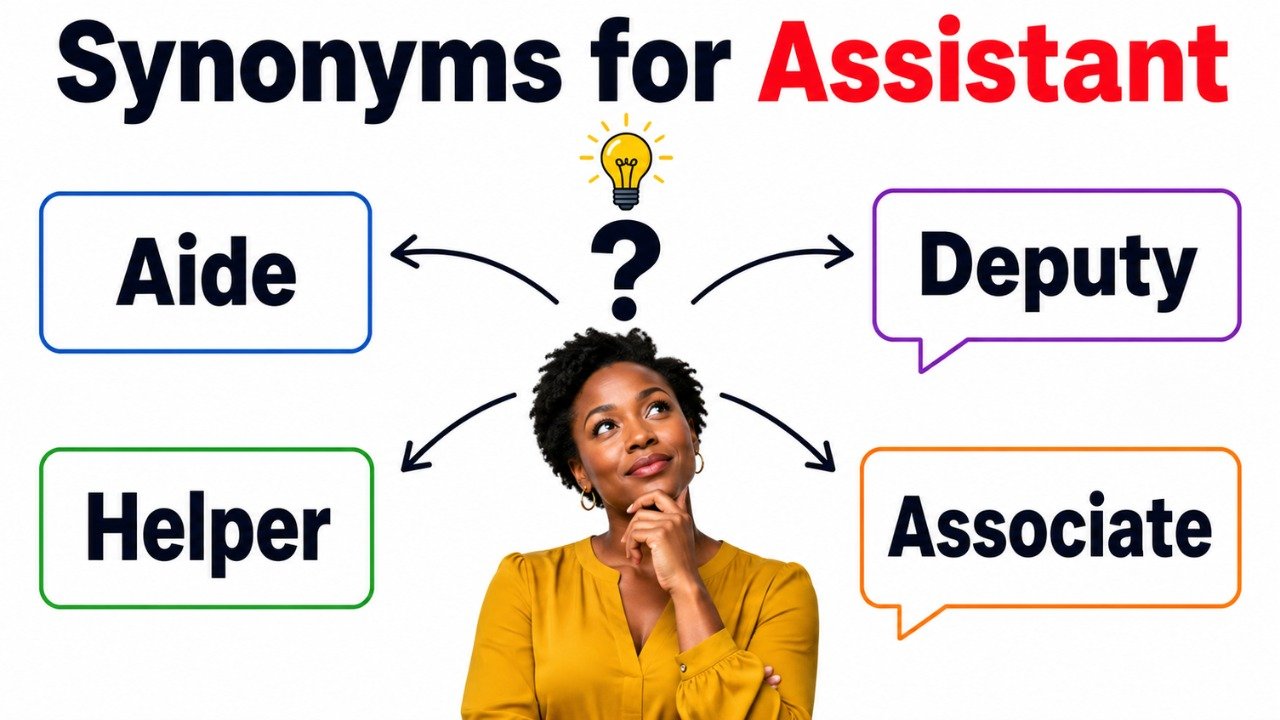
Quick Answer: The best synonyms for assistant include aide, helper, associate, deputy, secretary, clerk, attendant, coordinator, support worker, and apprentice. Use aide or associate in formal professional writing, helper in casual conversation, deputy when the person can act with authority, secretary for administrative duties, attendant for customer service, and apprentice for someone learning under an experienced professional. The right choice depends on the person’s responsibilities, authority, experience, and work setting.
Pronunciation and Word Details
Word: Assistant.
Pronunciation: /əˈsɪstənt/
Part of Speech: Noun and adjective.
Meaning: A person who helps another person complete tasks, manage responsibilities, or perform a particular job.
US Pronunciation:
UK Pronunciation:
What Does “Assistant” Mean?
An assistant is a person who helps someone perform duties, organize work, solve problems, or complete daily tasks. As a noun, it refers to the person providing support. As an adjective, it describes a supporting or junior position, as in assistant manager or assistant editor.
The word can describe many kinds of support. An office assistant may prepare documents and manage appointments. A teaching assistant may help students and support a teacher. A medical assistant may perform clinical and administrative duties. A personal assistant may organize schedules, messages, travel, and daily responsibilities.
The exact meaning depends on the sentence. In professional settings, assistant often identifies an official job title. In everyday conversation, it may simply mean someone who helps another person.
Meaning, Tone, and Context of “Assistant”
Assistant is a neutral and widely accepted word. It can sound formal or professional when used as a job title, but it also works naturally in everyday conversation.
In workplaces, the word usually refers to a recognized support position. It appears in offices, schools, hospitals, stores, laboratories, studios, workshops, and public services. The person may perform administrative, technical, creative, academic, or practical duties.
The tone of assistant is generally respectful. However, the word does not always reveal the person’s level of authority. Some assistants perform basic support tasks, while others manage confidential information, coordinate major projects, or make important decisions.
When greater precision is needed, use a specific title such as administrative assistant, research assistant, deputy, coordinator, or attendant.
When and How to Use “Assistant”
For General Help: Use assistant for someone whose main responsibility is helping another person or team.
Example: The assistant prepared the materials before the meeting.
For Administrative Support: Use assistant for someone who manages documents, schedules, communication, records, or office tasks.
Example: Her assistant arranged the appointments and updated the calendar.
For Professional Support: Use assistant when a person works under a more experienced professional.
Example: The laboratory assistant organized the equipment before the experiment.
For Academic Support: Use assistant for someone who helps with teaching, research, grading, or student guidance.
Example: The teaching assistant answered questions after the lecture.
For Personal Organization: Use assistant for someone who handles another person’s appointments, messages, travel, or daily plans.
Example: His personal assistant confirmed the reservation and prepared the schedule.
For Junior Positions: Use assistant as an adjective when identifying a supporting role below a senior position.
Example: She was promoted to assistant director.
For Customer Service: Use assistant for a worker who helps customers find products, services, or information.
Example: A sales assistant helped us locate the correct size.
Best Synonyms for Assistant
Aide: A person who provides practical or professional support.
Example: The senior adviser met with her aide before the conference.
Helper: A person who makes a task easier by giving assistance.
Example: We hired a helper to prepare the room for the event.
Associate: A person who works with another person, often in a professional setting.
Example: A junior associate helped prepare the client report.
Deputy: A person authorized to assist or act for someone in a senior position.
Example: The deputy managed the department while the director was away.
Secretary: A person who handles correspondence, records, schedules, and administrative duties.
Example: The secretary recorded the decisions made during the meeting.
Clerk: A person who manages records, documents, transactions, or routine office duties.
Example: The clerk entered the information into the database.
Attendant: A person who serves, guides, or assists customers and visitors.
Example: The attendant showed the guests to their seats.
Coordinator: A person who organizes people, schedules, resources, or activities.
Example: The project coordinator arranged the training sessions.
Support Worker: A person who provides practical, personal, or professional assistance.
Example: The support worker helped the client complete the application.
Apprentice: A person who assists an experienced professional while learning a skill or trade.
Example: The apprentice prepared the tools for the carpenter.
50 Synonyms for Assistant with Short Meanings
- Aide: A person who provides direct support.
- Helper: Someone who makes a task easier.
- Associate: A professional who works with another person.
- Deputy: A person who assists and may act for a leader.
- Secretary: Someone who manages administrative duties.
- Clerk: A worker who handles records or routine transactions.
- Support Worker: Someone who provides practical or personal assistance.
- Attendant: A person who serves or assists customers.
- Apprentice: A learner who assists an experienced worker.
- Trainee: A person receiving instruction while helping with work.
- Intern: A person gaining practical experience in a workplace.
- Junior: A person holding a lower level professional position.
- Adjunct: A person added to provide supplementary support.
- Auxiliary: A person or resource that provides additional help.
- Facilitator: Someone who helps a process run smoothly.
- Coordinator: A person who organizes activities and resources.
- Administrator: Someone who manages organizational tasks and procedures.
- Office Assistant: A person who performs general office duties.
- Administrative Assistant: Someone who manages schedules, records, and communication.
- Personal Assistant: A person who organizes another person’s daily responsibilities.
- Executive Assistant: A professional who supports a senior executive.
- Teaching Assistant: Someone who supports a teacher and students.
- Research Assistant: A person who helps conduct and document research.
- Laboratory Assistant: Someone who supports work in a laboratory.
- Legal Assistant: A person who supports legal professionals.
- Medical Assistant: Someone who performs clinical and administrative support duties.
- Nursing Assistant: A worker who supports nurses and helps care for patients.
- Sales Assistant: A person who helps customers and supports sales work.
- Shop Assistant: A worker who serves customers in a store.
- Production Assistant: A person who supports production tasks and schedules.
- Editorial Assistant: Someone who helps with publishing and editorial duties.
- Technical Assistant: A person who provides specialized technical support.
- Virtual Assistant: A remote worker or digital system that performs support tasks.
- Caregiver: A person who helps someone with personal needs.
- Companion: Someone who provides company and practical support.
- Paralegal: A trained professional who assists with legal work.
- Receptionist: A person who welcomes visitors and manages communication.
- Staffer: A member of staff who supports an organization or official.
- Subordinate: A person working under someone with greater authority.
- Understudy: Someone prepared to replace or support another person.
- Backup: A person available to provide replacement support.
- Supporter: Someone who gives help, encouragement, or resources.
- Contributor: A person who adds useful work or ideas.
- Collaborator: Someone who works jointly with another person.
- Team Member: A person who contributes to shared responsibilities.
- Right Hand: A trusted person who provides essential assistance.
- Second in Command: The person directly below a leader in authority.
- Lieutenant: A trusted subordinate who helps carry out plans.
- Factotum: A person who performs many different duties.
- Gofer: An informal term for someone who completes small errands.
Read Also:
Synonyms for Street

Synonyms for Assistant by Context
When Assistant Means a General Helper
Helper and aide are the most natural alternatives when the person provides broad support without holding a highly specialized role.
Helper Example: A helper carried the supplies into the building.
Aide Example: The aide prepared the documents for review.
Supporter can also work when the assistance is emotional, financial, or practical rather than connected to a formal job.
Supporter Example: She was a loyal supporter throughout the project.
When Assistant Means an Office Support Worker
Administrative assistant, secretary, clerk, receptionist, and administrator are useful for office based responsibilities.
An administrative assistant usually manages schedules, records, communication, and documents. A secretary often handles correspondence and organizational duties. A clerk commonly processes records or transactions. A receptionist welcomes visitors and responds to calls or messages.
Administrative Assistant Example: The administrative assistant scheduled the interviews.
Clerk Example: The clerk filed the completed forms.
Receptionist Example: The receptionist directed the visitor to the correct office.
When Assistant Means a Deputy or Junior Professional
Deputy, associate, junior, adjunct, and second in command can describe someone working below or beside a senior professional.
Deputy suggests authority and the ability to act for a leader. Associate often suggests professional cooperation and may sound more equal than assistant. Junior identifies a lower level position based on experience or rank.
Deputy Example: The deputy approved the request during the director’s absence.
Associate Example: The associate reviewed the financial records.
Junior Example: A junior editor checked the article for errors.
When Assistant Means a Personal Support Role
Personal assistant, executive assistant, aide, companion, and caregiver may describe someone who provides direct support to an individual.
A personal assistant manages schedules and daily arrangements. An executive assistant supports a senior leader and may handle confidential or complex work. A caregiver provides personal care, while a companion offers company and practical support.
Personal Assistant Example: The personal assistant organized the travel documents.
Executive Assistant Example: The executive assistant prepared the briefing notes.
Caregiver Example: The caregiver helped him prepare his evening meal.
When Assistant Means a Technical or Service Helper
Technical assistant, laboratory assistant, attendant, sales assistant, facilitator, and coordinator are useful in specialized or service settings.
Attendant is appropriate for someone serving visitors, passengers, or customers. Facilitator describes a person who helps a discussion or process move forward. Coordinator emphasizes organization and communication.
Technical Assistant Example: The technical assistant installed the new equipment.
Attendant Example: The attendant explained the safety instructions.
Facilitator Example: The facilitator encouraged everyone to share an idea.
Another Word for Assistant
The best general replacement for assistant is aide. It is concise, professional, and suitable for many situations involving direct support. However, the best alternative depends on the person’s duties and authority.
Use helper for casual or practical assistance. Use associate for professional collaboration. Use deputy when the person can act for a senior leader. Use coordinator when the role mainly involves organization.
Original: The assistant prepared the files for the manager.
Better Option: The aide prepared the files for the manager.
Original: I asked my assistant to carry the boxes.
Better Option: I asked my helper to carry the boxes.
Original: The assistant managed the event schedule.
Better Option: The coordinator managed the event schedule.
Original: The assistant led the department during the director’s absence.
Better Option: The deputy led the department during the director’s absence.
When Not to Use “Assistant”
Do not use assistant when a more precise job title explains the person’s responsibilities. A vague title can make an important professional role sound less specialized.
Weak: The assistant conducted the laboratory tests.
Better: The laboratory technician conducted the tests.
Avoid assistant when the person has authority to replace or represent a leader. Deputy may communicate that responsibility more clearly.
Weak: The assistant made the final decision while the director was away.
Better: The deputy made the final decision while the director was away.
Do not use assistant when describing equal professional partners. Associate or collaborator may be more respectful and accurate.
Weak: Morgan is my assistant on this joint research project.
Better: Morgan is my research collaborator on this joint project.
Avoid repeating assistant several times in one paragraph when different terms can clarify individual responsibilities.
Weak: The assistant spoke to the assistant before asking another assistant for the report.
Better: The coordinator spoke to the clerk before asking the research aide for the report.
Words Commonly Confused With Assistant
Assistant vs Aide: Both describe someone who helps. Assistant is broader and commonly appears in job titles. Aide often refers to direct support provided to a particular person or professional.
Assistant vs Associate: An assistant usually supports someone in a more senior position. An associate may work more independently and can have a similar professional level.
Assistant vs Deputy: An assistant provides support, while a deputy often has formal authority to act for a leader.
Assistant vs Secretary: Assistant is a broad title. Secretary usually refers specifically to administrative work such as correspondence, records, scheduling, and meeting preparation.
Assistant vs Clerk: An assistant may perform varied duties. A clerk usually handles routine records, documents, payments, or transactions.
Assistant vs Helper: Assistant sounds more professional and often identifies an official role. Helper is broader, more casual, and suitable for temporary or practical support.
Assistant vs Attendant: An assistant supports a person, team, or professional function. An attendant usually serves customers, guests, passengers, or visitors.
Assistant vs Coordinator: An assistant provides support, while a coordinator is mainly responsible for organizing schedules, people, activities, and resources.
Which Synonym Should You Choose?
Choose aide when you need a concise and professional term for someone who provides direct support.
Choose helper in casual speech or when describing practical, temporary, or informal assistance.
Choose associate when the person works professionally with someone and has a greater level of independence.
Choose deputy when the person can represent a leader, make decisions, or take control during the leader’s absence.
Choose secretary when the work mainly involves correspondence, records, appointments, and office organization.
Choose clerk when the person processes forms, records, payments, or routine information.
Choose attendant when the role involves serving customers, guests, passengers, or visitors.
Choose coordinator when the person organizes schedules, events, teams, or resources.
Choose apprentice when the person helps an experienced worker while learning a trade or skill.
Choose administrative assistant in formal reports, job descriptions, professional emails, and workplace documents involving office support.
Real Life Examples of “Assistant” in Sentences
Original: The assistant scheduled all the interviews for Monday.
Better Option: The coordinator scheduled all the interviews for Monday.
Original: The assistant carried the equipment into the workshop.
Better Option: The helper carried the equipment into the workshop.
Original: The assistant spoke for the director during the meeting.
Better Option: The deputy spoke for the director during the meeting.
Original: The assistant welcomed visitors at the front desk.
Better Option: The receptionist welcomed visitors at the front desk.
Original: The assistant entered the customer information into the system.
Better Option: The clerk entered the customer information into the system.
Original: The assistant supported the professor during the research project.
Better Option: The research aide supported the professor during the project.
Original: The assistant arranged transportation and accommodation.
Better Option: The personal aide arranged transportation and accommodation.
Original: The assistant helped customers choose suitable products.
Better Option: The sales associate helped customers choose suitable products.
Original: The assistant prepared the tools while learning the trade.
Better Option: The apprentice prepared the tools while learning the trade.
Original: The assistant guided the discussion and recorded the main ideas.
Better Option: The facilitator guided the discussion and recorded the main ideas.
Synonym Groups and Usage Differences
General Support Group
Aide, helper, supporter, and support worker describe people who make tasks or responsibilities easier. Aide sounds more professional, while helper is more casual.
Example: The aide organized the documents before the appointment.
Administrative Group
Secretary, clerk, receptionist, administrator, and administrative assistant relate to office procedures, communication, schedules, and records.
Example: The administrative assistant prepared the meeting agenda.
Authority Group
Deputy, second in command, lieutenant, and right hand describe trusted people who may have responsibility or decision making power.
Example: The deputy supervised the department during the director’s absence.
Learning Group
Apprentice, trainee, intern, and junior describe people who assist while developing knowledge, experience, or professional skills.
Example: The trainee observed the procedure before attempting it.
Organization Group
Coordinator, facilitator, administrator, and collaborator describe people who help organize work, communication, resources, or group activity.
Example: The coordinator confirmed the speakers and arranged the timetable.
Specialized Support Group
Research assistant, legal assistant, medical assistant, technical assistant, and laboratory assistant identify support roles requiring knowledge of a particular field.
Example: The legal assistant organized the case documents.
Antonyms of Assistant
Assistant has no single exact antonym because it describes a supporting role. Its opposites usually refer to leadership, supervision, authority, or independent responsibility.
Supervisor: A person who directs and evaluates other workers.
Manager: A person responsible for controlling a team or operation.
Leader: Someone who guides a group or organization.
Director: A person who manages a department, project, or institution.
Chief: The highest ranking person in a group or department.
Principal: The leading or most important person in a professional setting.
Employer: A person or organization that hires and directs workers.
Commander: A person who exercises authority over a group.
Head: The person in charge of a team, department, or organization.
Independent Worker: A person who completes responsibilities without serving in a supporting role.
Comparison of Assistant vs Related Words
Assistant vs Aide
Assistant is a broad word used in many job titles and professional settings. Aide usually suggests direct support for one person, official, or specialist.
Example With Assistant: The assistant updated the department’s records.
Example With Aide: The adviser’s aide prepared the speech notes.
Assistant vs Helper
Assistant sounds professional and often describes an established position. Helper is more informal and can describe anyone offering practical support.
Example With Assistant: The office assistant answered the telephone.
Example With Helper: A helper moved the chairs into the hall.
Assistant vs Associate
Assistant usually suggests a supporting or junior relationship. Associate often suggests professional cooperation and greater independence.
Example With Assistant: The assistant prepared the first draft.
Example With Associate: The associate presented the proposal to the client.
Assistant vs Deputy
An assistant helps a senior person complete responsibilities. A deputy may officially replace that person and exercise authority.
Example With Assistant: The assistant gathered information for the director.
Example With Deputy: The deputy approved the plan while the director was absent.
Assistant vs Secretary
Assistant can refer to many kinds of support work. Secretary primarily refers to administrative and organizational duties.
Example With Assistant: The assistant helped prepare the presentation.
Example With Secretary: The secretary recorded the meeting minutes.
Assistant vs Coordinator
An assistant supports existing tasks and responsibilities. A coordinator actively organizes people, schedules, resources, or events.
Example With Assistant: The assistant distributed the event materials.
Example With Coordinator: The coordinator assigned duties to each volunteer.
Common Phrases and Expressions With “Assistant”
Personal Assistant: A person who manages another individual’s daily arrangements.
Administrative Assistant: A professional who handles office communication, schedules, and records.
Executive Assistant: A skilled professional who supports a senior leader.
Teaching Assistant: A person who helps a teacher deliver lessons and support students.
Research Assistant: Someone who helps collect, analyze, or organize research information.
Medical Assistant: A worker who supports clinical and administrative healthcare duties.
Sales Assistant: A person who helps customers and supports sales activities.
Assistant Manager: A person who supports a manager and may supervise operations.
Assistant Director: A professional who helps a director manage responsibilities.
Virtual Assistant: A remote professional or digital system that performs support tasks.
Common Mistakes to Avoid
One common mistake is using assistant for every type of support role. A more specific word such as deputy, receptionist, clerk, coordinator, or research aide can give readers clearer information.
Another mistake is assuming that assistant always means inexperienced or unimportant. Many assistants manage confidential information, complex schedules, important projects, and communication with senior professionals.
Avoid using associate as an automatic replacement. An associate may have equal or greater independence, while an assistant usually works in a supporting position.
Do not use deputy when the person lacks authority to represent a leader. Deputy implies responsibility and decision making power.
Avoid using helper in highly formal job descriptions unless the position is genuinely informal. Administrative assistant, aide, or support worker will usually sound more professional.
Repetition can also weaken writing. When several assistants have different duties, identify each person by a precise role instead of repeating the same general word.
Conclusion
The most useful synonyms for assistant include aide, helper, associate, deputy, secretary, clerk, attendant, coordinator, and support worker. Aide is a strong general replacement, while helper suits casual situations. Deputy is best when authority is involved, coordinator emphasizes organization, and secretary or clerk describes administrative work. When choosing among synonyms for assistant, consider the person’s duties, professional level, independence, and relationship to the person or team receiving support.
FAQs About Synonyms for Assistant
What Is the Best Synonym for Assistant?
Aide is the best general synonym because it clearly describes someone who provides direct support. The best word may change according to the person’s duties.
What Is a Formal Word for Assistant?
Aide, associate, deputy, administrative assistant, and support professional are suitable formal alternatives.
What Is an Informal Synonym for Assistant?
Helper is the most common informal synonym. Gofer may also be used informally, but it can sound dismissive.
Is Associate the Same as Assistant?
Not always. An assistant usually supports a more senior person, while an associate may work independently or hold a similar professional rank.
What Is Another Word for a Personal Assistant?
Personal aide, executive assistant, secretary, right hand, and support professional can be suitable alternatives depending on the responsibilities.
What Is Another Word for an Assistant Manager?
Deputy manager, associate manager, junior manager, and second in command may be appropriate, although their exact meanings can differ between workplaces.
Can Helper Replace Assistant in Professional Writing?
Helper can replace assistant when the role is informal or practical. In formal writing, aide, associate, coordinator, or administrative assistant usually sounds more precise.
