
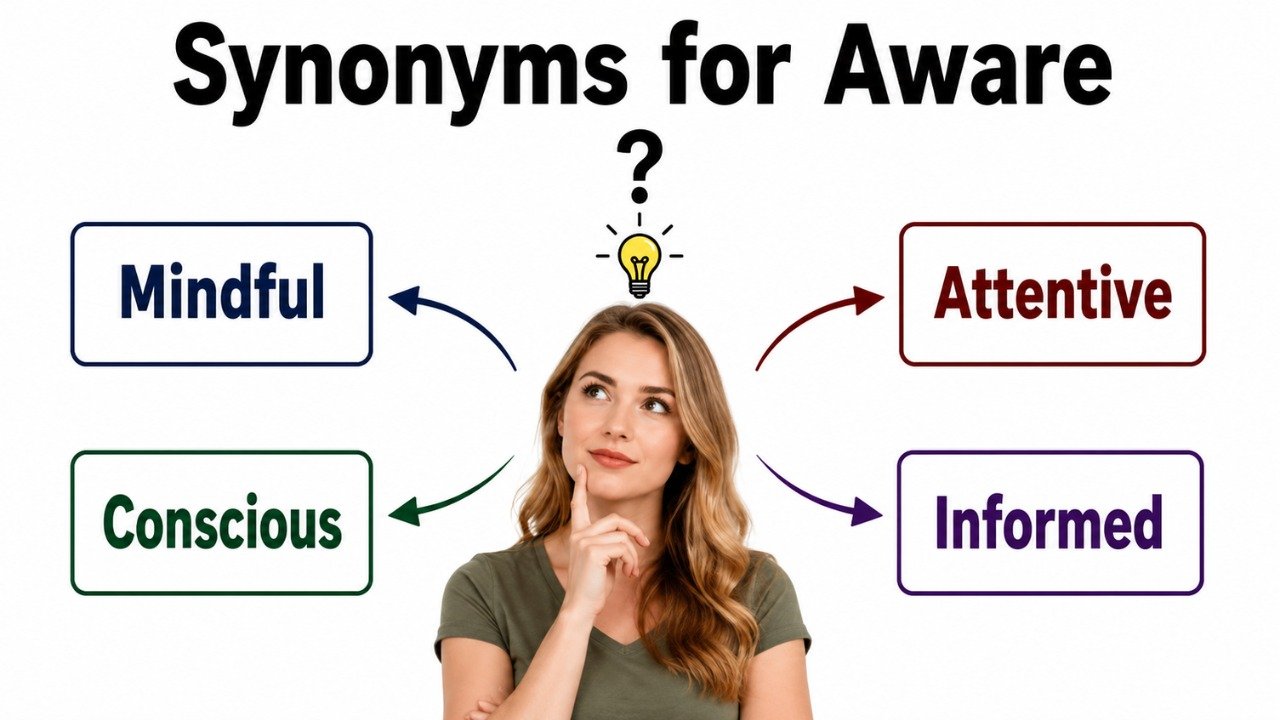
Quick Answer: The best synonyms for aware include conscious, informed, mindful, alert, knowledgeable, cognizant, attentive, familiar, observant, and perceptive. Use conscious when someone recognizes a fact, feeling, or situation. Choose informed or knowledgeable when someone has received useful information. Alert and attentive are best for noticing immediate details or risks. Mindful suits careful thought and consideration, while cognizant works well in formal writing. Familiar is useful for previous knowledge, and perceptive describes someone who notices meanings that others may miss.
Pronunciation and Word Details
Word: Aware.
Pronunciation: /əˈwer/.
Part of Speech: Adjective.
Meaning: Knowing about, noticing, or understanding a fact, situation, feeling, or possible danger.
US Pronunciation:
UK Pronunciation:
What Does “Aware” Mean?
Aware means knowing that something exists, understanding what is happening, or noticing a particular fact, condition, feeling, or risk.
The word aware is an adjective. It usually appears after linking verbs such as be, become, seem, remain, and grow. It is commonly followed by “of” before a noun or by “that” before a complete statement.
With Of: She was aware of the new policy.
With That: She was aware that the policy had changed.
Aware can describe several kinds of knowledge. A person may be aware of a fact because someone provided information. Someone may also be aware of a sound, emotion, movement, danger, or social issue through personal observation.
The word can therefore express knowledge, attention, understanding, sensitivity, or recognition.
Knowledge: He is aware of the application requirements.
Attention: Stay aware of the traffic around you.
Recognition: She became aware of a problem in the report.
Sensitivity: Good leaders are aware of how their decisions affect others.
Meaning, Tone, and Context of “Aware”
Aware has a neutral and flexible tone. It works naturally in casual conversations, professional messages, academic writing, reports, instructions, and formal discussions.
In everyday speech, aware often means that someone knows about a fact or situation.
Example: I was not aware that the meeting had moved.
In professional writing, aware can politely confirm that a person has received or understood information.
Example: Please be aware that the office will close early.
In safety instructions, aware suggests active attention to risks or surroundings.
Example: Drivers must remain aware of pedestrians.
In emotional or social contexts, aware can describe sensitivity to feelings, behavior, culture, or personal needs.
Example: She is aware of how her words may affect the team.
Aware is generally less technical than cognizant and less urgent than alert. It is broader than informed because a person can become aware through observation, experience, sensation, or communication.
When and How to Use “Aware”
For Knowledge
Use aware when someone knows that a fact, event, rule, or situation exists.
Example: Are you aware of the changes to the schedule?
For Recognition
Use aware when someone begins to notice or understand something that was previously unclear.
Example: He became aware of an error in the calculation.
For Personal Feelings
Use aware when someone recognizes an emotion, thought, habit, or physical sensation.
Example: She was aware of growing tension in the room.
For Safety
Use aware when someone needs to notice possible dangers, movements, or changes in the surrounding area.
Example: Hikers should remain aware of changing weather conditions.
For Social Sensitivity
Use aware when someone understands how words, actions, customs, or decisions may affect other people.
Example: The teacher was aware of the different needs within the class.
For Professional Notices
Use aware to introduce important information politely and clearly.
Example: Please be aware that late applications cannot be accepted.
For Careful Attention
Use aware when a person notices small details while completing a task.
Example: Editors must be aware of changes in tone and meaning.
For Wider Issues
Use aware when discussing public understanding of social, environmental, educational, or cultural matters.
Example: The campaign helped people become more aware of water conservation.
Best Synonyms for Aware
Conscious: Knowing or recognizing that something exists or is happening.
Example: She was conscious of the need to speak carefully.
Informed: Having received facts, explanations, or recent information.
Example: All employees were informed about the updated procedure.
Mindful: Carefully considering a fact, responsibility, feeling, or possible effect.
Example: Be mindful of how much time each task requires.
Alert: Actively watching for changes, problems, or danger.
Example: The guard remained alert throughout the night.
Knowledgeable: Having a strong amount of information or understanding about a subject.
Example: The adviser was knowledgeable about admission requirements.
Cognizant: Formally aware of a fact, condition, responsibility, or consequence.
Example: The committee was cognizant of the financial limitations.
Attentive: Giving close attention to what is happening or being said.
Example: The students were attentive during the demonstration.
Familiar: Having previous knowledge or experience of something.
Example: She is familiar with the basic safety rules.
Observant: Skilled at noticing details, behavior, or changes.
Example: An observant reader noticed the contradiction immediately.
Perceptive: Able to notice and understand subtle feelings, meanings, or situations.
Example: His perceptive comment revealed the real cause of the disagreement.
50 Synonyms for Aware with Short Meanings
- Conscious: Knowing that something exists or is happening.
- Informed: Given relevant facts or information.
- Mindful: Carefully considering something important.
- Alert: Ready to notice danger or change.
- Knowledgeable: Having considerable information about a subject.
- Cognizant: Formally aware of a fact or situation.
- Attentive: Giving close attention to something.
- Familiar: Having previous knowledge or experience.
- Observant: Quick to notice important details.
- Perceptive: Able to understand subtle meanings or feelings.
- Awake: Conscious and able to notice surroundings.
- Watchful: Carefully observing for changes or problems.
- Vigilant: Remaining highly alert to possible danger.
- Notified: Officially told about something.
- Advised: Given information, guidance, or warning.
- Apprised: Formally informed about a situation.
- Updated: Given the most recent information.
- Enlightened: Given greater knowledge or understanding.
- Acquainted: Having some knowledge or experience of something.
- Conversant: Familiar enough with a subject to discuss it.
- Versed: Experienced or knowledgeable in a subject.
- Sensitive: Able to notice feelings, needs, or small changes.
- Responsive: Quick to notice and react appropriately.
- Receptive: Willing and able to notice or understand ideas.
- Attuned: Closely aware of feelings, conditions, or changes.
- Discerning: Able to recognize important differences.
- Insightful: Showing a clear understanding of a situation.
- Understanding: Recognizing the meaning or importance of something.
- Realizing: Beginning to understand a fact or situation.
- Recognizing: Identifying or accepting something as true.
- Noticing: Becoming aware through attention or observation.
- Sensing: Becoming aware through feeling or instinct.
- Detecting: Discovering something that may not be obvious.
- Perceiving: Becoming aware through the senses or the mind.
- Comprehending: Fully understanding the meaning of something.
- Appreciative: Understanding the value or importance of something.
- Alive To: Fully conscious of a fact, possibility, or danger.
- Wise To: Informally aware of a plan, trick, or hidden fact.
- In The Know: Informed about current or private information.
- Up To Date: Having the latest available information.
- Well Informed: Having accurate and extensive information.
- Conscious Of: Recognizing the existence or importance of something.
- Mindful Of: Carefully considering a fact or consequence.
- Alert To: Ready to notice a risk, change, or opportunity.
- Familiar With: Having knowledge or experience of something.
- Knowledgeable About: Possessing detailed information about a subject.
- Sensitive To: Able to notice needs, feelings, or effects.
- Informed About: Given facts concerning a subject.
- Acquainted With: Having basic knowledge or experience of something.
- Aware Of One’s Surroundings: Conscious of nearby people, objects, and conditions.
Read Also:
Synonyms for young
Synonyms for Aware by Context
When Aware Means Informed
Use informed, notified, advised, apprised, updated, or in the know when awareness comes from receiving information.
Informed: Best for facts, decisions, policies, and professional communication.
Example: The manager informed the team about the deadline.
Notified: Best when someone receives an official message.
Example: Residents were notified of the planned repairs.
Advised: Best when information includes guidance or a warning.
Example: Passengers were advised to arrive early.
Apprised: Best for highly formal communication.
Example: The director was apprised of the latest developments.
Updated: Best when someone receives recent information.
Example: Keep me updated on the progress of the project.
When Aware Means Conscious
Use conscious, awake, realizing, recognizing, or perceiving when awareness involves mental recognition or physical sensation.
Conscious: Best for thoughts, feelings, actions, and surroundings.
Example: She was conscious of someone standing behind her.
Realizing: Best when awareness develops gradually or suddenly.
Example: He was realizing how serious the situation had become.
Recognizing: Best when identifying or accepting a fact.
Example: The company is recognizing the need for clearer instructions.
Perceiving: Best when awareness comes through the senses or understanding.
Example: She perceived a slight change in his tone.
When Aware Means Alert
Use alert, vigilant, watchful, attentive, or observant when someone must notice risks, movements, or changes.
Alert: Best for immediate readiness.
Example: Stay alert when crossing a busy road.
Vigilant: Best for continued attention to serious risks.
Example: Security staff remained vigilant during the event.
Watchful: Best for careful observation over time.
Example: The nurse kept a watchful eye on the patient.
Attentive: Best for listening and concentrating carefully.
Example: An attentive employee noticed the incorrect figure.
Observant: Best for noticing details that other people may overlook.
Example: The observant child spotted the missing piece.
When Aware Means Knowledgeable
Use knowledgeable, familiar, conversant, versed, or acquainted when someone has learned about a subject through study or experience.
Knowledgeable: Best for strong understanding and expertise.
Example: Choose someone knowledgeable about local regulations.
Familiar: Best for general recognition or previous experience.
Example: I am familiar with the main features of the system.
Conversant: Best for formal descriptions of practical understanding.
Example: Applicants should be conversant with basic accounting methods.
Versed: Best for developed skill or knowledge.
Example: She is well versed in traditional teaching methods.
Acquainted: Best for limited or introductory knowledge.
Example: He is acquainted with the basic principles of design.
When Aware Means Sensitive
Use mindful, sensitive, attuned, perceptive, responsive, or understanding when awareness involves feelings, needs, and consequences.
Mindful: Best for careful and considerate behavior.
Example: Be mindful of the needs of quieter team members.
Sensitive: Best for emotional, social, or physical reactions.
Example: The teacher was sensitive to the student’s concerns.
Attuned: Best for close awareness of changing feelings or conditions.
Example: Good managers remain attuned to team morale.
Perceptive: Best for noticing hidden emotions or meanings.
Example: Her perceptive response helped calm the discussion.
Responsive: Best when awareness leads to suitable action.
Example: The service was responsive to customer concerns.
Another Word for Aware
The best single replacement for aware is often conscious. However, the strongest alternative depends on why the person has awareness and what kind of awareness is being described.
Use conscious for personal recognition, informed for received information, alert for possible danger, mindful for careful consideration, and knowledgeable for developed understanding.
Original: She was aware of the tension in the room.
Better Option: She was conscious of the tension in the room.
Original: Employees are aware of the new rules.
Better Option: Employees are informed about the new rules.
Original: Drivers must be aware of cyclists.
Better Option: Drivers must remain alert to cyclists.
Original: Please be aware of other people’s feelings.
Better Option: Please be mindful of other people’s feelings.
When Not to Use “Aware”
Aware is useful, but another word may express the intended meaning more precisely.
When Expertise Is Important
Aware only means that someone knows something exists. It does not always suggest deep knowledge.
Weak: She is aware of employment law.
Better: She is knowledgeable about employment law.
When Immediate Danger Is Involved
Aware may sound too general when active readiness is required.
Weak: Remain aware while operating the equipment.
Better: Remain alert while operating the equipment.
When Someone Received Official Information
Use informed or notified when the method of communication matters.
Weak: Residents were made aware of the closure.
Better: Residents were officially notified of the closure.
When Careful Consideration Is Intended
Use mindful when the sentence emphasizes responsibility or consideration.
Weak: Be aware of the effect your words may have.
Better: Be mindful of the effect your words may have.
When Detailed Observation Is Intended
Use observant or perceptive when someone notices small or hidden details.
Weak: She was aware enough to notice the change in his expression.
Better: She was perceptive enough to notice the change in his expression.
When Repetition Makes Writing Dull
Repeating aware several times can make a paragraph sound vague.
Weak: She was aware of the rule, aware of the deadline, and aware of the possible penalty.
Better: She understood the rule, knew the deadline, and recognized the possible penalty.
Words Commonly Confused With Aware
Aware vs Conscious: Aware is a broad word for knowing or noticing something. Conscious often emphasizes active recognition, thought, sensation, or wakefulness.
Aware vs Informed: Aware means knowing that something exists. Informed means having received facts or explanations about it.
Aware vs Alert: Aware describes knowledge or notice. Alert describes active readiness to recognize and respond to change or danger.
Aware vs Mindful: Aware means knowing or noticing. Mindful adds the idea of careful consideration and responsible attention.
Aware vs Knowledgeable: Aware may describe basic knowledge. Knowledgeable suggests deeper understanding gained through study or experience.
Aware vs Familiar: Aware means knowing that something exists. Familiar means recognizing it through previous experience or repeated contact.
Aware vs Observant: Aware describes a state of knowing. Observant describes the ability or habit of noticing details.
Aware vs Perceptive: Aware is general. Perceptive suggests an ability to notice subtle emotions, meanings, or relationships.
Aware vs Acquainted: Aware can refer to a single fact. Acquainted usually means having some limited knowledge or experience of a subject or person.
Which Synonym Should You Choose?
Choose conscious when describing recognition of thoughts, feelings, behavior, or surroundings.
Choose informed when someone has received useful facts, explanations, or instructions.
Choose notified when information has been communicated officially.
Choose cognizant when you need a formal alternative in reports, policies, essays, or professional documents.
Choose mindful when someone should carefully consider feelings, duties, consequences, or limitations.
Choose alert when immediate attention to danger, movement, or change is necessary.
Choose vigilant when attention must remain strong over a longer period.
Choose attentive when describing careful listening, reading, or concentration.
Choose knowledgeable when a person understands a subject in depth.
Choose familiar when someone has previous experience or basic knowledge.
Choose observant when someone is skilled at noticing visible details.
Choose perceptive when someone notices hidden meanings, emotions, or motives.
Choose attuned when someone is closely connected to changing feelings, needs, or conditions.
Choose updated or up to date when the sentence concerns recent developments.
Choose in the know for relaxed or conversational writing about current or private information.
Real Life Examples of “Aware” in Sentences
Original: I was not aware that the deadline had changed.
Better Option: I was not informed that the deadline had changed.
Original: She is aware of the risks involved in the decision.
Better Option: She is cognizant of the risks involved in the decision.
Original: Please remain aware of your surroundings.
Better Option: Please remain alert to your surroundings.
Original: He is aware of the basic application process.
Better Option: He is familiar with the basic application process.
Original: The teacher was aware of the student’s anxiety.
Better Option: The teacher was sensitive to the student’s anxiety.
Original: Drivers should be aware of people crossing the road.
Better Option: Drivers should be watchful for people crossing the road.
Original: She became aware of a mistake in the document.
Better Option: She noticed a mistake in the document.
Original: The manager is aware of the latest sales results.
Better Option: The manager is informed about the latest sales results.
Original: Be aware of how your decision may affect the team.
Better Option: Be mindful of how your decision may affect the team.
Original: He was aware of a slight change in her voice.
Better Option: He was perceptive enough to detect a slight change in her voice.
Synonym Groups and Usage Differences
Knowledge Group
This group includes informed, knowledgeable, familiar, acquainted, conversant, and versed. These words describe different levels of learned information.
Informed suggests that someone has received facts. Knowledgeable and versed suggest deeper understanding. Familiar and acquainted usually describe more limited experience.
Example: She is knowledgeable about the subject but only acquainted with the new procedure.
Consciousness Group
This group includes conscious, awake, realizing, recognizing, sensing, and perceiving. These alternatives describe mental recognition, physical sensation, or wakefulness.
Conscious is the closest general alternative. Sensing and perceiving focus on how something is noticed.
Example: He became conscious of a faint sound near the window.
Attention Group
This group includes alert, attentive, vigilant, watchful, and observant. These words describe active attention rather than simple knowledge.
Alert suggests immediate readiness. Vigilant suggests continued attention to risk. Observant describes a natural ability to notice details.
Example: The observant guard remained alert throughout the inspection.
Sensitivity Group
This group includes mindful, sensitive, attuned, responsive, perceptive, and understanding. These words are useful when awareness concerns feelings, needs, behavior, or effects.
Mindful emphasizes careful consideration. Sensitive emphasizes emotional awareness. Attuned suggests close awareness of changing conditions.
Example: A perceptive leader stays attuned to the concerns of the team.
Communication Group
This group includes informed, notified, advised, apprised, updated, and enlightened. These words show that awareness resulted from communication.
Notified is usually official. Advised may include guidance. Apprised is formal, while updated refers to recent developments.
Example: The committee was apprised of the issue and updated on the proposed solution.
Discovery Group
This group includes noticing, detecting, recognizing, realizing, and discovering. These alternatives describe the process of becoming aware.
Noticing often happens through observation. Detecting suggests discovering something difficult to see. Realizing describes mental understanding.
Example: After reviewing the figures, she realized that a calculation was missing.
Antonyms of Aware
The opposite of aware changes according to context. A person may lack information, attention, consciousness, understanding, or sensitivity.
Unaware: Not knowing that something exists or is happening.
Uninformed: Not given the necessary facts or information.
Ignorant: Lacking knowledge about a particular subject.
Oblivious: Completely failing to notice something obvious.
Unconscious: Not awake or not mentally aware.
Inattentive: Not giving enough attention.
Unobservant: Not skilled at noticing details.
Heedless: Failing to consider warnings, advice, or consequences.
Insensitive: Not noticing or caring about other people’s feelings.
Unsuspecting: Not expecting danger, deception, or difficulty.
Distracted: Unable to give full attention because the mind is occupied.
Unfamiliar: Having little or no previous knowledge or experience.
Clueless: Informally having no knowledge or understanding of a situation.
Negligent: Failing to give proper attention to a responsibility.
Comparison: Aware vs Related Words
Aware vs Conscious
Aware is a broad term for knowing or noticing. Conscious often emphasizes active recognition of a feeling, action, fact, or physical sensation.
Example With Aware: She was aware of the noise outside.
Example With Conscious: She was conscious of every sound outside.
Aware vs Informed
Aware means knowing that something exists. Informed means having received enough information to understand it.
Example With Aware: The staff are aware of the new plan.
Example With Informed: The staff are fully informed about how the new plan will work.
Aware vs Alert
Aware can describe general knowledge. Alert suggests readiness to notice and respond quickly.
Example With Aware: He was aware that the road could be dangerous.
Example With Alert: He remained alert while driving along the dangerous road.
Aware vs Mindful
Aware means recognizing a fact. Mindful means keeping that fact in mind while deciding or acting.
Example With Aware: She was aware of the limited budget.
Example With Mindful: She was mindful of the limited budget when choosing materials.
Aware vs Knowledgeable
Aware may involve only basic recognition. Knowledgeable suggests developed understanding.
Example With Aware: He is aware of the tax changes.
Example With Knowledgeable: He is knowledgeable about how the tax changes affect small businesses.
Aware vs Familiar
Aware means knowing about something. Familiar means recognizing it through previous contact or experience.
Example With Aware: I am aware of the software.
Example With Familiar: I am familiar with the software and use it regularly.
Aware vs Observant
Aware describes a state of knowledge. Observant describes someone who notices details easily.
Example With Aware: She was aware that something had changed.
Example With Observant: She was observant enough to identify the exact change.
Aware vs Perceptive
Aware is neutral and general. Perceptive describes deeper awareness of subtle meanings or emotions.
Example With Aware: He was aware that she seemed uncomfortable.
Example With Perceptive: He was perceptive enough to understand why she felt uncomfortable.
Aware vs Cognizant
Aware is suitable for almost every context. Cognizant is more formal and often appears in legal, academic, administrative, or professional writing.
Example With Aware: We are aware of the possible delays.
Example With Cognizant: We are cognizant of the possible delays and their financial effects.
Common Phrases and Expressions With Aware
Aware Of: Knowing that something exists or is happening.
Fully Aware: Having complete knowledge of a fact or situation.
Well Aware: Clearly knowing something, often before another person mentions it.
Painfully Aware: Knowing something unpleasant very clearly.
Acutely Aware: Extremely conscious of a fact, feeling, or condition.
Become Aware: Begin to notice or understand something.
Make Someone Aware: Give someone information or help that person notice something.
Remain Aware: Continue paying attention or remembering an important fact.
Socially Aware: Understanding social conditions, behavior, and the needs of others.
Environmentally Aware: Understanding how actions can affect the natural environment.
Common Mistakes to Avoid
Using Aware Without the Correct Preposition
Aware is commonly followed by “of” before a noun.
Incorrect: She is aware the problem.
Correct: She is aware of the problem.
Aware can also be followed by “that” before a complete clause.
Correct: She is aware that the problem exists.
Using Aware About Unnaturally
“Aware about” may occasionally appear in speech, but “aware of” is usually more natural and standard.
Unnatural: Are you aware about the new rule?
Better: Are you aware of the new rule?
Confusing Awareness With Expertise
Knowing that something exists does not mean understanding it deeply.
Weak: He is aware about financial planning.
Better: He is knowledgeable about financial planning.
Choosing Alert for General Knowledge
Alert normally suggests active attention or readiness, especially around risks.
Incorrect Choice: She is alert of the policy change.
Better: She is aware of the policy change.
Correct Use of Alert: She remained alert while walking through the crowded station.
Repeating Aware Too Often
Repeated use can make writing sound vague or monotonous.
Repetitive: He was aware of the rule, aware of the risk, and aware of the deadline.
Improved: He understood the rule, recognized the risk, and knew the deadline.
Using Cognizant in Casual Conversation
Cognizant is correct, but it may sound unnecessarily formal in ordinary speech.
Too Formal: I am cognizant of your message.
Natural: I am aware of your message.
Confusing Aware With Awake
Awake means not sleeping. Aware means conscious of a fact, feeling, or situation.
Incorrect: I was not awake of the change.
Correct: I was not aware of the change.
Using a Weak Synonym for Danger
When active caution is needed, alert or vigilant is usually stronger than aware.
Weak: Be aware while using the machine.
Better: Stay alert while using the machine.
Forgetting the Difference Between Informed and Aware
A person can be aware that a subject exists without being informed about its details.
Example: She was aware of the proposal but was not fully informed about its cost.
Conclusion
The most useful synonyms for aware include conscious, informed, mindful, alert, knowledgeable, cognizant, attentive, familiar, observant, and perceptive. The best choice depends on the intended meaning. Use informed for received facts, conscious for personal recognition, alert for immediate attention, mindful for careful consideration, and knowledgeable for deeper understanding. These synonyms for aware can make sentences clearer, more accurate, and better suited to professional writing, essays, instructions, reports, and everyday conversation.
FAQs About Synonyms for Aware
What Is the Best Synonym for Aware?
Conscious is the closest general synonym. Informed, alert, mindful, or knowledgeable may be better in more specific contexts.
Is Conscious the Same as Aware?
The meanings are similar, but conscious often emphasizes active recognition, sensation, or wakefulness. Aware is broader and more neutral.
What Is a Formal Synonym for Aware?
Cognizant is a formal synonym for aware. Apprised is also formal, but it specifically means that someone has been informed.
What Is Another Word for Being Aware of Danger?
Alert, vigilant, and watchful are strong choices. Alert suggests immediate readiness, while vigilant suggests continued attention.
What Is Another Word for Socially Aware?
Sensitive, mindful, perceptive, attuned, and understanding can describe awareness of social feelings, needs, and behavior.
What Is the Difference Between Aware and Informed?
Aware means knowing that something exists. Informed means having received facts or explanations about it.
Can Aware Mean Knowledgeable?
Aware can suggest basic knowledge, but knowledgeable expresses deeper understanding or expertise. Use knowledgeable when experience or detailed learning is important.
