
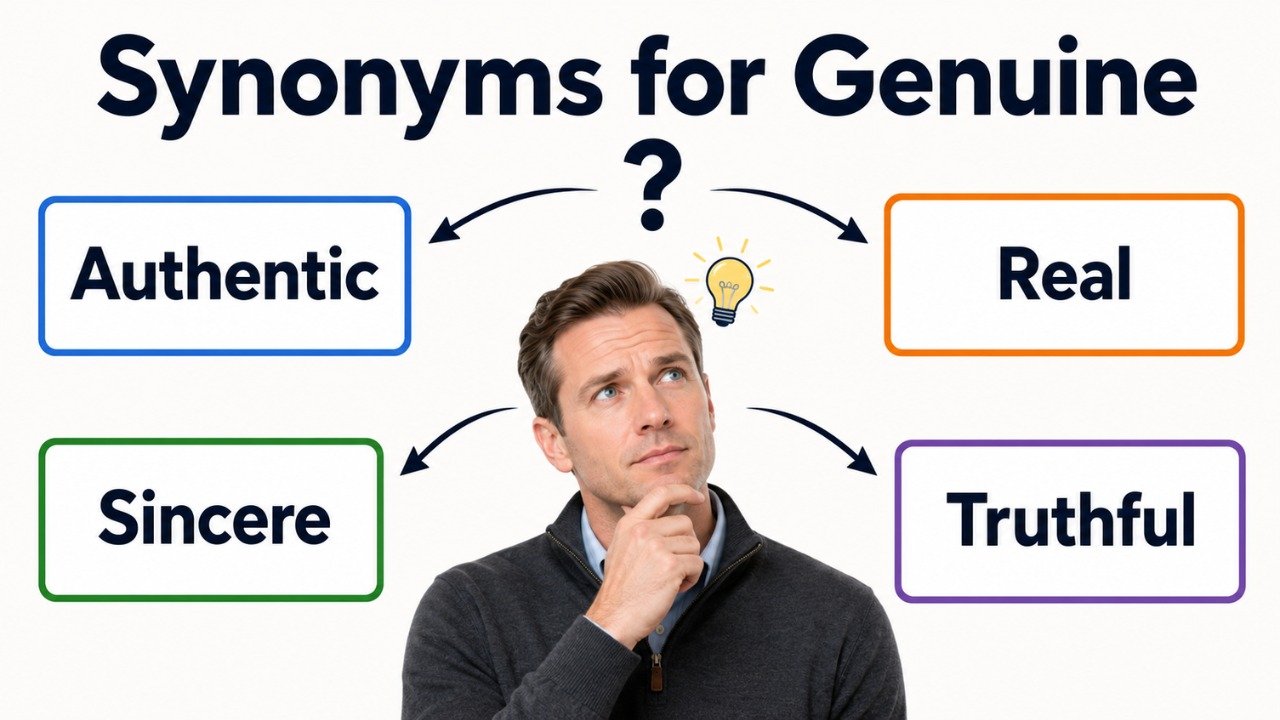
Quick Answer: The best synonyms for genuine include authentic, real, sincere, honest, true, legitimate, original, heartfelt, trustworthy, and bona fide. Use authentic for objects, documents, traditions, and experiences that are not copied or fake. Sincere and heartfelt are best for honest emotions, apologies, and intentions. Legitimate and bona fide suit formal writing about claims, businesses, qualifications, or authority. Real and true work well in everyday conversation, while trustworthy describes a person or source that deserves confidence.
Pronunciation and Word Details
Word: Genuine.
Pronunciation: /ˈdʒenjuɪn/.
Part of Speech: Adjective.
Meaning: Real, authentic, sincere, or honest rather than false, artificial, or misleading.
US Pronunciation:
UK Pronunciation:
What Does “Genuine” Mean?
Genuine means real, authentic, sincere, or honestly felt. It is an adjective used to describe people, emotions, objects, statements, claims, intentions, and experiences.
When genuine describes an object, it means the item is authentic rather than fake, copied, or artificial.
Example: The collector confirmed that the painting was genuine.
When it describes a person, genuine suggests that the person is honest, natural, and not pretending.
Example: She is a genuine person who treats everyone with respect.
When genuine describes an emotion, apology, compliment, or intention, it means the feeling is sincere and honestly expressed.
Example: His concern for the injured animal was genuine.
The word can also describe something that truly belongs to a particular type or category.
Example: This is a genuine opportunity for professional growth.
In different sentence contexts, genuine can emphasize authenticity, truthfulness, emotional sincerity, legitimacy, or natural behavior.
Meaning, Tone, and Context of “Genuine”
Genuine usually has a positive, approving, and trustworthy tone. It suggests that something is exactly what it claims to be or that someone’s feelings and intentions are honest.
The word is neutral enough for everyday conversation but also suitable for formal, academic, professional, and descriptive writing.
In casual speech, genuine often means real or sincere.
Example: She showed genuine excitement when she heard the news.
In formal writing, genuine may describe legitimate evidence, authentic documents, valid qualifications, or sincere concerns.
Example: The investigator found no genuine evidence supporting the claim.
In emotional contexts, genuine communicates honest affection, sympathy, gratitude, or regret.
Example: He expressed genuine gratitude for their support.
In commercial or historical contexts, genuine often distinguishes an original object from an imitation.
Example: The expert examined the item to determine whether it was genuine.
Genuine is usually stronger than nice, good, or real because it clearly emphasizes authenticity or sincerity.
When and How to Use “Genuine”
For Authentic Objects: Use genuine when confirming that an item is original rather than fake or copied.
Example: The museum displayed a genuine ancient coin.
For Sincere Feelings: Use genuine when an emotion is honest and deeply felt.
Example: Her happiness at seeing her friend was genuine.
For Honest People: Use genuine to describe someone who behaves naturally and does not pretend.
Example: He is a genuine person who speaks honestly.
For Real Concern: Use genuine when someone truly cares about a person, problem, or situation.
Example: The teacher showed genuine concern for the struggling student.
For Legitimate Claims: Use genuine when a claim, request, qualification, or reason is valid.
Example: The applicant had a genuine reason for missing the interview.
For Honest Apologies: Use genuine when an apology reflects real regret.
Example: Her genuine apology helped repair the friendship.
For Valuable Opportunities: Use genuine when something offers a real possibility rather than an empty promise.
Example: The course provides a genuine opportunity to develop practical skills.
For Natural Behavior: Use genuine when a reaction, expression, or personality is unaffected and spontaneous.
Example: His genuine smile made the guests feel welcome.
Best Synonyms for Genuine
Authentic
Synonym: Real and original rather than copied, false, or artificial.
Example: The specialist confirmed that the document was authentic.
Real
Synonym: Existing in fact and not imaginary, false, or artificial.
Example: Her desire to help the community was real.
Sincere
Synonym: Honest in feeling, intention, or expression.
Example: He offered a sincere apology for his mistake.
Honest
Synonym: Truthful, fair, and free from deception.
Example: She gave an honest explanation of what happened.
True
Synonym: Accurate, faithful, or consistent with reality.
Example: His account of the event proved true.
Legitimate
Synonym: Lawful, valid, reasonable, or properly accepted.
Example: The customer had a legitimate complaint.
Original
Synonym: Created first and not copied from something else.
Example: The gallery displayed the original drawing.
Heartfelt
Synonym: Deeply and sincerely felt.
Example: The family sent a heartfelt message of thanks.
Trustworthy
Synonym: Honest and dependable enough to deserve confidence.
Example: The researcher used trustworthy information.
Bona Fide
Synonym: Genuine, real, and accepted as valid.
Example: She received a bona fide offer from a respected employer.
50 Synonyms for Genuine with Short Meanings
- Authentic: Real and not copied or falsely presented.
- Real: Existing in fact rather than being false or imaginary.
- Sincere: Honest and truthful in feeling or intention.
- Honest: Free from lies, deception, or pretence.
- True: Consistent with reality, fact, or actual feeling.
- Legitimate: Valid, lawful, reasonable, or properly recognized.
- Actual: Existing or happening in reality.
- Original: Created first and not copied or imitated.
- Heartfelt: Deeply and sincerely experienced or expressed.
- Trustworthy: Dependable, honest, and deserving of confidence.
- Bona Fide: Truly what it claims to be.
- Valid: Logically, legally, or reasonably acceptable.
- Truthful: Accurately expressing facts or honest beliefs.
- Earnest: Serious, sincere, and strongly felt.
- Candid: Honest, direct, and open in expression.
- Frank: Open and truthful without hiding important facts.
- Unfeigned: Sincere and not pretended.
- Unaffected: Natural and free from artificial behavior.
- Natural: Not forced, artificial, or deliberately performed.
- Veritable: Truly deserving a particular description.
- Credible: Believable and worthy of trust.
- Reliable: Consistently accurate, honest, or dependable.
- Dependable: Able to be trusted or relied upon.
- Faithful: True to the original, facts, or commitments.
- Accurate: Correct and free from significant error.
- Factual: Based on real events, evidence, or facts.
- Validly Based: Supported by acceptable reasons or evidence.
- Lawful: Permitted or recognized by law.
- Proper: Correct, suitable, or officially accepted.
- Certified: Formally confirmed as real, correct, or qualified.
- Verified: Checked and shown to be true or authentic.
- Confirmed: Established as true through evidence or examination.
- Proven: Demonstrated to be real, valid, or correct.
- Undeniable: Clearly true and difficult to dispute.
- Substantial: Real, meaningful, and important rather than imaginary.
- Pure: Free from imitation, contamination, or mixed motives.
- Wholehearted: Fully sincere, enthusiastic, and committed.
- Genuine Hearted: Naturally kind, sincere, and honest.
- Straightforward: Direct, honest, and uncomplicated.
- Open: Honest and willing to reveal true thoughts or feelings.
- Transparent: Clear, honest, and free from hidden motives.
- Aboveboard: Honest, open, and conducted properly.
- Guileless: Innocent, honest, and free from deception.
- Artless: Natural and sincere without deliberate pretence.
- Unpretentious: Natural and not designed to impress falsely.
- Spontaneous: Naturally expressed without planning or pretence.
- Deeply Felt: Experienced with real emotional strength.
- Well Founded: Supported by good evidence or sound reasons.
- Recognized: Accepted as real, valid, or official.
- Authentic Looking: Appearing true to the original form or style.
Read Also:
Synonyms for Regret

Synonyms for Genuine by Context
When Genuine Means Authentic
Use these words when describing an object, document, signature, tradition, experience, or work that is real rather than copied.
Authentic: Real and supported by reliable evidence.
Example: The expert declared the signature authentic.
Original: The first version rather than a later copy.
Example: The library carefully protected the original manuscript.
Verified: Checked and confirmed as real.
Example: Only verified documents were accepted.
Certified: Officially confirmed as genuine or correct.
Example: The buyer requested a certified gemstone.
When Genuine Means Sincere
Use these alternatives for emotions, apologies, compliments, sympathy, gratitude, or personal intentions.
Sincere: Honest and free from pretence.
Example: She gave a sincere apology for the confusion.
Heartfelt: Deeply and emotionally sincere.
Example: He wrote a heartfelt message to his family.
Earnest: Serious and genuinely intended.
Example: Her earnest request persuaded the committee to reconsider.
Unfeigned: Truly felt and not performed for effect.
Example: His unfeigned delight was clear to everyone.
When Genuine Means Honest
These words describe people, statements, explanations, behavior, and communication that are truthful.
Honest: Free from deception or falsehood.
Example: The witness gave an honest answer.
Truthful: Accurately reflecting facts or beliefs.
Example: Please provide a truthful account of the incident.
Candid: Open and direct, even when the truth is uncomfortable.
Example: She offered a candid opinion about the proposal.
Frank: Plainly honest and direct.
Example: He was frank about the project’s weaknesses.
When Genuine Means Legitimate
Use these alternatives for requests, reasons, claims, qualifications, concerns, or organizations that are valid and properly recognized.
Legitimate: Lawful, reasonable, or genuinely acceptable.
Example: The employee raised a legitimate concern.
Valid: Supported by logic, evidence, rules, or accepted standards.
Example: Her criticism was based on a valid point.
Bona Fide: Real and formally accepted as genuine.
Example: The inquiry came from a bona fide customer.
Proper: Correct, suitable, or officially recognized.
Example: They followed the proper process for approval.
When Genuine Means Natural
These words describe behavior, expressions, reactions, or personalities that are relaxed and free from pretence.
Natural: Spontaneous and not forced.
Example: Her natural warmth made conversation easy.
Unaffected: Simple, honest, and free from artificial behavior.
Example: His unaffected manner made him easy to trust.
Unpretentious: Modest and not trying to appear more important.
Example: The speaker was knowledgeable but unpretentious.
Artless: Naturally sincere and without calculated behavior.
Example: Her artless enthusiasm charmed the audience.
Another Word for Genuine
Authentic is often the best single replacement for genuine when discussing objects, documents, traditions, products, or experiences. Sincere is usually better for emotions and intentions, while legitimate is more precise for claims, reasons, and qualifications.
Original: The expert confirmed that the ring was genuine.
Better Option: The expert confirmed that the ring was authentic.
Original: She showed genuine concern for her colleague.
Better Option: She showed sincere concern for her colleague.
Original: He had a genuine reason for arriving late.
Better Option: He had a legitimate reason for arriving late.
Original: Her genuine thanks moved the volunteers.
Better Option: Her heartfelt thanks moved the volunteers.
When Not to Use “Genuine”
Avoid genuine when another word communicates the intended meaning more precisely.
Genuine may sound vague when discussing whether information is factually correct. Accurate, factual, or verified may be clearer.
Weak: The report contains genuine information.
Better: The report contains verified information.
Do not use genuine when you specifically mean lawful or officially permitted. Legitimate or lawful is more exact.
Weak: They operated a genuine business.
Better: They operated a legitimate business.
Genuine may also be too general when discussing an original object.
Weak: The gallery owns a genuine version of the painting.
Better: The gallery owns the original painting.
Avoid using genuine repeatedly in nearby sentences.
Weak: She gave a genuine apology and showed genuine regret through her genuine effort to improve.
Better: She gave a sincere apology and showed real regret through her earnest effort to improve.
Do not use genuine as a replacement for accurate when discussing measurements, calculations, or data.
Weak: The genuine measurement was ten centimeters.
Better: The accurate measurement was ten centimeters.
Avoid genuine when the context requires proof rather than personal belief.
Weak: This appears to be a genuine certificate.
Better: This appears to be a verified certificate.
Words Commonly Confused With Genuine
Genuine vs Authentic: Genuine and authentic can both mean real rather than fake. Authentic often emphasizes verified origin, while genuine can also describe sincere emotions and honest people.
Genuine vs Real: Real is broader and more conversational. Genuine more strongly emphasizes authenticity, sincerity, or freedom from deception.
Genuine vs Sincere: Genuine can describe people, feelings, objects, and claims. Sincere mainly describes honest emotions, intentions, and communication.
Genuine vs Original: Genuine means real and not fake. Original means the first version or something created independently rather than copied.
Genuine vs Legitimate: Genuine means authentic or sincere. Legitimate means lawful, valid, reasonable, or officially accepted.
Genuine vs Honest: Genuine suggests natural sincerity or authenticity. Honest focuses more directly on truthfulness and freedom from deception.
Genuine vs True: Genuine often concerns identity, origin, or feeling. True usually concerns accuracy, reality, or faithfulness to facts.
Genuine vs Valid: Genuine means real or sincere. Valid means logically, legally, or formally acceptable.
Which Synonym Should You Choose?
Choose authentic when writing about antiques, documents, traditions, signatures, experiences, art, or historical objects.
Choose real in casual conversation when you need a simple and familiar alternative.
Choose sincere for apologies, gratitude, sympathy, promises, emotions, and intentions.
Choose heartfelt when an emotion or message is deeply and warmly expressed.
Choose honest when focusing on truthfulness, fairness, or freedom from deception.
Choose truthful when describing statements, testimony, reports, or personal accounts.
Choose legitimate for formal writing about concerns, businesses, authority, reasons, claims, or requests.
Choose valid when discussing arguments, evidence, criticism, conclusions, or official documents.
Choose original when referring to the first version of a work or an idea that was not copied.
Choose bona fide in formal, professional, legal, or academic contexts when something is unquestionably real or properly recognized.
Choose trustworthy when describing a person, source, organization, or method that deserves confidence.
Choose verified when evidence or examination has confirmed that something is true.
Choose natural or unaffected for behavior that is relaxed, spontaneous, and free from pretence.
Real Life Examples of “Genuine” in Sentences
Original: She gave me a genuine smile.
Better Option: She gave me a sincere smile.
Original: The expert said the vase was genuine.
Better Option: The expert said the vase was authentic.
Original: He showed genuine interest in the discussion.
Better Option: He showed real interest in the discussion.
Original: Their concern about safety was genuine.
Better Option: Their concern about safety was legitimate.
Original: She offered a genuine apology.
Better Option: She offered a heartfelt apology.
Original: The police examined whether the document was genuine.
Better Option: The police examined whether the document was authentic.
Original: His genuine personality made people trust him.
Better Option: His honest personality made people trust him.
Original: This is a genuine chance to improve your skills.
Better Option: This is a real chance to improve your skills.
Original: Her genuine gratitude was clear in her voice.
Better Option: Her sincere gratitude was clear in her voice.
Original: The organization received a genuine complaint.
Better Option: The organization received a valid complaint.
Synonym Groups and Usage Differences
Authenticity Group
This group includes authentic, original, real, bona fide, certified, verified, and confirmed. These words distinguish something real from something false, copied, or misleading.
Authentic emphasizes true origin. Original refers to the first version. Verified and certified suggest that evidence or an official process has confirmed authenticity.
Example: The verified signature matched the original document.
Sincerity Group
This group includes sincere, heartfelt, earnest, unfeigned, wholehearted, and deeply felt. These synonyms describe honest emotions, intentions, apologies, or expressions.
Sincere is the most flexible choice. Heartfelt adds emotional depth, while earnest suggests serious intention.
Example: She made an earnest request for another opportunity.
Honesty Group
This group includes honest, truthful, candid, frank, transparent, and straightforward. These words describe communication or behavior that is free from deception.
Candid and frank suggest directness. Transparent often describes open processes or communication.
Example: The manager gave a frank explanation of the problem.
Legitimacy Group
This group includes legitimate, valid, lawful, proper, recognized, and well founded. These terms are useful for claims, concerns, businesses, arguments, qualifications, and official matters.
Legitimate emphasizes acceptance or lawfulness. Valid emphasizes sound reasoning or formal correctness.
Example: The committee accepted her concern as valid.
Natural Behavior Group
This group includes natural, unaffected, spontaneous, artless, guileless, and unpretentious. These words describe behavior that is not forced or deliberately performed.
Unaffected suggests freedom from artificial manners, while spontaneous emphasizes an immediate and unplanned response.
Example: His spontaneous laughter showed that his amusement was real.
Reliability Group
This group includes trustworthy, credible, reliable, dependable, factual, and accurate. These words describe people, statements, or sources that deserve confidence.
Trustworthy focuses on honesty. Credible means believable, while reliable suggests consistent dependability.
Example: The journalist relied on credible evidence.
Antonyms of Genuine
The opposite of genuine changes according to whether the word refers to an object, emotion, person, claim, or piece of information.
Fake: Made to appear real but not authentic.
False: Untrue, incorrect, or deliberately misleading.
Artificial: Produced or performed rather than natural.
Counterfeit: Illegally copied to look like an authentic item.
Imitation: Created to resemble an original.
Fraudulent: Intended to deceive for personal advantage.
Insincere: Not honestly felt or expressed.
Dishonest: Untruthful or deceptive.
Pretended: Performed or claimed without being real.
Forced: Unnatural and lacking spontaneity.
Fabricated: Invented rather than based on truth.
Invalid: Not legally, logically, or formally acceptable.
Illegitimate: Not lawful, valid, or properly recognized.
Misleading: Likely to create a false impression.
Unreliable: Not consistently accurate or dependable.
Comparison: Genuine vs Related Words
Genuine vs Authentic
Genuine and authentic both describe something real rather than fake. Authentic often focuses on origin, identity, or historical accuracy. Genuine has a wider meaning and can also describe sincere feelings or honest behavior.
Example With Genuine: Her concern for the child was genuine.
Example With Authentic: The historian confirmed that the letter was authentic.
Genuine vs Real
Real is a broad and common word for something that exists or is true. Genuine adds the idea that something is not fake, artificial, or insincere.
Example With Genuine: He gave a genuine apology.
Example With Real: The danger was real.
Genuine vs Sincere
Genuine can describe an object, person, feeling, or claim. Sincere usually describes honest emotions, intentions, words, or actions.
Example With Genuine: She is a genuine and caring person.
Example With Sincere: She offered sincere thanks to the volunteers.
Genuine vs Honest
Genuine emphasizes natural sincerity or authenticity. Honest emphasizes truthfulness, fairness, and freedom from deception.
Example With Genuine: His enthusiasm seemed genuine.
Example With Honest: He gave an honest answer to the question.
Genuine vs Original
Genuine means real rather than fake. Original means the first version or something independently created.
Example With Genuine: The stone was genuine.
Example With Original: The original design was completed several years ago.
Genuine vs Legitimate
Genuine refers to authenticity or sincerity. Legitimate refers to something lawful, valid, reasonable, or properly recognized.
Example With Genuine: Her excitement was genuine.
Example With Legitimate: She had a legitimate reason for leaving early.
Genuine vs Valid
Genuine means real, honest, or authentic. Valid means acceptable because it is supported by logic, evidence, law, or rules.
Example With Genuine: His concern appeared genuine.
Example With Valid: His argument raised a valid point.
Common Phrases and Expressions With “Genuine”
Genuine Interest: Honest curiosity or enthusiasm about something.
Example: She showed genuine interest in the students’ ideas.
Genuine Concern: Sincere care or worry about a person or situation.
Example: His genuine concern encouraged her to speak openly.
Genuine Apology: An honest expression of regret.
Example: A genuine apology should acknowledge the harm caused.
Genuine Smile: A natural smile that reflects real happiness.
Example: Her genuine smile brightened the room.
Genuine Emotion: A feeling that is honestly experienced.
Example: The speech was filled with genuine emotion.
Genuine Friendship: A sincere and trustworthy personal relationship.
Example: Genuine friendship requires honesty and mutual respect.
Genuine Effort: A serious and sincere attempt to achieve something.
Example: He made a genuine effort to correct the mistake.
Genuine Reason: An honest and valid explanation.
Example: She had a genuine reason for requesting more time.
Genuine Article: A real and authentic example rather than an imitation.
Example: The collector believed the watch was the genuine article.
Genuine Opportunity: A real and practical chance to achieve something.
Example: The training program created a genuine opportunity for advancement.
Common Mistakes to Avoid
A common mistake is using genuine for every meaning of real. Although the two words overlap, genuine often emphasizes authenticity or sincerity, while real has a much wider meaning.
Unclear: The storm was genuine.
Better: The storm was real.
Do not use genuine when accurate is needed for numbers, data, measurements, or calculations.
Incorrect: The genuine total was twenty five.
Correct: The accurate total was twenty five.
Avoid confusing genuine with original. A genuine object can be authentic without being the first version, while an original is the first or independently created version.
Unclear: This is the genuine copy of the agreement.
Better: This is the original copy of the agreement.
Do not use sincere for physical objects.
Incorrect: The expert examined the sincere painting.
Correct: The expert examined the authentic painting.
Avoid using authentic for every emotion. Sincere or heartfelt often sounds more natural for apologies, gratitude, affection, and sympathy.
Less Natural: She gave an authentic apology.
Better: She gave a sincere apology.
Do not repeat genuine several times in one paragraph. Replace it with precise alternatives that match each context.
Repetitive: His genuine concern led to a genuine apology and a genuine effort to improve.
Improved: His sincere concern led to a heartfelt apology and an earnest effort to improve.
Be careful with the phrase bona fide. It is appropriate in formal contexts, but it may sound overly formal in ordinary conversation.
Too Formal: She gave me a bona fide smile.
Natural: She gave me a genuine smile.
Finally, do not assume that calling something genuine proves it is authentic. When evidence matters, use verified, certified, or confirmed.
Vague: The document appears genuine.
Precise: The document has been verified as authentic.
Conclusion
Understanding synonyms for genuine helps you choose a word that matches the exact meaning you want to express. Authentic and original work well for real objects and documents, while sincere, heartfelt, and earnest describe honest emotions and intentions. Legitimate and valid suit formal claims, reasons, and concerns. Honest and truthful emphasize accuracy and openness, while natural and unaffected describe behavior without pretence. Choosing a precise synonym makes your writing clearer, more credible, and more expressive.
FAQs About Synonyms for Genuine
What Is the Best Synonym for Genuine?
Authentic is the best general synonym when genuine means real rather than fake. Sincere is better for feelings, apologies, and intentions.
What Is a Stronger Word Than Genuine?
Bona fide, verified, authentic, and unquestionably real can sound stronger when authenticity must be emphasized.
Is Sincere a Synonym for Genuine?
Yes. Sincere is a close synonym when genuine describes feelings, intentions, apologies, gratitude, or personal behavior.
What Is the Difference Between Genuine and Authentic?
Both words can mean real rather than fake. Authentic often emphasizes verified origin, while genuine can also describe honest emotions and natural behavior.
What Is a Casual Synonym for Genuine?
Real is the most common casual alternative. Honest and sincere also work well when describing people or feelings.
Which Synonym for Genuine Is Best in Formal Writing?
Authentic suits objects and documents, legitimate suits claims and reasons, and bona fide suits officially recognized people, offers, or organizations.
Can Genuine Describe a Person?
Yes. A genuine person is sincere, honest, natural, and free from pretence.
