
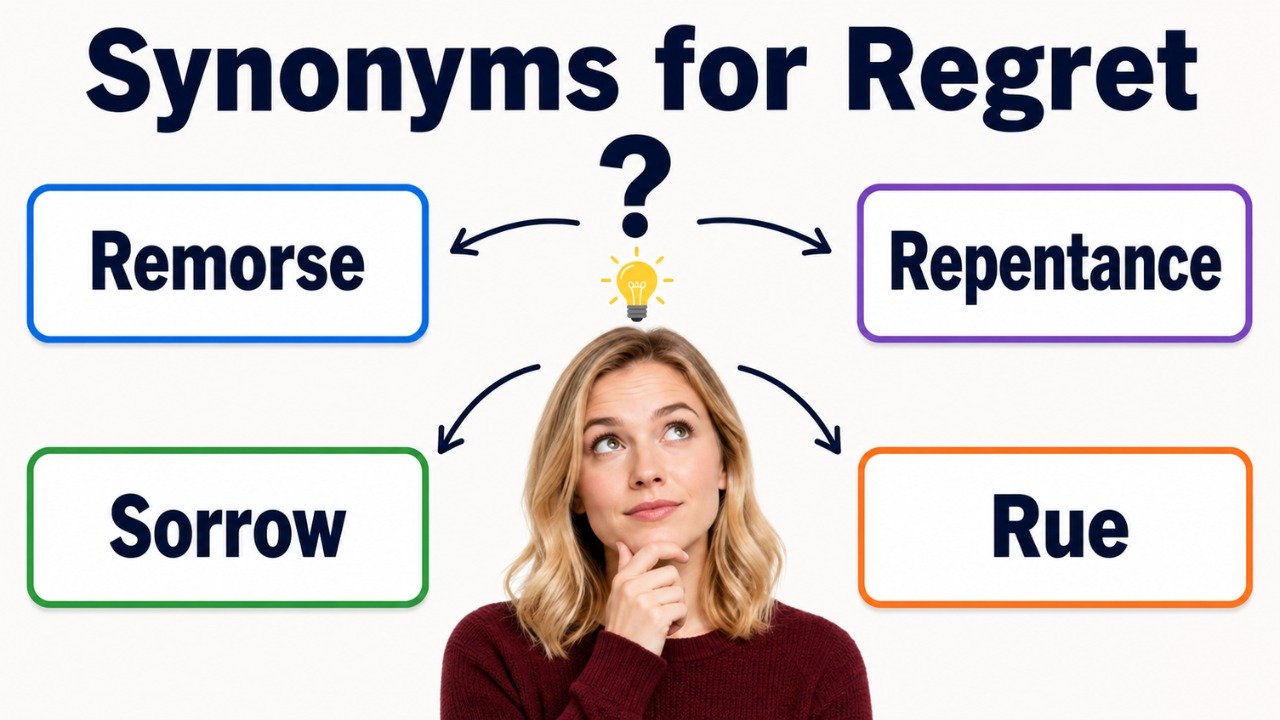
Quick Answer: People searching for synonyms for synonyms for regret are usually looking for words such as remorse, sorrow, guilt, repentance, contrition, ruefulness, disappointment, chagrin, lament, and second thoughts. Use remorse for deep guilt about wrongdoing, sorrow for sadness about an event, and repentance when someone wants to correct past behavior. Disappointment suits an unsatisfying result, while second thoughts describe doubt about a recent decision. Contrition is appropriate in formal or serious writing, and chagrin expresses embarrassment mixed with regret.
Pronunciation and Word Details
Word: Regret.
Pronunciation: /rɪˈɡrɛt/.
Part of Speech: Noun and verb.
Meaning: A feeling of sadness, guilt, or disappointment about something that happened or something a person did or failed to do.
US Pronunciation:
UK Pronunciation:
What Does “Regret” Mean?
Regret means feeling sad, disappointed, or guilty about a past action, missed opportunity, decision, or result. It can function as both a noun and a verb.
As a noun, regret names the feeling itself.
Example: Her greatest regret was leaving the course too early.
As a verb, regret describes the experience of wishing that something had happened differently.
Example: He regrets ignoring his friend’s advice.
Regret may involve personal responsibility, but it does not always suggest wrongdoing. A person can regret making a mistake, missing an opportunity, losing something valuable, or receiving an unwanted result.
The word can also introduce formal bad news.
Example: We regret to inform you that the event has been canceled.
Meaning, Tone, and Context of “Regret”
Regret is a neutral but emotional word. It can describe mild disappointment, serious guilt, personal sadness, or a formal expression of sympathy.
In casual conversation, regret often refers to a poor choice or missed opportunity.
Example: I regret not buying the tickets earlier.
In emotional writing, regret can express lasting sadness about the past.
Example: She carried deep regret over the argument.
In formal communication, regret is often used to deliver disappointing information politely.
Example: We regret that your request cannot be approved.
In moral or ethical situations, stronger words such as remorse, contrition, or repentance may communicate responsibility more clearly.
Example: He showed genuine remorse for the harm he caused.
The tone of regret depends on the situation. It may sound reflective, apologetic, disappointed, sorrowful, or deeply emotional.
When and How to Use “Regret”
For a Past Mistake: Use regret when someone wishes they had acted differently.
Example: I regret speaking before I understood the situation.
For a Missed Opportunity: Use regret when a person feels sad about something they did not do.
Example: She regrets not applying for the scholarship.
For Moral Responsibility: Use regret when someone recognizes that an action caused harm.
Example: He deeply regrets hurting his family.
For an Unwanted Result: Use regret when an outcome causes disappointment.
Example: They regretted choosing such an expensive plan.
For Formal Bad News: Use regret before sharing information that may disappoint the reader.
Example: We regret to announce that the meeting has been postponed.
For Sympathy: Use regret to express sadness about another person’s experience.
Example: I regret hearing that your journey was so difficult.
For Reconsidering a Decision: Use regret when someone develops doubts after making a choice.
Example: She began to regret accepting the offer.
Best Synonyms for Regret
Remorse
Synonym: Deep guilt and sadness about causing harm or doing something wrong.
Example: He felt sincere remorse after realizing how much pain he had caused.
Sorrow
Synonym: Deep sadness about a loss, event, or painful situation.
Example: She expressed sorrow over the end of their friendship.
Guilt
Synonym: The uncomfortable feeling of having done something wrong.
Example: His guilt prevented him from enjoying the success.
Repentance
Synonym: Regret for wrongdoing combined with a desire to change.
Example: Her actions demonstrated genuine repentance.
Contrition
Synonym: Sincere and serious regret for improper behavior.
Example: He spoke with visible contrition during the apology.
Ruefulness
Synonym: Regret mixed with sadness or self criticism.
Example: She smiled with ruefulness as she remembered her mistake.
Disappointment
Synonym: Sadness caused by an unsatisfying result or failed expectation.
Example: He felt disappointment when the plan did not succeed.
Chagrin
Synonym: Embarrassment and disappointment caused by failure or error.
Example: To her chagrin, she had sent the message to the wrong person.
Lament
Synonym: A spoken or written expression of regret, grief, or sorrow.
Example: His speech was a lament for the opportunities they had lost.
Second Thoughts
Synonym: Doubts that arise after a decision has been made.
Example: She had second thoughts about moving so far away.
50 Synonyms for Regret with Short Meanings
- Remorse: Deep guilt about a harmful or wrong action.
- Sorrow: Strong sadness about an event or loss.
- Guilt: The feeling of having acted wrongly.
- Repentance: Regret accompanied by a desire to change.
- Contrition: Sincere regret for improper behavior.
- Ruefulness: Sad regret mixed with reflection.
- Compunction: Uneasiness caused by guilt or conscience.
- Penitence: Serious regret for wrongdoing.
- Self Reproach: Criticism directed at oneself for a mistake.
- Shame: Painful embarrassment about one’s behavior.
- Chagrin: Embarrassment and regret after failure.
- Disappointment: Sadness caused by an unwanted result.
- Sadness: Emotional pain caused by loss or dissatisfaction.
- Grief: Deep sorrow about a serious loss.
- Lamentation: An expression of sorrow or regret.
- Heartache: Strong emotional pain and sadness.
- Anguish: Severe emotional suffering.
- Distress: Strong worry, sadness, or discomfort.
- Misery: Intense unhappiness about a situation.
- Dismay: Sudden disappointment or concern.
- Mortification: Extreme embarrassment over a mistake.
- Embarrassment: Discomfort caused by an awkward action.
- Qualm: An uneasy feeling about a decision or action.
- Misgiving: A doubt about whether something was right.
- Second Thoughts: Doubts that appear after making a choice.
- Guilty Conscience: An uncomfortable awareness of wrongdoing.
- Pang of Conscience: A sudden feeling of guilt.
- Sorrowful Reflection: Sad thinking about a past event.
- Regretfulness: The state of feeling regret.
- Remorsefulness: The state of feeling deeply sorry.
- Rue: To regret an action or result deeply.
- Repent: To feel regret and seek personal change.
- Lament: To express sadness or regret openly.
- Mourn: To feel or express sorrow about a loss.
- Deplore: To strongly regret or disapprove of something.
- Bemoan: To complain about or express regret over something.
- Bewail: To express deep sorrow about a situation.
- Feel Sorry: To experience sadness or regret.
- Wish to Undo: To desire to reverse a past action.
- Wish It Had Not Happened: To feel sadness about a past event.
- Reconsider: To think again about a decision.
- Rethink: To examine a choice from a new perspective.
- Dissatisfaction: Unhappiness with a result or situation.
- Frustration: Annoyance caused by failure or disappointment.
- Unease: A mild feeling of worry or discomfort.
- Concern: Worry about an action, result, or situation.
- Wistfulness: Gentle sadness about something lost or missed.
- Sense of Loss: Sadness about something no longer available.
- Disappointment in Oneself: Sadness about one’s own behavior.
- Sorrow Over the Past: Sad reflection on something that has happened.
Read Also:
Synonyms for Suspicious

Synonyms for Regret by Context
When Regret Means Moral Remorse
Use these words when someone feels responsible for causing harm or acting wrongly.
Remorse: Deep emotional pain caused by wrongdoing.
Example: She felt remorse for betraying her friend’s trust.
Guilt: Awareness that an action was wrong.
Example: His guilt became stronger when he saw the consequences.
Contrition: Formal and sincere regret for bad behavior.
Example: The apology was delivered with genuine contrition.
Compunction: Uneasiness caused by conscience.
Example: He showed no compunction about breaking the agreement.
When Regret Means Sadness About Loss
These alternatives describe emotional pain about losing a person, opportunity, relationship, or experience.
Sorrow: Deep sadness about a painful event.
Example: She felt sorrow when the friendship ended.
Grief: Intense sadness about a serious loss.
Example: His grief remained long after the departure.
Heartache: Emotional pain caused by loss or disappointment.
Example: Leaving the family home caused considerable heartache.
Wistfulness: Gentle sadness about something that cannot return.
Example: He looked at the old photographs with wistfulness.
When Regret Means Disappointment
These words work when the feeling comes from an unsatisfying result rather than wrongdoing.
Disappointment: Sadness because expectations were not met.
Example: The final result brought disappointment to the entire team.
Chagrin: Disappointment mixed with embarrassment.
Example: To his chagrin, everyone noticed the error.
Dismay: Sudden concern or disappointment.
Example: She reacted with dismay when the plan was rejected.
Dissatisfaction: Unhappiness with a result or condition.
Example: Customer dissatisfaction increased after the changes.
When Regret Means Doubting a Decision
Use these alternatives when a person begins questioning a choice.
Second Thoughts: Doubts that develop after deciding.
Example: He had second thoughts about signing the agreement.
Misgiving: A feeling that a decision may be wrong.
Example: She accepted the position despite her misgivings.
Qualm: A sudden doubt based on conscience or judgment.
Example: He had no qualms about changing the schedule.
Reconsideration: The act of thinking about a choice again.
Example: The unexpected cost led to reconsideration of the plan.
When Regret Is Expressed Formally
Formal writing often uses regret to communicate bad news, disappointment, or sympathy politely.
Deplore: To strongly regret or disapprove of an event.
Example: The committee deplored the unnecessary delay.
Lament: To express sorrow about a loss or negative development.
Example: The report lamented the decline in public participation.
Regret to Inform: A polite phrase used before disappointing information.
Example: We regret to inform you that no spaces remain.
Another Word for Regret
Remorse is often the strongest single replacement for regret when the feeling involves wrongdoing. However, the best alternative depends on whether the context involves guilt, sadness, disappointment, loss, or uncertainty.
Original: He felt regret about the cruel remark.
Better Option: He felt remorse about the cruel remark.
Original: She expressed regret over the missed opportunity.
Better Option: She expressed disappointment over the missed opportunity.
Original: I began to regret my decision.
Better Option: I began to have second thoughts about my decision.
Original: The family spoke about the past with regret.
Better Option: The family spoke about the past with sorrow.
When Not to Use “Regret”
Do not use regret when a more precise word can identify the exact emotion or situation.
Regret may sound too weak when someone caused serious harm. Remorse or contrition may communicate greater emotional responsibility.
Weak: He had regret after deliberately hurting several people.
Better: He felt profound remorse after deliberately hurting several people.
Regret may sound inaccurate when the main feeling is grief over a serious loss.
Weak: She experienced regret after losing someone close to her.
Better: She experienced deep grief after losing someone close to her.
Regret can also sound vague when discussing an unsatisfying outcome.
Weak: The poor result caused regret.
Better: The poor result caused disappointment.
Avoid using regret repeatedly in the same paragraph when sorrow, guilt, disappointment, remorse, or second thoughts would make the meaning clearer.
Weak: She regretted the decision and felt regret whenever she remembered it.
Better: She regretted the decision and felt lasting disappointment whenever she remembered it.
Words Commonly Confused With Regret
Regret vs Remorse: Regret can describe any wish that the past had been different. Remorse specifically involves deep guilt about wrongdoing.
Regret vs Guilt: Regret is sadness about a choice or result. Guilt is the belief or feeling that one has done something morally wrong.
Regret vs Repentance: Regret is an emotion. Repentance includes regret along with a sincere intention to change one’s behavior.
Regret vs Grief: Regret concerns past actions, missed chances, or unwanted outcomes. Grief is deep sorrow caused mainly by serious loss.
Regret vs Disappointment: Regret looks back at something a person wishes had been different. Disappointment comes from expectations that were not fulfilled.
Regret vs Apology: Regret is a feeling. An apology is a statement or action through which someone accepts responsibility or expresses sorrow.
Regret vs Shame: Regret focuses on an action or decision. Shame often affects how a person views their character or identity.
Which Synonym Should You Choose?
Choose remorse when the person feels deep guilt about causing harm.
Choose sorrow when the feeling comes from loss, separation, or a painful event.
Choose guilt when the focus is on personal responsibility for wrongdoing.
Choose repentance when regret leads to a serious desire to change.
Choose contrition in formal, moral, or highly serious writing.
Choose disappointment when expectations were not met.
Choose chagrin when regret is mixed with embarrassment.
Choose second thoughts when someone is reconsidering a decision.
Choose misgiving when a person has doubts before or after making a choice.
Choose lament in essays, reports, speeches, or reflective writing about an unfortunate situation.
Choose feel sorry in ordinary conversation when the emotion is mild or personal.
Choose regret to inform in formal messages that deliver bad news politely.
Real Life Examples of “Regret” in Sentences
Original: I regret ignoring your warning.
Better Option: I feel remorse for ignoring your warning.
Original: She regrets missing the final interview.
Better Option: She feels disappointed about missing the final interview.
Original: He regretted speaking so harshly.
Better Option: He felt guilty about speaking so harshly.
Original: They regretted leaving the town.
Better Option: They felt sorrow about leaving the town.
Original: I regret choosing the cheapest option.
Better Option: I have second thoughts about choosing the cheapest option.
Original: She expressed regret for her behavior.
Better Option: She expressed sincere contrition for her behavior.
Original: He looked back on the missed opportunity with regret.
Better Option: He looked back on the missed opportunity with wistfulness.
Original: We regret that the event cannot continue.
Better Option: We are disappointed that the event cannot continue.
Original: She regretted the comment immediately.
Better Option: She felt an immediate pang of conscience about the comment.
Original: The writer regretted the loss of local traditions.
Better Option: The writer lamented the loss of local traditions.
Synonym Groups and Usage Differences
Moral Responsibility Group
This group includes remorse, guilt, contrition, repentance, compunction, and penitence. These words are appropriate when regret results from wrongdoing or harmful behavior.
Remorse is emotional, guilt emphasizes responsibility, and repentance includes a desire to improve.
Example: His remorse encouraged him to repair the damage he had caused.
Sadness and Loss Group
This group includes sorrow, grief, heartache, anguish, mourning, and wistfulness. These words focus on emotional pain rather than moral responsibility.
Grief is especially strong, while wistfulness describes softer sadness about the past.
Example: She remembered her childhood home with wistfulness.
Disappointment Group
This group includes disappointment, dissatisfaction, dismay, frustration, and chagrin. These alternatives describe regret connected to failed expectations or poor results.
Chagrin adds embarrassment, while dissatisfaction focuses on unhappiness with a condition.
Example: To his chagrin, his prediction was completely wrong.
Reconsideration Group
This group includes second thoughts, misgivings, qualms, reconsideration, and rethinking. These terms describe uncertainty about a choice.
Second thoughts usually appear after a decision, while misgivings can exist before or after it.
Example: Unexpected difficulties gave her second thoughts about the move.
Formal Expression Group
This group includes lament, deplore, contrition, and regret to inform. These choices are useful in essays, professional communication, reports, and serious statements.
Example: The report deplored the lack of preparation.
Antonyms of Regret
The opposite of regret depends on whether regret refers to sadness, guilt, doubt, or dissatisfaction.
Satisfaction: A feeling that a choice or result was acceptable.
Contentment: Peaceful happiness with a situation.
Pride: Pleasure in an action, achievement, or decision.
Relief: Comfort after worry, difficulty, or uncertainty ends.
Confidence: Belief that a decision was correct.
Approval: Positive acceptance of an action or result.
Happiness: A positive emotional state without sadness.
Gratitude: Appreciation for an event, person, or outcome.
Certainty: Freedom from doubt about a decision.
Acceptance: Willingness to recognize the past without wishing to change it.
Comparison: Regret vs Related Words
Regret vs Remorse
Regret is broad and can involve a mistake, missed chance, loss, or disappointing result. Remorse is stronger and usually involves guilt about harming someone or acting wrongly.
Example With Regret: I regret not taking the earlier train.
Example With Remorse: He felt remorse for deceiving his family.
Regret vs Guilt
Regret means wishing that something had happened differently. Guilt means feeling responsible for doing something wrong.
Example With Regret: She regretted selling the house too soon.
Example With Guilt: She felt guilt about hiding the truth.
Regret vs Repentance
Regret describes sadness about the past. Repentance adds a commitment to correct the behavior and avoid repeating it.
Example With Regret: He regretted his angry response.
Example With Repentance: His repentance was clear in his changed behavior.
Regret vs Disappointment
Regret usually concerns a choice, action, or missed opportunity. Disappointment usually concerns an outcome that failed to meet expectations.
Example With Regret: I regret declining the invitation.
Example With Disappointment: I felt disappointment when the event was canceled.
Regret vs Grief
Regret involves wishing the past had been different. Grief is deep emotional suffering caused by a serious loss.
Example With Regret: She regretted not visiting more often.
Example With Grief: She experienced grief after the loss of a close relative.
Regret vs Chagrin
Regret describes sadness about a choice or result. Chagrin combines disappointment with embarrassment.
Example With Regret: He regretted making the careless error.
Example With Chagrin: To his chagrin, the error appeared in the final document.
Common Phrases and Expressions With Regret
Deep Regret: A powerful feeling of sadness or remorse.
Example: She expressed deep regret for her actions.
Bitter Regret: Painful and lasting regret about the past.
Example: He remembered the missed opportunity with bitter regret.
With Regret: In a manner showing sadness or disappointment.
Example: With regret, she declined the invitation.
Regret to Inform: A polite phrase used before delivering bad news.
Example: We regret to inform you that your application was unsuccessful.
Live With Regret: To continue feeling sadness about a past choice.
Example: He did not want to live with regret.
Full of Regret: Experiencing a strong sense of guilt or disappointment.
Example: She returned home full of regret.
No Regrets: Satisfaction with past choices despite difficulties.
Example: He accepted the result and said he had no regrets.
Biggest Regret: The past action or missed chance that causes the most sadness.
Example: Her biggest regret was abandoning her studies.
Express Regret: To communicate sadness, sympathy, or disappointment.
Example: The manager expressed regret about the misunderstanding.
Cause for Regret: A situation that may later create sadness or disappointment.
Example: Ignoring the warning became a cause for regret.
Common Mistakes to Avoid
One common mistake is using regret, remorse, guilt, and grief as though they have identical meanings. Regret is broad, remorse involves wrongdoing, guilt focuses on responsibility, and grief concerns serious loss.
Avoid choosing a synonym that is too strong for the situation. Remorse may sound excessive when discussing a minor inconvenience.
Unnatural: I felt profound remorse for ordering the wrong drink.
Natural: I regretted ordering the wrong drink.
Do not use regret repeatedly when more precise alternatives would improve the paragraph.
Repetitive: He regretted the choice, and his regret increased when he saw the result.
Improved: He regretted the choice, and his disappointment increased when he saw the result.
Use the correct grammatical pattern after regret. Use regret followed by an ing form when referring to a past action.
Correct: I regret saying those words.
Use regret to followed by a verb when formally introducing bad news.
Correct: We regret to announce the cancellation.
Use regret that followed by a complete clause when explaining a situation.
Correct: She regrets that she cannot attend.
Avoid writing regret about when a more natural structure is available.
Less Natural: I regret about missing the meeting.
Better: I regret missing the meeting.
Finally, do not confuse feeling regret with making an apology. A person may regret something privately, but an apology directly communicates responsibility or sympathy to another person.
Conclusion
Understanding synonyms for synonyms for regret helps writers describe sadness, guilt, disappointment, and doubt more precisely. Remorse is best for deep guilt, while sorrow and grief suit painful loss. Disappointment works for unmet expectations, and second thoughts describe uncertainty about a decision. Contrition and repentance are stronger choices for serious wrongdoing, while chagrin adds embarrassment. Selecting the right synonym makes emotional writing clearer, more accurate, and better suited to the situation.
FAQs About Synonyms for Regret
What Is the Best Synonym for Regret?
Remorse is the best synonym when regret involves wrongdoing. Disappointment, sorrow, or second thoughts may be better in other contexts.
What Is a Stronger Word Than Regret?
Remorse, contrition, and repentance are stronger words when someone feels deeply responsible for harmful behavior.
Is Sorrow a Synonym for Regret?
Yes. Sorrow can replace regret when the feeling involves sadness about a loss, event, or missed opportunity.
What Is the Difference Between Regret and Remorse?
Regret can involve any unwanted choice or outcome. Remorse specifically involves deep guilt about doing something wrong.
What Is a Casual Synonym for Regret?
Feel sorry, wish I had not, and second thoughts are natural alternatives in casual conversation.
Which Synonym for Regret Is Best in Formal Writing?
Contrition works for serious wrongdoing, while lament and deplore suit formal discussions of unfortunate events.
Can Regret Be Both a Noun and a Verb?
Yes. As a noun, it names the emotion. As a verb, it describes feeling sorry or disappointed about something.
