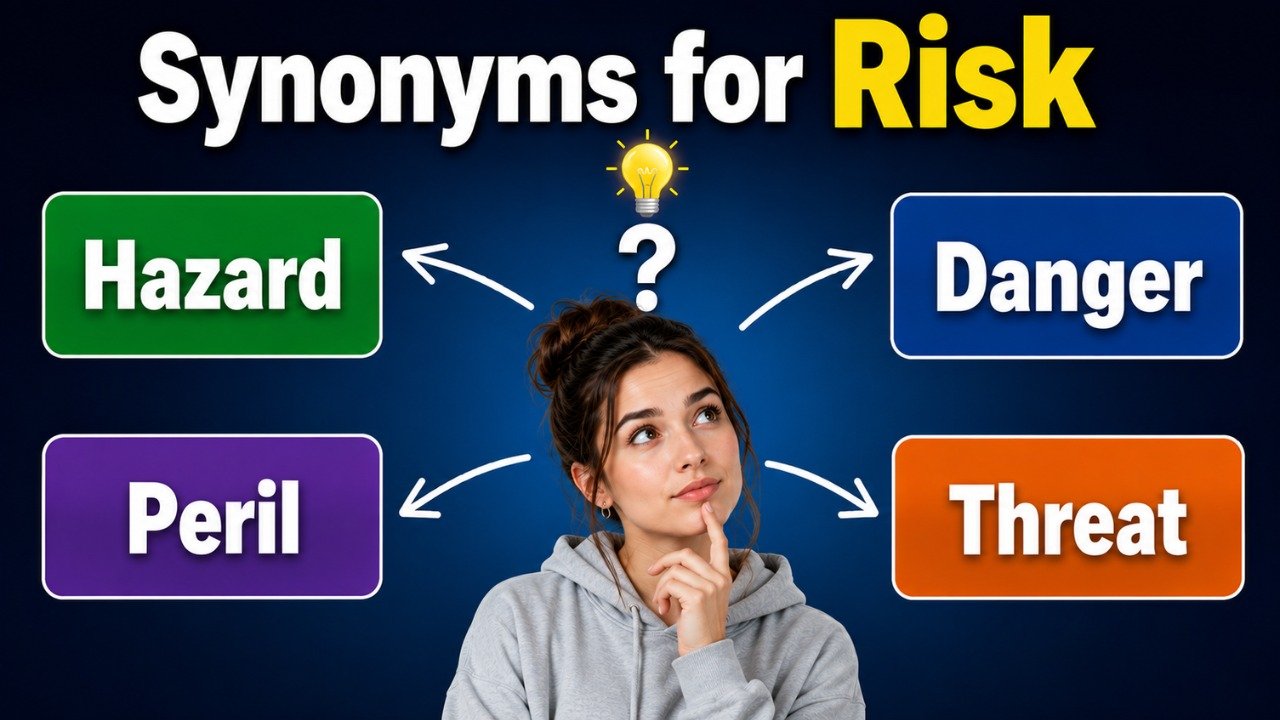
Quick Answer: The best synonyms for risk include danger, hazard, peril, threat, uncertainty, exposure, jeopardy, gamble, vulnerability, and chance. Use danger for a general possibility of harm, hazard for a specific source of harm, and peril for serious or immediate danger. Uncertainty is best for formal reports and planning, while exposure suits financial, legal, health, and business contexts. Gamble and chance are natural when someone knowingly accepts an uncertain outcome. Vulnerability describes weakness that makes harm more likely.
Pronunciation and Word Details
Word: Risk.
Pronunciation: /rɪsk/
Part of Speech: Noun and verb.
Meaning: The possibility that something harmful, unwanted, or uncertain may happen.
US Pronunciation:
UK Pronunciation:
What Does “Risk” Mean?
Risk means the possibility that an action, decision, situation, or event may lead to harm, loss, failure, or another unwanted result.
As a noun, risk can describe a possible danger, the likelihood of harm, or a person or thing that may cause difficulty.
Example: Driving in heavy fog increases the risk of an accident.
As a verb, risk means to expose someone or something to possible harm, loss, or failure.
Example: Do not risk your safety by entering the damaged building.
Risk can also describe a deliberate decision to accept uncertainty in the hope of receiving a benefit.
Example: She took a risk by starting a new business.
In finance, risk often means the possibility of losing money or receiving a lower return than expected.
Example: Every investment carries some level of risk.
In health contexts, risk refers to the chance that a condition, injury, or negative outcome may occur.
Example: Regular safety checks can reduce the risk of injury.
In business and project planning, risk may describe any uncertain event that could affect cost, quality, timing, performance, or success.
Example: A delay in delivery is a major project risk.
Meaning, Tone, and Context of “Risk”
Risk is a neutral and widely used word. It appears in casual speech, formal writing, professional reports, academic discussions, safety instructions, financial analysis, health information, legal communication, and everyday decision making.
Neutral Tone: There is a risk of rain this afternoon.
Conversational Tone: Taking that shortcut is not worth the risk.
Formal Tone: The report identifies several risks that may affect completion.
Technical Tone: The assessment measures the probability and impact of each risk.
Financial Tone: Higher potential returns often involve greater risk.
Medical Tone: Certain habits may increase the risk of illness.
Legal Tone: The agreement explains which party accepts the risk of loss.
Emotional Tone: He feared the risk of losing an important friendship.
Positive Tone: Taking a thoughtful risk can create new opportunities.
Negative Tone: Ignoring the warning exposed everyone to unnecessary risk.
The tone of risk depends on context. It can sound serious when physical safety is involved, analytical when used in reports, cautious in advice, or adventurous when discussing personal growth.
More specific alternatives can improve clarity. Hazard identifies the source of harm, vulnerability identifies a weakness, uncertainty emphasizes the unknown, and gamble suggests a decision made despite an unpredictable outcome.
When and How to Use “Risk”
For Physical Danger
Use risk when an action or environment could cause injury, illness, or damage.
Example: Wet floors create a risk of falling.
For Financial Loss
Use risk when money, property, income, or financial value may be lost.
Example: The investor understood the risk of losing part of the original amount.
For Business Decisions
Risk describes uncertainty that may affect performance, revenue, reputation, operations, or long term success.
Example: Depending on one supplier creates a serious business risk.
For Project Planning
Use risk for an uncertain event that may affect deadlines, budgets, quality, or results.
Example: The team recorded each project risk before beginning the work.
For Health Concerns
Risk can describe the possibility of developing an illness or experiencing a harmful health outcome.
Example: Wearing protective equipment reduces the risk of injury.
For Legal Responsibility
Use risk when discussing possible loss, responsibility, liability, or harm under an agreement.
Example: The contract states which party carries the risk of damage.
For Personal Decisions
Risk is useful when someone must choose between safety and an uncertain opportunity.
Example: Moving to a new city was a risk, but it opened new possibilities.
For Reputation
Use risk when a decision could damage trust, credibility, or public opinion.
Example: Publishing unverified information may risk the writer’s reputation.
For Security
Risk may describe the possibility of theft, attack, data loss, or unauthorized access.
Example: Weak passwords increase the risk of unauthorized access.
For Deliberate Chance Taking
As a verb, risk can mean knowingly accepting possible harm or failure.
Example: She risked rejection by presenting her idea to the committee.
Best Synonyms for Risk
Danger
Synonym: The possibility that harm, injury, damage, or loss may occur.
Example: The damaged bridge presented a serious danger to drivers.
Hazard
Synonym: A specific object, condition, or situation that may cause harm.
Example: Loose electrical wires are a major safety hazard.
Peril
Synonym: Serious, immediate, or extreme danger.
Example: The sailors found themselves in great peril during the storm.
Threat
Synonym: Something that may cause harm, loss, or difficulty.
Example: Rising costs pose a threat to the project.
Uncertainty
Synonym: A lack of confidence or knowledge about what will happen.
Example: Economic uncertainty made planning difficult.
Exposure
Synonym: The state of being open to possible harm, loss, or negative effects.
Example: The company reduced its exposure to sudden price changes.
Jeopardy
Synonym: A condition in which someone or something may be harmed or lost.
Example: The unexpected delay placed the agreement in jeopardy.
Gamble
Synonym: A decision involving significant uncertainty and possible loss.
Example: Launching the product without testing was a gamble.
Vulnerability
Synonym: A weakness that makes harm, loss, or attack more likely.
Example: The review revealed a serious security vulnerability.
Chance
Synonym: The possibility that a particular event may happen.
Example: There is a chance that the schedule will change.
50 Synonyms for Risk with Short Meanings
Not every alternative below can replace risk in every sentence. The correct choice depends on whether risk means danger, uncertainty, probability, weakness, financial exposure, or deliberate chance taking.
- Danger: The possibility of harm or injury.
- Hazard: A specific source of possible harm.
- Peril: Serious or immediate danger.
- Threat: Something likely to cause harm or difficulty.
- Jeopardy: A condition involving possible loss or harm.
- Uncertainty: A lack of knowledge about the outcome.
- Chance: The possibility that something may happen.
- Possibility: An outcome that may occur.
- Probability: The measured or estimated likelihood of an event.
- Likelihood: The degree to which something is expected to happen.
- Prospect: The possibility of a future event.
- Potential: The capacity for an outcome to develop.
- Exposure: Openness to possible harm or loss.
- Vulnerability: Weakness that increases the chance of harm.
- Susceptibility: The tendency to be affected or harmed.
- Liability: Legal or financial responsibility for possible loss.
- Insecurity: A lack of safety, stability, or certainty.
- Instability: A condition likely to change or fail.
- Unpredictability: The quality of being difficult to forecast.
- Precariousness: A state of being unsafe or uncertain.
- Menace: A person or thing that may cause harm.
- Endangerment: The act of placing someone or something in danger.
- Gamble: A decision involving uncertain gain or loss.
- Wager: Something placed at risk on an uncertain result.
- Bet: A commitment based on an uncertain outcome.
- Venture: An undertaking involving uncertainty or possible loss.
- Speculation: An uncertain decision based on limited information.
- Adventure: An exciting activity involving uncertainty or danger.
- Undertaking: A task or project that may involve difficulty.
- Challenge: A difficult situation requiring effort and judgment.
- Contingency: A possible future event requiring preparation.
- Pitfall: A hidden problem or unexpected danger.
- Downside: A possible negative part of a decision.
- Drawback: A disadvantage that may cause difficulty.
- Concern: A matter that may create worry or problems.
- Complication: A problem that makes a situation more difficult.
- Consequence: A result that may follow an action.
- Adversity: A difficult or harmful condition.
- Trouble: A situation involving difficulty or danger.
- Crisis: A serious situation requiring urgent action.
- Emergency: A sudden dangerous situation needing immediate attention.
- Harm: Physical, emotional, financial, or practical damage.
- Damage: Injury or loss that reduces value or function.
- Loss: The removal or reduction of something valuable.
- Cost: A negative effect, sacrifice, or price of a decision.
- Stake: Something valuable that may be gained or lost.
- Leap: A bold action taken without certainty.
- Recklessness: Careless acceptance of serious danger.
- Exposure to Loss: A condition in which loss may occur.
- Possibility of Harm: The chance that damage or injury may happen.
Read Also:
Synonyms for Convince

Synonyms for Risk by Context
When Risk Means General Danger
Danger is the strongest general alternative when harm may occur but the exact source is not emphasized.
Useful Synonyms: Danger, peril, jeopardy, threat.
Example With Risk: The damaged stairs created a serious risk.
Example With Danger: The damaged stairs created a serious danger.
When Risk Means a Specific Hazard
Hazard is best when identifying the particular object, action, or condition that may cause harm.
Useful Synonyms: Hazard, menace, threat, pitfall.
Example With Risk: The exposed cable is a safety risk.
Example With Hazard: The exposed cable is a safety hazard.
When Risk Means Serious Immediate Danger
Peril and jeopardy suit situations in which harm is severe or close.
Useful Synonyms: Peril, jeopardy, crisis, emergency.
Example With Risk: The climbers were at risk during the storm.
Example With Peril: The climbers were in great peril during the storm.
When Risk Means an Unknown Outcome
Uncertainty is best when the result cannot be confidently predicted.
Useful Synonyms: Uncertainty, unpredictability, instability, insecurity.
Example With Risk: Market risk affected the company’s plans.
Example With Uncertainty: Market uncertainty affected the company’s plans.
When Risk Means Probability
Chance, likelihood, possibility, and probability describe how likely an event is to occur.
Useful Synonyms: Chance, likelihood, possibility, probability.
Example With Risk: There is a risk that the delivery will be late.
Example With Chance: There is a chance that the delivery will be late.
When Risk Means Financial Exposure
Exposure and liability work well in financial, business, insurance, and legal contexts.
Useful Synonyms: Exposure, liability, stake, potential loss.
Example With Risk: The company reduced its risk from changing prices.
Example With Exposure: The company reduced its exposure to changing prices.
When Risk Means Weakness
Vulnerability and susceptibility identify a condition that makes harm more likely.
Useful Synonyms: Vulnerability, susceptibility, insecurity, weakness.
Example With Risk: The old system creates a risk of unauthorized access.
Example With Vulnerability: The old system contains a security vulnerability.
When Risk Means a Bold Decision
Gamble, venture, wager, and leap describe deliberate action despite uncertainty.
Useful Synonyms: Gamble, venture, wager, leap.
Example With Risk: Opening a second location was a major risk.
Example With Gamble: Opening a second location was a major gamble.
When Risk Means a Hidden Problem
Pitfall, downside, drawback, and complication describe negative factors that may not be immediately obvious.
Useful Synonyms: Pitfall, downside, drawback, complication.
Example With Risk: One risk of the plan is its high cost.
Example With Downside: One downside of the plan is its high cost.
When Risk Means Possible Damage
Harm, damage, loss, and cost describe the negative result that risk may produce.
Useful Synonyms: Harm, damage, loss, cost.
Example With Risk: The decision may create a risk to the company’s reputation.
Example With Harm: The decision may cause harm to the company’s reputation.
Another Word for Risk
Danger is the best general replacement for risk when the sentence refers to possible harm. However, the strongest alternative depends on the exact meaning.
Hazard is better for a specific source of danger. Uncertainty suits planning and analysis. Exposure works in financial and legal writing. Gamble is appropriate when someone deliberately accepts an uncertain outcome.
Original: The broken railing creates a serious risk.
Better Option: The broken railing creates a serious danger.
Original: The chemical presents a risk to workers.
Better Option: The chemical presents a hazard to workers.
Original: The company faces risk from changing exchange values.
Better Option: The company faces financial exposure from changing exchange values.
Original: Starting the project without enough funding was a risk.
Better Option: Starting the project without enough funding was a gamble.
When Not to Use “Risk”
Risk can sound vague when the sentence should identify a specific danger, probability, weakness, legal responsibility, or negative effect.
When the Source of Harm Is Known
Use hazard when a specific condition may cause injury or damage.
Weak: The wet floor is a risk.
Better: The wet floor is a slipping hazard.
When the Outcome Is Merely Possible
Chance or possibility may sound more natural when the result is not necessarily harmful.
Weak: There is a risk that she will arrive early.
Better: There is a chance that she will arrive early.
When the Problem Is a Weakness
Use vulnerability when a flaw makes harm more likely.
Weak: The software contains a security risk.
Better: The software contains a security vulnerability.
When Legal Responsibility Is Intended
Liability is clearer when responsibility for loss, injury, or payment is the main issue.
Weak: The owner accepted the risk for the damaged equipment.
Better: The owner accepted liability for the damaged equipment.
When a Negative Feature Is Certain
Use drawback or downside when the problem already exists rather than merely being possible.
Weak: A risk of the apartment is its limited storage space.
Better: A drawback of the apartment is its limited storage space.
When the Word Is Repeated
Replace repeated uses with more precise terms.
Weak: The report identified a financial risk, a safety risk, and a technology risk.
Better: The report identified financial exposure, a safety hazard, and a technology vulnerability.
When Risk Sounds Too Formal
Chance may sound more natural in casual conversation.
Weak: There is a small risk that we will miss the bus.
Better: There is a small chance that we will miss the bus.
When the Situation Is Extremely Dangerous
Peril or grave danger may provide stronger emphasis.
Weak: The trapped hikers were at some risk.
Better: The trapped hikers were in serious peril.
Words Commonly Confused With Risk
Risk vs Danger: Risk is the possibility or likelihood of harm. Danger is the condition or source that may cause harm.
Risk vs Hazard: Risk considers the chance and possible effect of harm. A hazard is the specific thing that may cause the harm.
Risk vs Threat: A threat is something capable of causing harm. Risk includes the possibility that the threat will actually produce damage.
Risk vs Peril: Risk may be small, moderate, or serious. Peril usually means severe or immediate danger.
Risk vs Chance: Risk usually involves an unwanted result. Chance can refer to either a positive or negative possibility.
Risk vs Probability: Risk often combines likelihood with possible negative consequences. Probability measures how likely an event is.
Risk vs Uncertainty: Risk usually involves outcomes that can be considered or estimated. Uncertainty emphasizes a lack of knowledge about what will happen.
Risk vs Vulnerability: Risk is the possibility of harm. Vulnerability is the weakness that makes harm more likely.
Risk vs Exposure: Risk is a broad possibility of loss. Exposure describes how much someone or something is open to that loss.
Risk vs Liability: Risk is possible harm or loss. Liability is legal or financial responsibility for that harm or loss.
Risk vs Gamble: Risk is any possibility of loss. A gamble is a deliberate decision to accept uncertainty in the hope of benefit.
Risk vs Hazardous: Risk is a noun or verb. Hazardous is an adjective describing something dangerous.
Which Synonym Should You Choose?
Choose danger for general writing about possible harm, injury, damage, or loss.
Choose hazard when identifying a specific source of physical, environmental, workplace, or safety related harm.
Choose peril when the danger is serious, immediate, or dramatic.
Choose threat when a person, condition, event, or trend may cause harm in the future.
Choose uncertainty in reports, essays, planning documents, and professional discussions when the outcome is unknown.
Choose chance in casual speech when something may happen but the wording does not need to sound technical.
Choose probability when discussing measurements, statistics, research, forecasting, or calculated likelihood.
Choose likelihood when describing how probable an event appears without using a precise number.
Choose exposure in financial, legal, business, insurance, security, and operational writing.
Choose liability when responsibility for payment, injury, loss, or legal consequences is involved.
Choose vulnerability when a weakness allows harm, attack, failure, or loss.
Choose susceptibility when a person, material, system, or group is easily affected by something harmful.
Choose gamble when a decision involves significant uncertainty and possible loss.
Choose venture for a business, project, or activity that involves uncertain results.
Choose speculation when a financial or practical decision is based on limited information.
Choose pitfall when describing a hidden problem that readers should avoid.
Choose downside when explaining a possible negative side of a choice in conversation or general writing.
Choose drawback when the disadvantage already exists and is not merely possible.
Choose contingency when discussing a possible future event that requires a backup plan.
Choose jeopardy when something important may be lost, damaged, or destroyed.
Choose stake when emphasizing what may be gained or lost through a decision.
Real Life Examples of “Risk” in Sentences
Original: The loose steps create a risk for visitors.
Better Option: The loose steps create a hazard for visitors.
Original: There is a risk that the outdoor event will be delayed.
Better Option: There is a chance that the outdoor event will be delayed.
Original: The business faces risk because it depends on one customer.
Better Option: The business faces vulnerability because it depends on one customer.
Original: The storm placed the fishing boats at risk.
Better Option: The storm placed the fishing boats in peril.
Original: The company reduced its risk in foreign markets.
Better Option: The company reduced its exposure in foreign markets.
Original: Starting production before testing was a major risk.
Better Option: Starting production before testing was a major gamble.
Original: One risk of the proposal is the high operating cost.
Better Option: One downside of the proposal is the high operating cost.
Original: Weak access controls create a serious risk.
Better Option: Weak access controls create a serious security vulnerability.
Original: The manager discussed every risk that might delay completion.
Better Option: The manager discussed every contingency that might delay completion.
Original: The decision put the company’s reputation at risk.
Better Option: The decision placed the company’s reputation in jeopardy.
Synonym Groups and Usage Differences
Danger Group
Danger, peril, jeopardy, menace, and threat describe situations in which harm may occur.
Danger is the broadest word. Peril is stronger and more dramatic. Threat identifies something that may cause harm. Jeopardy emphasizes that something valuable may be lost.
Example: The sudden flood placed nearby homes in jeopardy.
Probability Group
Chance, possibility, probability, likelihood, prospect, and potential describe whether an event may occur.
Chance is common in everyday speech. Probability is more technical. Likelihood is useful in reports and analysis. Prospect often refers to a future possibility.
Example: There is a strong likelihood of further delays.
Uncertainty Group
Uncertainty, unpredictability, instability, insecurity, and precariousness describe a lack of reliable knowledge or stability.
Uncertainty focuses on the unknown. Instability suggests frequent or dangerous change. Precariousness describes a situation that may quickly become unsafe.
Example: Economic uncertainty affected long term planning.
Exposure Group
Exposure, liability, vulnerability, and susceptibility describe how open someone or something is to harm.
Exposure often refers to the amount of possible loss. Liability involves responsibility. Vulnerability identifies weakness. Susceptibility means being easily affected.
Example: The new controls reduced the system’s vulnerability to attack.
Chance Taking Group
Gamble, wager, bet, venture, speculation, adventure, and leap describe decisions made without a guaranteed result.
Gamble often implies significant possible loss. Venture is common in business. Speculation suggests limited evidence. Leap emphasizes bold action.
Example: Leaving a stable position to begin the venture was a calculated gamble.
Problem Group
Pitfall, downside, drawback, complication, concern, and challenge describe difficulties connected with an action or plan.
A pitfall is often hidden. A drawback is an existing disadvantage. A downside is an informal negative feature. A complication makes progress more difficult.
Example: One potential pitfall is the lack of trained staff.
Harm Group
Harm, damage, loss, cost, consequence, and adversity describe possible or actual negative effects.
Harm is broad. Damage usually reduces value or function. Loss involves something valuable being removed. Cost can describe a sacrifice beyond money.
Example: The decision caused lasting damage to public trust.
Emergency Group
Crisis, emergency, trouble, endangerment, and peril describe urgent or serious situations.
A crisis threatens stability. An emergency requires immediate action. Endangerment focuses on placing someone in danger.
Example: The equipment failure created a serious emergency.
Antonyms of Risk
The opposite of risk depends on whether the word refers to danger, uncertainty, loss, or unsafe action.
Safety: Freedom from danger, injury, or harm.
Security: Protection against threats, loss, or attack.
Certainty: Complete confidence about an outcome.
Assurance: A feeling or statement of confidence and reliability.
Protection: Action taken to prevent harm or damage.
Safeguard: A measure designed to prevent danger or loss.
Stability: A condition that is unlikely to change or fail suddenly.
Reliability: The quality of performing consistently and dependably.
Predictability: The quality of being easy to forecast.
Guarantee: A firm promise that a result will occur or a condition will be met.
Confidence: Belief that an outcome is likely to be successful.
Precaution: An action taken before harm occurs.
Prevention: The act of stopping harm, loss, or failure from happening.
Certitude: Complete freedom from doubt.
Surety: A state of confidence, security, or assurance.
Low Exposure: A condition involving limited possibility of loss.
Comparison: Risk vs Related Words
Risk vs Danger
Risk refers to the possibility that harm may occur. Danger refers to a condition in which harm is possible or likely.
Example With Risk: There is a risk of falling on the wet floor.
Example With Danger: The wet floor presents a danger to visitors.
Risk vs Hazard
Risk considers both the chance and possible effect of harm. A hazard is the source of the harm.
Example With Risk: The risk of injury increases near the machine.
Example With Hazard: The unguarded machine is a workplace hazard.
Risk vs Threat
Risk describes possible loss or harm. A threat is the person, event, or condition capable of producing that harm.
Example With Risk: The data faces a risk of unauthorized access.
Example With Threat: Unauthorized access is a serious threat to the data.
Risk vs Peril
Risk can describe any level of possible harm. Peril usually suggests severe and immediate danger.
Example With Risk: The travelers understood the risk of bad weather.
Example With Peril: The travelers were in peril when the bridge collapsed.
Risk vs Chance
Risk normally emphasizes an unwanted result. Chance is neutral and may refer to either a positive or negative outcome.
Example With Risk: There is a risk that the plan will fail.
Example With Chance: There is a chance that the plan will succeed.
Risk vs Uncertainty
Risk focuses on possible harmful outcomes. Uncertainty focuses on what is unknown or difficult to predict.
Example With Risk: The investment carries a risk of loss.
Example With Uncertainty: Market uncertainty makes future returns difficult to predict.
Risk vs Probability
Risk includes the possible consequence of an event. Probability focuses on how likely the event is to happen.
Example With Risk: The project has a risk of delay.
Example With Probability: The probability of delay is high.
Risk vs Vulnerability
Risk is the possibility of harm. Vulnerability is the weakness that allows harm to happen more easily.
Example With Risk: The building faces a risk of water damage.
Example With Vulnerability: The damaged roof is the building’s main vulnerability.
Risk vs Exposure
Risk is the broad possibility of loss. Exposure describes the extent to which a person, company, or asset is open to that loss.
Example With Risk: The company faces financial risk.
Example With Exposure: The company has significant exposure to rising material costs.
Risk vs Liability
Risk is possible harm or loss. Liability is responsibility for harm, payment, debt, or legal consequences.
Example With Risk: The activity involves a risk of injury.
Example With Liability: The organizer may have liability for injuries caused by unsafe equipment.
Risk vs Gamble
Risk may be unavoidable or accidental. A gamble is a deliberate choice involving an uncertain outcome.
Example With Risk: Travel during the storm carries considerable risk.
Example With Gamble: Traveling without a reservation was a gamble.
Risk vs Downside
Risk is something negative that may happen. A downside is a disadvantage that already belongs to an option.
Example With Risk: There is a risk that maintenance costs will rise.
Example With Downside: The main downside is the high maintenance cost.
Common Phrases and Expressions With “Risk”
At Risk: In a situation where harm, loss, or failure may occur.
Example: Older trees may be at risk during the storm.
Take a Risk: Make a decision despite possible harm or failure.
Example: She decided to take a risk and present her original idea.
Run the Risk: Put oneself in a situation where an unwanted result may occur.
Example: You run the risk of losing your work if you do not save the file.
Risk of Loss: The possibility that money, property, or value may be lost.
Example: The agreement explains the risk of loss during delivery.
High Risk: Involving a strong possibility of harm, failure, or loss.
Example: The team avoided the high risk route.
Low Risk: Involving a small possibility of harm or failure.
Example: The savings option is considered relatively low risk.
Calculated Risk: A risk accepted after carefully considering possible gains and losses.
Example: Expanding into the new area was a calculated risk.
Safety Risk: A condition that may cause injury or physical harm.
Example: The broken handrail is a serious safety risk.
Risk Factor: A condition or behavior that increases the possibility of a negative outcome.
Example: Poor maintenance is a risk factor for equipment failure.
Risk Management: The process of identifying, evaluating, and controlling possible harm or loss.
Example: Effective risk management helped the project remain on schedule.
Common Mistakes to Avoid
Confusing Risk and Hazard
A hazard is the source of possible harm. Risk describes the chance and possible effect of that harm.
Incorrect: The risk is the exposed electrical wire.
Better: The exposed electrical wire is a hazard that creates a risk of electric shock.
Using Risk for a Positive Possibility
Chance or possibility is usually better when the possible result is positive.
Unnatural: There is a risk that she will win the award.
Natural: There is a chance that she will win the award.
Treating Risk and Certainty as the Same
Risk refers to something that may happen, not something that will definitely happen.
Incorrect: The delayed shipment is a risk that has already occurred.
Better: The delayed shipment is now a problem rather than a risk.
Confusing Risk and Drawback
A risk is uncertain. A drawback is an existing disadvantage.
Incorrect: The small kitchen is a possible risk of the apartment.
Correct: The small kitchen is a drawback of the apartment.
Using Risk Too Vaguely
State the exact possible harm whenever clarity matters.
Vague: The new process creates risk.
Clear: The new process creates a risk of delays and data errors.
Repeating Risk Too Often
Use hazard, exposure, vulnerability, uncertainty, danger, or another precise alternative where appropriate.
Repetitive: The risk report identified a safety risk, a financial risk, and a security risk.
Improved: The report identified a safety hazard, financial exposure, and a security vulnerability.
Using Take Risk Without an Article
Risk is usually countable in the expression take a risk.
Incorrect: She decided to take risk.
Correct: She decided to take a risk.
Confusing At Risk and In Risk
At risk is the standard expression for being exposed to danger.
Incorrect: The building is in risk of collapse.
Correct: The building is at risk of collapse.
Using Risk of When Risk to Is Needed
Use risk of before a noun or an ing form. Use risk to before the person or thing that may be harmed.
Example With Risk of: There is a risk of flooding.
Example With Risk to: The flooding creates a risk to nearby homes.
Choosing an Overly Dramatic Synonym
Peril may sound too dramatic for a minor inconvenience.
Weak: The late bus placed our lunch plans in peril.
Better: The late bus created a small scheduling problem.
Confusing Gamble With Every Type of Risk
A gamble usually involves a deliberate decision. Some risks exist without anyone choosing them.
Incorrect: The earthquake created a gamble for the town.
Correct: The earthquake created a serious danger for the town.
Conclusion
The strongest synonyms for risk depend on the kind of uncertainty or harm being described. Danger is the best general alternative, while hazard identifies a specific source of harm. Uncertainty and probability suit reports and analysis, exposure fits financial and legal contexts, and vulnerability describes a weakness. Gamble and venture work for deliberate chance taking, while pitfall and downside identify possible problems. When using synonyms for risk, choose a word that clearly expresses likelihood, severity, responsibility, weakness, or potential loss.
FAQs About Synonyms for Risk
What Is the Best Synonym for Risk?
Danger is the best general synonym for risk. Hazard is better for a specific source of harm, while uncertainty suits unknown outcomes.
What Is a Formal Synonym for Risk?
Exposure, uncertainty, liability, probability, and vulnerability are useful formal alternatives depending on the context.
What Is Another Word for Taking a Risk?
Taking a chance, making a gamble, venturing, and taking a leap are common alternatives.
What Is the Difference Between Risk and Hazard?
A hazard is something that can cause harm. Risk is the likelihood and possible impact of that harm occurring.
Can Chance Replace Risk?
Chance can replace risk when discussing possibility. However, chance is neutral, while risk usually suggests a negative outcome.
What Is the Opposite of Risk?
Safety is the most direct opposite. Other antonyms include security, certainty, protection, stability, and assurance.
Is Risk a Noun or a Verb?
Risk can be both. As a noun, it means possible harm or loss. As a verb, it means exposing someone or something to possible harm.
