
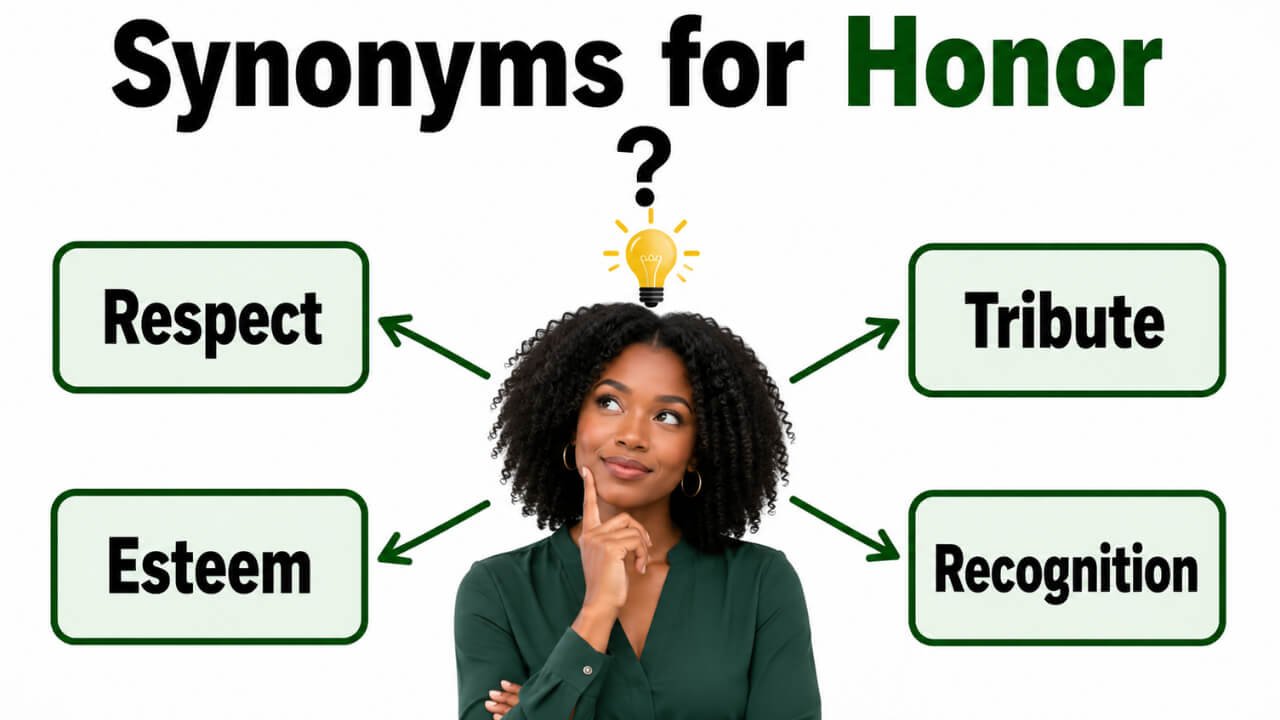
Quick Answer: The best synonyms for honor include respect, esteem, dignity, integrity, tribute, recognition, distinction, prestige, reverence, and glory. When describing admiration for a person, respect or esteem works well. Use integrity or dignity for strong moral character, tribute for a public expression of appreciation, and recognition or distinction for an achievement. In formal or ceremonial writing, reverence, prestige, and commemoration may be more suitable. The right choice among synonyms for honor depends on whether you mean respect, moral character, public praise, an important privilege, or keeping a promise.
Pronunciation and Word Details
Word: Honor
Pronunciation: /ˈɑːnər/
Part of Speech: Noun and verb
Meaning: Respect, moral integrity, public recognition, or the act of fulfilling an obligation.
US Pronunciation:
UK Pronunciation:
What Does “Honor” Mean?
Honor means deep respect, strong moral character, public recognition, or a special privilege. It can function as both a noun and a verb.
As a noun, honor may describe the respect someone receives because of good character, achievement, courage, or service. It can also refer to personal integrity, an award, or the privilege of taking part in something important.
As a verb, honor means to show respect, celebrate someone, recognize an achievement, or fulfill a promise or responsibility.
The word changes slightly according to the sentence. In “She acted with honor,” it means integrity. In “They honored the teacher,” it means showed respect. In “It was an honor to attend,” it describes a valued privilege. In “He honored his promise,” it means fulfilled or upheld.
Meaning, Tone, and Context of “Honor”
Honor usually has a formal, respectful, and positive tone. It often communicates admiration, dignity, responsibility, or moral strength. The word sounds more serious and meaningful than casual alternatives such as like or appreciate.
In personal descriptions, honor refers to honesty, integrity, and ethical behavior. In ceremonies, it may describe public praise, recognition, or remembrance. In professional settings, it can refer to respecting an agreement, commitment, request, or obligation.
The word is also common in emotional and ceremonial language. People may honor a loved one, a respected leader, an important tradition, or the memory of someone who has died.
Honor can sound strong and elevated, so it should be used when the situation deserves genuine respect. In ordinary conversation, respect, appreciate, thank, or remember may sound more natural.
When and How to Use “Honor”
For Showing Respect: Use honor when expressing deep admiration for a person, group, tradition, or achievement.
Example: The community gathered to honor the volunteers for their service.
For Moral Character: Use honor when describing someone who behaves honestly and follows strong ethical principles.
Example: She was known as a person of courage and honor.
For Public Recognition: Honor can describe praise, an award, or recognition given for an accomplishment.
Example: Receiving the teaching award was a great honor.
For a Special Privilege: Use honor when something makes a person feel proud, grateful, or highly valued.
Example: It was an honor to speak at the ceremony.
For Remembering Someone: Use honor when respectfully celebrating a person’s life, work, sacrifice, or influence.
Example: They planted a garden to honor their grandfather’s memory.
For Keeping a Promise: As a verb, honor means to fulfill, respect, or uphold an agreement or commitment.
Example: The team honored its promise to complete the project responsibly.
For Respecting Traditions: Honor may describe following a custom, value, or belief with care.
Example: The family continues to honor its cultural traditions.
For Accepting a Responsibility: Honor can show that someone respects an obligation and acts according to it.
Example: He honored his responsibility by admitting the mistake.
Best Synonyms for Honor
Respect: A feeling or expression of high regard for someone or something.
Example: The students showed respect for their experienced teacher.
Esteem: A high opinion based on admiration for someone’s character or ability.
Example: She was held in great esteem by her colleagues.
Dignity: The quality of being worthy, composed, and deserving of respect.
Example: He accepted the difficult decision with dignity.
Integrity: The quality of being honest and guided by strong moral principles.
Example: Her integrity made her a trusted member of the community.
Tribute: An action, statement, or gift that expresses admiration or gratitude.
Example: The concert was a tribute to the composer’s remarkable career.
Recognition: Public appreciation or acknowledgment of an achievement.
Example: The scientist received recognition for her valuable research.
Distinction: Special importance, excellence, or recognition gained through achievement.
Example: He completed his studies with distinction.
Prestige: Widespread respect connected with success, status, or achievement.
Example: The position carried considerable prestige.
Reverence: Deep and serious respect, often connected with tradition or belief.
Example: The historic building was treated with reverence.
Uphold: To support, maintain, or fulfill a value, promise, law, or responsibility.
Example: Every member promised to uphold the principles of fairness.
50 Synonyms for Honor with Short Meanings
- Respect: High regard for someone or something.
- Esteem: Admiration based on character or ability.
- Regard: A feeling of consideration and respect.
- Admiration: Warm approval of someone’s qualities or achievements.
- Reverence: Deep and serious respect.
- Veneration: Great respect given to someone highly valued.
- Deference: Polite respect for another person’s position or judgment.
- Appreciation: Recognition of someone’s worth or contribution.
- Recognition: Public acknowledgment of value or achievement.
- Tribute: An expression of gratitude, admiration, or respect.
- Homage: Special public respect shown to a person or tradition.
- Praise: Words expressing approval or admiration.
- Acclaim: Strong public approval and enthusiastic praise.
- Distinction: Special recognition gained through excellence.
- Prestige: Respect associated with status or achievement.
- Glory: Great praise, admiration, or fame.
- Renown: Widespread respect and fame.
- Credit: Praise given for an achievement or contribution.
- Dignity: The quality of deserving respect.
- Integrity: Strong honesty and moral principles.
- Virtue: Goodness and moral excellence.
- Nobility: Honorable character and high moral qualities.
- Uprightness: Honest and morally correct behavior.
- Honesty: Truthful and sincere conduct.
- Decency: Respectable, fair, and acceptable behavior.
- Morality: Principles concerning right and wrong conduct.
- Principle: A moral rule that guides behavior.
- Righteousness: The quality of being morally right.
- Probity: Complete honesty and strong moral character.
- Respectability: The quality of being socially or morally worthy.
- Reputation: The general opinion people have about someone.
- Good Name: A positive reputation based on trustworthy behavior.
- High Standing: A respected position within a group or community.
- Privilege: A valued opportunity that creates pride or gratitude.
- Award: A prize given for achievement or service.
- Accolade: An expression or symbol of praise and approval.
- Commendation: Formal praise for excellent conduct or achievement.
- Decoration: An official award for courage, service, or success.
- Merit: The quality of deserving praise or reward.
- Salute: A formal action showing respect or recognition.
- Acknowledgment: Recognition of someone’s effort, value, or contribution.
- Commemoration: Respectful remembrance of a person or event.
- Celebration: Public appreciation of an achievement or important occasion.
- Revere: To feel or show deep respect.
- Admire: To regard someone with approval and respect.
- Recognize: To acknowledge value, service, or achievement.
- Celebrate: To praise or mark something as important.
- Commemorate: To preserve and honor a memory.
- Uphold: To support and maintain a principle or promise.
- Fulfill: To carry out a promise, duty, or obligation.
Read Also:
Synonyms for Found

Synonyms for Honor by Context
When Honor Means Respect
Respect is the most direct replacement when honor refers to valuing a person, idea, tradition, or position. Esteem suggests a high opinion developed over time, while reverence communicates deeper and more serious admiration.
Useful Synonyms: Respect, esteem, regard, admiration, reverence, veneration, and deference.
Example: The students respected the professor for her patience and knowledge.
Example: The leader was held in high esteem throughout the community.
Example: Visitors treated the memorial with reverence.
When Honor Means Moral Character
When honor describes a person’s ethical character, integrity is often the strongest synonym. Dignity emphasizes self respect and worthy behavior, while uprightness and probity emphasize honesty.
Useful Synonyms: Integrity, dignity, virtue, uprightness, honesty, nobility, morality, and probity.
Example: His integrity prevented him from accepting an unfair advantage.
Example: She responded to the criticism with dignity.
Example: The judge was respected for her fairness and uprightness.
When Honor Means Public Recognition
Recognition is appropriate when a person receives acknowledgment for an achievement. Distinction suggests excellence, while acclaim refers to enthusiastic public approval.
Useful Synonyms: Recognition, distinction, acclaim, praise, credit, commendation, accolade, and award.
Example: The writer received recognition for her contribution to education.
Example: The young musician performed with distinction.
Example: The medical team earned widespread acclaim for its work.
When Honor Means a Respectful Expression
Tribute is an action, statement, performance, or object created to show admiration. Homage is more formal and often expresses deep respect for a person, tradition, or artistic influence.
Useful Synonyms: Tribute, homage, salute, praise, acknowledgment, appreciation, and celebration.
Example: The speech was a moving tribute to the retiring principal.
Example: The ceremony paid homage to the town’s founders.
Example: The audience gave the performers a respectful salute.
When Honor Means Keeping a Commitment
When honor is used as a verb for promises, duties, or agreements, fulfill and uphold are usually clearer alternatives. Observe works well for rules and traditions, while keep is natural in everyday language.
Useful Synonyms: Fulfill, uphold, keep, observe, respect, follow, maintain, and carry out.
Example: She fulfilled every promise she had made.
Example: The committee agreed to uphold the original decision.
Example: They continued to observe the family tradition.
When Honor Means a Special Privilege
Privilege is the closest alternative when honor describes an opportunity that creates gratitude or pride. Distinction can be used when the privilege also represents achievement or importance.
Useful Synonyms: Privilege, distinction, pleasure, recognition, opportunity, and compliment.
Example: It was a privilege to represent the local community.
Example: Being selected for the role was a significant distinction.
Another Word for Honor
Respect is the best general replacement for honor when the meaning involves admiration or high regard. However, the most accurate alternative depends on the sentence. Integrity is better for moral character, tribute is better for an expression of appreciation, and fulfill is better when discussing promises or obligations.
Original: The community gathered to honor the local volunteers.
Better Option: The community gathered to recognize the local volunteers.
Original: She is a person of great honor.
Better Option: She is a person of great integrity.
Original: It was an honor to accept the invitation.
Better Option: It was a privilege to accept the invitation.
Original: He promised to honor the agreement.
Better Option: He promised to uphold the agreement.
When Not to Use “Honor”
Honor can be too broad when the sentence needs a more precise word. It may describe respect, integrity, recognition, privilege, or fulfillment, so readers may not always know which meaning is intended.
Avoid honor when a simpler verb explains the action more clearly. For instance, thank is better for ordinary gratitude, remember is better for a simple act of remembrance, and fulfill is clearer for a promise.
Do not overuse honor in the same paragraph. Repeating it can make formal writing sound exaggerated or ceremonial.
Weak: The school honored the student with an honor that honored her service.
Better: The school recognized the student with an award celebrating her service.
Honor may also sound too formal in casual conversation.
Weak: I wish to honor you for helping me carry these boxes.
Better: I want to thank you for helping me carry these boxes.
Use a precise term when discussing a responsibility.
Weak: She honored the assignment before the deadline.
Better: She completed the assignment before the deadline.
Choose integrity when describing moral behavior.
Weak: His honor encouraged him to report the error.
Better: His integrity encouraged him to report the error.
Words Commonly Confused With Honor
Honor vs Respect: Honor is broader and may refer to respect, integrity, recognition, or privilege. Respect mainly describes high regard or considerate treatment.
Honor vs Dignity: Honor may come from personal conduct or public recognition. Dignity is the quality of being worthy and maintaining self respect.
Honor vs Integrity: Honor can describe reputation, praise, or moral character. Integrity specifically refers to honesty and consistent moral principles.
Honor vs Pride: Honor is usually connected with respect or moral worth. Pride is satisfaction in oneself, another person, or an achievement. Pride may be positive or excessive depending on context.
Honor vs Tribute: Honor is the respect itself or the act of showing it. A tribute is a particular speech, gift, performance, or action used to express that respect.
Honor vs Privilege: Honor can mean a valued privilege, but privilege focuses on the special opportunity or advantage rather than the respect connected with it.
Honor vs Recognition: Honor may involve deep respect or moral character. Recognition focuses on acknowledging a person’s work, identity, service, or achievement.
Honor vs Reputation: Honor describes worthy character or respect. Reputation is the opinion that other people have about a person, whether that opinion is positive or negative.
Which Synonym Should You Choose?
For Formal Writing: Choose esteem, distinction, recognition, integrity, or commendation. These words communicate precise meanings and work well in reports, speeches, essays, and professional communication.
For Casual Speech: Choose respect, admire, appreciate, thank, or remember. These alternatives sound natural in ordinary conversations.
For Moral Character: Choose integrity when emphasizing honesty and ethical behavior. Choose dignity when emphasizing worthy and composed conduct.
For Deep Respect: Choose reverence or veneration. Reverence is more common, while veneration sounds highly formal and intense.
For Public Praise: Choose recognition, acclaim, praise, commendation, or credit. Recognition is neutral, while acclaim suggests strong public approval.
For a Ceremony: Choose tribute, homage, salute, commemoration, or celebration. Tribute works well for speeches and performances, while commemoration focuses on respectful remembrance.
For an Achievement: Choose distinction, accolade, award, recognition, prestige, or merit. Distinction emphasizes excellence, while prestige emphasizes respected status.
For a Special Opportunity: Choose privilege. It clearly communicates gratitude for being included in something meaningful.
For Promises and Agreements: Choose fulfill, uphold, keep, or respect. Fulfill emphasizes completion, while uphold emphasizes continued support.
For Traditions and Customs: Choose observe, preserve, respect, maintain, or celebrate. Observe is especially useful for established practices and traditions.
Real Life Examples of “Honor” in Sentences
Original: The town will honor the firefighters at a public ceremony.
Better Option: The town will recognize the firefighters at a public ceremony.
Original: She considered it an honor to lead the discussion.
Better Option: She considered it a privilege to lead the discussion.
Original: He lived his entire life with honor.
Better Option: He lived his entire life with integrity.
Original: The family created a scholarship to honor her memory.
Better Option: The family created a scholarship to commemorate her life.
Original: The award honored his contribution to education.
Better Option: The award recognized his contribution to education.
Original: The speaker honored the former leader in her closing remarks.
Better Option: The speaker paid tribute to the former leader in her closing remarks.
Original: We must honor the promises we make.
Better Option: We must fulfill the promises we make.
Original: The organization honored its commitment to fairness.
Better Option: The organization upheld its commitment to fairness.
Original: The visitors honored the customs of the local community.
Better Option: The visitors respected the customs of the local community.
Original: Her years of service brought honor to her family.
Better Option: Her years of service brought pride and distinction to her family.
Synonym Groups and Usage Differences
Respect Group
Respect, esteem, regard, admiration, reverence, veneration, and deference describe positive feelings toward a person, tradition, position, or achievement. Respect is the broadest word. Esteem suggests a favorable judgment, while reverence and veneration express deeper admiration.
Example: The experienced doctor was held in high esteem by her patients.
Integrity Group
Integrity, dignity, virtue, uprightness, probity, morality, and nobility describe honorable character. Integrity focuses on honesty and consistent principles. Dignity emphasizes worthy conduct, while probity is a formal word for complete honesty.
Example: His integrity remained strong even when the decision was difficult.
Recognition Group
Recognition, distinction, acclaim, praise, credit, commendation, accolade, and award relate to achievement and public approval. Recognition is broad and neutral. Acclaim suggests enthusiastic approval, and commendation is usually formal.
Example: The volunteer received a commendation for years of dedicated service.
Tribute Group
Tribute, homage, salute, acknowledgment, appreciation, commemoration, and celebration describe ways of expressing respect. A tribute may be personal or public. Homage sounds formal, while commemoration focuses on preserving a memory.
Example: The exhibition was created as a tribute to local artists.
Commitment Group
Fulfill, uphold, keep, observe, maintain, respect, and carry out can replace honor when discussing promises, duties, customs, or agreements. Fulfill emphasizes completing an obligation. Uphold means supporting or maintaining it over time.
Example: The members agreed to uphold the principles of equal treatment.
Status Group
Prestige, renown, distinction, glory, reputation, high standing, and respectability describe the status or admiration a person has gained. Prestige often comes from achievement or position, while reputation is based on public opinion.
Example: The award added to the researcher’s international prestige.
Antonyms of Honor
The opposite of honor depends on whether the word refers to respect, integrity, recognition, or fulfillment.
Disrespect: Lack of proper regard or consideration.
Dishonor: Loss of respect caused by shameful conduct.
Disgrace: A condition of shame or damaged reputation.
Shame: Painful embarrassment connected with wrongdoing or failure.
Contempt: A strong belief that someone is unworthy of respect.
Humiliation: The experience of being made to feel ashamed or inferior.
Discredit: Damage to someone’s reputation or reliability.
Corruption: Dishonest or immoral conduct, especially involving power.
Betrayal: The act of breaking trust or loyalty.
Deceit: Dishonest behavior intended to mislead.
Insult: A disrespectful word or action.
Neglect: Failure to give proper care, attention, or respect.
Infamy: A reputation for serious wrongdoing.
Ignominy: Public shame or disgrace.
Violation: Failure to respect a rule, promise, right, or agreement.
Comparison: Honor vs Related Words
Honor vs Respect
Honor has several meanings, including respect, integrity, privilege, and recognition. Respect mainly refers to high regard or considerate treatment.
Example With Honor: It was an honor to represent the students.
Example With Respect: The students showed respect for every speaker.
Honor vs Integrity
Honor may involve reputation or public praise, while integrity specifically describes honesty and strong moral principles.
Example With Honor: Her actions brought honor to the entire group.
Example With Integrity: Her integrity led her to report the mistake immediately.
Honor vs Tribute
Honor can be a feeling, quality, status, or action. A tribute is a specific expression of admiration or remembrance.
Example With Honor: The community wanted to honor the retiring teacher.
Example With Tribute: The students prepared a video tribute for the retiring teacher.
Honor vs Dignity
Honor may be received from others or demonstrated through moral conduct. Dignity is an inner quality of worthiness, composure, and self respect.
Example With Honor: He received the honor because of his public service.
Example With Dignity: He responded to the disappointing result with dignity.
Honor vs Recognition
Honor can express deep respect or moral value. Recognition focuses on acknowledging an achievement, contribution, identity, or effort.
Example With Honor: The ceremony was held to honor the medical workers.
Example With Recognition: The medical workers received recognition for their service.
Honor vs Prestige
Honor may describe ethical character, respect, or a valued privilege. Prestige describes admired status gained through achievement, influence, or position.
Example With Honor: She believed that honesty was a matter of honor.
Example With Prestige: The appointment added to her professional prestige.
Common Phrases and Expressions With “Honor”
In Honor of: As an expression of respect, admiration, or remembrance.
Example: The library was named in honor of its founder.
Guest of Honor: The most important or specially recognized guest at an event.
Example: The retiring coach was the guest of honor.
It Is an Honor: An expression of gratitude for a valued opportunity.
Example: It is an honor to welcome everyone to the ceremony.
Do the Honors: Perform a special task, often opening, serving, or presenting something.
Example: Would you do the honors and announce the winner?
Word of Honor: A serious promise based on personal honesty.
Example: He gave his word of honor that he would return.
Matter of Honor: Something connected with personal principles or reputation.
Example: Keeping the promise became a matter of honor.
Honor a Promise: Do what was sincerely promised.
Example: She honored her promise to support the project.
Honor a Commitment: Fulfill or respect an accepted responsibility.
Example: Every participant must honor the commitment.
Honor Someone’s Memory: Show respect for a person who has died.
Example: They shared stories to honor their grandmother’s memory.
Bring Honor to: Cause someone or a group to receive respect and pride.
Example: Her achievement brought honor to her community.
Common Mistakes to Avoid
One common mistake is using honor without considering its intended meaning. Because the word can refer to respect, morality, recognition, privilege, or fulfillment, a more precise synonym may communicate the idea better.
Avoid repeating honor several times in one paragraph. Replace it with respect, recognition, integrity, tribute, privilege, or fulfill when the context allows.
Do not use honor as a general replacement for every positive action. Thank is better for ordinary gratitude, congratulate is better for celebrating success, and remember is often better for simple reflection.
Be careful when selecting formal synonyms. Veneration and homage communicate deep or ceremonial respect, so they may sound excessive in everyday situations.
Do not confuse honor with pride. Honor usually relates to worth, respect, or ethical conduct. Pride describes satisfaction and may refer to a personal feeling.
Match the part of speech correctly. Integrity, dignity, and respect can function as nouns, while recognize, commemorate, uphold, and fulfill are useful verbs.
Choose synonyms according to the object of the sentence. A person may be respected, an achievement may be recognized, a life may be commemorated, and a promise may be fulfilled.
Conclusion
The best synonyms for honor depend on the meaning you want to express. Respect and esteem suit admiration, while integrity and dignity describe moral character. Recognition, distinction, and accolade work well for achievements. Tribute and commemoration express remembrance, and privilege describes a valued opportunity. When honor refers to promises or duties, choose uphold or fulfill. Understanding these differences will help you select natural, precise, and meaningful alternatives in essays, speeches, professional writing, and everyday conversation.
FAQs About Synonyms for Honor
What Is the Best Synonym for Honor?
Respect is the best general synonym for honor. However, integrity is better for moral character, tribute for appreciation, and recognition for achievement.
What Is Another Word for Honor as a Verb?
Recognize, respect, commemorate, celebrate, uphold, and fulfill can replace honor as a verb. The correct choice depends on the action being described.
What Is a Formal Synonym for Honor?
Esteem, reverence, distinction, commendation, veneration, and prestige are formal alternatives. Each one expresses a different kind of respect or recognition.
What Is a Synonym for a Person With Honor?
A person with honor may be described as principled, honest, upright, dignified, virtuous, noble, or trustworthy.
Are Honor and Respect the Same?
They overlap, but they are not always identical. Respect means high regard, while honor can also mean integrity, recognition, privilege, or fulfilling a promise.
What Synonym for Honor Describes an Award?
Accolade, distinction, recognition, commendation, decoration, and award can describe an honor received for achievement or service.
What Is the Opposite of Honor?
Common opposites include dishonor, disgrace, disrespect, shame, contempt, humiliation, and discredit. The best antonym depends on the meaning of honor in the sentence.
