
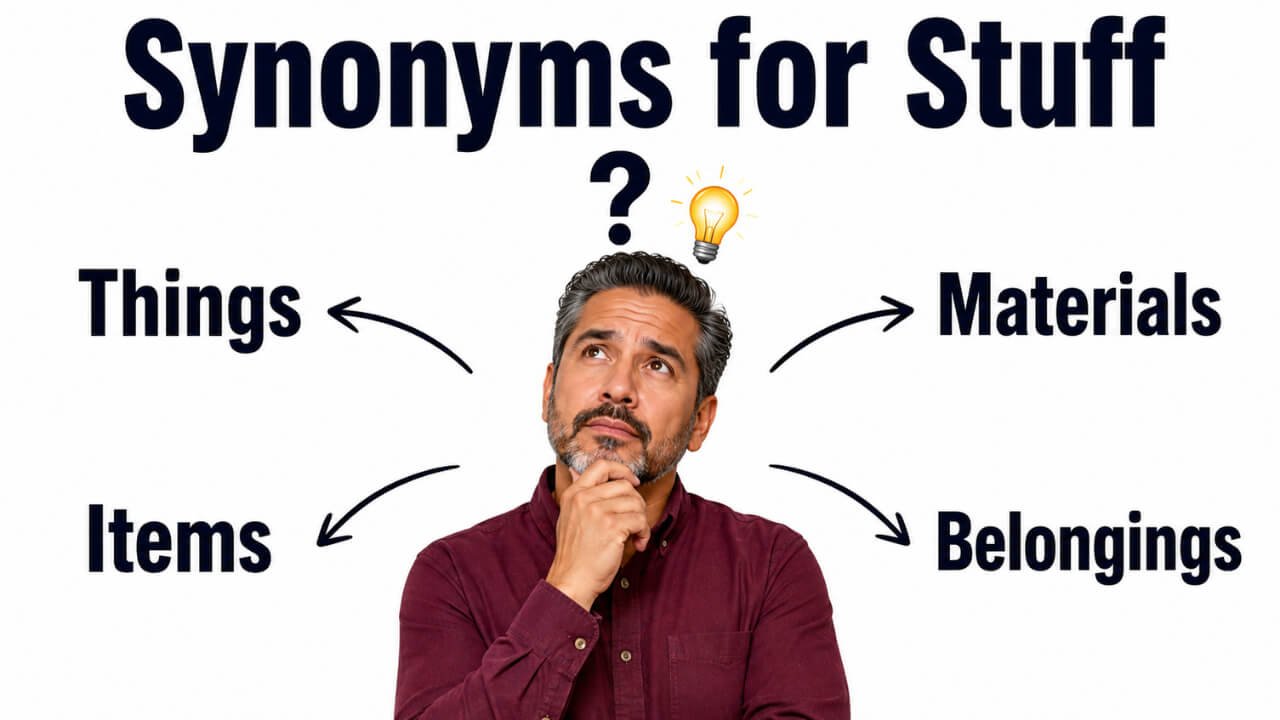
Quick Answer: The best synonyms for stuff include things, items, objects, belongings, materials, goods, equipment, content, information, and possessions. Use things in casual speech, items for individual objects, belongings for personal property, materials for substances used to make something, and equipment for tools or machinery. In formal writing, goods, resources, contents, data, or property may be more precise. When stuff is a verb meaning to fill something tightly, pack, fill, cram, and load are better alternatives.
Pronunciation and Word Details
Word: Stuff.
Pronunciation: /stʌf/.
Part of Speech: Noun and verb.
Meaning: Stuff refers to things, materials, information, or possessions, and it can also mean to fill something tightly.
US Pronunciation:
UK Pronunciation:
What Does “Stuff” Mean?
Stuff means things, materials, possessions, information, or an unspecified substance. It can also mean to fill a space or container tightly.
As a noun, stuff usually refers to a collection of things that the speaker does not name individually.
Example: Please move your stuff from the table.
It can refer to personal belongings.
Example: She packed all her stuff before leaving.
Stuff can also describe a material or substance.
Example: What is this sticky stuff on the floor?
In conversation, it may refer to information, ideas, activities, or knowledge.
Example: We learned some useful stuff in class.
As a verb, stuff means to fill, pack, or push something into a space.
Example: He stuffed the papers into the drawer.
The meaning of stuff depends heavily on context. It may describe physical objects, abstract information, commercial goods, food, or the action of filling something.
Meaning, Tone, and Context of “Stuff”
Stuff is common, informal, and conversational. It is useful when the exact names of objects or ideas are unknown, unimportant, or already understood.
In casual speech, stuff sounds natural and convenient.
Example: I need to finish some stuff before dinner.
In formal writing, stuff can sound vague or imprecise. A more specific word such as materials, belongings, equipment, information, property, or contents is usually stronger.
Stuff is generally neutral, but its tone changes according to the sentence. Personal stuff may refer to private matters. Good stuff expresses approval. Bad stuff can describe unpleasant events, harmful substances, or poor quality objects.
In academic and technical writing, stuff should usually be replaced with a precise noun. In stories and dialogue, however, it can make speech sound natural and realistic.
When and How to Use “Stuff”
For General Things: Use dialogue, however, it can make speech sound natural and realistic stuff when referring informally to several unnamed objects.
Example: There is too much stuff on the desk.
For Personal Belongings: Use stuff when talking casually about possessions.
Example: She left her stuff in the guest room.
For Materials or Substances: Use stuff when the exact type of material is unknown.
Example: A strange powdery stuff covered the shelf.
For Tasks and Activities: Use stuff when several activities do not need to be listed.
Example: I have some important stuff to complete today.
For Information: Use stuff informally for facts, ideas, lessons, or knowledge.
Example: He knows a lot of interesting stuff about plants.
For Food: Use stuff informally when referring to food or ingredients.
Example: This spicy stuff tastes delicious.
For Filling a Container: Use stuff as a verb when placing things tightly into a space.
Example: She stuffed the clothes into her suitcase.
For Eating Too Much: Use stuff in expressions describing excessive eating.
Example: They stuffed themselves at the celebration.
Best Synonyms for Stuff
Things: Unspecified objects, activities, or ideas.
Example: I need to organize a few things before the meeting.
Items: Separate objects in a group or list.
Example: Place the fragile items in a smaller box.
Objects: Physical things that can be seen or touched.
Example: Several unusual objects were displayed in the room.
Belongings: Personal possessions owned by someone.
Example: He collected his belongings before leaving the office.
Materials: Substances or items used to create or complete something.
Example: The students gathered the materials for the project.
Goods: Products or possessions, especially those bought or sold.
Example: The damaged goods were removed from the store.
Equipment: Tools, machines, or objects needed for a purpose.
Example: The team checked its equipment before starting work.
Content: Information, ideas, images, or material contained in something.
Example: The course content covers grammar and vocabulary.
Information: Facts or details communicated or learned.
Example: The guide provides useful information for beginners.
Possessions: Things owned by a person.
Example: Her most valuable possessions were stored safely.
50 Synonyms for Stuff with Short Meanings
- Things: Unspecified objects, ideas, or activities.
- Items: Individual objects within a group.
- Objects: Physical things that can be seen or touched.
- Belongings: Personal things owned by someone.
- Possessions: Property belonging to a person.
- Goods: Products or movable property.
- Property: Things legally owned by someone.
- Effects: Personal possessions, especially during travel or relocation.
- Articles: Individual objects or products.
- Materials: Substances or objects used for a purpose.
- Matter: Physical substance or material.
- Substance: A particular kind of physical material.
- Contents: Things contained inside something.
- Supplies: Materials kept for future use.
- Equipment: Tools or machines needed for an activity.
- Gear: Equipment or personal items used for a purpose.
- Resources: Useful materials, money, information, or support.
- Stock: Goods kept for sale or future use.
- Inventory: A complete supply or list of goods.
- Merchandise: Products offered for sale.
- Products: Things created, produced, or sold.
- Wares: Goods offered for sale.
- Commodities: Useful products that can be bought or sold.
- Cargo: Goods carried by a vehicle, ship, or aircraft.
- Baggage: Bags and personal possessions taken on a journey.
- Luggage: Suitcases and bags used for travel.
- Paraphernalia: Various objects connected with an activity.
- Clutter: Unorganized things filling a space.
- Junk: Unwanted or low value objects.
- Debris: Scattered remains or broken material.
- Ingredients: Substances used to prepare food or another product.
- Information: Facts or knowledge communicated to someone.
- Details: Specific pieces of information.
- Facts: Statements or information known to be true.
- Data: Collected information used for analysis.
- Content: Information or material contained in something.
- Knowledge: Information and understanding gained through learning.
- Ideas: Thoughts, plans, or concepts.
- Fill: To make a space full.
- Pack: To place things closely into a container.
- Cram: To force many things into a small space.
- Jam: To push something tightly into a space.
- Load: To put goods or materials into something.
- Plug: To block or fill an opening.
- Pad: To fill or protect with soft material.
- Crowd: To fill a space with too many people or things.
- Squeeze: To force something into a limited space.
- Insert: To put something inside another thing.
- Force: To push something into a position with pressure.
- Gorge: To fill oneself with too much food.
Read Also:
Synonyms for Persuade
Synonyms for Stuff by Context
When Stuff Means General Things
Things, items, objects, and articles are useful when stuff refers to unnamed physical objects.
Things is the closest casual alternative. Items sounds more organized and specific, while objects focuses on physical form.
Example With Stuff: Please remove your stuff from the chair.
Example With Things: Please remove your things from the chair.
Example With Items: Please remove the items from the chair.
When Stuff Means Personal Belongings
Belongings, possessions, property, effects, baggage, and luggage describe things owned or carried by someone.
Belongings is usually the most natural replacement when discussing personal items.
Example With Stuff: She packed her stuff before moving.
Example With Belongings: She packed her belongings before moving.
Effects is more formal and often appears in descriptions of personal property.
When Stuff Means Materials or Substances
Materials, matter, substance, ingredients, and contents work when stuff refers to a physical material.
Material is useful when something is used for construction, production, art, or study. Substance is better when describing an unknown liquid, powder, chemical, or physical material.
Example With Stuff: What is that oily stuff?
Example With Substance: What is that oily substance?
When Stuff Means Equipment or Supplies
Equipment, gear, supplies, resources, and paraphernalia refer to objects needed for an activity.
Equipment is suitable for professional and formal contexts. Gear is more casual and often refers to clothing, tools, or accessories used for sports, travel, or work.
Example With Stuff: Bring your camping stuff.
Example With Gear: Bring your camping gear.
When Stuff Means Goods or Products
Goods, merchandise, products, stock, inventory, wares, and commodities are useful in commercial contexts.
Goods and products are broad terms. Inventory refers to the complete amount of products held by a business.
Example With Stuff: The shop sells handmade stuff.
Example With Products: The shop sells handmade products.
When Stuff Means Information or Ideas
Information, details, facts, data, content, knowledge, and ideas replace stuff when it refers to something learned, discussed, written, or communicated.
Example With Stuff: The report contains useful stuff.
Example With Information: The report contains useful information.
Data works best for collected figures, measurements, or research results. Content refers to the material inside a book, course, document, or presentation.
When Stuff Means Fill Tightly
Fill, pack, cram, jam, load, plug, insert, and squeeze replace stuff when it functions as a verb.
Fill is neutral. Pack suggests arranging things inside a container. Cram and jam imply that the space is too small or overly full.
Example With Stuff: He stuffed the books into the bag.
Example With Cram: He crammed the books into the bag.
Another Word for Stuff
Things is the best general replacement for stuff in casual speech. However, the most accurate choice depends on whether the sentence refers to possessions, materials, information, equipment, goods, or the action of filling something.
Original: I left my stuff in the car.
Better Option: I left my belongings in the car.
Original: We need more stuff for the experiment.
Better Option: We need more materials for the experiment.
Original: She told me some interesting stuff.
Better Option: She told me some interesting information.
Original: He stuffed the blankets into the cupboard.
Better Option: He packed the blankets into the cupboard.
When Not to Use “Stuff”
Avoid stuff when the reader needs to know exactly what objects, materials, or information you mean. It can make formal writing vague.
Weak: The workers brought the stuff needed for the repair.
Better: The workers brought the tools and materials needed for the repair.
Do not use stuff repeatedly in the same paragraph.
Weak: She packed her stuff, moved the kitchen stuff, and organized the office stuff.
Better: She packed her belongings, moved the kitchen supplies, and organized the office equipment.
Avoid stuff in academic writing when a specific term is available.
Weak: The study collected stuff from several participants.
Better: The study collected data from several participants.
Do not use stuff when referring to countable objects after words such as many or several.
Weak: We purchased many stuff for the event.
Better: We purchased many items for the event.
Avoid a verb such as cram when the objects were arranged carefully.
Weak: She crammed the gifts neatly into the box.
Better: She packed the gifts neatly into the box.
Words Commonly Confused With Stuff
Stuff vs Things: Stuff is an uncountable noun, while things is a plural countable noun. Say much stuff but many things.
Stuff vs Staff: Stuff means objects, materials, or information. Staff means employees working for an organization.
Stuff vs Material: Stuff is broad and informal. Material refers more specifically to a substance, resource, or information used for a purpose.
Stuff vs Matter: Stuff can refer to objects or belongings. Matter usually refers to physical substance, a subject, or an issue.
Stuff vs Belongings: Stuff may refer to almost anything. Belongings specifically refers to personal possessions.
Stuff vs Equipment: Stuff is vague. Equipment refers to tools, machines, or objects needed for a particular task.
Stuff vs Content: Stuff may refer to physical or abstract things. Content refers to information or material inside a publication, course, message, or container.
Stuff vs Fill: Stuff as a verb usually suggests packing something tightly. Fill simply means making a space full.
Which Synonym Should You Choose?
Choose things in casual conversation when the exact names of objects or activities are not important.
Choose items when referring to separate objects in a list, order, collection, or storage area.
Choose belongings when discussing personal possessions.
Choose possessions in formal descriptions of ownership or valuable property.
Choose materials for substances or resources used in construction, art, study, or production.
Choose substance when referring to an unknown liquid, powder, chemical, or physical material.
Choose equipment when discussing tools and machines used for work, sports, or technical activities.
Choose gear in casual speech when referring to clothing, tools, or accessories used for an activity.
Choose goods, products, or merchandise in business writing.
Choose inventory when describing all products currently stored or available.
Choose information for general facts and explanations in reports, essays, or emails.
Choose data when referring to collected facts, figures, measurements, or research results.
Choose content when discussing material inside an article, book, course, document, or presentation.
Choose pack when things are arranged inside a container.
Choose cram when too many things are pushed into a small space.
Real Life Examples of “Stuff” in Sentences
Original: Please put your stuff in the cupboard.
Better Option: Please put your belongings in the cupboard.
Original: The box contains art stuff.
Better Option: The box contains art supplies.
Original: He bought some new stuff for the kitchen.
Better Option: He bought some new equipment for the kitchen.
Original: I learned a lot of useful stuff today.
Better Option: I learned a lot of useful information today.
Original: The factory produces plastic stuff.
Better Option: The factory produces plastic products.
Original: Remove that wet stuff from the floor.
Better Option: Remove that wet substance from the floor.
Original: She keeps too much stuff in her room.
Better Option: She keeps too much clutter in her room.
Original: They loaded their stuff onto the truck.
Better Option: They loaded their possessions onto the truck.
Original: He stuffed the documents into the folder.
Better Option: He inserted the documents into the folder.
Original: The website has helpful stuff for students.
Better Option: The website has helpful content for students.
Synonym Groups and Usage Differences
General Object Group
Things, items, objects, and articles refer to physical objects. Things is informal, items is organized, objects is neutral, and articles is more formal.
Example: Several valuable items were found inside the cabinet.
Personal Property Group
Belongings, possessions, property, effects, baggage, and luggage describe things owned or carried by a person.
Example: Passengers should keep their belongings with them.
Material and Substance Group
Materials, matter, substance, ingredients, and contents describe physical substances or what something contains.
Example: The container held an unknown substance.
Business Goods Group
Goods, products, merchandise, stock, inventory, wares, and commodities relate to production, storage, selling, and trade.
Example: The manager checked the inventory before ordering more products.
Equipment and Resource Group
Equipment, gear, supplies, resources, and paraphernalia describe objects or support needed for an activity.
Example: The hikers checked their gear before beginning the journey.
Information Group
Information, details, facts, data, content, knowledge, and ideas describe abstract material that can be learned, shared, stored, or discussed.
Example: The document contains important details about the project.
Filling Action Group
Fill, pack, cram, jam, load, plug, squeeze, and insert describe placing something into a container or space.
Example: She packed the books carefully into the box.
Antonyms of Stuff
Stuff has no single antonym because it has several meanings. Its opposite depends on whether it refers to filling, possessions, materials, or clutter.
Empty: To remove everything from a container or space.
Clear: To remove objects from an area.
Remove: To take something away.
Unpack: To take things out of a bag or container.
Unload: To remove goods or materials from a vehicle.
Extract: To pull or take something out.
Release: To free something from a tight space.
Discard: To throw away something unwanted.
Organize: To arrange items neatly instead of leaving clutter.
Declutter: To remove unnecessary possessions from a space.
Vacancy: An empty or unoccupied condition.
Space: An area that is not filled.
Comparison: Stuff vs Related Words
Stuff vs Things
Stuff is uncountable and usually refers to a collection without separating individual objects. Things is plural and can be counted.
Example With Stuff: There is too much stuff in the room.
Example With Things: There are too many things in the room.
Stuff vs Belongings
Stuff can refer to objects, materials, information, or activities. Belongings refers only to personal possessions.
Example With Stuff: She moved her stuff upstairs.
Example With Belongings: She moved her belongings upstairs.
Stuff vs Material
Stuff is informal and broad. Material is more precise and often refers to a substance or resource used to make, teach, or complete something.
Example With Stuff: We need more stuff for the model.
Example With Material: We need more material for the model.
Stuff vs Equipment
Stuff may refer vaguely to any objects. Equipment refers to tools or machines needed for a specific activity.
Example With Stuff: They brought their sports stuff.
Example With Equipment: They brought their sports equipment.
Stuff vs Information
Stuff can refer informally to facts, ideas, or knowledge. Information is clearer and more appropriate in formal communication.
Example With Stuff: The document contains important stuff.
Example With Information: The document contains important information.
Stuff vs Pack
Stuff as a verb suggests pushing objects tightly into a space. Pack suggests placing or arranging objects inside a container, often carefully.
Example With Stuff: He stuffed the clothes into the suitcase.
Example With Pack: He packed the clothes into the suitcase.
Common Phrases and Expressions With “Stuff”
Personal Stuff: Private belongings, information, or concerns.
Good Stuff: Something useful, enjoyable, impressive, or high quality.
Bad Stuff: Something unpleasant, harmful, or poor in quality.
Stuff Like That: Other similar things, actions, or ideas.
Know Your Stuff: To understand a subject very well.
Do Your Stuff: To perform an activity using your skill or ability.
Show Your Stuff: To demonstrate talent, knowledge, or possessions.
Stuff Yourself: To eat too much food.
Stuffed With: Completely filled with something.
That Is the Stuff: An expression of approval for something suitable or effective.
Common Mistakes to Avoid
A common mistake is treating stuff as a countable noun. Stuff is normally uncountable, so many stuff and several stuff are incorrect. Use much stuff, a lot of stuff, many things, or several items.
Writers often use stuff when a more specific noun would make the sentence clearer. In formal writing, identify whether you mean information, materials, products, equipment, belongings, or supplies.
Do not confuse stuff with staff. Staff refers to employees, while stuff refers to things or materials.
Avoid using stuffs as the plural of stuff. Stuff normally has no plural when it means things or material. Stuffs may appear as a verb, as in she stuffs the bag, but that is a different grammatical use.
Choose verb synonyms carefully. Pack suggests organized placement, while cram and jam suggest forcing too much into a limited space.
Avoid repeating stuff several times in one paragraph. Replace it with precise words that match each meaning.
Conclusion
Understanding synonyms for stuff helps you replace a broad, informal word with clearer language. Things and items work for general objects, while belongings and possessions describe personal property. Materials, substances, and ingredients are useful for physical matter. Equipment, gear, and supplies identify practical resources. Information, data, and content improve formal writing about ideas or facts. When stuff is a verb, fill, pack, cram, and load provide more specific meanings. Choose the alternative that clearly matches the sentence and context.
FAQs About Synonyms for Stuff
What Is the Best Synonym for Stuff?
Things is the best general synonym in casual speech. A more specific alternative may be belongings, materials, information, equipment, or goods.
What Is a Formal Word for Stuff?
Items, materials, possessions, property, contents, information, equipment, and resources are useful formal alternatives.
Is Stuff the Same as Things?
They are similar, but stuff is uncountable and things is countable. Say too much stuff but too many things.
What Is Another Word for Personal Stuff?
Belongings, possessions, property, effects, baggage, and personal items can replace personal stuff.
What Can Replace Stuff in Academic Writing?
Use information, data, evidence, content, materials, resources, details, or findings, depending on the intended meaning.
What Is a Synonym for Stuff as a Verb?
Fill, pack, cram, jam, load, insert, and squeeze can replace stuff as a verb.
Is Stuffs the Plural of Stuff?
No. Stuff is normally an uncountable noun and does not take a regular plural. Use things or items when referring to separate countable objects.
