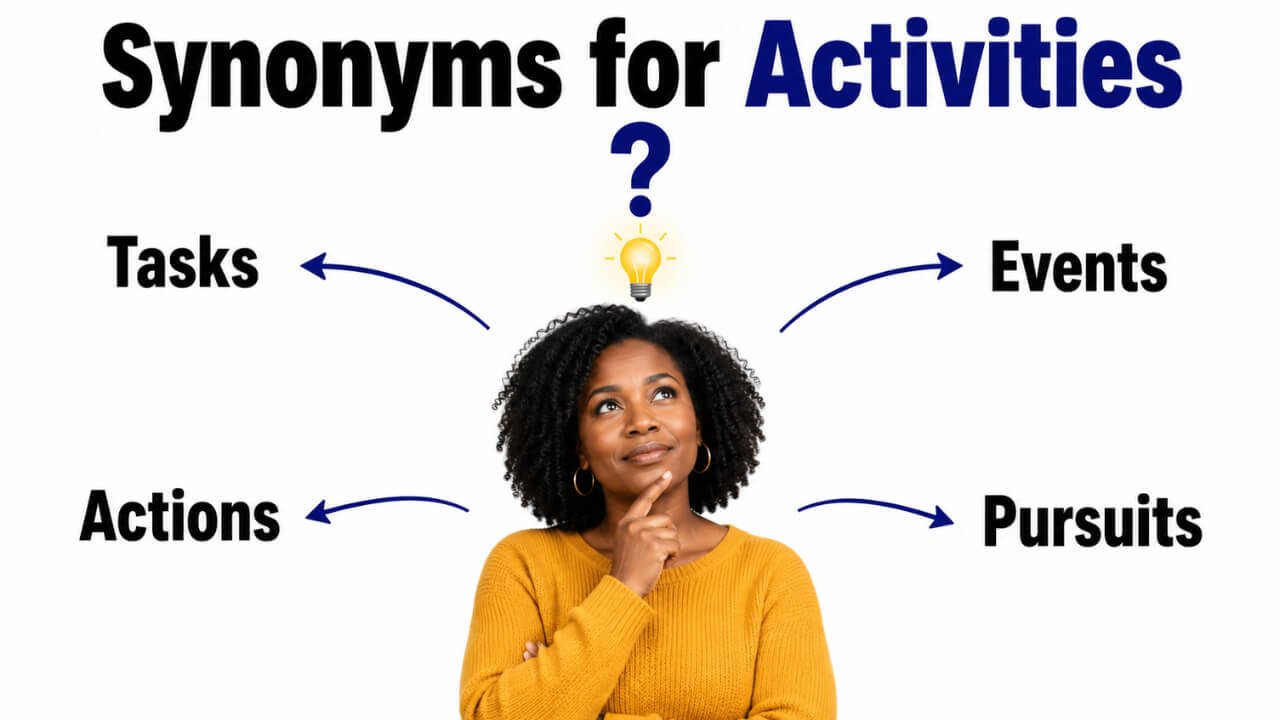
Quick Answer: The best synonyms for activities are tasks, actions, pursuits, events, exercises, operations, projects, duties, hobbies, and undertakings. The keyword synonyms for activities includes alternatives for work, recreation, education, physical movement, planned occasions, and organized processes. Use tasks for specific pieces of work, pursuits for interests or long term goals, events for planned occasions, exercises for learning or fitness, operations for organized business processes, and hobbies for enjoyable free time interests.
Pronunciation and Word Details
Word: Activities
Pronunciation: /ækˈtɪv.ə.tiz/
Part of Speech: Plural noun
Meaning: Things that people, groups, or organizations do for work, learning, exercise, enjoyment, or a particular purpose.
US Pronunciation:
UK Pronunciation:
What Does “Activities” Mean?
Activities means actions, tasks, events, or pursuits that people or organizations take part in. It is the plural form of the noun activity.
The word can refer to almost any form of purposeful action. Activities may involve work, education, exercise, entertainment, social interaction, business, travel, or daily responsibilities.
In education, activities are tasks that help students learn or practice. In leisure, they are enjoyable things people do during their free time. In business, the word may describe operations, projects, or commercial actions. In science, activities can refer to processes or changes taking place within a system.
Work Context: The manager reviewed the team’s daily activities.
Education Context: The lesson includes reading and writing activities.
Leisure Context: Swimming and painting are her favorite activities.
Event Context: The festival offers activities for visitors of all ages.
Scientific Context: Researchers observed changes in cellular activities.
Meaning, Tone, and Context of “Activities”
Activities is a neutral and flexible word. It is common in everyday conversation, formal writing, education, business, science, health, travel, and event planning.
In casual speech, activities often refers to enjoyable things to do. Someone may ask about weekend activities, family activities, or indoor activities.
In professional writing, activities may describe duties, operations, projects, responsibilities, or planned work. The word can sound broad, so a more specific alternative may improve reports, instructions, and formal documents.
In education, activities usually means exercises or learning tasks. In fitness and health discussions, it often refers to physical movement, sports, or exercise.
The word itself is not strongly emotional. Its tone becomes positive, negative, serious, or playful according to the type of activity being described.
Neutral Tone: The schedule lists all planned activities.
Formal Tone: The report summarizes the organization’s financial activities.
Educational Tone: Students completed several vocabulary activities.
Recreational Tone: The resort provides relaxing outdoor activities.
Technical Tone: The system records unusual network activities.
When and How to Use “Activities”
For Work
Use activities when referring generally to tasks, duties, or actions completed as part of a job.
Example: The supervisor monitored the department’s daily activities.
For Education
Use activities for exercises and tasks designed to support learning, practice, or participation.
Example: The teacher prepared several grammar activities for the class.
For Exercise
Use activities for forms of movement that improve fitness, strength, flexibility, or health.
Example: Walking and cycling are useful physical activities.
For Recreation
Use activities for hobbies, games, entertainment, and enjoyable ways to spend free time.
Example: The center offers art and music activities for families.
For Events
Use activities for planned experiences within a festival, meeting, celebration, or gathering.
Example: The community event included cooking activities and live performances.
For Business
Use activities when describing commercial actions, internal operations, projects, or transactions.
Example: The company reviewed its marketing activities for the previous month.
For Daily Life
Use activities for ordinary actions that form part of a routine.
Example: Cooking, cleaning, and shopping are common daily activities.
For Research
Use activities to describe processes, behaviors, or actions being studied.
Example: The researchers recorded the animals’ nighttime activities.
Best Synonyms for Activities
Tasks
Synonym: Specific pieces of work that need to be completed.
Example: The assistant finished all assigned tasks before lunch.
Actions
Synonym: Things done by a person, group, or organization.
Example: Their actions helped improve safety in the neighborhood.
Pursuits
Synonym: Interests, goals, or activities followed over time.
Example: Reading and gardening are among his favorite pursuits.
Events
Synonym: Planned occasions, programs, or public gatherings.
Example: Several cultural events will take place during the celebration.
Exercises
Synonym: Tasks performed for learning, practice, or physical fitness.
Example: The workbook contains exercises for improving vocabulary.
Operations
Synonym: Organized processes carried out by a business or group.
Example: The factory resumed normal operations after the inspection.
Projects
Synonym: Planned pieces of work with defined goals.
Example: Students displayed their science projects in the hall.
Duties
Synonym: Responsibilities that someone is expected to perform.
Example: Her duties include preparing records and answering questions.
Hobbies
Synonym: Enjoyable interests followed during free time.
Example: His hobbies include photography, cooking, and drawing.
Undertakings
Synonym: Important tasks or projects requiring effort and planning.
Example: Renovating the old building was a major undertaking.
50 Synonyms for Activities with Short Meanings
- Tasks: Specific pieces of work to complete.
- Actions: Things that people or groups do.
- Pursuits: Interests or goals followed over time.
- Events: Planned occasions or organized gatherings.
- Exercises: Tasks for learning, practice, or fitness.
- Operations: Organized business or practical processes.
- Projects: Planned work completed for a goal.
- Duties: Responsibilities someone is expected to perform.
- Hobbies: Enjoyable interests practiced during free time.
- Undertakings: Important tasks that require effort.
- Work: Effort used to complete a purpose.
- Jobs: Particular pieces or types of work.
- Assignments: Tasks given to someone for completion.
- Responsibilities: Duties for which someone is accountable.
- Chores: Regular household or routine tasks.
- Functions: Actions or purposes performed by someone or something.
- Practices: Repeated actions or established ways of working.
- Processes: Series of actions leading to a result.
- Procedures: Ordered methods for completing tasks.
- Programs: Organized sets of planned activities.
- Sessions: Periods devoted to a particular activity.
- Games: Activities played for enjoyment or competition.
- Sports: Physical games requiring skill or effort.
- Recreation: Enjoyable activity done for relaxation.
- Pastimes: Pleasant ways of spending free time.
- Interests: Subjects or activities that attract attention.
- Occupations: Regular work or ways of spending time.
- Endeavors: Serious attempts to achieve something.
- Ventures: Projects involving effort, opportunity, or risk.
- Enterprises: Organized projects or business efforts.
- Initiatives: New actions or plans intended to create change.
- Efforts: Attempts made to achieve a result.
- Engagements: Planned commitments or activities.
- Experiences: Events or actions personally encountered.
- Proceedings: Organized actions during a formal event.
- Transactions: Exchanges or business dealings.
- Affairs: Matters, actions, or areas of involvement.
- Functions: Organized social occasions or official purposes.
- Campaigns: Coordinated actions designed to achieve a goal.
- Missions: Important tasks completed for a purpose.
- Assignments: Work officially given to a person.
- Performances: Acts of presenting, doing, or completing something.
- Drills: Repeated exercises used for training.
- Lessons: Learning periods or instructional activities.
- Workshops: Practical sessions involving learning and participation.
- Competitions: Activities in which people try to win.
- Gatherings: Meetings of people for a shared purpose.
- Routines: Regular sets of repeated actions.
- Movements: Physical actions or organized efforts for change.
- Occupations: Activities that keep someone busy or employed.
Read Also:
Synonyms for Warm
Synonyms for Activities by Context
When Activities Means Work Tasks
Tasks, duties, assignments, responsibilities, jobs, chores, and work describe things that need to be completed.
Tasks is the broadest practical replacement. Duties emphasizes obligation, while assignments usually refers to work given by another person.
Example: The employee completed all assigned tasks.
Example: Her duties include checking records and preparing reports.
Example: Students submitted their writing assignments on Friday.
When Activities Means Leisure Interests
Hobbies, pastimes, pursuits, interests, recreation, and games describe enjoyable ways of spending free time.
Hobbies are practiced regularly. Pastimes may be casual, while pursuits can involve serious or long term interest.
Example: Painting is one of her favorite hobbies.
Example: Reading provides a peaceful pastime during travel.
Example: He devoted more time to creative pursuits after retirement.
When Activities Means Physical Exercise
Exercises, sports, movements, drills, games, and recreation describe physical action.
Exercises may be performed for health or training. Sports involve rules and competition, while drills involve repeated practice.
Example: Stretching exercises can improve flexibility.
Example: The children participated in several outdoor sports.
Example: The coach introduced new training drills.
When Activities Means Organized Events
Events, programs, sessions, workshops, gatherings, functions, and proceedings describe scheduled occasions.
Events is the broadest choice. Workshops focus on practical learning, while functions often refer to formal or social occasions.
Example: The festival includes several family events.
Example: Participants attended a writing workshop.
Example: The evening function began with a formal welcome.
When Activities Means Business Operations
Operations, transactions, enterprises, ventures, procedures, processes, and affairs describe organized commercial or professional actions.
Operations refers to the regular functioning of an organization. Transactions involve exchanges, while procedures describe approved methods.
Example: The business expanded its operations into another region.
Example: All financial transactions were recorded accurately.
Example: Employees must follow the correct safety procedures.
When Activities Means Planned Efforts
Projects, initiatives, campaigns, missions, endeavors, efforts, and undertakings describe actions organized around a goal.
Projects usually have a defined outcome. Initiatives introduce change, while campaigns involve coordinated action over time.
Example: The students completed several community projects.
Example: The health initiative encouraged regular exercise.
Example: The campaign focused on reducing waste.
When Activities Means Learning Work
Exercises, lessons, assignments, sessions, workshops, practices, and projects describe educational participation.
Exercises develop a specific skill. Lessons provide instruction, while projects often require research, creativity, and independent work.
Example: The lesson contains several reading exercises.
Example: The class completed a group project about local history.
Example: Students attended a practical writing session.
Another Word for Activities
Tasks is often the best single replacement for activities when discussing work, education, or responsibilities. However, the strongest alternative depends on the purpose of the sentence.
Use events for planned occasions, hobbies for personal interests, exercises for learning or fitness, operations for business processes, and pursuits for interests followed over time.
Original: The team completed several activities during the morning.
Better Option: The team completed several tasks during the morning.
Original: The school organized creative activities for families.
Better Option: The school organized creative events for families.
Original: Swimming and drawing are her favorite activities.
Better Option: Swimming and drawing are her favorite hobbies.
Original: The report describes the organization’s daily activities.
Better Option: The report describes the organization’s daily operations.
When Not to Use “Activities”
Activities may sound too broad when the reader needs to know exactly what people are doing. A more precise word can make the sentence clearer.
Weak: The employee performed several activities.
Better: The employee completed several administrative tasks.
The word may also feel repetitive in schedules, reports, and educational content.
Weak: The program includes learning activities, group activities, and outdoor activities.
Better: The program includes lessons, group projects, and outdoor games.
Do not use activities when referring to one action. Activity is singular, while activities is plural.
Weak: Walking is one of my favorite activity.
Better: Walking is one of my favorite activities.
Avoid using activities as a replacement for events when discussing scheduled occasions.
Weak: Three activities will be held in the main hall tonight.
Better: Three events will be held in the main hall tonight.
In formal business writing, operations, transactions, procedures, or initiatives may provide greater accuracy.
Weak: The report examines the bank’s activities.
Better: The report examines the bank’s financial operations.
Words Commonly Confused With Activities
Activities vs Actions: Activities may include organized, repeated, or purposeful participation. Actions refers more directly to individual things someone does.
Activities vs Tasks: Activities is broad, while tasks are specific pieces of work with clear goals.
Activities vs Events: Activities are things people do. Events are planned occasions that happen at a particular time and place.
Activities vs Hobbies: Activities can include work and responsibilities. Hobbies are enjoyable interests practiced during free time.
Activities vs Exercises: Activities is general. Exercises are completed for physical training, learning, or practice.
Activities vs Operations: Activities can describe any actions. Operations usually refers to organized business, military, technical, or practical processes.
Activities vs Projects: Activities may be brief or ongoing. Projects involve planned work intended to produce a particular result.
Activities vs Duties: Activities may be optional. Duties are responsibilities that a person is expected or required to perform.
Activities vs Pursuits: Activities describes actions in general. Pursuits often refers to interests, goals, or careers followed over time.
Which Synonym Should You Choose?
Choose tasks when describing specific pieces of work in offices, classrooms, plans, or instructions.
Choose duties when emphasizing responsibilities connected to a role or position.
Choose assignments when work has been officially given to a student, employee, or team.
Choose actions when discussing behavior, decisions, or steps taken in response to a situation.
Choose events for scheduled occasions, celebrations, festivals, conferences, or public programs.
Choose exercises for physical training, classroom practice, grammar work, or skill development.
Choose hobbies for enjoyable personal interests practiced during free time.
Choose pursuits for long term interests, ambitions, creative work, or academic goals.
Choose operations for regular business processes, organizational work, or technical systems.
Choose projects for planned work with a defined goal, deadline, or final result.
Choose initiatives for new plans intended to create improvement or change.
Choose programs when referring to an organized series of events, lessons, or services.
Choose procedures in reports, instructions, and formal writing about approved methods.
Choose recreation in formal discussions of enjoyable free time activity.
Real Life Examples of “Activities” in Sentences
Original: The children enjoyed several outdoor activities.
Better Option: The children enjoyed several outdoor games.
Original: The manager reviewed the team’s daily activities.
Better Option: The manager reviewed the team’s daily tasks.
Original: The center offers activities for older adults.
Better Option: The center offers recreational programs for older adults.
Original: The lesson includes activities for vocabulary practice.
Better Option: The lesson includes exercises for vocabulary practice.
Original: The organization expanded its international activities.
Better Option: The organization expanded its international operations.
Original: Painting and gardening are relaxing activities.
Better Option: Painting and gardening are relaxing hobbies.
Original: The committee planned several activities for the celebration.
Better Option: The committee planned several events for the celebration.
Original: The report explains the research activities completed this month.
Better Option: The report explains the research projects completed this month.
Original: Staff members discussed their weekly activities.
Better Option: Staff members discussed their weekly responsibilities.
Original: The campaign involved many community activities.
Better Option: The campaign involved many community initiatives.
Synonym Groups and Usage Differences
Work Group
Tasks, jobs, duties, assignments, responsibilities, and chores describe work that must be completed.
Tasks is neutral and flexible. Duties and responsibilities emphasize obligation. Chores usually refers to routine household work.
Example: Each employee received a list of daily tasks.
Leisure Group
Hobbies, pastimes, pursuits, interests, games, and recreation describe enjoyable activity.
Hobbies involve regular participation. Pastimes are ways to pass free time, while pursuits can require serious dedication.
Example: Music and gardening are meaningful pursuits for her.
Education Group
Exercises, lessons, assignments, workshops, sessions, and projects describe learning experiences.
Exercises focus on practice. Workshops encourage practical participation, while projects usually require a completed result.
Example: The workshop included several writing exercises.
Business Group
Operations, transactions, processes, procedures, enterprises, and ventures describe commercial or organizational work.
Operations focuses on regular functioning. Transactions involve exchanges, while ventures may involve opportunity and risk.
Example: The company simplified its daily operations.
Event Group
Events, gatherings, functions, programs, sessions, and proceedings refer to organized occasions.
Gatherings emphasize people meeting together. Functions often sound formal, while programs may contain several related activities.
Example: The cultural program included music, food, and storytelling.
Goal Group
Projects, initiatives, campaigns, missions, efforts, endeavors, and undertakings describe purposeful action.
Initiatives often begin a new change. Campaigns coordinate repeated actions, while undertakings are usually large or demanding.
Example: Restoring the historic building was a difficult undertaking.
Antonyms of Activities
The opposite of activities depends on whether the word refers to movement, work, participation, or organized action.
Inactivity: A state in which little or nothing is being done.
Idleness: The condition of not working or being active.
Rest: A period without work or physical effort.
Stillness: A state without movement or activity.
Passivity: Lack of active participation or response.
Pause: A temporary stop in action.
Break: A short period away from work or activity.
Dormancy: A state of temporary inactivity.
Cessation: The act of bringing an activity to an end.
Stoppage: A period when work or movement has stopped.
Withdrawal: The act of ending participation.
Nonparticipation: The condition of not joining an activity.
Silence: Lack of sound or communication.
Repose: A state of rest and calm.
Unemployment: The condition of not having paid work.
Comparison: Activities vs Related Words
Activities vs Tasks
Activities is broad and may include work, play, exercise, or events. Tasks are specific pieces of work that need to be completed.
Example With Activities: The class participated in several creative activities.
Example With Tasks: The class completed three writing tasks.
Activities vs Actions
Activities often involves planned or repeated participation. Actions refers to individual things done by a person or group.
Example With Activities: The center provides activities for children.
Example With Actions: His quick actions prevented further damage.
Activities vs Events
Activities are actions people perform. Events are organized occasions that occur at a set time.
Example With Activities: Guests enjoyed cooking and painting activities.
Example With Events: The town will hold several cultural events this month.
Activities vs Hobbies
Activities can be necessary, optional, professional, or recreational. Hobbies are personal interests pursued for enjoyment.
Example With Activities: Her daily activities include work and exercise.
Example With Hobbies: Her hobbies include painting and reading.
Activities vs Exercises
Activities is a general word. Exercises are designed to improve fitness, knowledge, or skill.
Example With Activities: The students participated in language activities.
Example With Exercises: The students completed grammar exercises.
Activities vs Operations
Activities can refer to any kind of action. Operations usually describes organized and continuing professional processes.
Example With Activities: The report covers the group’s recent activities.
Example With Operations: The report covers the factory’s daily operations.
Activities vs Projects
Activities may be short, repeated, or informal. Projects usually have a goal, plan, and final result.
Example With Activities: The children tried several art activities.
Example With Projects: The children completed a mural project.
Activities vs Pursuits
Activities describes things people do. Pursuits often suggests interests or goals followed seriously over time.
Example With Activities: She balances work activities with family life.
Example With Pursuits: She devoted more time to academic pursuits.
Common Phrases and Expressions With Activities
Daily Activities: Regular actions completed each day.
Outdoor Activities: Actions or recreation performed outside.
Indoor Activities: Things done inside a building.
Physical Activities: Actions involving bodily movement and effort.
Learning Activities: Tasks designed to develop knowledge or skills.
Group Activities: Tasks or experiences completed with other people.
Social Activities: Events or actions involving interaction with others.
Recreational Activities: Enjoyable actions performed for relaxation.
Business Activities: Commercial actions or organizational operations.
Extracurricular Activities: Organized interests pursued outside regular lessons.
Common Mistakes to Avoid
A common mistake is using activities when a more precise noun would communicate the meaning better. Use tasks for work, exercises for practice, events for scheduled occasions, and hobbies for personal interests.
Another mistake is using the singular and plural forms incorrectly.
Incorrect: The program offers one activities every morning.
Correct: The program offers one activity every morning.
Incorrect: The program offers several activity.
Correct: The program offers several activities.
Avoid unnecessary repetition in lists and descriptions.
Repetitive: The camp offers sports activities, art activities, and music activities.
Improved: The camp offers sports, art projects, and music sessions.
Do not treat activity and event as exact synonyms. An event may contain several activities.
Unclear: The festival is an outdoor activity held each year.
Clear: The festival is an annual outdoor event with several activities.
Be careful when replacing activities with actions. Actions often refers to decisions or behavior rather than organized participation.
Unnatural: The children enjoyed several classroom actions.
Natural: The children enjoyed several classroom activities.
In formal reports, avoid broad wording when a precise category is available.
Vague: The document examines financial activities.
Precise: The document examines financial transactions and investment operations.
Conclusion
The keyword synonyms for activities covers words for work, learning, recreation, exercise, events, and organized processes. Tasks and duties suit responsibilities, while exercises work well for education and fitness. Events describe planned occasions, hobbies refer to personal interests, and pursuits suggest long term interests or goals. Operations is effective in business writing, while projects and initiatives describe planned efforts. Choosing a precise alternative helps readers understand what kind of activity is taking place and why it matters.
FAQs About Synonyms for Activities
What Is the Best Synonym for Activities?
Tasks is a useful general alternative for work or education. Events, hobbies, exercises, or operations may be better in other contexts.
What Is a Formal Synonym for Activities?
Operations, undertakings, pursuits, initiatives, procedures, and endeavors are useful formal alternatives. Choose the word that matches the specific context.
What Is Another Word for Fun Activities?
Games, hobbies, pastimes, recreation, entertainment, and leisure pursuits are natural alternatives for enjoyable activities.
What Is Another Word for Work Activities?
Tasks, duties, assignments, responsibilities, operations, and projects can describe work activities.
What Is Another Word for School Activities?
Exercises, lessons, assignments, projects, workshops, and learning tasks are useful alternatives.
What Is the Difference Between Activities and Events?
Activities are things people do. Events are organized occasions that may include several different activities.
What Is the Opposite of Activities?
Common opposite concepts include inactivity, idleness, rest, stillness, passivity, and nonparticipation.
