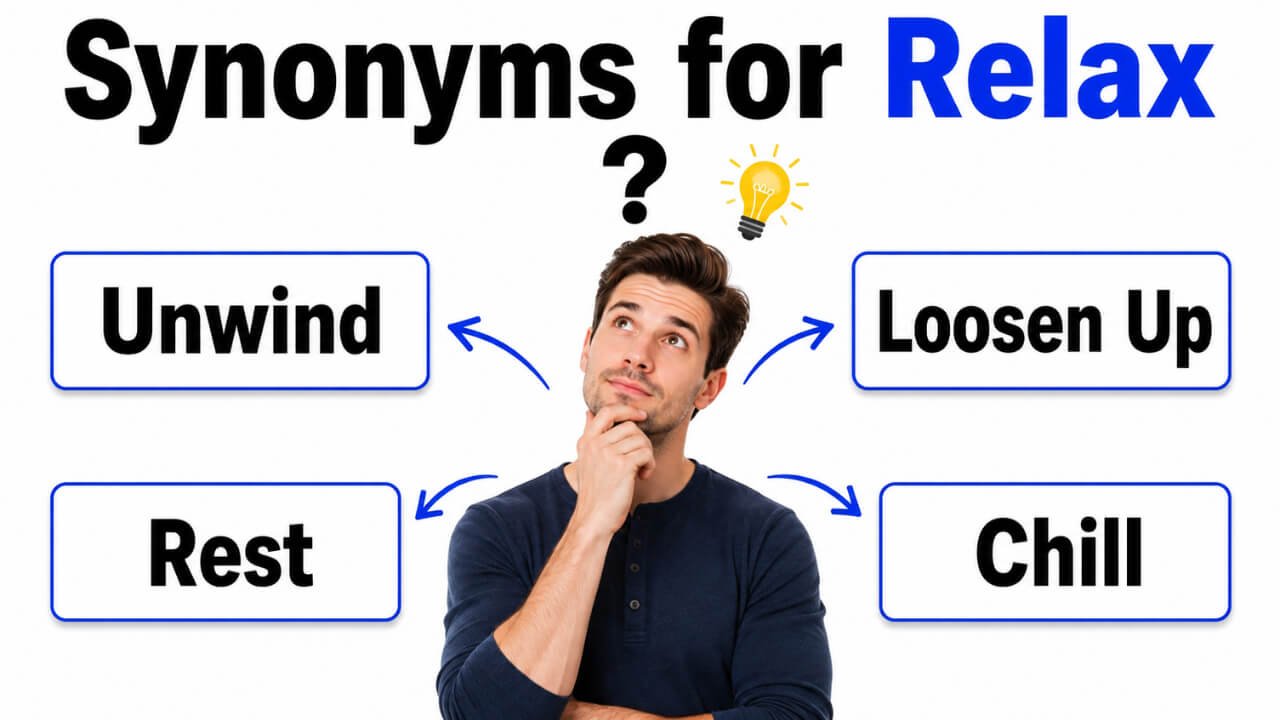
Quick Answer: The best synonyms for relax are unwind, rest, calm down, decompress, loosen up, take it easy, recharge, recuperate, settle down, and recline. Use unwind for releasing stress after work, rest for stopping physical activity, calm down for reducing strong emotions, and decompress for recovering from mental pressure. Loosen up works for physical or emotional tension, while recharge and recuperate are better for restoring energy. These synonyms for relax help you choose a word that matches rest, comfort, emotional calm, recovery, leisure, or reduced tension.
Pronunciation and Word Details
Word: Relax
Pronunciation: /rɪˈlæks/
Part of Speech: Verb
Meaning: To become calmer, less tense, less active, or more comfortable.
US Pronunciation:
UK Pronunciation:
What Does “Relax” Mean?
Relax means to become calm, comfortable, or free from physical or emotional tension. It is mainly used as a verb and can describe resting the body, calming the mind, loosening muscles, reducing pressure, or making rules less strict.
Someone may relax after finishing a difficult task, relax their shoulders during exercise, or relax a rule that is no longer necessary. The word can therefore describe both personal feelings and practical changes.
In everyday conversation, relax often means stopping work and enjoying a peaceful activity. In emotional situations, it means becoming less worried, angry, or nervous. In physical contexts, it can mean releasing tight muscles or loosening a firm grip.
Personal Rest: I like to relax with a book after dinner.
Emotional Calm: Try to relax before the interview begins.
Physical Release: Relax your shoulders and breathe slowly.
Reduced Strictness: The school decided to relax some of its rules.
Meaning, Tone, and Context of “Relax”
Relax is a common, neutral, and conversational word. It is suitable for everyday speech, informal writing, instructions, health discussions, travel descriptions, and workplace communication.
The word usually has a positive and reassuring tone. It suggests comfort, relief, calmness, rest, or freedom from pressure. However, the tone can change depending on how it is used.
When someone gently says, “Try to relax,” the expression sounds supportive. When someone angrily says, “Relax,” it may sound dismissive because it can appear to ignore another person’s concerns.
In formal writing, more specific alternatives may communicate the intended meaning more clearly. Recuperate may be better for recovery after illness, recline for changing body position, and reduce restrictions for making a policy less strict.
Neutral Use: The guests relaxed in the garden.
Supportive Use: Relax your breathing and focus on the present moment.
Casual Use: We stayed home and relaxed all afternoon.
Formal Use: Employees need sufficient time to recuperate after demanding work.
Technical Use: The therapist instructed the patient to relax the affected muscles.
When and How to Use “Relax”
Relax can describe several different actions. The surrounding context helps readers understand whether it refers to the body, the mind, emotions, leisure, recovery, or restrictions.
For Rest After Activity
Use: Relax when someone stops working or exercising and begins to rest.
Example: She relaxed on the sofa after cleaning the house.
For Emotional Calm
Use: Relax when someone becomes less worried, frightened, angry, or nervous.
Example: He began to relax after hearing that everyone was safe.
For Physical Tension
Use: Relax when muscles, hands, shoulders, or other parts of the body become less tight.
Example: Relax your jaw before taking another deep breath.
For Mental Pressure
Use: Relax when a person needs relief from concentration, stress, responsibilities, or demanding decisions.
Example: A quiet walk helps me relax after a busy day.
For Leisure
Use: Relax when someone spends time doing something peaceful or enjoyable.
Example: They relaxed beside the pool during the afternoon.
For Recovery
Use: Relax when rest is needed to restore strength or energy.
Example: You should relax for a few days before returning to your normal routine.
For Reduced Control
Use: Relax when a rule, standard, limit, or restriction becomes less strict.
Example: The organizers relaxed the entry requirements for younger participants.
For Reassurance
Use: Relax when encouraging someone to remain calm and avoid unnecessary worry.
Example: Relax, we still have enough time to finish the project.
Best Synonyms for Relax
Unwind
Synonym: To release stress and become comfortable after activity or pressure.
Example: She listens to soft music to unwind after work.
Rest
Synonym: To stop physical or mental activity in order to recover energy.
Example: He rested for an hour before continuing the journey.
Calm Down
Synonym: To become less upset, worried, excited, or angry.
Example: Take a slow breath and calm down before responding.
Decompress
Synonym: To recover mentally after a stressful or demanding experience.
Example: I need a quiet evening to decompress after the conference.
Loosen Up
Synonym: To become less physically tense, emotionally nervous, or socially reserved.
Example: A few gentle stretches will help your muscles loosen up.
Take It Easy
Synonym: To avoid hard work, stress, or excessive activity.
Example: The doctor advised her to take it easy for several days.
Recharge
Synonym: To restore physical or mental energy through rest.
Example: A peaceful weekend gave him time to recharge.
Recuperate
Synonym: To recover strength or health after illness, injury, or exhaustion.
Example: She stayed with her family while she recuperated from the operation.
Settle Down
Synonym: To become calmer, quieter, or more comfortable.
Example: The children settled down when the story began.
Recline
Synonym: To lean or lie back in a comfortable position.
Example: He reclined in the chair and closed his eyes.
50 Synonyms for Relax with Short Meanings
- Unwind: To release stress after work or pressure.
- Rest: To stop activity and recover energy.
- Repose: To rest in a calm and peaceful way.
- Recuperate: To regain strength after illness or exhaustion.
- Recover: To return to a healthy or energetic condition.
- Recharge: To restore mental or physical energy.
- Decompress: To reduce stress after a demanding experience.
- Calm Down: To become less worried, angry, or excited.
- Settle Down: To become quieter, calmer, or more comfortable.
- Cool Off: To become less angry or emotionally intense.
- Loosen Up: To release physical or emotional tension.
- Take It Easy: To avoid stress or difficult activity.
- Slow Down: To reduce speed, effort, or intensity.
- Pause: To stop briefly before continuing.
- Recline: To lean or lie back comfortably.
- Lounge: To sit or lie in a relaxed manner.
- Idle: To spend time without working or being active.
- Laze: To spend time resting without effort.
- Breathe: To pause and regain calm through steady breathing.
- Meditate: To focus the mind and develop calmness.
- Refresh: To restore energy, comfort, or alertness.
- Soothe: To reduce pain, worry, or emotional discomfort.
- Ease: To reduce tension, difficulty, or discomfort.
- Calm: To make someone or something more peaceful.
- Compose Yourself: To regain emotional control.
- Regain Composure: To become calm after emotional distress.
- Release Tension: To let physical or mental pressure leave.
- Let Go: To stop holding tension, worry, or control.
- Unclench: To release a tightly held hand, jaw, or muscle.
- Loosen: To make something less tight or controlled.
- Slacken: To become less tight, active, or intense.
- Soften: To become gentler, calmer, or less severe.
- Ease Up: To reduce effort, pressure, or strictness.
- Lighten Up: To become less serious, worried, or tense.
- Chill: To relax in a very casual way.
- Chill Out: To become calm or spend time casually.
- Wind Down: To gradually become less active before resting.
- Sit Back: To rest while allowing events to continue.
- Put Your Feet Up: To sit comfortably and rest.
- Take a Break: To stop an activity for a short rest.
- Take Time Out: To pause work or responsibilities temporarily.
- Take a Breather: To pause briefly and regain energy.
- Get Some Rest: To sleep or stop activity for recovery.
- Clear Your Mind: To release distracting or stressful thoughts.
- Find Peace: To reach a calmer emotional state.
- Become Tranquil: To enter a peaceful and undisturbed state.
- Release: To stop holding physical or emotional tension.
- Unbend: To become less formal, serious, or restrained.
- Luxuriate: To enjoy comfort and pleasure for an extended time.
- Bask: To rest and enjoy pleasant warmth or attention.
Read Also:
Synonyms for System
Synonyms for Relax by Context
When Relax Means Rest After Work
Unwind, rest, recharge, wind down, and take a break are useful when someone stops working and begins recovering energy.
Unwind emphasizes releasing stress. Rest focuses on stopping activity. Recharge suggests restoring energy, while wind down describes gradually becoming less active.
Example With Relax: I need to relax after completing the report.
Example With Unwind: I need to unwind after completing the report.
Example With Recharge: I need a quiet evening to recharge after completing the report.
When Relax Means Become Emotionally Calm
Calm down, settle down, compose yourself, regain composure, and cool off describe a change in emotional state.
Calm down is common in conversation. Compose yourself sounds more controlled and formal. Cool off is especially useful when anger is involved.
Example With Relax: She relaxed after receiving the good news.
Example With Calm Down: She calmed down after receiving the good news.
Example With Regain Composure: She regained her composure after receiving the good news.
When Relax Means Release Physical Tension
Loosen up, unclench, release tension, loosen, and slacken work well for muscles, hands, shoulders, jaws, and other parts of the body.
Unclench is specific to something held tightly. Loosen up is broader and can describe the entire body.
Example With Relax: Relax your hands before beginning the exercise.
Example With Unclench: Unclench your hands before beginning the exercise.
Example With Loosen Up: Loosen up your shoulders before beginning the exercise.
When Relax Means Reduce Stress
Decompress, meditate, clear your mind, breathe, and find peace describe relief from mental pressure.
Decompress is useful after demanding work. Meditate describes a deliberate mental practice. Clear your mind focuses on reducing distracting thoughts.
Example With Relax: He walked through the park to relax.
Example With Decompress: He walked through the park to decompress.
Example With Clear Your Mind: A walk through the park may help you clear your mind.
When Relax Means Enjoy Leisure
Lounge, laze, recline, chill, and sit back describe comfortable or unhurried leisure.
Lounge often involves sitting or lying comfortably. Recline describes a physical position. Chill is highly casual and is best suited to informal conversation.
Example With Relax: We relaxed on the beach all morning.
Example With Lounged: We lounged on the beach all morning.
Example With Reclined: We reclined in comfortable chairs beside the beach.
When Relax Means Make Something Less Strict
Ease, loosen, soften, slacken, and ease up may replace relax when discussing rules, limits, standards, control, or pressure.
Ease is usually the clearest choice in formal writing. Loosen works for control or restrictions. Soften is useful for language, attitudes, or demands.
Example With Relax: The committee relaxed the attendance rules.
Example With Eased: The committee eased the attendance rules.
Example With Loosened: The committee loosened the attendance restrictions.
Another Word for Relax
Unwind is often the best general replacement for relax when describing relief from stress after work, study, travel, or responsibility. However, the best alternative depends on the intended meaning.
Use rest when physical recovery is important, calm down for emotions, recharge for energy, and loosen up for physical or social tension.
Original: I relax by reading before bed.
Better Option: I unwind by reading before bed.
Original: You need to relax after the long journey.
Better Option: You need to rest after the long journey.
Original: She tried to relax before giving her speech.
Better Option: She tried to calm down before giving her speech.
Original: He took the weekend to relax and restore his energy.
Better Option: He took the weekend to recharge.
When Not to Use “Relax”
Relax is useful, but it may be too broad when a sentence requires a precise description. A more specific synonym can show exactly what kind of rest, calmness, recovery, or release is taking place.
When Describing Medical Recovery
Recuperate or recover is often clearer than relax when someone is healing from illness, injury, or treatment.
Weak: She stayed home to relax after the operation.
Better: She stayed home to recuperate after the operation.
When Describing Body Position
Recline is more precise when someone leans or lies backward.
Weak: He relaxed his body in the adjustable chair.
Better: He reclined in the adjustable chair.
When Describing Anger
Cool off or calm down communicates emotional change more accurately.
Weak: He walked outside to relax after the argument.
Better: He walked outside to cool off after the argument.
When Describing Muscle Movement
Loosen, release, or unclench may provide a clearer physical instruction.
Weak: Relax the tight grip around the handle.
Better: Loosen your grip around the handle.
When Describing Rules
Ease, loosen, or reduce is clearer in formal discussions about policies and restrictions.
Weak: The organization relaxed its requirements.
Better: The organization eased its requirements.
When the Tone May Sound Dismissive
Telling an upset person to relax may make them feel unheard. A more supportive sentence acknowledges the emotion before offering reassurance.
Weak: Relax. There is nothing to worry about.
Better: I understand why you are concerned. Let us examine the situation calmly.
Words Commonly Confused With Relax
Relax vs Rest: Relax means becoming less tense or stressed. Rest means stopping activity to recover energy. A person can rest physically without feeling mentally relaxed.
Relax vs Unwind: Relax is a broad term for becoming calm or comfortable. Unwind usually describes releasing stress after work, study, travel, or responsibility.
Relax vs Calm: Relax can involve the body, mind, emotions, or activity level. Calm focuses more directly on reducing emotional disturbance or excitement.
Relax vs Recline: Relax describes a state of comfort or reduced tension. Recline describes leaning or lying backward in a particular position.
Relax vs Loosen: Relax can refer to a person’s general state. Loosen usually means making something physically less tight or figuratively less controlled.
Relax vs Recover: Relax means resting or becoming calm. Recover means returning to health, strength, stability, or a previous condition.
Relax vs Recharge: Relax describes the act or state of becoming less tense. Recharge emphasizes restoring energy and motivation.
Relax vs Meditate: Relax is a broad result or activity. Meditate is a deliberate practice involving attention, awareness, reflection, or breathing.
Relax vs Soothe: Relax often describes what a person does. Soothe usually means reducing another person’s pain, worry, irritation, or discomfort.
Which Synonym Should You Choose?
Choose a synonym according to the exact reason for relaxing.
For Formal Writing: Choose recuperate, repose, recline, ease, or regain composure when the context requires precision.
For Casual Speech: Choose unwind, take it easy, chill, chill out, or put your feet up.
For Emotional Calm: Choose calm down, settle down, compose yourself, regain composure, or cool off.
For Physical Rest: Choose rest, recline, lounge, repose, or get some rest.
For Mental Pressure: Choose decompress, clear your mind, meditate, unwind, or take time out.
For Restoring Energy: Choose recharge, refresh, recuperate, or recover.
For Muscle Tension: Choose loosen up, unclench, release tension, loosen, or slacken.
For Anger: Choose cool off, calm down, settle down, or regain composure.
For Rules and Restrictions: Choose ease, loosen, soften, reduce, or slacken.
For Essays: Choose a precise alternative that identifies whether the subject is resting, recovering, becoming calm, or reducing control.
For Reports: Use recover, recuperate, reduce tension, ease restrictions, or lower intensity when accuracy matters.
For Emails: Unwind and recharge work well in friendly messages. Recuperate and recover are more suitable for professional messages about health.
For Conversation: Relax, unwind, rest, take it easy, and calm down are usually natural and easy to understand.
Real Life Examples of “Relax” in Sentences
Original: I relax by listening to music after work.
Better Option: I unwind by listening to music after work.
Original: She relaxed for several days after completing the difficult project.
Better Option: She recharged for several days after completing the difficult project.
Original: He tried to relax before the examination.
Better Option: He tried to calm down before the examination.
Original: We relaxed in the garden throughout the afternoon.
Better Option: We lounged in the garden throughout the afternoon.
Original: Relax your hands before holding the instrument again.
Better Option: Unclench your hands before holding the instrument again.
Original: The manager relaxed the rules for remote attendance.
Better Option: The manager eased the rules for remote attendance.
Original: She needs time to relax after her illness.
Better Option: She needs time to recuperate after her illness.
Original: He relaxed in the chair and watched the rain.
Better Option: He reclined in the chair and watched the rain.
Original: A quiet evening helped them relax after the stressful meeting.
Better Option: A quiet evening helped them decompress after the stressful meeting.
Original: He went outside to relax after becoming angry.
Better Option: He went outside to cool off after becoming angry.
Synonym Groups and Usage Differences
Rest and Recovery Group
Rest, recuperate, recover, recharge, refresh, and repose describe stopping activity or restoring strength.
Rest is the broadest word. Recuperate is especially useful after illness or exhaustion. Recharge often refers to renewed mental or emotional energy.
Example: She spent the weekend recharging after a demanding month.
Emotional Calm Group
Calm down, settle down, cool off, compose yourself, and regain composure describe emotional control.
Calm down works in general situations. Cool off is strongly connected with anger. Regain composure suggests returning to a controlled state after shock, embarrassment, or distress.
Example: He paused to regain his composure before continuing the discussion.
Mental Relief Group
Unwind, decompress, clear your mind, meditate, and find peace describe freedom from mental stress.
Unwind is common after work. Decompress emphasizes relief after intense pressure. Meditate describes an intentional method of developing calm awareness.
Example: She took a quiet walk to decompress after the interview.
Physical Release Group
Loosen up, unclench, release tension, loosen, and slacken describe reduced tightness.
These words are useful for muscles, hands, shoulders, jaws, ropes, grips, and other forms of tension.
Example: Unclench your jaw and allow your shoulders to loosen.
Leisure Group
Lounge, laze, recline, sit back, chill, and put your feet up describe unhurried comfort.
Lounge and recline often involve a physical position. Chill and put your feet up sound more informal.
Example: We lounged beside the window and enjoyed the quiet afternoon.
Reduced Intensity Group
Ease, soften, slacken, slow down, and ease up describe reduced pressure, strictness, speed, or force.
Ease is suitable for formal writing about restrictions or discomfort. Soften often applies to language, attitudes, demands, or emotional reactions.
Example: The revised schedule eased the pressure on the entire team.
Antonyms of Relax
The opposite of relax depends on whether the word refers to physical tension, emotional calm, rest, effort, or reduced restrictions.
Tense: To become physically or emotionally tight.
Tighten: To make something firmer or less loose.
Strain: To use excessive physical or mental effort.
Worry: To remain troubled by uncertain or difficult thoughts.
Agitate: To make someone nervous, upset, or disturbed.
Stress: To create pressure, worry, or tension.
Work: To perform physical or mental activity.
Exert: To apply effort, strength, or influence.
Rush: To act quickly without allowing time for rest.
Intensify: To make an action, feeling, or condition stronger.
Restrict: To control or limit freedom.
Enforce: To make a rule or requirement more strictly followed.
Contract: To become shorter, tighter, or narrower.
Clench: To close or hold something tightly.
Disturb: To interrupt calmness, rest, or peace.
Comparison: Relax vs Related Words
Relax vs Unwind
Relax is a broad word for becoming calm or comfortable. Unwind usually refers to releasing accumulated stress after responsibilities or demanding activity.
Example With Relax: She relaxed in the living room before dinner.
Example With Unwind: She listened to music to unwind after work.
Relax vs Rest
Relax focuses on reduced tension. Rest focuses on stopping activity to restore energy. Relaxation does not always involve sleep, while rest may include sleep or physical inactivity.
Example With Relax: He relaxed by watching the clouds.
Example With Rest: He rested for an hour after the long walk.
Relax vs Calm Down
Relax may refer to leisure, physical comfort, or emotional calm. Calm down specifically refers to reducing excitement, fear, anger, or worry.
Example With Relax: We relaxed at home throughout the evening.
Example With Calm Down: She took several breaths to calm down before speaking.
Relax vs Recharge
Relax describes a peaceful state or activity. Recharge emphasizes gaining fresh energy, motivation, or concentration.
Example With Relax: I relaxed in the garden.
Example With Recharge: I spent the weekend in the countryside to recharge.
Relax vs Recuperate
Relax is common and general. Recuperate is more formal and usually refers to recovering strength after illness, injury, or exhaustion.
Example With Relax: He relaxed at home after the event.
Example With Recuperate: He remained at home to recuperate after his treatment.
Relax vs Recline
Relax describes a condition of comfort. Recline describes the position of leaning or lying backward.
Example With Relax: She relaxed near the fireplace.
Example With Recline: She reclined in a comfortable chair near the fireplace.
Relax vs Loosen Up
Relax may describe a general state. Loosen up usually refers to releasing physical tension, becoming socially comfortable, or acting less seriously.
Example With Relax: Try to relax before the performance.
Example With Loosen Up: Stretch your arms to loosen up before the performance.
Relax vs Decompress
Relax is suitable for many forms of rest. Decompress specifically suggests recovering from mental pressure, demanding work, or an intense experience.
Example With Relax: He relaxed after the meeting.
Example With Decompress: He took a walk to decompress after the difficult meeting.
Common Phrases and Expressions With “Relax”
Relax and Unwind: To release stress and enjoy a calmer state.
Sit Back and Relax: To become comfortable and stop worrying or working.
Relax Your Mind: To reduce stressful, distracting, or anxious thoughts.
Relax Your Body: To release physical tightness and muscular tension.
Relax Your Grip: To hold something less tightly.
Relax Your Shoulders: To release tension from the upper body.
Relax After Work: To rest or unwind after completing job responsibilities.
Relax at Home: To enjoy comfort and leisure in one’s living space.
Relax for a While: To rest for a limited period.
Relax Into It: To gradually become comfortable with an activity, position, or situation.
Just Relax: A direct request for someone to become calmer.
Time to Relax: A period intended for rest, peace, or leisure.
Help You Relax: To make it easier for someone to feel calm or comfortable.
Relax the Rules: To make requirements or restrictions less strict.
Relax and Breathe: To release tension while using steady breathing.
Common Mistakes to Avoid
Using Relax Too Repeatedly
Repeating relax in every sentence can make writing sound vague and monotonous. Choose alternatives that identify the exact type of rest or calmness.
Repetitive: I relaxed after work, relaxed during dinner, and relaxed before bed.
Improved: I unwound after work, rested during the evening, and settled down before bed.
Choosing a Synonym With the Wrong Meaning
Not every synonym works in every sentence. Recline describes posture, recuperate describes recovery, and calm down describes emotion.
Incorrect: She reclined after becoming angry.
Better: She calmed down after becoming angry.
Writing “Be Relax”
Relax is a verb. Relaxed is the adjective used after forms of be.
Incorrect: Try to be relax during the interview.
Correct: Try to be relaxed during the interview.
Correct: Try to relax during the interview.
Confusing Relaxed and Relaxing
Relaxed describes how a person feels. Relaxing describes something that creates a calm feeling.
Incorrect: The music made me feel relaxing.
Correct: The music made me feel relaxed.
Correct: The music was relaxing.
Overusing “Relax Yourself”
Relax yourself is grammatically possible in limited contexts, but it often sounds unnatural. Relax usually works without a reflexive pronoun.
Awkward: Sit down and relax yourself.
Natural: Sit down and relax.
Using Calm Down for Physical Recovery
Calm down concerns emotions or excitement. Rest, recover, or recuperate is better for physical exhaustion or illness.
Incorrect: He stayed home to calm down after the illness.
Correct: He stayed home to recuperate after the illness.
Using Chill in Formal Writing
Chill and chill out are very casual. They may sound unsuitable in reports, academic writing, official instructions, or professional communication.
Too Casual: Employees need time to chill after demanding assignments.
More Formal: Employees need time to recover after demanding assignments.
Giving Dismissive Advice
A direct command to relax may sound insensitive when someone is genuinely upset. Acknowledge the concern and offer useful support.
Dismissive: Relax. You are worrying too much.
Supportive: I understand your concern. Let us review the problem one step at a time.
Using a Vague Meaning
Relax may be unclear when readers need to know whether a person should sleep, pause, breathe, stretch, or reduce activity.
Vague: Relax before continuing.
Clearer: Take a brief break and breathe slowly before continuing.
Conclusion
The best synonyms for relax depend on the kind of calmness, rest, or recovery being described. Use unwind and decompress for mental pressure, rest and recuperate for physical recovery, calm down and settle down for emotions, and loosen up or unclench for physical tension. Recharge works well when energy needs to be restored, while recline and lounge describe comfortable positions. Choosing a precise alternative makes sentences clearer, prevents repetition, and helps readers understand exactly how a person, body, rule, or situation becomes less tense.
FAQs About Synonyms for Relax
What Is the Best Synonym for Relax?
Unwind is the best general synonym when relax means releasing stress. Rest is better for physical recovery, while calm down is better for strong emotions.
What Is a Formal Synonym for Relax?
Recuperate, repose, recline, decompress, and regain composure are useful formal alternatives. The correct choice depends on whether the context involves recovery, posture, stress, or emotion.
What Is a Casual Word for Relax?
Chill, chill out, take it easy, sit back, and put your feet up are casual alternatives. They are most suitable for friendly conversation and informal writing.
What Is Another Word for Relax After Work?
Unwind, decompress, recharge, and wind down are natural choices. Unwind is the most common option for releasing stress after work.
What Is Another Word for Relaxing the Body?
Loosen up, release tension, unclench, slacken, and soften are useful choices. The best word depends on the specific muscle or body part.
Is Rest the Same as Relax?
Not completely. Rest means stopping activity to recover energy, while relax means becoming less tense or stressed. A person may rest without feeling emotionally relaxed.
Can Relax Mean Making Rules Less Strict?
Yes. Relax can mean reducing the strictness of a rule, limit, standard, or requirement. Ease, loosen, reduce, and soften are often more precise alternatives in formal writing.
