
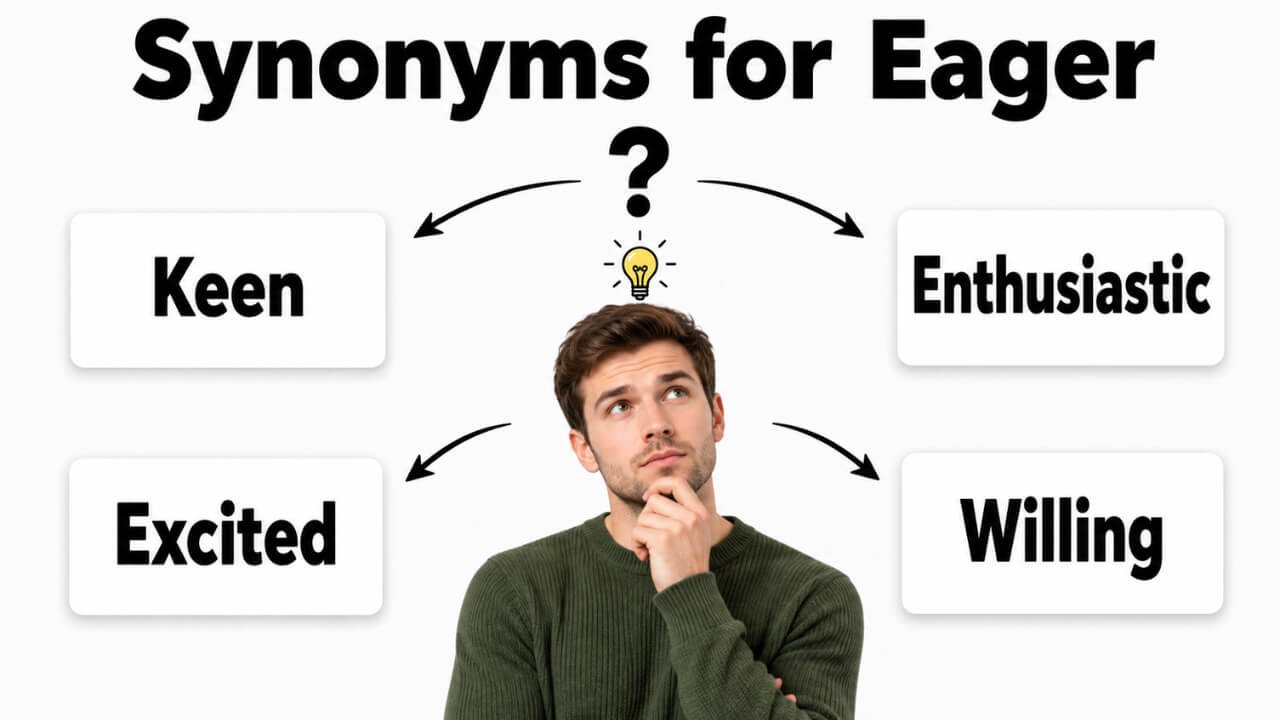
Quick Answer: Synonyms for eager include enthusiastic, keen, excited, willing, anxious, ready, motivated, impatient, interested, and zealous. Choose enthusiastic for positive energy, keen for formal or polished writing, excited for casual speech, willing for readiness to help, motivated for goals, anxious when eagerness includes worry, ready for action, and zealous when the feeling is very strong or passionate.
Pronunciation and Word Details
Word: Eager
Pronunciation: /ˈiːɡər/
Part of Speech: Adjective
Meaning: Eager means strongly wanting to do, have, learn, or experience something.
US Pronunciation:
UK Pronunciation:
What Does “Eager” Mean?
Eager means strongly interested, excited, or ready to do something. It is an adjective used to describe a person, attitude, feeling, response, or action that shows desire and enthusiasm. An eager student wants to learn. An eager worker wants to begin. An eager crowd is excited for an event.
The word eager often appears before a noun, as in eager learner, eager volunteer, or eager response. It can also come after linking verbs, as in she is eager to help or they seemed eager for answers. It is commonly followed by to plus a verb, as in eager to begin, or by for plus a noun, as in eager for success.
Meaning, Tone, and Context of “Eager”
Eager usually has a positive tone. It suggests energy, interest, willingness, and strong desire. In most contexts, it sounds polite, natural, and useful. It can work in casual speech, school writing, business communication, essays, stories, and professional messages.
In formal writing, eager can describe willingness or strong interest without sounding too emotional. In casual speech, it can describe excitement or readiness. In academic or professional contexts, words like keen, motivated, interested, or committed may sound more polished.
Eager can sometimes suggest impatience if the desire is too strong. For example, an eager child may be excited in a positive way, but an overly eager salesperson may seem pushy. The context decides whether eager sounds positive, intense, or slightly impatient.
When and How to Use “Eager”
For Strong Interest: Use eager when someone clearly wants to learn, know, or understand something.
Example: The students were eager to hear the answer.
For Willingness: Use eager when someone is ready and happy to help, join, or take action.
Example: She was eager to support the project.
For Excitement: Use eager when someone feels excited about an event, result, or opportunity.
Example: They were eager for the concert to begin.
For Motivation: Use eager when someone has strong drive toward a goal.
Example: He was eager to improve his writing skills.
For Anticipation: Use eager when someone is waiting with interest or expectation.
Example: The team was eager to see the final design.
For Readiness: Use eager when someone is prepared to begin quickly.
Example: The new employee was eager to start work.
Best Synonyms for Eager
Enthusiastic: Full of strong interest, excitement, or positive energy.
Example: She was enthusiastic about joining the class.
Keen: Very interested or strongly willing to do something.
Example: He was keen to learn a new language.
Excited: Feeling happy, energetic, and ready for something.
Example: The children were excited about the trip.
Willing: Ready and happy to do something.
Example: She was willing to help with the event.
Anxious: Strongly wanting something, often with worry or nervousness.
Example: He was anxious to hear the decision.
Ready: Prepared and willing to begin or act.
Example: The players were ready to start the match.
Motivated: Driven by a goal, reason, or strong purpose.
Example: The team was motivated to finish early.
Interested: Wanting to know more or take part.
Example: She was interested in the training program.
Zealous: Extremely passionate and devoted to a cause or goal.
Example: He was zealous in his efforts to protect the community.
Impatient: Unable to wait calmly because of strong desire.
Example: The crowd grew impatient for the show to begin.
50 Synonyms for Eager with Short Meanings
- Enthusiastic: Full of excited interest.
- Keen: Strongly interested or willing.
- Excited: Happy and energetic about something.
- Willing: Ready to help or act.
- Anxious: Strongly wanting something, sometimes with worry.
- Ready: Prepared to begin or respond.
- Motivated: Driven by purpose or desire.
- Interested: Wanting to know or join.
- Zealous: Passionate and deeply committed.
- Impatient: Wanting something to happen quickly.
- Avid: Very eager and deeply interested.
- Ardent: Warmly passionate or devoted.
- Intent: Strongly focused on a goal.
- Desirous: Having a strong wish for something.
- Hungry: Strongly wanting success, progress, or achievement.
- Thirsty: Strongly wanting knowledge, attention, or success.
- Yearning: Deeply longing for something.
- Longing: Strongly wishing for something absent or future.
- Ambitious: Eager to succeed or achieve.
- Driven: Strongly motivated to act.
- Passionate: Showing deep emotion and interest.
- Energetic: Full of active enthusiasm.
- Lively: Full of life, interest, or excitement.
- Earnest: Serious and sincere in desire.
- Fervent: Showing intense feeling or belief.
- Fervid: Intensely enthusiastic or passionate.
- Wholehearted: Fully sincere and committed.
- Committed: Dedicated to a goal or action.
- Dedicated: Strongly devoted to a purpose.
- Devoted: Loyal, caring, and strongly attached.
- Enthralled: Deeply interested or fascinated.
- Fascinated: Strongly attracted by interest or curiosity.
- Curious: Eager to know or learn.
- Inquisitive: Eager to ask questions and learn.
- Expectant: Waiting with hope or interest.
- Anticipative: Looking forward to something.
- Hopeful: Expecting a good result.
- Receptive: Ready to accept ideas or suggestions.
- Responsive: Quick and willing to react.
- Cooperative: Willing to work with others.
- Obliging: Willing and helpful.
- Helpful: Ready to assist or support.
- Proactive: Ready to act before being asked.
- Prompt: Ready and quick to act.
- Alert: Ready to notice and respond.
- Attentive: Carefully interested and focused.
- Engaged: Actively interested and involved.
- Inspired: Filled with desire to act or create.
- Determined: Strongly decided and unwilling to give up.
- Resolute: Firm, eager, and steady in purpose.
Read Also:
Synonyms for Normal
Synonyms for Eager by Context
When Eager Means Excited
When eager means excited and happy about something, use enthusiastic, excited, lively, energetic, or inspired. These words are useful for events, plans, hobbies, opportunities, and positive experiences.
Example: The children were excited to visit the museum.
Example: She was enthusiastic about the new course.
Example: The group felt inspired to begin the project.
When Eager Means Willing
When eager means ready to help, support, or participate, use willing, ready, cooperative, obliging, or helpful. These words are good for workplace messages, teamwork, service, and polite communication.
Example: He was willing to assist the new students.
Example: The staff were ready to answer questions.
Example: She remained cooperative throughout the process.
When Eager Means Interested
When eager means wanting to know, learn, or explore, use interested, curious, inquisitive, attentive, or engaged. These synonyms work well in education, learning, research, and conversation.
Example: The class was curious about the experiment.
Example: He was interested in the history of the town.
Example: The audience stayed engaged during the lecture.
When Eager Means Ambitious
When eager means driven by goals or success, use motivated, ambitious, driven, determined, or resolute. These words are useful in resumes, essays, career writing, and personal development.
Example: She was motivated to improve her skills.
Example: He was ambitious about building a better future.
Example: The team was determined to reach its target.
When Eager Means Impatient
When eager includes urgency or difficulty waiting, use impatient, anxious, expectant, longing, or yearning. These words are stronger and may include nervousness, pressure, or emotional desire.
Example: The fans grew impatient for the match to begin.
Example: She was anxious to receive the final result.
Example: He was yearning for a chance to prove himself.
Another Word for Eager
Another word for eager is enthusiastic. It is one of the best single replacements because it keeps the positive meaning of strong interest, excitement, and willingness. However, the best alternative depends on context. Use keen for formal writing, willing for helpfulness, motivated for goals, and anxious when eagerness includes nervous waiting.
Original: She was eager to join the training session.
Better Option: She was enthusiastic about joining the training session.
Original: He was eager to help with the project.
Better Option: He was willing to help with the project.
Original: The students were eager to learn more.
Better Option: The students were keen to learn more.
Original: The team was eager to win.
Better Option: The team was motivated to win.
When Not to Use “Eager”
Do not use eager when the sentence needs a more exact meaning. Eager can mean excited, willing, interested, ambitious, or impatient, so it may sound vague if the context is specific.
Weak: She was eager about the numbers.
Better: She was interested in the numbers.
Weak: He was eager for the meeting because he was worried.
Better: He was anxious about the meeting because he was worried.
Weak: The worker was eager every day.
Better: The worker was motivated and ready to help every day.
Weak: The child was eager and would not stop asking.
Better: The child was impatient and would not stop asking.
Avoid eager when you want to describe calm interest, quiet agreement, or simple availability. In those cases, interested, willing, available, prepared, or receptive may sound more natural.
Words Commonly Confused With Eager
Eager vs Anxious: Eager usually means excited or strongly willing, while anxious often includes worry, fear, or nervous expectation.
Eager vs Enthusiastic: Eager focuses on strong desire to do or receive something, while enthusiastic focuses on positive excitement and energy.
Eager vs Keen: Eager is common in everyday speech, while keen sounds slightly more polished and is often used for strong interest or willingness.
Eager vs Interested: Eager is stronger than interested. Interested means wanting to know more, while eager suggests active desire or readiness.
Eager vs Willing: Eager means strongly wanting to do something, while willing means ready to do it without resistance.
Eager vs Impatient: Eager can be positive, while impatient suggests difficulty waiting calmly.
Eager vs Ambitious: Eager can describe any strong desire, while ambitious specifically describes desire for success, achievement, or status.
Which Synonym Should You Choose?
Choose enthusiastic when describing positive energy, excitement, or strong interest.
Choose keen when writing in a polished, formal, or professional style.
Choose excited when speaking casually about happy anticipation.
Choose willing when the focus is readiness to help, cooperate, or participate.
Choose motivated when writing about goals, effort, progress, or personal growth.
Choose interested when the feeling is curious but not extremely strong.
Choose anxious when the desire includes worry, nervousness, or uncertainty.
Choose ready when the focus is preparation and immediate action.
Choose zealous when someone is extremely passionate about a belief, mission, or cause.
Choose impatient when eagerness becomes restless or difficult to control.
Real Life Examples of “Eager” in Sentences
Original: She was eager to start her new job.
Better Option: She was excited to start her new job.
Original: The students were eager to ask questions.
Better Option: The students were curious to ask questions.
Original: He was eager to help his friend move.
Better Option: He was willing to help his friend move.
Original: The team was eager to finish the project.
Better Option: The team was motivated to finish the project.
Original: I am eager to hear your response.
Better Option: I am keen to hear your response.
Original: The children were eager for the game to begin.
Better Option: The children were impatient for the game to begin.
Original: She was eager to understand the topic.
Better Option: She was interested in understanding the topic.
Original: He was eager to support the cause.
Better Option: He was zealous in supporting the cause.
Original: The audience was eager for more details.
Better Option: The audience was expectant and ready for more details.
Original: They were eager to accept the offer.
Better Option: They were ready to accept the offer.
Synonym Groups and Usage Differences
Excitement Group
This group includes enthusiastic, excited, lively, energetic, and inspired. Use these words when eagerness comes from joy, interest, or positive anticipation.
Example: She was enthusiastic about the upcoming workshop.
Willingness Group
This group includes willing, ready, helpful, cooperative, and obliging. Use these words when someone is prepared to assist, join, or respond.
Example: He was willing to guide the new employee.
Curiosity Group
This group includes interested, curious, inquisitive, attentive, and engaged. Use these words when eagerness comes from a desire to learn or understand.
Example: The child was curious about how the machine worked.
Ambition Group
This group includes motivated, ambitious, driven, determined, and resolute. Use these words when eagerness is connected to progress, achievement, or success.
Example: The athlete was determined to improve her record.
Urgency Group
This group includes anxious, impatient, expectant, longing, and yearning. Use these words when eagerness includes waiting, pressure, or strong emotional desire.
Example: He was anxious to know the final decision.
Antonyms of Eager
Eager has different opposites depending on whether it means excited, willing, interested, or ready. If eager means excited, the opposite may be indifferent. If it means willing, the opposite may be reluctant. If it means motivated, the opposite may be unmotivated.
Reluctant: Not willing or ready to do something.
Unwilling: Refusing or not prepared to act.
Indifferent: Not interested or concerned.
Apathetic: Showing no interest, energy, or emotion.
Disinterested: Not personally interested or involved.
Uninterested: Not wanting to know or take part.
Hesitant: Slow to act because of doubt or uncertainty.
Resistant: Opposing or refusing something.
Unmotivated: Lacking drive or desire to act.
Bored: Feeling no excitement or interest.
Comparison: Eager vs Related Words
Eager vs Enthusiastic
Eager means strongly wanting to do or experience something. Enthusiastic adds a clearer sense of excitement, positivity, and energy.
Example With Eager: She was eager to begin the lesson.
Example With Enthusiastic: She was enthusiastic about beginning the lesson.
Eager vs Keen
Eager and keen are very close. Keen often sounds more formal or polished, especially in professional and educational writing.
Example With Eager: He was eager to learn the process.
Example With Keen: He was keen to learn the process.
Eager vs Anxious
Eager is usually positive, while anxious can include worry or nervousness. Use anxious when the desire is mixed with concern.
Example With Eager: I am eager to see the results.
Example With Anxious: I am anxious to see the results after the delay.
Eager vs Willing
Eager is stronger than willing. Willing means ready to do something, while eager suggests strong desire and interest.
Example With Eager: She was eager to help organize the event.
Example With Willing: She was willing to help organize the event.
Eager vs Interested
Interested means wanting to know more. Eager means strongly interested and ready to act.
Example With Eager: The students were eager to begin the activity.
Example With Interested: The students were interested in the activity.
Eager vs Impatient
Eager can sound positive, but impatient suggests restlessness or frustration while waiting.
Example With Eager: The crowd was eager for the speech to begin.
Example With Impatient: The crowd became impatient when the speech was delayed.
Common Phrases and Expressions With Eager
Eager To Learn: Strongly interested in gaining knowledge.
Eager To Help: Ready and happy to support someone.
Eager To Please: Strongly wanting to make others happy or satisfied.
Eager For Success: Strongly wanting achievement or progress.
Eager For Answers: Strongly wanting information or explanation.
Eager Crowd: A group of people waiting with excitement.
Eager Student: A learner who shows strong interest.
Eager Response: A quick and interested reaction.
Too Eager: So interested that it may seem impatient or pushy.
Eager Anticipation: Excited waiting for something expected.
Common Mistakes to Avoid
One common mistake is using eager when the meaning is only mild interest. If someone simply wants to know more, interested may be better. Eager suggests stronger desire, energy, or readiness.
Another mistake is confusing eager with anxious. Eager is usually positive, while anxious often includes worry. Write eager to describe excitement and willingness. Write anxious when the person feels nervous or uncertain.
Writers also overuse eager in professional writing. Instead of repeating eager, use motivated, willing, keen, ready, committed, or enthusiastic based on the sentence. Also avoid using eager when it makes a person sound pushy. In that case, impatient, overenthusiastic, or too eager may be more accurate.
Conclusion
Synonyms for eager help you describe interest, excitement, readiness, and strong desire with better accuracy. Use enthusiastic for positive energy, keen for polished writing, willing for helpfulness, motivated for goals, interested for curiosity, and anxious when eagerness includes worry. Eager is a useful word, but the best synonym depends on whether someone is excited, ready, curious, ambitious, or impatient. Choosing the right word makes your writing clearer and more natural.
FAQs About Synonyms for Eager
What are the best synonyms for eager?
The best synonyms for eager are enthusiastic, keen, excited, willing, ready, motivated, interested, anxious, zealous, and impatient.
What is another word for eager in formal writing?
Keen is a strong formal synonym for eager. Motivated, interested, willing, and committed also work well in professional writing.
Is eager a positive word?
Yes, eager is usually positive because it suggests interest, excitement, and readiness. However, it can sound slightly impatient in some contexts.
What is the difference between eager and anxious?
Eager means strongly interested or excited. Anxious means strongly wanting something but often with worry, nervousness, or fear.
What is a casual synonym for eager?
Excited is a natural casual synonym for eager. Ready, interested, and happy to help can also work in everyday speech.
What is the opposite of eager?
The opposite of eager can be reluctant, unwilling, indifferent, apathetic, uninterested, hesitant, or unmotivated.
Which synonym for eager is best for resumes?
Motivated is often the best resume synonym for eager because it sounds professional and shows goal focused energy.
