
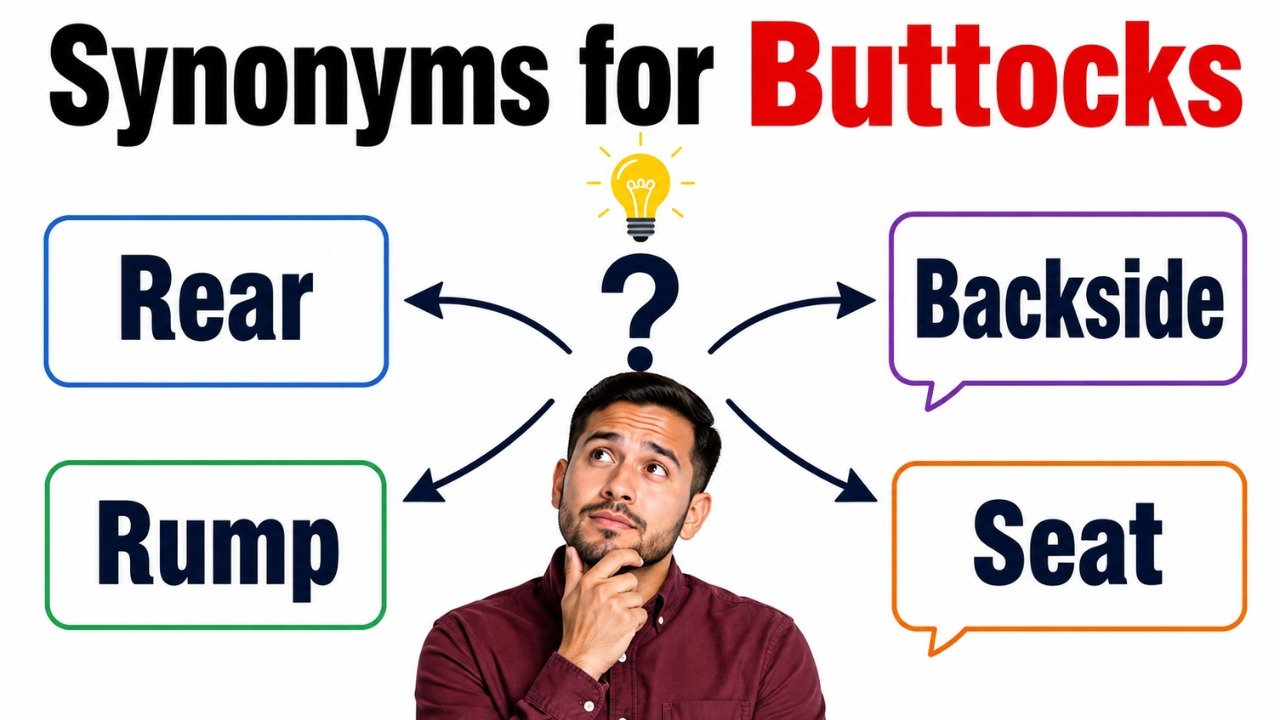
Quick Answer: The best synonyms for buttocks include posterior, backside, rear, rear end, bottom, seat, rump, behind, gluteal region, and glutes. Use gluteal region in medical, anatomical, or professional writing. Posterior is a formal and polite alternative, while bottom, backside, rear, and behind are suitable for neutral conversation. Butt and bum are informal, glutes refers more specifically to the muscles, and rump is common in descriptions of both people and animals. The best choice depends on formality, audience, anatomical accuracy, and regional usage.
Pronunciation and Word Details
Word: Buttocks.
Pronunciation: /ˈbʌtəks/
Part of Speech: Plural noun.
Meaning: The two rounded parts of the body located behind the hips and below the lower back.
US Pronunciation:
UK Pronunciation:
What Does “Buttocks” Mean?
Buttocks means the two rounded areas at the back of the human body below the waist. The word is a plural noun because it refers collectively to the left and right buttock.
A single side is called a buttock. When discussing both sides together, buttocks is the correct form.
The word is commonly used in medical instructions, anatomy, exercise guidance, health descriptions, and formal communication. It may describe the external body region, the soft tissue covering the pelvis, or the area containing the gluteal muscles.
In a medical sentence, someone might say that a patient has pain in the buttocks. In exercise writing, an instructor may tell someone to tighten the buttocks. In everyday conversation, speakers often choose softer alternatives such as bottom, backside, or rear.
Buttocks is accurate and neutral, but it can sound more clinical than casual alternatives.
Meaning, Tone, and Context of “Buttocks”
Buttocks has a neutral, anatomical, and moderately formal tone. It is neither insulting nor vulgar, which makes it appropriate for health information, educational materials, exercise instructions, and professional communication.
In medical or anatomical writing, buttocks is clear and precise. It identifies the external body region without using slang.
In polite conversation, the word may sound slightly clinical. Bottom, backside, rear, or behind may feel more natural when anatomical precision is unnecessary.
In exercise contexts, glutes is common, but glutes refers primarily to the gluteal muscles rather than the entire external region. Therefore, buttocks and glutes are related but not perfectly interchangeable.
Some alternatives, including butt, bum, booty, buns, and tush, are informal. Others, including caboose and keister, are humorous. Ass and arse are coarse terms and should be avoided in formal, professional, educational, or respectful communication.
Regional differences also matter. Fanny can mean the buttocks in American English, but it has a different and potentially inappropriate meaning in British English. Writers should therefore use it cautiously.
When and How to Use “Buttocks”
For Medical Descriptions: Use buttocks when identifying symptoms, injuries, skin conditions, injections, or pain in the rear pelvic area.
Example: The patient reported soreness in the left buttock and lower back.
For Anatomy Lessons: Use buttocks when discussing the visible external region behind the pelvis.
Example: The buttocks contain layers of muscle, fat, connective tissue, and skin.
For Exercise Instructions: Use buttocks when the instruction concerns the whole body region rather than only a particular muscle.
Example: Keep the buttocks supported while performing the movement.
For Muscle Training: Use glutes when specifically referring to the gluteal muscles.
Example: This exercise strengthens the glutes and supports hip stability.
For Polite Conversation: Use bottom, backside, rear, or behind when a less clinical expression is more suitable.
Example: The child slipped and landed on his bottom.
For Animal Descriptions: Use rump, hindquarters, or haunches when describing the rear body area of an animal.
Example: The horse developed strong muscles across its hindquarters.
For Informal Conversation: Use butt or bum only when the setting and audience make casual wording appropriate.
Example: He fell backward and landed on his butt.
For Formal Reports: Use posterior, buttocks, or gluteal region to maintain a professional tone.
Example: The injury affected the posterior pelvic region.
Best Synonyms for Buttocks
Gluteal Region: The anatomical area at the back of the pelvis containing the gluteal muscles and surrounding tissue.
Example: The clinician examined the gluteal region for swelling.
Posterior: A formal and polite term for the rear part of the body.
Example: The patient experienced discomfort in the posterior after the fall.
Backside: A neutral and mildly informal word for the rear of the body.
Example: She slipped on the steps and bruised her backside.
Rear: A polite general term for the back part of the body.
Example: The seat provided additional support for the lower rear.
Rear End: A common euphemism for the buttocks.
Example: He landed on his rear end but was not seriously injured.
Bottom: A polite and widely understood everyday alternative.
Example: The toddler sat on the floor and rubbed his bottom.
Seat: A polite euphemism referring to the part of the body used when sitting.
Example: The padded chair protected her seat from the hard surface.
Rump: The rear part of the body, especially in descriptions of animals.
Example: The animal had a dark patch across its rump.
Behind: A gentle and conversational euphemism for the buttocks.
Example: He fell backward and landed on his behind.
Glutes: An informal anatomical term for the gluteal muscles.
Example: Squats can help strengthen the glutes.
50 Synonyms for Buttocks with Short Meanings
- Gluteal Region: The anatomical area behind the pelvis.
- Gluteal Area: The body area containing the gluteal muscles.
- Posterior: A formal term for the rear of the body.
- Posterior Region: The area located at the back of the body.
- Posterior Pelvic Region: The anatomical area behind the pelvis.
- Backside: A neutral term for the rear of the body.
- Rear: The back part of the body.
- Rear End: A common polite euphemism for the buttocks.
- Back End: An informal expression for the rear body area.
- Bottom: A polite everyday term for the buttocks.
- Seat: The body area that rests on a chair.
- Behind: A gentle conversational term for the buttocks.
- Rump: The rounded rear part of a person or animal.
- Hindquarters: The rear body section, especially of an animal.
- Haunches: The rear hip, thigh, and buttock area.
- Butt: A common informal word for the buttocks.
- Butt Cheeks: The two rounded sides of the buttocks.
- Cheeks: An informal shortened term for the two buttocks.
- Glutes: The muscles forming much of the buttock area.
- Gluteal Muscles: The muscles located in the buttocks.
- Gluteus Maximus Muscles: The largest muscles forming the buttocks.
- Nates: A medical or literary term for the buttocks.
- Fundament: An old fashioned formal or humorous term for the buttocks.
- Derriere: A polite, playful, and refined term for the buttocks.
- Rear Quarters: The rear section of the body.
- Hind End: An informal term for the back end of the body.
- Lower Posterior: A polite expression for the lower rear body area.
- Posterior End: A formal description of the rear part of the body.
- Sitting Area: A descriptive term for the body area used when sitting.
- Seat Area: A polite description of the buttock region.
- Rump Area: The rounded rear region of the body.
- Buttock Area: The general region containing one or both buttocks.
- Gluteal Anatomy: The muscles and tissues forming the buttock region.
- Posterior Anatomy: The anatomical structures at the back of the body.
- Gluteal Tissue: The muscle, fat, skin, and connective tissue of the buttocks.
- Gluteal Prominence: The rounded outward shape of a buttock.
- Rear Body Area: A general description of the back portion of the body.
- Lower Rear: The lower part of the back side of the body.
- Tail End: A humorous euphemism for the rear of the body.
- Caboose: A humorous informal term for the buttocks.
- Buns: A playful informal term for the buttocks.
- Booty: A casual slang term for the buttocks.
- Bum: A common informal term in British and international English.
- Bum Cheeks: An informal term for the two sides of the buttocks.
- Tush: A mild and playful term for the buttocks.
- Tushie: A gentle or child friendly variation of tush.
- Keister: A humorous informal term for the buttocks.
- Fanny: An informal American term that has a different meaning in British English.
- Ass: A coarse slang term for the buttocks.
- Arse: A coarse British and Irish slang term for the buttocks.
Read Also:
Synonyms for Assistant
Synonyms for Buttocks by Context
When Buttocks Means an Anatomical Body Region
Gluteal region, gluteal area, posterior pelvic region, buttock area, and nates are appropriate in anatomical or medical contexts.
Gluteal region is often the most precise alternative because it describes the entire area behind the pelvis. Nates is technically related but uncommon in everyday writing. Posterior pelvic region is useful when a formal description is needed.
Example With Gluteal Region: The rash appeared across the upper gluteal region.
Example With Buttock Area: The patient noticed tenderness in the right buttock area.
Example With Posterior Pelvic Region: The scan showed no injury to the posterior pelvic region.
When Buttocks Means the Gluteal Muscles
Glutes, gluteal muscles, and gluteus maximus muscles are best when the sentence focuses on strength, movement, training, or muscle function.
Glutes is common in exercise communication. Gluteal muscles is more precise in health and anatomy writing. Gluteus maximus refers to one particular muscle on each side, not every structure within the buttocks.
Example With Glutes: Lunges activate the glutes and thighs.
Example With Gluteal Muscles: Strong gluteal muscles help stabilize the hips.
Example With Gluteus Maximus: The gluteus maximus helps extend the hip.
When Buttocks Needs a Polite Everyday Alternative
Bottom, backside, rear, rear end, seat, and behind are polite or neutral alternatives.
Bottom is especially suitable when speaking to children or discussing a minor fall. Backside and rear end are conversational without being strongly vulgar. Posterior is more formal.
Example With Bottom: The child landed on her bottom.
Example With Backside: He bruised his backside during the fall.
Example With Behind: Please remain seated with your behind against the chair.
When Buttocks Refers to an Animal
Rump, hindquarters, and haunches are common when discussing animals.
Rump refers to the rounded rear part. Hindquarters includes a larger section of the animal’s rear body. Haunches can include the hips, upper legs, and buttock area.
Example With Rump: The horse had a white marking on its rump.
Example With Hindquarters: The dog pushed forward using its powerful hindquarters.
Example With Haunches: The lion rested on its haunches.
When Buttocks Is Used Informally
Butt, bum, buns, booty, tush, and tushie are informal alternatives.
Butt and bum are common in casual speech. Buns and booty are playful slang. Tush and tushie are milder and may be used humorously or when speaking to children.
Example With Butt: He landed on his butt after slipping.
Example With Bum: Sitting for too long made his bum uncomfortable.
Example With Tush: Move your tush away from the wet paint.
When Buttocks Is Used Humorously
Caboose, keister, tail end, and fundament can create a humorous or old fashioned tone.
These expressions are inappropriate in serious medical instructions unless humor is intentional.
Example With Caboose: He slipped and landed directly on his caboose.
Example With Keister: Get off your keister and help carry the boxes.
Example With Tail End: The puppy sat its tail end on the clean towel.
When Buttocks Requires Coarse Slang
Ass and arse directly refer to the buttocks, but both can sound rude, aggressive, or vulgar.
Ass is more common in American English. Arse is more common in British and Irish English. Neither is suitable for formal articles, medical communication, professional emails, or polite educational materials.
Example With Ass: The informal expression sounded rude in the formal meeting.
Example With Arse: The speaker used a coarse regional term for the rear of the body.
Another Word for Buttocks
Posterior is one of the best single replacements for buttocks in formal and polite writing. Gluteal region is more anatomically precise, while bottom is more natural in gentle everyday conversation.
The best alternative depends on whether the sentence concerns anatomy, exercise, injury, children, animals, or casual speech.
Original: The patient had bruising across the buttocks.
Better Option: The patient had bruising across the gluteal region.
Original: The child fell and landed on his buttocks.
Better Option: The child fell and landed on his bottom.
Original: The athlete exercised the muscles in her buttocks.
Better Option: The athlete exercised her glutes.
Original: The horse had a dark mark on its buttocks.
Better Option: The horse had a dark mark on its rump.
When Not to Use “Buttocks”
Do not use buttocks when the sentence requires a more precise muscle name, a gentler expression, or a term that fits an animal better.
Buttocks can sound unnecessarily clinical in casual conversation. It can also be less precise when a writer actually means the gluteal muscles, one buttock, the hips, or the entire hindquarters of an animal.
Avoid repeating buttocks several times in a short paragraph. Use the body region, gluteal area, posterior, or a suitable pronoun when clarity remains intact.
Weak: This exercise strengthens the buttocks muscles.
Better: This exercise strengthens the gluteal muscles.
Weak: The little child landed on her buttocks.
Better: The little child landed on her bottom.
Weak: The horse developed powerful buttocks.
Better: The horse developed powerful hindquarters.
Weak: The injection was given somewhere near the buttocks.
Better: The injection was given in the designated gluteal area.
Weak: One of his buttocks were bruised.
Better: One of his buttocks was bruised.
Weak: The buttocks is supported by the seat.
Better: The buttocks are supported by the seat.
Words Commonly Confused With Buttocks
Buttocks vs Buttock: Buttocks is plural and refers to both rounded sides collectively. Buttock is singular and refers to one side.
Buttocks vs Glutes: Buttocks describes the external body region. Glutes refers mainly to the gluteal muscles within that region.
Buttocks vs Hips: The buttocks are located behind the pelvis. The hips are positioned more toward the sides where the upper legs meet the pelvis.
Buttocks vs Lower Back: The buttocks are below the lower back. Pain can spread between these areas, but they are not the same anatomical region.
Buttocks vs Thighs: The buttocks are behind the pelvis, while the thighs extend from the hips toward the knees.
Buttocks vs Haunches: Buttocks is precise for humans. Haunches includes the hips, upper thighs, and rear area and is often used for animals.
Buttocks vs Rump: Buttocks is anatomically neutral. Rump is less technical and is especially common for animals.
Buttocks vs Posterior: Buttocks names a specific body region. Posterior can refer more broadly to anything located toward the back.
Buttocks vs Seat: Buttocks is an anatomical term. Seat is a polite euphemism based on the body area used when sitting.
Buttocks vs Fanny: Buttocks is widely understood and neutral. Fanny means buttocks in American English but can refer to a different intimate body area in British English.
Which Synonym Should You Choose?
Choose gluteal region when writing medical, anatomical, clinical, or professional information.
Choose posterior when you need a formal and polite alternative that avoids sounding overly direct.
Choose bottom when speaking gently, especially to children or when describing a minor fall.
Choose backside, rear, rear end, or behind for neutral and conversational descriptions.
Choose glutes when discussing exercise, muscle strength, movement, fitness, or physical training.
Choose gluteal muscles when precision matters in reports, educational material, or health guidance.
Choose buttock when referring to only one side of the body.
Choose rump when describing the rounded rear of an animal or using a less technical expression.
Choose hindquarters when discussing the entire rear section of an animal.
Choose haunches when referring to the combined hip, thigh, and rear area, especially when an animal is sitting.
Choose butt or bum in casual conversation when an informal tone is acceptable.
Choose tush, tushie, buns, booty, caboose, or keister only when a playful or humorous tone suits the audience.
Choose ass or arse only when accurately discussing coarse slang. Avoid them in polite, academic, medical, professional, and child friendly writing.
Real Life Examples of “Buttocks” in Sentences
Original: The patient felt pain in both buttocks after running.
Better Option: The patient felt pain throughout the gluteal region after running.
Original: The child slipped and landed on her buttocks.
Better Option: The child slipped and landed on her bottom.
Original: The exercise helps strengthen the buttocks.
Better Option: The exercise helps strengthen the glutes.
Original: The horse had a white patch on its buttocks.
Better Option: The horse had a white patch on its rump.
Original: He developed a bruise on his left buttocks.
Better Option: He developed a bruise on his left buttock.
Original: The chair supports the buttocks and lower back.
Better Option: The chair supports the seat area and lower back.
Original: She fell backward and injured her buttocks.
Better Option: She fell backward and injured her posterior.
Original: The dog used its buttocks to push itself forward.
Better Option: The dog used its hindquarters to push itself forward.
Original: Tighten your buttocks before lifting your hips.
Better Option: Engage your gluteal muscles before lifting your hips.
Original: He sat with his buttocks near the edge of the chair.
Better Option: He sat with his seat near the edge of the chair.
Synonym Groups and Usage Differences
Anatomical Group
Gluteal region, gluteal area, posterior pelvic region, nates, gluteal tissue, and buttock area belong to the anatomical group.
These terms are useful when location and physical structure matter. Gluteal region describes the entire area, while gluteal tissue describes the muscle, fat, skin, and connective tissue within it.
Example: The clinician examined the gluteal region for inflammation.
Muscle Group
Glutes, gluteal muscles, and gluteus maximus muscles relate specifically to muscular anatomy.
Glutes is concise and conversational. Gluteal muscles is more formal. Gluteus maximus identifies the largest and most visible muscle in the region.
Example: Bridges can strengthen the gluteal muscles.
Neutral Everyday Group
Bottom, backside, rear, rear end, behind, and seat are neutral or polite everyday alternatives.
Bottom is gentle. Backside and rear end are conversational. Posterior is more formal, while seat functions as a mild euphemism.
Example: He fell backward and landed on his backside.
Animal Description Group
Rump, hindquarters, and haunches are especially useful for animals.
Rump refers to the rounded rear. Hindquarters includes the wider rear body section. Haunches can include the hips and upper legs.
Example: The horse shifted its weight onto its hindquarters.
Informal Group
Butt, bum, butt cheeks, bum cheeks, buns, booty, tush, and tushie are informal expressions.
Their tone ranges from ordinary casual speech to playful slang. They should not replace anatomical terms in serious medical content.
Example: He slipped and landed on his butt.
Humorous Group
Caboose, keister, tail end, and fundament are humorous or old fashioned alternatives.
They can make a sentence playful, but they may distract from serious information.
Example: He landed on his caboose with a surprised expression.
Coarse Slang Group
Ass and arse are direct but vulgar alternatives.
These terms may appear in dialogue, slang explanations, or discussions of register. They should generally be avoided in respectful public communication.
Example: The coarse expression was unsuitable for the medical instructions.
Antonyms of Buttocks
Buttocks does not have a true dictionary antonym because it names a body part. However, directional and anatomical contrasts can serve as practical opposites.
Front: The forward facing side of the body.
Anterior: A formal anatomical term meaning toward the front.
Front Side: The part of the body opposite the backside.
Abdomen: The front region between the chest and pelvis.
Chest: The upper front part of the torso.
Face: The front part of the head.
Ventral Side: The front or belly side of the body in anatomical descriptions.
Upper Body: The torso, shoulders, arms, and head rather than the lower posterior region.
Front of the Pelvis: The pelvic region located opposite the buttocks.
Anterior Pelvic Region: A formal term for the front portion of the pelvis.
Comparison: Buttocks vs Related Words
Buttocks vs Posterior
Buttocks refers specifically to the two rounded areas behind the pelvis. Posterior is a broader formal term for the back part of a person or object.
Example With Buttocks: The patient had bruising on both buttocks.
Example With Posterior: The fall caused discomfort in her posterior.
Buttocks vs Bottom
Buttocks is anatomical and moderately formal. Bottom is gentler and more common in everyday conversation.
Example With Buttocks: The examination included the lower back and buttocks.
Example With Bottom: The child landed safely on his bottom.
Buttocks vs Glutes
Buttocks describes the complete external region. Glutes refers to the muscles that create much of its shape and movement.
Example With Buttocks: The rash covered part of the buttocks.
Example With Glutes: Squats activated the glutes.
Buttocks vs Butt
Buttocks is neutral and suitable for professional contexts. Butt is informal and more common in casual conversation.
Example With Buttocks: The clinician examined the injured buttocks.
Example With Butt: He slipped and landed on his butt.
Buttocks vs Rump
Buttocks is more anatomically precise for humans. Rump is commonly used for animals and sometimes humorously for people.
Example With Buttocks: The patient felt pressure in the buttocks.
Example With Rump: The horse had a dark marking on its rump.
Buttocks vs Hindquarters
Buttocks refers to a specific human body area. Hindquarters refers to the larger rear section of an animal, including nearby hips and legs.
Example With Buttocks: The chair supports the buttocks.
Example With Hindquarters: The animal rose using its strong hindquarters.
Buttocks vs Haunches
Buttocks identifies the rounded rear body area. Haunches includes more of the hips, thighs, and rear region, particularly in animals.
Example With Buttocks: The fall caused bruising across the buttocks.
Example With Haunches: The dog sat back on its haunches.
Buttocks vs Backside
Buttocks is clinical and anatomical. Backside is neutral, less technical, and more conversational.
Example With Buttocks: The treatment was applied to the buttocks.
Example With Backside: The fall left a bruise on his backside.
Common Phrases and Expressions With “Buttocks”
Clench the Buttocks: Tighten the muscles of the buttocks.
Tighten the Buttocks: Contract the muscles in the gluteal region.
Relax the Buttocks: Release tension in the gluteal muscles.
Pain in the Buttocks: Discomfort felt in one or both buttocks.
Upper Buttocks: The higher portion of the gluteal region.
Lower Buttocks: The lower portion near the buttock crease.
Both Buttocks: The left and right buttocks considered together.
One Buttock: Either the left or right side individually.
Buttock Muscles: An informal name for the gluteal muscles.
Buttock Area: The general body region containing the buttocks.
Common Mistakes to Avoid
Using a Singular Verb With Buttocks: Buttocks is plural, so it normally takes a plural verb.
Incorrect: The buttocks is sore.
Correct: The buttocks are sore.
Using Buttocks for One Side: Use buttock when referring to only one side.
Incorrect: The bruise appeared on the left buttocks.
Correct: The bruise appeared on the left buttock.
Confusing Buttocks With Glutes: Glutes refers mainly to muscles, while buttocks includes the entire external region.
Incorrect: The skin condition affected the glutes.
Correct: The skin condition affected the buttocks.
Choosing Slang in Formal Writing: Butt, booty, buns, ass, and arse may be inappropriate in medical or professional material.
Weak: The patient reported pain in the butt.
Better: The patient reported pain in the gluteal region.
Using Animal Terms for People Without a Reason: Rump, hindquarters, and haunches can sound humorous or dehumanizing when applied to a person.
Weak: The employee injured his hindquarters.
Better: The employee injured his buttocks.
Ignoring Regional Meaning: Fanny is a mild term for buttocks in American English, but it has a different intimate meaning in British English.
Better Practice: Use bottom, backside, or rear when writing for an international audience.
Repeating the Same Word: Repeated use of buttocks can make a paragraph sound mechanical.
Better Practice: Alternate carefully with gluteal region, posterior, body area, or a pronoun when the meaning remains clear.
Using Vague Anatomical Language: Phrases such as lower area or rear part may be too unclear for medical instructions.
Better Practice: Identify the left buttock, right buttock, upper gluteal region, or another precise location.
Conclusion
The best synonyms for buttocks depend on tone, audience, and anatomical accuracy. Gluteal region and posterior work well in formal or medical writing, while bottom, backside, rear, and behind suit polite conversation. Glutes is best when discussing muscles and exercise. Rump, hindquarters, and haunches are useful for animals, while butt, bum, buns, and tush are informal. When choosing among synonyms for buttocks, consider whether the sentence needs clinical precision, gentle wording, casual speech, or humor.
FAQs About Synonyms for Buttocks
What is the most polite synonym for buttocks?
Bottom, backside, rear, behind, and posterior are polite alternatives. Posterior is the most formal, while bottom is gentle and conversational.
What is the medical synonym for buttocks?
Gluteal region is a clear medical alternative. Nates is also an anatomical term, but it is much less common in ordinary health writing.
Is glutes another word for buttocks?
Glutes is a close alternative, but it refers specifically to the gluteal muscles. Buttocks includes the complete external region, including muscle, fat, skin, and connective tissue.
Is buttocks singular or plural?
Buttocks is plural. The singular form is buttock. Write one buttock when referring to one side and both buttocks when referring to both sides.
What is a child friendly synonym for buttocks?
Bottom, behind, tush, and tushie are mild options. Bottom is usually the clearest and most widely understood choice.
What word should be used for an animal’s buttocks?
Rump, hindquarters, and haunches are common choices. Rump is the closest direct alternative, while hindquarters describes a larger rear body section.
Are ass and arse synonyms for buttocks?
Yes, but both are coarse slang. Ass is common in American English, while arse is common in British and Irish English. Neither is appropriate for formal or polite writing.
