
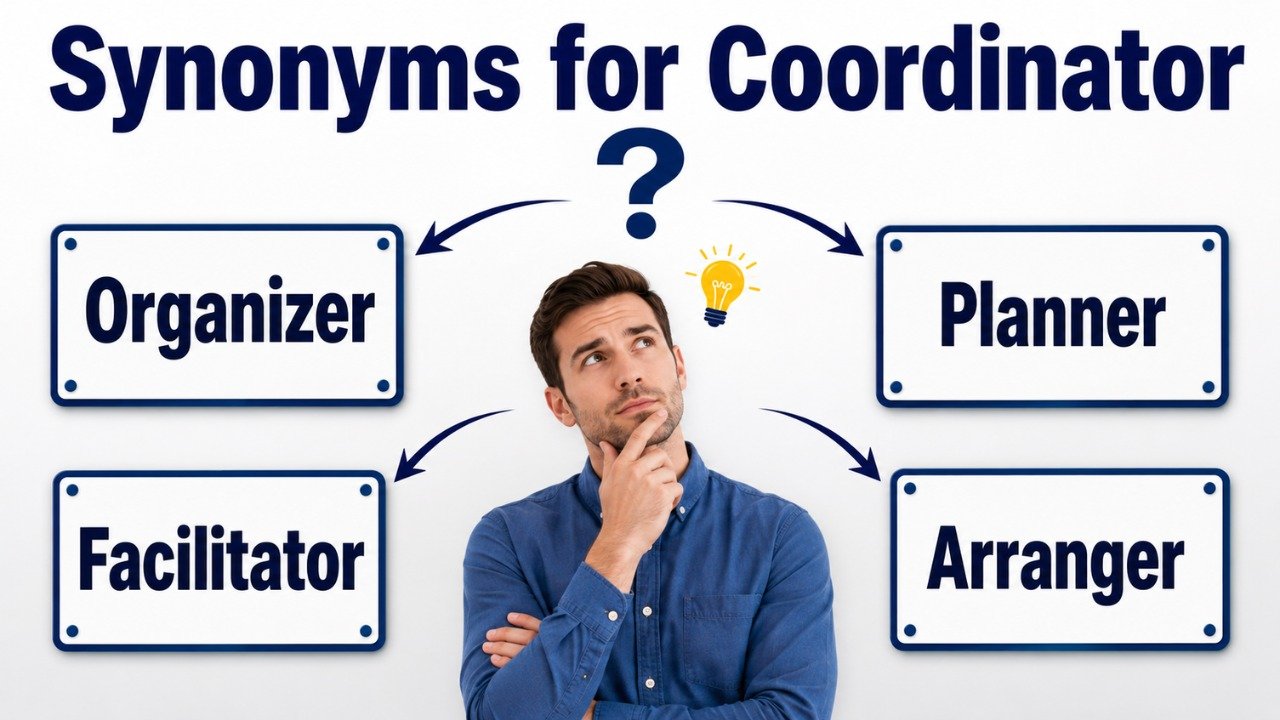
Quick Answer: The best synonyms for coordinator include organizer, manager, administrator, facilitator, planner, supervisor, director, liaison, scheduler, and project lead. Use organizer for someone arranging activities, manager for a person responsible for people and results, and administrator for office or program duties. Facilitator suits meetings and group discussions, while liaison emphasizes communication between different parties. Planner is best for schedules and events, and project lead works well when one person guides a specific project. The most accurate synonyms for coordinator depend on the role, authority, industry, and responsibilities involved.
Pronunciation and Word Details
Word: Coordinator.
Pronunciation: /koʊˈɔːr.də.neɪ.tɚ/
Part of Speech: Noun.
Meaning: A person who organizes people, activities, schedules, or resources so that work proceeds effectively.
US Pronunciation:
UK Pronunciation:
What Does “Coordinator” Mean?
A coordinator is a person who organizes different people, tasks, schedules, or resources so they work together successfully.
Coordinator is a noun. It commonly refers to someone who plans activities, communicates information, tracks progress, solves scheduling issues, and connects individuals or departments.
Example: The project coordinator arranged the meetings and monitored each deadline.
The word may describe someone with formal authority, but many coordinators guide work through communication and organization rather than direct supervision.
A coordinator may work in several contexts.
Project Context: The coordinator keeps tasks, deadlines, and team members aligned.
Event Context: The coordinator arranges the venue, schedule, guests, and services.
Office Context: The coordinator manages records, appointments, and communication.
Program Context: The coordinator helps deliver activities and services to participants.
Logistics Context: The coordinator organizes transportation, supplies, and deliveries.
Communication Context: The coordinator shares updates between teams and ensures that everyone receives the correct information.
The exact meaning depends on the title. A project coordinator may support a project manager, while an event coordinator may directly control most event arrangements.
Meaning, Tone, and Context of “Coordinator”
Coordinator has a neutral and professional tone. It is common in workplaces, educational settings, public services, events, health services, community programs, and administrative departments.
Formality: Neutral to formal.
Professional Tone: The word describes a recognized position with organizational responsibilities.
Conversational Tone: It can also appear naturally in everyday discussions about work, events, or group activities.
Administrative Context: A coordinator may arrange appointments, prepare documents, update records, and communicate with staff.
Management Context: Some coordinators guide teams and monitor results, although they may have less authority than managers.
Educational Context: A course coordinator may organize lessons, schedules, teaching materials, and assessments.
Event Context: An event coordinator plans practical details and keeps activities running according to schedule.
Technical Context: A technical coordinator connects specialists, resources, and project requirements.
Community Context: A volunteer coordinator recruits, schedules, and supports volunteers.
The tone is usually practical rather than emotional. Coordinator suggests organization, communication, responsibility, and cooperation.
When and How to Use “Coordinator”
For Managing Projects
Use coordinator for a person who keeps project tasks, deadlines, resources, and communication organized.
Example: The project coordinator prepared the schedule and followed up with each team member.
For Planning Events
Use coordinator when someone arranges an event and ensures that all practical details work together.
Example: The event coordinator confirmed the venue, speakers, seating, and timetable.
For Organizing Programs
The word suits someone who manages the daily operation of a course, service, campaign, or community program.
Example: The program coordinator registered participants and arranged weekly activities.
For Connecting Departments
Use coordinator when someone acts as a central contact between different teams or departments.
Example: The coordinator shared updates between the design and production teams.
For Scheduling Work
Coordinator works well for a person who arranges appointments, shifts, meetings, or deliveries.
Example: The scheduling coordinator assigned appointments based on staff availability.
For Supporting a Team
Use the word when someone helps team members remain informed, organized, and focused.
Example: The team coordinator recorded decisions and distributed the action list.
For Handling Logistics
Coordinator is appropriate when a person organizes transportation, equipment, supplies, locations, or deliveries.
Example: The logistics coordinator arranged vehicles and confirmed delivery times.
For Administrative Duties
Use coordinator for a position involving records, communication, planning, and office support.
Example: The office coordinator maintained files and organized staff meetings.
For Volunteer Activities
The word can describe someone who recruits, trains, schedules, and supports volunteers.
Example: The volunteer coordinator assigned each person to a suitable task.
For Communication Duties
Use coordinator when someone prepares updates and connects groups that need to exchange information.
Example: The communications coordinator prepared announcements and answered public questions.
Best Synonyms for Coordinator
Organizer: A person who arranges activities, people, or events.
Example: The organizer confirmed the schedule and contacted every participant.
Manager: A person responsible for directing work, resources, people, or results.
Example: The manager reviewed progress and approved the final plan.
Administrator: A person who handles organizational, office, or program duties.
Example: The administrator processed applications and maintained accurate records.
Facilitator: A person who helps a group communicate, cooperate, or complete a process.
Example: The facilitator guided the discussion and encouraged everyone to contribute.
Planner: A person who develops arrangements, schedules, or strategies in advance.
Example: The planner created a detailed timetable for the conference.
Supervisor: A person who oversees employees and checks the quality of their work.
Example: The supervisor assigned duties and reviewed the completed tasks.
Director: A senior person who guides a department, organization, or major activity.
Example: The director established the program goals and approved the budget.
Liaison: A person who maintains communication between individuals, teams, or organizations.
Example: She acted as a liaison between the clients and the technical team.
Scheduler: A person who arranges appointments, shifts, meetings, or activities.
Example: The scheduler found a suitable meeting time for all participants.
Project Lead: A person who guides a project and helps the team achieve its objectives.
Example: The project lead clarified responsibilities and monitored each milestone.
50 Synonyms for Coordinator with Short Meanings
- Organizer: A person who arranges people, activities, or events.
- Manager: A person responsible for directing work and resources.
- Administrator: A person who manages organizational or office duties.
- Facilitator: A person who helps a group work or communicate effectively.
- Planner: A person who creates plans, schedules, or arrangements.
- Supervisor: A person who oversees employees or activities.
- Director: A senior person who guides an organization or department.
- Liaison: A person who connects different groups through communication.
- Scheduler: A person who arranges appointments, meetings, or shifts.
- Controller: A person who regulates or directs a process.
- Arranger: A person who puts plans or details into order.
- Orchestrator: A person who brings many activities together successfully.
- Overseer: A person who watches and directs work.
- Team Leader: A person who guides members of a team.
- Project Manager: A person responsible for planning and completing a project.
- Program Manager: A person who directs a group of related activities or projects.
- Operations Manager: A person who manages daily processes and resources.
- Event Planner: A person who arranges events and their practical details.
- Logistics Manager: A person who organizes transportation, supplies, or deliveries.
- Office Manager: A person who oversees office systems and administrative work.
- Production Manager: A person who organizes production schedules and resources.
- Campaign Manager: A person who plans and directs a campaign.
- Account Manager: A person who coordinates services and communication for clients.
- Case Manager: A person who organizes support and services for an individual case.
- Service Manager: A person who oversees the delivery of a service.
- Workflow Manager: A person who organizes the movement and order of tasks.
- Resource Manager: A person who assigns and monitors available resources.
- Traffic Manager: A person who controls the movement and timing of work.
- Dispatcher: A person who assigns workers, vehicles, or services to locations.
- Expeditor: A person who helps work, supplies, or deliveries move quickly.
- Convener: A person who calls people together for a meeting or activity.
- Moderator: A person who guides a discussion or formal session.
- Mediator: A person who helps different parties communicate and reach agreement.
- Host: A person who receives guests and manages an occasion.
- Producer: A person who organizes the practical creation of a performance or project.
- Project Lead: A person who guides a particular project.
- Program Lead: A person who directs a program or major activity.
- Operations Lead: A person who guides daily operational work.
- Team Lead: A person who organizes and supports a working group.
- Unit Head: A person responsible for a particular unit or section.
- Chairperson: A person who leads meetings or directs a committee.
- Program Officer: A person who helps organize and deliver a program.
- Project Officer: A person who supports project planning and implementation.
- Operations Officer: A person who coordinates practical processes and activities.
- Organizing Officer: A person responsible for arranging an activity or initiative.
- Point Person: The main person responsible for communication or action.
- Contact Person: The person others approach for information or assistance.
- Representative: A person who communicates or acts for a group.
- Integrator: A person who combines different parts into one effective system.
- Harmonizer: A person who helps people or activities work together smoothly.
Read Also:
Synonyms for Anarchy

Synonyms for Coordinator by Context
When Coordinator Means Organizer
Use these alternatives when the main duty involves arranging an activity, meeting, program, or event.
Organizer: A broad word for someone who makes arrangements.
Example: The organizer prepared the guest list and confirmed the venue.
Arranger: Someone who puts practical details into order.
Example: The arranger booked transportation for the visiting group.
Event Planner: A professional who plans the details of an event.
Example: The event planner created a schedule for the entire celebration.
Host: A person who receives guests and manages an occasion.
Example: The host welcomed the speakers and introduced each session.
When Coordinator Means Manager
Use these synonyms when the role includes authority over people, budgets, decisions, or results.
Manager: A person who directs resources and accepts responsibility for outcomes.
Example: The manager assigned the work and reviewed the results.
Project Manager: Someone responsible for the planning and delivery of a project.
Example: The project manager approved the timeline and controlled project costs.
Program Manager: Someone who manages several related projects or services.
Example: The program manager reviewed the progress of all regional activities.
Operations Manager: A person who oversees daily business processes.
Example: The operations manager improved the ordering and delivery process.
When Coordinator Means Administrator
Use these alternatives for roles involving records, documents, appointments, communication, and office systems.
Administrator: Someone who manages organizational procedures and records.
Example: The administrator processed the forms and updated the database.
Office Manager: A person who keeps an office operating efficiently.
Example: The office manager arranged supplies and supervised reception duties.
Program Officer: A person who supports the administration and delivery of a program.
Example: The program officer prepared attendance records and progress reports.
Operations Officer: A person who handles practical administrative processes.
Example: The operations officer confirmed that all required documents were complete.
When Coordinator Means Facilitator
Use these words when the person helps others communicate, participate, or cooperate.
Facilitator: Someone who guides a process without controlling every decision.
Example: The facilitator encouraged the group to discuss each concern openly.
Moderator: Someone who manages a discussion, debate, or formal session.
Example: The moderator ensured that every speaker had equal time.
Mediator: Someone who helps people resolve disagreement.
Example: The mediator helped both departments agree on a shared schedule.
Convener: Someone who brings people together for a meeting or discussion.
Example: The convener invited representatives from every local group.
When Coordinator Means Liaison
Use these alternatives when the main responsibility is communication between different people or groups.
Liaison: A person who maintains communication between parties.
Example: The liaison shared client feedback with the development team.
Representative: A person who communicates or acts for a group.
Example: A representative attended the meeting on behalf of the department.
Contact Person: The person approached for information or assistance.
Example: Jordan is the contact person for all registration questions.
Point Person: The main person responsible for a task or communication channel.
Example: She became the point person for communication with suppliers.
When Coordinator Means Planner
Use these alternatives when the role focuses on schedules, preparation, or future arrangements.
Planner: A person who prepares detailed arrangements in advance.
Example: The planner developed a schedule for each stage of the event.
Scheduler: A person who assigns times for appointments, duties, or activities.
Example: The scheduler arranged interviews throughout the week.
Resource Manager: Someone who assigns people, equipment, or funds.
Example: The resource manager ensured that each team had the required equipment.
Workflow Manager: Someone who organizes the order and movement of tasks.
Example: The workflow manager reduced delays between approval stages.
When Coordinator Means Supervisor
Use these words when the role includes monitoring work or guiding employees.
Supervisor: A person who oversees work and checks performance.
Example: The supervisor reviewed the completed orders before shipment.
Overseer: A person who watches and directs an activity.
Example: The overseer checked that safety procedures were followed.
Team Leader: A person who guides team members toward a shared goal.
Example: The team leader assigned responsibilities according to experience.
Unit Head: A person responsible for a particular department or section.
Example: The unit head approved the revised working procedure.
When Coordinator Means Operational Organizer
Use these alternatives when someone manages movement, supplies, production, or practical execution.
Logistics Manager: A person who organizes supplies, transportation, and delivery.
Example: The logistics manager confirmed the arrival of all equipment.
Dispatcher: A person who sends workers, vehicles, or services where needed.
Example: The dispatcher assigned each driver a delivery route.
Expeditor: A person who prevents delays and speeds up work or delivery.
Example: The expeditor contacted suppliers to prevent a production delay.
Production Manager: A person who organizes production activities and resources.
Example: The production manager adjusted the schedule after equipment repairs.
When Coordinator Means Project Leader
Use these synonyms when the person guides progress but may not hold full managerial authority.
Project Lead: The main person guiding a specific project.
Example: The project lead clarified the goals before work began.
Program Lead: A person who provides direction for a program.
Example: The program lead reviewed the yearly activity plan.
Operations Lead: A person who guides operational tasks and improvements.
Example: The operations lead introduced a simpler approval process.
Team Lead: A person who organizes the work of a small team.
Example: The team lead checked progress during the morning meeting.
Another Word for Coordinator
The best general replacement for coordinator is organizer because both words describe someone who brings people, plans, and activities together. However, the best alternative depends on the person’s actual duties.
Manager is more suitable when the role includes authority and responsibility for results. Facilitator works better for meetings and discussions, while liaison is best when communication between groups is the main duty.
Original: The coordinator arranged all parts of the community event.
Better Option: The organizer arranged all parts of the community event.
Original: The coordinator approved the budget and evaluated employee performance.
Better Option: The manager approved the budget and evaluated employee performance.
Original: The coordinator guided the group discussion.
Better Option: The facilitator guided the group discussion.
Original: The coordinator communicated between the client and the technical department.
Better Option: The liaison communicated between the client and the technical department.
When Not to Use “Coordinator”
Do not use coordinator when a more precise job title explains the person’s authority or duties more clearly.
A person who directly supervises employees, approves budgets, and accepts responsibility for results may be better described as a manager.
Weak: The coordinator hired staff and controlled the department budget.
Better: The manager hired staff and controlled the department budget.
Avoid coordinator when the person only arranges a single informal activity.
Weak: Maya was the coordinator of our small family dinner.
Better: Maya was the organizer of our small family dinner.
Do not use coordinator for someone whose main role is leading a meeting.
Weak: The discussion coordinator invited the next speaker.
Better: The moderator invited the next speaker.
Avoid the word when communication between two groups is the main responsibility.
Weak: He serves as the coordinator between the residents and the council.
Better: He serves as the liaison between the residents and the council.
Do not use coordinator when the person’s main responsibility is creating schedules.
Weak: The appointment coordinator assigned all patient times.
Better: The scheduler assigned all patient times.
Avoid repeating coordinator in every sentence of a job description.
Weak: The coordinator schedules meetings. The coordinator prepares reports. The coordinator contacts participants.
Better: The coordinator schedules meetings, prepares reports, and contacts participants.
Do not use coordinator as a vague title when the reader needs to understand the role.
Weak: Contact the coordinator for assistance.
Better: Contact the event coordinator for registration assistance.
Words Commonly Confused With Coordinator
Coordinator vs Manager: A coordinator usually organizes activities and communication. A manager often has greater authority over employees, budgets, decisions, and results.
Coordinator vs Organizer: Coordinator often refers to an ongoing professional role. Organizer may describe anyone who arranges a particular event or activity.
Coordinator vs Administrator: A coordinator connects people, schedules, and tasks. An administrator focuses more on records, procedures, documents, and office systems.
Coordinator vs Facilitator: A coordinator organizes the overall process. A facilitator helps a group communicate, participate, or reach an outcome.
Coordinator vs Liaison: A coordinator may handle many organizational duties. A liaison mainly maintains communication between different parties.
Coordinator vs Supervisor: A coordinator may guide work without directly controlling employees. A supervisor formally monitors staff performance and work quality.
Coordinator vs Director: A coordinator usually handles practical organization. A director normally sets strategy, approves major decisions, and holds senior authority.
Coordinator vs Planner: A coordinator manages people and activities during execution. A planner mainly develops arrangements before the activity begins.
Coordinator vs Scheduler: A coordinator may manage schedules as one part of a wider role. A scheduler focuses specifically on assigning times and appointments.
Coordinator vs Project Lead: A coordinator supports organization and communication. A project lead usually provides stronger direction and may make important project decisions.
Which Synonym Should You Choose?
Choose organizer when describing someone who arranges an event, meeting, activity, or community initiative.
Choose manager when the person controls staff, budgets, decisions, resources, or final results.
Choose administrator for office duties, applications, records, documents, and organizational procedures.
Choose facilitator when someone guides meetings, workshops, training sessions, or group discussions.
Choose planner when the role focuses on creating schedules, arrangements, and future plans.
Choose supervisor when the person formally monitors employees and checks work quality.
Choose director for a senior role involving strategy, leadership, and major decisions.
Choose liaison when communication between departments, clients, groups, or organizations is the main duty.
Choose scheduler when the position mainly involves appointments, shifts, meetings, or timetables.
Choose project manager for formal reports or job descriptions when the person is responsible for full project delivery.
Choose project lead when someone guides a project without necessarily managing a large budget or department.
Choose point person in casual workplace conversation when referring to the main contact for a task.
Choose contact person in emails, notices, and instructions when readers need to know whom to approach.
Choose moderator when the person controls the order and fairness of a discussion.
Choose logistics manager when the role involves transportation, equipment, supplies, or delivery.
Choose dispatcher when someone assigns drivers, workers, or services to particular locations.
Choose expeditor when the person’s main purpose is preventing delays.
Choose operations manager when describing responsibility for daily systems and processes.
Real Life Examples of “Coordinator” in Sentences
Original: The coordinator organized the annual training event.
Better Option: The organizer arranged the annual training event.
Original: The coordinator approved expenses and supervised the entire department.
Better Option: The manager approved expenses and supervised the entire department.
Original: The coordinator prepared application forms and updated participant records.
Better Option: The administrator prepared application forms and updated participant records.
Original: The coordinator guided the workshop discussion.
Better Option: The facilitator guided the workshop discussion.
Original: The coordinator created the conference timetable.
Better Option: The planner created the conference timetable.
Original: The coordinator communicated between the residents and the construction team.
Better Option: The liaison communicated between the residents and the construction team.
Original: The coordinator assigned appointment times to each client.
Better Option: The scheduler assigned appointment times to each client.
Original: The coordinator monitored the daily work of five assistants.
Better Option: The supervisor monitored the daily work of five assistants.
Original: The coordinator arranged transportation and equipment delivery.
Better Option: The logistics manager arranged transportation and equipment delivery.
Original: The coordinator guided the team through every stage of the project.
Better Option: The project lead guided the team through every stage of the project.
Synonym Groups and Usage Differences
Organization Group
This group includes organizer, arranger, event planner, orchestrator, host, and convener.
These words focus on bringing people, activities, and practical details together. Organizer is broad and natural, while orchestrator suggests skillfully controlling many connected parts.
Example: The organizer ensured that every session began on time.
Management Group
This group includes manager, project manager, program manager, operations manager, service manager, and production manager.
These terms suggest greater authority and responsibility than coordinator. They often involve decisions, budgets, performance, and results.
Example: The project manager approved the revised budget and deadline.
Administrative Group
This group includes administrator, office manager, program officer, project officer, and operations officer.
These alternatives emphasize records, procedures, documents, schedules, and organizational support.
Example: The administrator checked each application for missing information.
Communication Group
This group includes liaison, representative, contact person, point person, and mediator.
These words are appropriate when the role connects people or carries information between groups.
Example: The liaison communicated the client’s concerns to the technical staff.
Meeting Group
This group includes facilitator, moderator, chairperson, convener, and mediator.
These alternatives relate to guiding meetings, discussions, workshops, or negotiations. Moderator controls discussion, while facilitator encourages participation and progress.
Example: The facilitator helped the group identify a practical solution.
Planning Group
This group includes planner, scheduler, resource manager, workflow manager, and traffic manager.
These words emphasize preparation, timing, task order, and resource assignment.
Example: The scheduler arranged interviews around the panel’s availability.
Supervision Group
This group includes supervisor, overseer, team leader, team lead, and unit head.
These terms suggest responsibility for monitoring work and guiding others. Supervisor is more formal, while team lead often describes practical leadership within a group.
Example: The team lead reviewed progress and removed a major obstacle.
Logistics Group
This group includes logistics manager, dispatcher, expeditor, operations lead, and controller.
These terms relate to the movement of people, services, supplies, or work. Dispatcher assigns resources, while expeditor prevents delays.
Example: The dispatcher sent the nearest repair team to the location.
Leadership Group
This group includes director, project lead, program lead, operations lead, and chairperson.
These words suggest direction and responsibility. Director usually carries the highest authority, while project lead focuses on one defined initiative.
Example: The program lead established the goals for the coming year.
Antonyms of Coordinator
Coordinator has no single exact antonym because it describes a role rather than a simple quality. Its opposites depend on whether the contrast involves leadership, participation, cooperation, or organization.
Participant: A person who takes part without organizing the activity.
Attendee: A person who is present at an event but does not manage it.
Follower: A person who accepts direction rather than coordinating others.
Subordinate: A person working under the authority of another person.
Individual Contributor: A person responsible mainly for personal tasks rather than team organization.
Observer: A person who watches an activity without directing it.
Outsider: A person who is not part of the group or organizing process.
Independent Worker: A person who works alone rather than coordinating a team.
Disorganizer: A person who causes activities or plans to become confused.
Disruptor: A person or force that interrupts an organized process.
Divider: A person who separates people rather than bringing them together.
Opponent: A person who works against a plan, group, or organizer.
Comparison Between Coordinator and Related Words
Coordinator vs Organizer
Coordinator usually describes an ongoing professional role involving communication, schedules, and follow up. Organizer is broader and often refers to someone arranging one event or activity.
Example With Coordinator: The program coordinator monitored registrations throughout the year.
Example With Organizer: The organizer arranged the weekend community fair.
Coordinator vs Manager
Coordinator emphasizes organization and communication. Manager usually suggests formal authority over people, money, decisions, and results.
Example With Coordinator: The coordinator collected updates from each team.
Example With Manager: The manager evaluated performance and approved spending.
Coordinator vs Administrator
Coordinator focuses on connecting tasks, people, and schedules. Administrator focuses more on procedures, records, documentation, and office systems.
Example With Coordinator: The coordinator arranged meetings between the departments.
Example With Administrator: The administrator processed the registration documents.
Coordinator vs Facilitator
Coordinator organizes the wider activity or project. Facilitator guides a particular discussion, meeting, or learning process.
Example With Coordinator: The coordinator prepared the workshop schedule and materials.
Example With Facilitator: The facilitator encouraged participants to share their ideas.
Coordinator vs Liaison
Coordinator may handle planning, records, scheduling, and communication. Liaison mainly connects two or more parties.
Example With Coordinator: The coordinator monitored the entire volunteer program.
Example With Liaison: The liaison communicated between volunteers and local officials.
Coordinator vs Supervisor
Coordinator often guides work through organization. Supervisor formally oversees employees and checks their performance.
Example With Coordinator: The coordinator reminded the team about upcoming deadlines.
Example With Supervisor: The supervisor reviewed each employee’s work.
Coordinator vs Director
Coordinator handles practical organization and daily communication. Director provides senior leadership and makes major strategic decisions.
Example With Coordinator: The coordinator arranged the monthly program activities.
Example With Director: The director approved the program’s long term strategy.
Coordinator vs Planner
Coordinator manages communication and execution as well as preparation. Planner focuses mainly on creating arrangements before action begins.
Example With Coordinator: The coordinator contacted participants and handled schedule changes.
Example With Planner: The planner created the original timetable and seating plan.
Coordinator vs Scheduler
Coordinator has broad organizational responsibilities. Scheduler concentrates on assigning dates, times, shifts, or appointments.
Example With Coordinator: The coordinator managed registrations, communication, and supplies.
Example With Scheduler: The scheduler assigned every applicant an interview time.
Coordinator vs Project Lead
Coordinator often supports progress, reporting, and communication. Project lead gives stronger direction and may make project decisions.
Example With Coordinator: The coordinator updated the task list after each meeting.
Example With Project Lead: The project lead selected the final approach.
Common Phrases and Expressions With Coordinator
Project Coordinator: A person who organizes project tasks, schedules, records, and communication.
Program Coordinator: A person who helps manage the activities and administration of a program.
Event Coordinator: A person who arranges and supervises the details of an event.
Logistics Coordinator: A person who organizes transportation, supplies, equipment, or deliveries.
Office Coordinator: A person who manages office schedules, records, supplies, and communication.
Team Coordinator: A person who helps team members remain organized and informed.
Scheduling Coordinator: A person who arranges appointments, shifts, meetings, or services.
Communications Coordinator: A person who organizes messages, announcements, and communication activities.
Volunteer Coordinator: A person who recruits, trains, schedules, and supports volunteers.
Operations Coordinator: A person who helps organize daily processes, resources, and practical activities.
Common Mistakes to Avoid
Treating Coordinator and Manager as Identical
A coordinator usually organizes and supports work. A manager normally has greater authority over staff, budgets, and decisions.
Unclear: The coordinator dismissed two employees and approved the department budget.
Clearer: The manager dismissed two employees and approved the department budget.
Choosing a Synonym Without Checking the Duties
Organizer, facilitator, supervisor, and liaison describe different responsibilities. Select the word that matches the main function.
Unclear: The meeting liaison controlled the speaking order.
Clearer: The meeting moderator controlled the speaking order.
Using a Vague Job Title
Coordinator alone may not explain the person’s area of responsibility.
Vague: Contact the coordinator before registering.
Specific: Contact the course coordinator before registering.
Repeating Coordinator Too Frequently
Repeated use can make a job description sound mechanical.
Repetitive: The coordinator schedules meetings. The coordinator updates records. The coordinator contacts suppliers.
Improved: The coordinator schedules meetings, updates records, and contacts suppliers.
Capitalizing the Word Unnecessarily
Coordinator is usually lowercase unless it begins a sentence or appears as part of a formal title before a name.
Incorrect: Please contact the Program Coordinator for assistance.
Correct: Please contact the program coordinator for assistance.
Using Coordinator for a Temporary Helper
A person who assists with one simple task may be a helper, assistant, or volunteer rather than a coordinator.
Unclear: He was the chair coordinator for the small dinner.
Clearer: He helped arrange the chairs for the small dinner.
Confusing a Coordinator With a Facilitator
A coordinator plans the overall process. A facilitator usually guides participation during a meeting or activity.
Incorrect: The facilitator booked the venue, arranged transport, and processed registrations.
Better: The event coordinator booked the venue, arranged transport, and processed registrations.
Confusing a Coordinator With a Liaison
A liaison focuses mainly on communication between parties. A coordinator often has wider responsibilities.
Incorrect: Her only duty as coordinator was carrying messages between two departments.
Better: Her only duty as liaison was carrying messages between two departments.
Using an Informal Synonym in Formal Writing
Point person is useful in conversation but may sound too informal in a contract, report, or official notice.
Informal: Nina is the point person for formal complaints.
Formal: Nina is the contact person for formal complaints.
Failing to Show the Area of Coordination
A job title becomes clearer when it identifies the subject or department.
Unclear: He works as a coordinator.
Clear: He works as a logistics coordinator.
Conclusion
The most useful synonyms for coordinator include organizer, manager, administrator, facilitator, planner, supervisor, liaison, scheduler, and project lead. Choose organizer for events, manager for authority and results, administrator for office duties, and facilitator for discussions. Liaison is best for communication between groups, while scheduler suits appointments and timetables. Because coordinator covers many different responsibilities, the strongest replacement depends on the person’s authority, main duties, workplace, and relationship with others.
FAQs About Synonyms for Coordinator
What Is the Best Synonym for Coordinator?
Organizer is the best general synonym. Manager, administrator, facilitator, liaison, and planner may be more accurate in specific contexts.
Is Manager a Synonym for Coordinator?
Yes, but the words are not always interchangeable. A manager usually has more authority over staff, budgets, decisions, and results.
What Is a Formal Synonym for Coordinator?
Formal alternatives include administrator, manager, facilitator, liaison, supervisor, project lead, and program officer.
What Is a Casual Synonym for Coordinator?
Organizer and point person are natural casual alternatives. Contact person also works well when identifying the person responsible for communication.
What Is Another Word for Event Coordinator?
Event planner, organizer, event manager, host, and producer can replace event coordinator, depending on the person’s duties.
What Is the Difference Between a Coordinator and a Supervisor?
A coordinator organizes tasks, schedules, and communication. A supervisor formally oversees employees and evaluates their work.
What Is Another Word for Project Coordinator?
Project officer, project lead, project administrator, project manager, and project organizer are useful alternatives. The best choice depends on authority and responsibility.
