
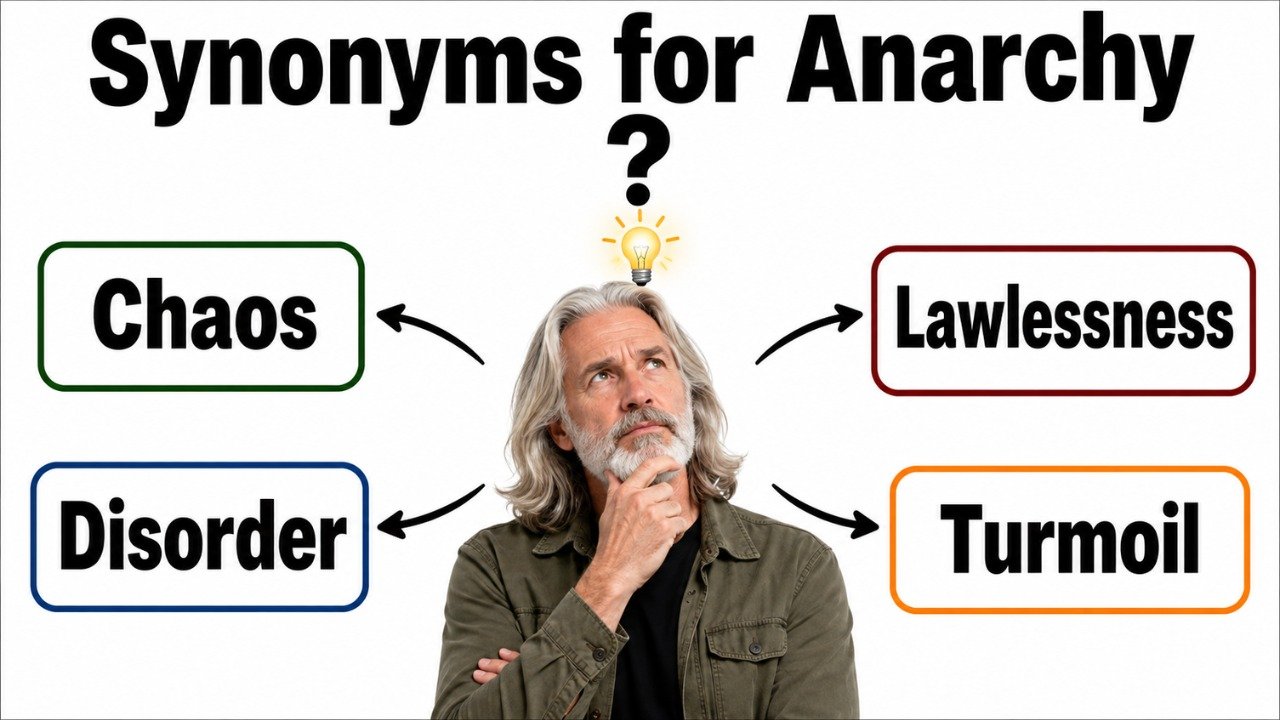
Quick Answer: The best synonyms for anarchy include chaos, disorder, lawlessness, turmoil, mayhem, unrest, statelessness, disarray, upheaval, and pandemonium. Chaos is the strongest general alternative when anarchy means complete confusion. Lawlessness fits situations in which laws are ignored or cannot be enforced. Disorder and disarray suit neutral or formal writing, while mayhem and pandemonium add stronger emotional emphasis. Unrest and upheaval describe social or political instability. Statelessness is more accurate when anarchy refers specifically to the absence of government. The best choice among synonyms for anarchy depends on whether the context involves disorder, missing authority, public unrest, or political theory.
Pronunciation and Word Details
Word: Anarchy.
Pronunciation: /ˈæn.ə.ki/
Part of Speech: Noun.
Meaning: A condition without effective government or authority, often associated with disorder and confusion.
US Pronunciation:
UK Pronunciation:
What Does “Anarchy” Mean?
Anarchy means a condition in which effective government, authority, or organized control is absent. It is a noun that can describe political disorder, social chaos, lawlessness, or a society without rulers.
In everyday speech, anarchy often means complete confusion or uncontrolled disorder. A person might use it to describe a crowded place, a failed system, or a situation in which nobody follows rules.
Everyday Context: The cancellation caused anarchy at the station.
In political writing, anarchy may have a more specific meaning. It can refer to the absence of a governing state or central authority. This meaning does not always imply violence or chaos.
Political Context: The region entered a period of anarchy after the government collapsed.
In discussions of political philosophy, the word may describe a social condition without rulers or compulsory government. However, anarchy should not automatically be treated as identical to anarchism. Anarchism is a political philosophy, while anarchy is a condition or state of affairs.
Social Context: Without clear leadership, the organization descended into anarchy.
Legal Context: Weak law enforcement allowed an atmosphere of anarchy to develop.
Figurative Context: The files were arranged in complete anarchy.
Anarchy is usually an uncountable noun.
Correct: The collapse of authority led to anarchy.
Less Natural: The collapse created an anarchy.
The phrase “a state of anarchy” is natural when referring to one particular situation.
Correct: The country remained in a state of anarchy for several months.
Meaning, Tone, and Context of “Anarchy”
Anarchy is a strong and often negative word in ordinary conversation. It usually suggests a serious lack of control, leadership, rules, or public order.
The word can sound emotional when used to describe confusion, violence, or social breakdown. It may sound formal or academic when used in political science, history, sociology, law, or philosophy.
Neutral Tone: Disorder is often more neutral than anarchy.
Strong Tone: Anarchy suggests that normal control has almost completely disappeared.
Formal Tone: Anarchy may describe the collapse of government or legal authority.
Conversational Tone: People sometimes use anarchy dramatically to describe a messy or uncontrolled situation.
Academic Tone: The term may refer to the absence of a central governing authority.
Political Tone: Anarchy can describe statelessness, a power vacuum, or the failure of political institutions.
Emotional Tone: The word can communicate fear, danger, confusion, or instability.
Figurative Tone: Anarchy may describe disorganization even when no political issue exists.
The context matters because the everyday and political meanings are not identical. In everyday language, anarchy commonly means chaos. In political theory, it can mean the absence of rulers without necessarily meaning violence or confusion.
When and How to Use “Anarchy”
For the Absence of Government
Use anarchy when a country, region, or community has no effective governing authority.
Example: The collapse of the central government left the region in anarchy.
For a Breakdown of Law and Order
Use the word when laws are ignored, unenforced, or unable to control behavior.
Example: Residents feared that weak enforcement would lead to anarchy.
For Complete Social Disorder
Anarchy can describe a situation in which normal social rules and systems stop working.
Example: The sudden shortage created anarchy in several crowded markets.
For Political Instability
Use anarchy when authority has weakened so severely that rival groups compete for control.
Example: The political crisis pushed the country toward anarchy.
For Uncontrolled Public Confusion
The word can describe a crowded or disorganized event in which nobody appears to be in control.
Example: The announcement caused anarchy at the entrance.
For Organizational Failure
Anarchy may describe a workplace, institution, or project without clear leadership or rules.
Example: Without a project manager, the entire operation fell into anarchy.
For Figurative Disorder
Use anarchy figuratively for extreme messiness or lack of organization.
Example: His desk was a scene of paper, cables, and complete anarchy.
For Historical Writing
Anarchy is useful when discussing periods marked by weak authority, competing rulers, or failed institutions.
Example: The historian examined how the leadership crisis produced anarchy.
For Academic Discussion
In political studies, the word may refer to the absence of a central authority rather than simple chaos.
Example: The essay explores whether anarchy must always produce disorder.
For Strong Emphasis
Choose anarchy when disorder is severe enough that words such as confusion or disorganization feel too weak.
Example: What began as a minor delay soon turned into anarchy.
Best Synonyms for Anarchy
Chaos
Synonym: A state of complete confusion with no clear order or organization.
Example: The unexpected closure caused chaos throughout the building.
Disorder
Synonym: A lack of organization, control, or normal arrangement.
Example: The absence of leadership created widespread disorder.
Lawlessness
Synonym: A condition in which laws are ignored or cannot be enforced.
Example: The community suffered from growing lawlessness.
Turmoil
Synonym: A state of serious confusion, uncertainty, or emotional disturbance.
Example: The political dispute threw the country into turmoil.
Mayhem
Synonym: Violent, noisy, or highly uncontrolled confusion.
Example: The sudden rush created mayhem near the gates.
Unrest
Synonym: Social or political dissatisfaction that produces instability or disturbance.
Example: Economic hardship contributed to months of public unrest.
Statelessness
Synonym: The condition of existing without an effective state or governing structure.
Example: The conflict produced a period of practical statelessness.
Disarray
Synonym: A condition in which people, plans, or objects lack order.
Example: The administration was left in complete disarray.
Upheaval
Synonym: A major and often disruptive social or political change.
Example: The transfer of power led to widespread upheaval.
Pandemonium
Synonym: Wild, noisy, and uncontrolled confusion.
Example: The false alarm caused pandemonium in the hall.
50 Synonyms for Anarchy with Short Meanings
- Chaos: Complete confusion and absence of order.
- Disorder: A lack of organization or control.
- Lawlessness: A condition in which laws are ignored or unenforced.
- Turmoil: Serious confusion, uncertainty, or disturbance.
- Mayhem: Wild and often destructive disorder.
- Unrest: Social or political dissatisfaction causing instability.
- Disarray: A state of poor organization and confusion.
- Pandemonium: Loud, uncontrolled, and widespread confusion.
- Upheaval: A major disruption of social or political order.
- Bedlam: A scene of noisy and uncontrolled confusion.
- Confusion: A lack of clarity, order, or understanding.
- Commotion: Noisy disturbance and excited activity.
- Tumult: Loud disorder involving crowds or strong emotion.
- Disturbance: An event or condition that interrupts peace and order.
- Instability: A lack of political, social, or structural steadiness.
- Disorganization: A condition in which proper arrangement is missing.
- Disruption: An interruption that prevents normal order or activity.
- Disorderliness: Habitual or visible lack of order.
- Anomie: A condition in which accepted social rules lose influence.
- Statelessness: The absence of an effective state or government.
- Leaderlessness: A condition in which no recognized leader is present.
- Rulelessness: The absence of accepted or enforced rules.
- Unruliness: Behavior that resists discipline or control.
- Wildness: Uncontrolled behavior or lack of restraint.
- Unrestraint: Absence of limits, control, or moderation.
- Absence of Government: A condition without functioning political authority.
- Lack of Authority: A situation in which no effective power is recognized.
- Breakdown of Order: The collapse of normal rules and organization.
- Collapse of Authority: The failure of governing or controlling power.
- Power Vacuum: A situation in which no authority has clear control.
- Political Vacuum: The absence of effective political leadership.
- Governmental Collapse: The failure of institutions responsible for governing.
- Institutional Collapse: The breakdown of important public structures.
- Administrative Collapse: The failure of systems that manage public affairs.
- Governance Failure: Inability of governing institutions to maintain control.
- Social Breakdown: The failure of normal social order and cooperation.
- Civil Disorder: Public disruption involving groups, protests, or violence.
- Public Disorder: Disturbance that affects peace in a public setting.
- Political Disorder: Instability caused by weakened political control.
- Social Disorder: A lack of stable rules or functioning social systems.
- Mob Rule: Control exercised by an uncontrolled crowd rather than lawful authority.
- Free for All: A situation in which everyone acts without effective rules.
- Riot: A violent public disturbance involving a crowd.
- Rebellion: Organized resistance against authority or control.
- Revolt: An attempt to reject or overthrow authority.
- Insurrection: An organized and often violent uprising against authority.
- Uprising: Collective action against established power.
- Revolution: A major overthrow or transformation of political authority.
- Mutiny: Rebellion by people subject to organized command.
- Uncontrolled Disorder: Confusion that no authority is effectively managing.
Read Also:
Synonyms for Draw

Synonyms for Anarchy by Context
When Anarchy Means Complete Disorder
Chaos, disorder, disarray, pandemonium, bedlam, and confusion are useful when anarchy describes a situation without organization or control.
Chaos is the strongest general replacement. Disorder is more neutral. Disarray often describes an organization, plan, or system that has become badly organized.
Example With Anarchy: The cancellation created anarchy at the airport.
Example With Chaos: The cancellation created chaos at the airport.
Example With Disorder: The cancellation produced serious disorder at the airport.
Example With Disarray: The cancellation left the travel schedule in disarray.
When Anarchy Means No Effective Government
Statelessness, absence of government, power vacuum, collapse of authority, and governance failure are more precise in political contexts.
Statelessness describes the absence of an effective state, although the word can also refer to a person who has no recognized nationality. Power vacuum focuses on missing leadership after authority disappears.
Example With Anarchy: The fall of the government led to anarchy.
Example With Power Vacuum: The fall of the government created a power vacuum.
Example With Collapse of Authority: The collapse of authority left local institutions unable to function.
Example With Governance Failure: Years of governance failure weakened public order.
When Anarchy Means Lawlessness
Lawlessness, rulelessness, mob rule, unruliness, and breakdown of order emphasize the absence of effective rules or enforcement.
Lawlessness is the best choice when people openly ignore laws. Mob rule describes control by an uncontrolled crowd rather than lawful institutions.
Example With Anarchy: The streets descended into anarchy after law enforcement withdrew.
Example With Lawlessness: The streets experienced growing lawlessness after law enforcement withdrew.
Example With Mob Rule: Residents feared that lawful government would be replaced by mob rule.
When Anarchy Means Political Instability
Turmoil, unrest, upheaval, instability, and political disorder describe a society experiencing conflict or uncertainty.
Turmoil emphasizes confusion and distress. Unrest often involves public dissatisfaction. Upheaval describes a major disruptive change.
Example With Anarchy: The leadership dispute pushed the nation toward anarchy.
Example With Turmoil: The leadership dispute pushed the nation into political turmoil.
Example With Unrest: The leadership dispute contributed to public unrest.
Example With Upheaval: The leadership dispute caused months of political upheaval.
When Anarchy Means No Clear Leadership
Leaderlessness, lack of authority, administrative collapse, institutional collapse, and disorganization fit situations in which management has failed.
These alternatives work in governments, organizations, workplaces, schools, and community groups.
Example With Anarchy: The organization fell into anarchy after its leaders resigned.
Example With Leaderlessness: The organization experienced leaderlessness after its senior officials resigned.
Example With Disorganization: The resignations caused severe disorganization.
When Anarchy Means Noisy Public Confusion
Mayhem, pandemonium, bedlam, commotion, and tumult emphasize noise, movement, and excitement.
Mayhem suggests severe uncontrolled activity. Pandemonium and bedlam are vivid choices for dramatic descriptions. Commotion is milder.
Example With Anarchy: The announcement caused anarchy in the hall.
Example With Pandemonium: The announcement caused pandemonium in the hall.
Example With Commotion: The announcement caused a sudden commotion in the hall.
When Anarchy Means Resistance to Authority
Rebellion, revolt, insurrection, uprising, revolution, and mutiny describe active opposition to authority.
These words are not exact replacements for every use of anarchy. They describe actions that may cause or occur during anarchy.
Example With Anarchy: The province moved toward anarchy as armed groups challenged the state.
Example With Rebellion: Armed groups began a rebellion against the state.
Example With Insurrection: Officials attempted to end the insurrection.
Another Word for Anarchy
Chaos is usually the best general replacement for anarchy when the sentence describes complete confusion or a lack of control. Lawlessness is better when laws cannot be enforced. Turmoil suits political instability, while statelessness is more precise when no effective government exists.
Original: The sudden evacuation caused anarchy in the building.
Better Option: The sudden evacuation caused chaos in the building.
Original: Weak enforcement allowed anarchy to spread.
Better Option: Weak enforcement allowed lawlessness to spread.
Original: The disputed election pushed the country toward anarchy.
Better Option: The disputed election pushed the country into political turmoil.
Original: After the state collapsed, the region entered anarchy.
Better Option: After the state collapsed, the region experienced a power vacuum.
The best alternative depends on whether the writer means disorder, missing authority, public instability, or active resistance.
When Not to Use “Anarchy”
Avoid anarchy when it exaggerates a minor problem or incorrectly suggests that all authority has disappeared. A more precise word may communicate the situation without adding unnecessary drama.
When the Situation Is Only Slightly Disorganized
Anarchy is too strong for ordinary messiness or a small planning problem.
Weak: The books on the table were in anarchy.
Better: The books on the table were in disarray.
When the Problem Is Simple Confusion
Use confusion when people are uncertain but the situation remains controlled.
Weak: A small change in the schedule caused anarchy.
Better: A small change in the schedule caused confusion.
When Laws Still Function
Do not use anarchy simply because some people break rules. Lawlessness or misconduct may be more accurate.
Weak: One act of vandalism proved that the town was in anarchy.
Better: One act of vandalism raised concerns about public disorder.
When Describing a Protest
A peaceful protest is not automatically anarchy. Use demonstration, protest, or unrest according to the facts.
Weak: Residents gathered in anarchy to demand reform.
Better: Residents gathered in a peaceful protest to demand reform.
When Describing Anarchism
Anarchy and anarchism are related but not interchangeable. Anarchism is a political philosophy. Anarchy is a condition without rulers or effective government.
Weak: She studied anarchy as a political philosophy.
Better: She studied anarchism as a political philosophy.
When Discussing a Specific Uprising
Use rebellion, revolt, uprising, or insurrection when organized resistance is the main idea.
Weak: The soldiers began an anarchy against their commander.
Better: The soldiers began a mutiny against their commander.
When Repetition Weakens the Paragraph
Replace repeated uses with more exact alternatives.
Weak: Anarchy followed the crisis, and the anarchy caused fear as the anarchy spread.
Better: Political disorder followed the crisis, causing fear as lawlessness spread.
Words Commonly Confused With Anarchy
Anarchy vs Chaos: Anarchy may mean no effective government or authority. Chaos means complete confusion and lack of order. Chaos does not require a political context.
Anarchy vs Anarchism: Anarchy is a condition without rulers or effective authority. Anarchism is a political philosophy that questions or rejects compulsory hierarchical authority.
Anarchy vs Lawlessness: Anarchy is broader and may involve missing government, disorder, or stateless organization. Lawlessness specifically emphasizes the absence or rejection of effective law.
Anarchy vs Disorder: Disorder means a lack of order or organization. Anarchy is usually stronger and may suggest that authority itself has collapsed.
Anarchy vs Unrest: Anarchy suggests absent or ineffective control. Unrest describes dissatisfaction, protest, tension, or disturbance within a society that may still have a functioning government.
Anarchy vs Rebellion: Anarchy is a condition. Rebellion is organized resistance against authority.
Anarchy vs Revolution: Anarchy describes missing or ineffective authority. Revolution is a major attempt to replace or transform a political system.
Anarchy vs Riot: Anarchy is a broad state of disorder. A riot is a particular violent public disturbance involving a crowd.
Anarchy vs Statelessness: Anarchy may refer to disorder or a society without rulers. Statelessness may describe the absence of a functioning state or the legal condition of having no recognized nationality.
Anarchy vs Anomie: Anarchy involves missing authority or control. Anomie is a social condition in which shared norms and values become weak or unclear.
Anarchy vs Power Vacuum: Anarchy is the broader condition of absent authority or disorder. A power vacuum is the specific gap created when no person or institution holds effective power.
Which Synonym Should You Choose?
Choose chaos for everyday descriptions of complete confusion or loss of control.
Choose disorder for neutral, formal, or less dramatic writing about poor organization.
Choose lawlessness when laws are ignored, rejected, or not effectively enforced.
Choose turmoil for periods of political, social, or emotional uncertainty.
Choose unrest when public dissatisfaction causes protests, tension, or instability.
Choose upheaval when society or government experiences major disruptive change.
Choose statelessness when the focus is the absence of an effective state, but explain the intended meaning clearly.
Choose power vacuum when leadership has disappeared and no replacement authority has taken control.
Choose disarray when an organization, plan, office, or system is badly organized.
Choose pandemonium when describing loud and dramatic confusion.
Choose mayhem when disorder is wild, destructive, or physically uncontrolled.
Choose commotion for a smaller and shorter noisy disturbance.
Choose anomie in academic discussions about the weakening of social norms.
Choose rebellion when people actively resist established authority.
Choose insurrection for an organized and often violent challenge to government.
Choose revolution when the goal is to overthrow or transform a political system.
Choose mob rule when an uncontrolled crowd replaces lawful decision making.
Choose governance failure in reports, essays, and formal analysis of ineffective institutions.
Choose institutional collapse when important political, legal, or administrative systems stop functioning.
Choose social breakdown when cooperation, trust, and normal community order have seriously weakened.
Real Life Examples of “Anarchy” in Sentences
Original: The cancellation caused anarchy throughout the terminal.
Better Option: The cancellation caused chaos throughout the terminal.
Original: The absence of law enforcement led to anarchy.
Better Option: The absence of law enforcement led to lawlessness.
Original: The disputed result pushed the country toward anarchy.
Better Option: The disputed result pushed the country into political turmoil.
Original: The department fell into anarchy after the manager resigned.
Better Option: The department fell into disarray after the manager resigned.
Original: The collapse of government created anarchy in the region.
Better Option: The collapse of government created a power vacuum in the region.
Original: The sudden rush caused anarchy near the entrance.
Better Option: The sudden rush caused mayhem near the entrance.
Original: Months of anarchy damaged public confidence.
Better Option: Months of political disorder damaged public confidence.
Original: The crowd reacted with anarchy after the announcement.
Better Option: The crowd reacted with loud commotion after the announcement.
Original: Rival groups took advantage of the growing anarchy.
Better Option: Rival groups took advantage of the collapse of authority.
Original: Without clear rules, the project descended into anarchy.
Better Option: Without clear rules, the project descended into disorganization.
Synonym Groups and Usage Differences
Disorder Group
Chaos, disorder, confusion, disarray, disorganization, and disorderliness describe the absence of proper arrangement or control.
Chaos is the strongest general word. Disorder is broader and more neutral. Disarray focuses on poor arrangement, while disorganization often describes a failed system or process.
Example: The sudden change left the entire schedule in disarray.
No Government Group
Statelessness, absence of government, power vacuum, political vacuum, and governmental collapse describe missing or ineffective state authority.
These terms are more precise than chaos when discussing government, political institutions, or control over territory.
Example: The collapse of the administration created a dangerous power vacuum.
Law and Authority Group
Lawlessness, rulelessness, lack of authority, collapse of authority, and mob rule emphasize weak or missing enforcement.
Lawlessness focuses on the failure of law. Mob rule suggests that an uncontrolled crowd has replaced lawful authority.
Example: Residents feared that lawlessness would continue to spread.
Political Instability Group
Turmoil, unrest, upheaval, instability, and political disorder describe tension or disruption within a political system.
These words do not necessarily mean that government has completely disappeared.
Example: The disputed election caused months of political unrest.
Noisy Confusion Group
Mayhem, pandemonium, bedlam, commotion, and tumult describe loud, active, and visible disturbance.
Pandemonium and bedlam are vivid and dramatic. Commotion is usually milder and shorter.
Example: The unexpected announcement created pandemonium in the hall.
Institutional Failure Group
Governance failure, institutional collapse, administrative collapse, and social breakdown refer to serious failures within systems that maintain order.
These phrases work well in reports, essays, and formal analysis.
Example: Administrative collapse prevented essential public services from operating.
Resistance Group
Rebellion, revolt, insurrection, uprising, revolution, and mutiny describe challenges against authority.
They may occur before, during, or after a period of anarchy, but they do not always mean the same thing as anarchy.
Example: The uprising challenged the authority of the central government.
Social Norm Group
Anomie, rulelessness, unruliness, wildness, and unrestraint describe weakened social rules or uncontrolled behavior.
Anomie is mainly academic. Unruliness is suitable for people or groups that resist discipline.
Example: The writer described a society experiencing deep anomie.
Antonyms of Anarchy
The opposite of anarchy depends on whether the word means disorder, absent government, weak law, or social instability.
Order: A condition in which rules, systems, and arrangements function properly.
Government: The organized authority that directs and administers a society.
Authority: Recognized power to make decisions and enforce rules.
Lawfulness: Behavior and conditions that follow established law.
Stability: A condition of political, social, or institutional steadiness.
Peace: Freedom from violence, conflict, and serious disturbance.
Control: The power to direct behavior, events, or systems.
Organization: A structured and coordinated arrangement of people or activities.
Discipline: Controlled behavior based on rules or standards.
Governance: The process through which a society or institution is directed.
Leadership: Guidance provided by a recognized person or group.
Security: Protection from danger, violence, or instability.
Public Order: Peaceful social conditions maintained through effective rules.
Rule of Law: The principle that laws govern people and institutions consistently.
Civil Order: A stable condition in which public institutions and laws function.
Social Harmony: Peaceful cooperation among members of a community.
Coordination: Organized management of people, resources, or actions.
Structure: An established framework that creates order.
Regulation: Rules and controls used to guide behavior or activity.
Institutional Stability: Reliable functioning of political, legal, or social institutions.
Comparison of Anarchy and Related Words
Anarchy vs Chaos
Anarchy may refer to absent government or authority. Chaos means complete disorder in any kind of situation.
Example With Anarchy: The collapse of government left the region in anarchy.
Example With Chaos: The unexpected evacuation caused chaos in the building.
Anarchy vs Lawlessness
Anarchy is a broad condition involving missing control or authority. Lawlessness focuses specifically on the absence or rejection of effective law.
Example With Anarchy: Rival groups competed for power during the anarchy.
Example With Lawlessness: Weak enforcement allowed lawlessness to spread.
Anarchy vs Disorder
Anarchy is usually stronger and may have a political meaning. Disorder can describe any lack of organization or control.
Example With Anarchy: The state entered anarchy after its institutions collapsed.
Example With Disorder: The office was in disorder after the rushed move.
Anarchy vs Turmoil
Anarchy suggests absent or ineffective authority. Turmoil describes serious confusion, uncertainty, or emotional disturbance.
Example With Anarchy: The disappearance of central authority produced anarchy.
Example With Turmoil: The leadership dispute caused political turmoil.
Anarchy vs Unrest
Anarchy suggests a collapse or absence of control. Unrest means public dissatisfaction or tension and can exist under a functioning government.
Example With Anarchy: The government collapse resulted in anarchy.
Example With Unrest: Rising prices contributed to public unrest.
Anarchy vs Upheaval
Anarchy is a condition of missing authority or severe disorder. Upheaval is a major disruptive change.
Example With Anarchy: The region experienced anarchy after authority disappeared.
Example With Upheaval: The political reforms caused widespread upheaval.
Anarchy vs Rebellion
Anarchy is a state or condition. Rebellion is an organized act of resistance against authority.
Example With Anarchy: The province remained in anarchy after the conflict.
Example With Rebellion: The group began a rebellion against the government.
Anarchy vs Revolution
Anarchy describes absent authority or disorder. Revolution describes the overthrow or major transformation of a system.
Example With Anarchy: Anarchy followed the collapse of the old institutions.
Example With Revolution: The revolution replaced the former political system.
Anarchy vs Anarchism
Anarchy is a social or political condition. Anarchism is a philosophy concerning society, authority, and voluntary forms of organization.
Example With Anarchy: The author described a period without effective government as anarchy.
Example With Anarchism: The student examined anarchism as a political philosophy.
Anarchy vs Statelessness
Anarchy can mean disorder or absence of rulers. Statelessness can mean a territory without effective state institutions or a person without recognized nationality.
Example With Anarchy: The collapse produced anarchy across the region.
Example With Statelessness: The essay discussed political statelessness after institutional collapse.
Common Phrases and Expressions With Anarchy
State of Anarchy: A condition without effective authority or public order.
Complete Anarchy: Total absence of organization, rules, or control.
Political Anarchy: Disorder caused by the collapse or absence of political authority.
Social Anarchy: Breakdown of normal social rules and cooperation.
Economic Anarchy: Severe lack of control or coordination within economic activity.
Administrative Anarchy: Confusion caused by failed leadership or management systems.
Descend Into Anarchy: Gradually move from order into uncontrolled disorder.
Fall Into Anarchy: Enter a condition without effective control or authority.
Lead to Anarchy: Cause severe disorder or collapse of authority.
Prevent Anarchy: Stop public order or government from breaking down.
Bordering on Anarchy: Becoming dangerously close to complete disorder.
Scene of Anarchy: A place marked by severe confusion and lack of control.
Fear of Anarchy: Concern that authority, law, or stability may collapse.
Period of Anarchy: A length of time marked by weak government or disorder.
Threat of Anarchy: The possibility that control and public order may fail.
Common Mistakes to Avoid
Treating Anarchy and Chaos as Perfect Synonyms
Chaos is a common synonym, but anarchy can have a specific political meaning involving absent government.
Weak: Every messy room is an example of political anarchy.
Better: A messy room may be chaotic, but political anarchy concerns authority and government.
Confusing Anarchy With Anarchism
Anarchy is a condition. Anarchism is a political philosophy.
Incorrect: He wrote an essay about anarchy as a political ideology.
Correct: He wrote an essay about anarchism as a political ideology.
Using Anarchy for Minor Confusion
The word is often too dramatic for small mistakes or ordinary disorganization.
Weak: A missing pen caused anarchy in the office.
Better: A missing document caused brief confusion in the office.
Calling Every Protest Anarchy
A peaceful protest may involve disagreement without lawlessness or collapse of authority.
Incorrect: The peaceful march created anarchy.
Correct: The peaceful march expressed public dissatisfaction.
Confusing Rebellion With Anarchy
Rebellion is active resistance. Anarchy is a condition of absent authority or severe disorder.
Weak: The soldiers started an anarchy.
Better: The soldiers started a mutiny.
Using Statelessness Without Clarification
Statelessness can describe a person without recognized nationality. In political writing, clarify when it means the absence of an effective state.
Vague: The conflict caused statelessness.
Better: The conflict caused political statelessness by destroying effective government.
Assuming Anarchy Always Means Violence
A lack of central authority does not automatically mean that violence is occurring. The exact meaning depends on context.
Weak: Anarchy always produces immediate violence.
Better: Anarchy may involve disorder, but the term can also describe the absence of governing authority.
Using an Unnatural Article
Anarchy is usually uncountable.
Incorrect: The country entered an anarchy.
Correct: The country entered a state of anarchy.
Repeating Anarchy Too Often
Repeated use can make writing dramatic and vague.
Weak: Anarchy followed the collapse, and the anarchy increased as the anarchy spread.
Better: Political disorder followed the collapse, and lawlessness increased as authority weakened.
Choosing a Word That Changes the Meaning
Riot, revolution, rebellion, and unrest are related concepts, but each describes something different.
Weak: The peaceful political unrest was a violent insurrection.
Better: The peaceful political unrest involved demonstrations and public demands.
Ignoring the Context
A synonym suitable for a government crisis may sound unnatural in an office or household context.
Weak: The untidy filing cabinet created governmental collapse.
Better: The untidy filing cabinet created disorganization.
Conclusion
The most useful synonyms for anarchy include chaos, disorder, lawlessness, turmoil, mayhem, unrest, disarray, upheaval, statelessness, and pandemonium. Choose chaos for complete confusion, lawlessness for weak legal enforcement, and turmoil for political instability. Disarray suits organizational problems, while power vacuum and statelessness are more precise when effective government is absent. Understanding these distinctions helps writers avoid exaggeration and select language that matches the situation. The best choice among synonyms for anarchy depends on whether the sentence describes disorder, missing authority, social unrest, or political collapse.
FAQs About Synonyms for Anarchy
What Is the Best Synonym for Anarchy?
Chaos is the best general synonym when anarchy means complete disorder. Lawlessness is better when rules cannot be enforced, while statelessness fits the absence of government.
Is Chaos the Same as Anarchy?
Not always. Chaos means complete confusion. Anarchy may mean chaos, but it can also refer specifically to a condition without rulers or effective government.
What Is a Formal Synonym for Anarchy?
Political disorder, collapse of authority, power vacuum, governance failure, and statelessness are formal alternatives. The best term depends on the precise political situation.
What Is a Stronger Word for Disorder?
Anarchy, chaos, mayhem, and pandemonium are stronger than disorder. Use them only when the situation is severely uncontrolled.
What Is the Difference Between Anarchy and Anarchism?
Anarchy is a condition without effective government or authority. Anarchism is a political philosophy concerning authority, hierarchy, and voluntary organization.
Can Lawlessness Replace Anarchy?
Lawlessness can replace anarchy when the sentence focuses on ignored laws or weak enforcement. It is less suitable when the main idea is simply missing government.
What Is the Opposite of Anarchy?
Order, government, authority, stability, lawfulness, public order, and rule of law are common opposites of anarchy.
