
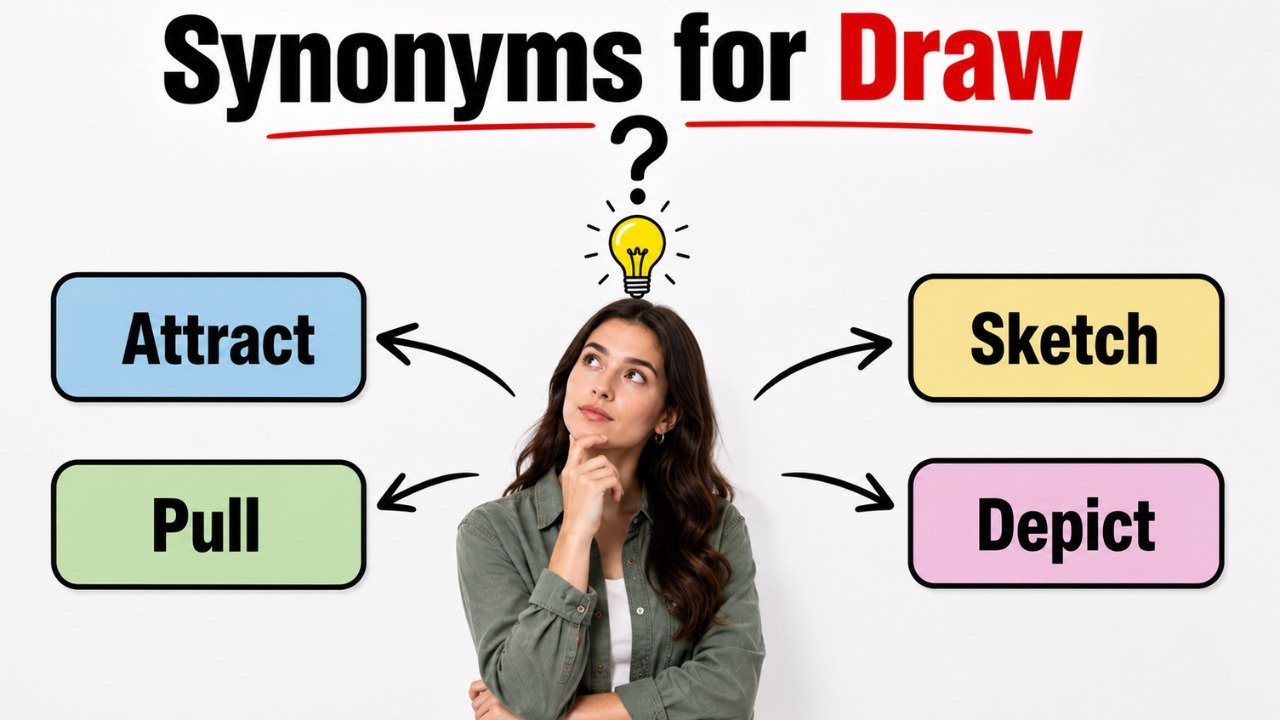
Quick Answer: The best synonyms for draw include sketch, illustrate, depict, pull, attract, extract, select, tie, infer, and approach. Use sketch or illustrate when creating a picture, pull when moving something toward you, attract when gaining attention, extract when removing something, select when choosing a name or number, tie for an equal result, and infer when reaching a conclusion from evidence. The correct choice among synonyms for draw depends on the intended meaning and sentence context.
Pronunciation and Word Details
Word: Draw.
Pronunciation: /drɔː/
Part of Speech: Verb and noun.
Meaning: To create a picture, pull something, attract attention, remove something, choose randomly, or reach a conclusion.
US Pronunciation:
UK Pronunciation:
What Does “Draw” Mean?
Draw means to make a picture using lines, move something by pulling it, or cause someone or something to come closer.
It can function as both a verb and a noun. As a verb, it appears in sentences such as “She drew a flower,” “He drew the chair closer,” and “The advertisement drew attention.”
As a noun, draw can describe an equal result in a competition, a random selection, or something that attracts people.
Picture Meaning: To create an image using a pencil, pen, chalk, or another tool.
Pulling Meaning: To move an object toward a person or position.
Attraction Meaning: To gain attention, interest, support, or visitors.
Removal Meaning: To take out liquid, money, breath, or another substance.
Selection Meaning: To choose a person, number, or item, often randomly.
Result Meaning: To finish a competition with equal scores.
Reasoning Meaning: To form a conclusion from facts or evidence.
The intended meaning usually becomes clear from the object that follows draw. For example, draw a picture, draw a curtain, draw attention, draw money, and draw a conclusion all use the same word differently.
Meaning, Tone, and Context of “Draw”
Draw is generally a neutral and common word. It appears naturally in casual conversation, formal writing, academic discussions, sports reports, business communication, and creative instructions.
When draw refers to making a picture, it sounds simple and conversational. Sketch, illustrate, depict, and render may provide greater precision in artistic or professional contexts.
When draw means pull, it is neutral but may sound slightly formal in expressions such as draw the curtains or draw the chair closer. Pull is usually more direct in everyday speech.
When draw means attract, it is common in reports, advertisements, event descriptions, and analytical writing. Attract may be clearer when discussing attention, customers, visitors, or interest.
When draw means conclude, it is frequently used in academic and professional phrases such as draw a conclusion or draw an inference.
Formal Context: Draw is suitable for reports, essays, instructions, and professional communication.
Casual Context: It is natural in everyday requests such as “Draw me a picture” or “Draw the curtains.”
Creative Context: It describes making images, plans, outlines, diagrams, and designs.
Technical Context: It may describe extracting liquid, taking electrical power, or obtaining a sample.
Competitive Context: It describes a result in which neither side wins.
Analytical Context: It refers to forming conclusions from information or evidence.
When and How to Use “Draw”
For Creating a Picture
Use draw when someone makes an image by producing lines on a surface.
Example: The student used a pencil to draw a detailed map.
For Making a Quick Image
Use draw for a general picture, but choose sketch when the picture is quick or unfinished.
Example: She drew the outline before adding color.
For Pulling an Object
Use draw when something is moved toward a person, place, or position.
Example: He drew the chair closer to the table.
For Opening or Closing Curtains
Draw is commonly used when moving curtains across a window.
Example: Please draw the curtains before the presentation begins.
For Attracting Attention
Use draw when something causes people to notice, visit, support, or become interested.
Example: The unusual display drew the attention of everyone nearby.
For Removing Money or Liquid
Use draw when taking money from an account or removing liquid from a source.
Example: She drew enough water to fill the container.
For Choosing Randomly
Use draw when selecting a name, card, number, or item by chance.
Example: Each participant drew a number from the box.
For an Equal Result
Use draw as a noun or verb when both sides finish with the same score.
Example: The teams drew after scoring two goals each.
For Reaching a Conclusion
Use draw when forming an opinion or judgment from evidence.
Example: The researchers could not draw a firm conclusion from the limited data.
For Coming Near
Use draw with near, nearer, or closer when something approaches.
Example: The deadline is drawing near.
Best Synonyms for Draw
Sketch
Synonym: To create a quick or simple picture using lines.
Example: She sketched the building before painting it.
Illustrate
Synonym: To create a picture that explains or decorates something.
Example: The artist illustrated every chapter of the book.
Depict
Synonym: To represent a person, object, scene, or idea visually.
Example: The mural depicts life in a peaceful village.
Pull
Synonym: To move something toward yourself or another position.
Example: He pulled the door open slowly.
Attract
Synonym: To cause people, interest, attention, or support to come toward something.
Example: The exhibition attracted hundreds of visitors.
Extract
Synonym: To remove or take something out of a larger source.
Example: The technician extracted a small sample for testing.
Select
Synonym: To choose someone or something from a group.
Example: The organizer selected three names from the list.
Tie
Synonym: To finish a competition with an equal score.
Example: The two teams tied in the final match.
Infer
Synonym: To form an understanding from evidence rather than a direct statement.
Example: We can infer from his response that he disagrees.
Approach
Synonym: To move closer in distance or time.
Example: The students became more focused as the examination approached.
50 Synonyms for Draw with Short Meanings
- Sketch: To make a quick or simple picture.
- Illustrate: To create an image that explains or decorates.
- Depict: To represent something through a picture or description.
- Portray: To show a person, scene, or idea in a particular way.
- Render: To produce an artistic representation.
- Outline: To show the main shape or basic form.
- Trace: To copy lines by following an existing shape.
- Draft: To create an early version of a picture or plan.
- Diagram: To represent information through a structured drawing.
- Doodle: To make simple drawings without careful planning.
- Pull: To move something toward a person or place.
- Drag: To pull something along a surface.
- Tug: To pull something with a quick or forceful movement.
- Haul: To pull or transport something heavy.
- Tow: To pull a vehicle or object behind another vehicle.
- Reel: To pull something in by winding a rope, line, or cable.
- Attract: To cause attention, people, or interest to come closer.
- Entice: To attract someone by offering something appealing.
- Lure: To attract someone through temptation or promise.
- Appeal: To interest or attract a particular person or group.
- Captivate: To hold someone’s complete interest.
- Engage: To gain and maintain attention or involvement.
- Invite: To encourage a response, action, or feeling.
- Bring: To cause someone or something to come to a place.
- Summon: To call someone to come or appear.
- Extract: To remove something from a source.
- Withdraw: To take money, support, or something else away.
- Remove: To take something out or away.
- Drain: To remove liquid from a place or container.
- Siphon: To draw liquid through a tube.
- Tap: To obtain something from an available source.
- Take: To remove, receive, or obtain something.
- Collect: To gather or receive something from a source.
- Obtain: To acquire something through effort or a process.
- Select: To choose someone or something from several options.
- Choose: To decide which person or thing to take.
- Pick: To choose someone or something, often informally.
- Assign: To give a selected item, number, or duty to someone.
- Tie: To finish with an equal score or result.
- Equal: To reach the same number, level, or result.
- Level: To make scores or positions equal.
- Match: To equal another person or side in performance.
- Deadlock: To reach a position in which neither side can win or progress.
- Infer: To form an idea from available evidence.
- Deduce: To reach a logical conclusion from facts.
- Conclude: To decide something after considering evidence.
- Derive: To obtain an idea, result, or meaning from a source.
- Approach: To move closer in distance, time, or condition.
- Close: To move toward an ending.
- Inhale: To draw air into the lungs.
Read Also:
Synonyms for Killed
Synonyms for Draw by Context
When Draw Means Make a Picture
The most useful synonyms are sketch, illustrate, depict, portray, render, outline, trace, and doodle.
Use sketch for a quick image. Use illustrate for an image that explains text. Use depict or portray when showing a person, scene, situation, or idea.
Example With Draw: She drew a picture of the old bridge.
Example With Sketch: She sketched the old bridge in her notebook.
Example With Depict: The painting depicts the old bridge during winter.
When Draw Means Pull
The best alternatives are pull, drag, tug, haul, tow, and reel.
Pull is the most general replacement. Drag suggests movement across a surface. Tug describes a short or sudden pull. Haul suggests considerable weight or effort.
Example With Draw: He drew the heavy box across the floor.
Example With Pull: He pulled the heavy box across the floor.
Example With Haul: They hauled the equipment into the building.
When Draw Means Attract
Useful synonyms include attract, entice, lure, appeal, captivate, engage, and invite.
Attract is the clearest neutral option. Entice and lure suggest temptation. Captivate means holding someone’s complete attention.
Example With Draw: The bright display drew a large crowd.
Example With Attract: The bright display attracted a large crowd.
Example With Captivate: The speaker captivated the audience with a powerful opening.
When Draw Means Remove or Extract
Suitable alternatives include extract, withdraw, remove, drain, siphon, collect, and take.
Extract works well in scientific, medical, and technical contexts. Withdraw is best for money. Drain and siphon relate mainly to liquids.
Example With Draw: The nurse drew a small amount of blood.
Example With Extract: The technician extracted a small sample.
Example With Withdraw: He withdrew money from his account.
When Draw Means Select
The strongest alternatives are select, choose, pick, and assign.
Choose is general. Select sounds slightly more formal. Pick is common in casual speech.
Example With Draw: She drew the winning name from the container.
Example With Select: She selected the winning name from the container.
Example With Pick: Each student picked a card.
When Draw Means Finish Equally
The most useful alternatives are tie, equal, level, match, and deadlock.
Tie is the clearest word for equal scores. Deadlock is stronger and often describes a situation in which neither side can progress.
Example With Draw: The teams drew by one goal each.
Example With Tie: The teams tied with one goal each.
Example With Deadlock: The negotiations reached a deadlock.
When Draw Means Reach a Conclusion
The best alternatives are infer, deduce, conclude, derive, and reason.
Infer means understanding something from indirect evidence. Deduce suggests logical reasoning. Conclude is the clearest formal option for making a final judgment.
Example With Draw: We can draw several conclusions from the results.
Example With Infer: We can infer several important facts from the results.
Example With Conclude: We can conclude that the new method performed better.
When Draw Means Come Closer
Useful alternatives include approach, near, and close.
Approach works for time, distance, or events. Close is often used when something is moving toward an ending.
Example With Draw: Winter is drawing near.
Example With Approach: Winter is approaching.
Example With Close: The meeting was coming to a close.
Another Word for Draw
The best single replacement for draw is often pull, but the correct alternative depends entirely on context.
Use sketch when the sentence concerns making a picture. Use attract when the sentence concerns attention or interest. Use extract when something is being removed. Use infer or conclude when the sentence concerns reasoning.
Original: Please draw the table closer to the wall.
Better Option: Please pull the table closer to the wall.
Original: The child drew a picture of her family.
Better Option: The child sketched a picture of her family.
Original: The event drew many local visitors.
Better Option: The event attracted many local visitors.
Original: We should not draw conclusions without enough evidence.
Better Option: We should not reach conclusions without enough evidence.
When Not to Use “Draw”
Do not use draw when its meaning could be misunderstood. Since the word has many definitions, a more exact synonym can make the sentence clearer.
When Describing Professional Artwork
Draw may sound too general when a specific artistic process is intended.
Weak: The artist drew the historical scene on a large wall.
Better: The artist depicted the historical scene in a large mural.
When Describing Physical Movement
Draw can sound formal or old fashioned when pull would be more natural.
Weak: Draw the door toward you.
Better: Pull the door toward you.
When Discussing Scientific Removal
Draw may be less precise than extract, collect, or withdraw.
Weak: The researcher drew material from the sample.
Better: The researcher extracted material from the sample.
When Discussing Audience Interest
Draw is correct, but attract may be clearer when the object is visitors, viewers, customers, or attention.
Weak: The new display drew many customers.
Better: The new display attracted many customers.
When Explaining Reasoning
Avoid draw when the exact reasoning action should be emphasized.
Weak: She drew that the plan would fail.
Better: She inferred from the evidence that the plan would fail.
When Repeating the Word
Using draw several times close together can make writing sound mechanical.
Weak: The picture drew attention because the artist drew every figure carefully, which drew praise from the judges.
Better: The picture attracted attention because the artist rendered every figure carefully, which earned praise from the judges.
Words Commonly Confused With Draw
Draw vs Sketch
Draw: A general term for creating an image with lines.
Sketch: A quick, simple, or unfinished drawing.
A completed portrait can be drawn, while an early visual plan is more likely to be sketched.
Example With Draw: She drew a detailed portrait of her grandfather.
Example With Sketch: She sketched the basic shape before adding details.
Draw vs Illustrate
Draw: To create almost any image using lines.
Illustrate: To create a picture that explains, supports, or decorates written content.
An artist may draw for practice but illustrate a story for readers.
Example With Draw: He drew several animals in his notebook.
Example With Illustrate: He illustrated the story with colorful animal pictures.
Draw vs Pull
Draw: Can mean moving something toward a person or position.
Pull: The more direct and common word for physical movement.
Draw is frequent in fixed expressions such as draw the curtains, while pull is more natural for many everyday actions.
Example With Draw: She drew the curtains across the window.
Example With Pull: She pulled the suitcase behind her.
Draw vs Attract
Draw: Can mean causing attention, interest, or people to come.
Attract: States the attraction meaning more directly.
Draw is natural in phrases such as draw attention, while attract is often clearer before visitors, customers, and interest.
Example With Draw: The announcement drew immediate attention.
Example With Attract: The exhibition attracted many visitors.
Draw vs Extract
Draw: Can mean taking liquid, money, information, or a substance from a source.
Extract: Means removing something through a deliberate process.
Extract is usually more precise in scientific and technical writing.
Example With Draw: The nurse drew blood for the test.
Example With Extract: The laboratory extracted material from the sample.
Draw vs Tie
Draw: Commonly describes an equal result, especially as a noun.
Tie: A direct verb or noun for an equal score.
Both are correct, but their frequency may differ between regional varieties of English and types of competition.
Example With Draw: The match ended in a draw.
Example With Tie: The teams tied at three points each.
Draw vs Infer
Draw: Appears in the phrase draw an inference or draw a conclusion.
Infer: Directly describes understanding something from evidence.
Do not use draw alone when infer is required.
Incorrect: I drew that she was unhappy.
Correct: I inferred from her expression that she was unhappy.
Which Synonym Should You Choose?
For General Pictures: Choose draw when no special artistic method needs to be identified.
For Quick Pictures: Choose sketch when the image is simple, rough, or unfinished.
For Explanatory Images: Choose illustrate when a picture supports written information.
For Visual Representation: Choose depict when showing a person, event, object, or idea.
For Artistic Description: Choose portray when representing someone or something in a particular manner.
For Physical Movement: Choose pull for clear everyday instructions.
For Heavy Movement: Choose haul or drag when weight, effort, or contact with a surface matters.
For Attention: Choose attract when discussing interest, visitors, customers, or notice.
For Persuasion: Choose entice when something appealing encourages action.
For Technical Removal: Choose extract when removing material, data, or a substance.
For Money: Choose withdraw when taking funds from an account.
For Random Choice: Choose select, choose, or pick when a name, card, or number is taken from a group.
For Equal Scores: Choose tie in casual or general sports language.
For Formal Reasoning: Choose conclude when presenting a final judgment in reports or essays.
For Indirect Evidence: Choose infer when the meaning is understood from clues.
For Logical Reasoning: Choose deduce when a conclusion follows through a clear reasoning process.
For Reports: Use attract, extract, conclude, depict, or select according to the intended meaning.
For Essays: Use illustrate, demonstrate, infer, conclude, or portray when greater precision is needed.
For Emails: Use pull, select, attract, or conclude to keep instructions clear and direct.
For Conversation: Use draw, pull, pick, sketch, or tie because these words sound natural and familiar.
Real Life Examples of “Draw” in Sentences
Creating a Picture
Original: The student drew a diagram of the water cycle.
Better Option: The student illustrated the water cycle with a clear diagram.
Making a Quick Design
Original: She drew an early plan for the garden.
Better Option: She sketched an early plan for the garden.
Moving Something Closer
Original: He drew the lamp nearer to the book.
Better Option: He pulled the lamp nearer to the book.
Attracting Attention
Original: The unusual sound drew everyone’s attention.
Better Option: The unusual sound attracted everyone’s attention.
Attracting Visitors
Original: The annual exhibition drew visitors from nearby towns.
Better Option: The annual exhibition attracted visitors from nearby towns.
Removing Money
Original: She drew money from her account to pay the fee.
Better Option: She withdrew money from her account to pay the fee.
Removing a Sample
Original: The technician drew a sample from the container.
Better Option: The technician extracted a sample from the container.
Choosing a Name
Original: The teacher drew one name from the box.
Better Option: The teacher selected one name from the box.
Finishing Equally
Original: The teams drew after a closely contested game.
Better Option: The teams tied after a closely contested game.
Reaching a Conclusion
Original: The committee drew a conclusion after reviewing the evidence.
Better Option: The committee reached a conclusion after reviewing the evidence.
Synonym Groups and Usage Differences
Art and Image Group
Sketch, illustrate, depict, portray, render, outline, trace, and doodle relate to making or presenting images.
Sketch suggests speed or limited detail. Illustrate usually supports text or explains information. Depict and portray focus on representation. Render often describes a polished artistic version.
Example: The designer rendered a detailed image after sketching several early ideas.
Pulling and Movement Group
Pull, drag, tug, haul, tow, and reel describe movement caused by force.
Pull is general. Drag involves movement across a surface. Tug is brief or forceful. Haul suggests effort. Tow involves one vehicle or object pulling another.
Example: The workers hauled the equipment while another vehicle towed the trailer.
Attraction Group
Attract, entice, lure, appeal, captivate, engage, and invite describe gaining interest or encouraging action.
Attract is neutral. Entice emphasizes an appealing offer. Lure may suggest temptation or possible deception. Captivate means holding complete attention.
Example: The opening scene captivated the audience and encouraged them to continue watching.
Extraction Group
Extract, withdraw, remove, drain, siphon, tap, and collect describe taking something from a source.
Extract is precise and technical. Withdraw is common for money or support. Drain and siphon usually concern liquids. Collect focuses on receiving or gathering.
Example: The technician extracted the sample and collected the remaining liquid in a clean container.
Selection Group
Select, choose, pick, and assign relate to deciding who or what will be taken.
Select is slightly formal. Choose is neutral. Pick is informal. Assign means giving a chosen role, duty, number, or item to someone.
Example: The manager selected a leader and assigned tasks to the remaining members.
Equal Result Group
Tie, equal, level, match, and deadlock describe equality or lack of a clear winner.
Tie is the most direct sports synonym. Equal and level emphasize sameness. Deadlock describes a situation in which progress stops.
Example: The teams tied, while the following negotiation ended in a deadlock.
Reasoning Group
Infer, deduce, conclude, and derive describe reaching an idea or judgment.
Infer relies on clues. Deduce emphasizes logic. Conclude expresses a final decision. Derive means obtaining information or meaning from a source.
Example: From the available evidence, the researchers inferred a pattern and concluded that further testing was necessary.
Antonyms of Draw
The opposite of draw changes according to its meaning. A word that opposes draw as pull will not oppose draw as attract, select, or conclude.
Push: To move something away rather than pull it closer.
Repel: To force someone or something away rather than attract it.
Insert: To put something into a place rather than extract it.
Deposit: To place money into an account rather than withdraw it.
Return: To give something back rather than take or remove it.
Release: To let something go rather than pull or hold it.
Ignore: To give no attention rather than become attracted or engaged.
Reject: To refuse someone or something rather than select it.
Separate: To move apart rather than bring together.
Win: To achieve a higher score rather than finish in a draw.
Lose: To achieve a lower score rather than finish equally.
Diverge: To move apart rather than draw near.
Exhale: To breathe air out rather than draw it into the lungs.
Dismiss: To reject an idea rather than infer or conclude it from evidence.
Comparison: Draw vs Related Words
Draw vs Sketch
Draw is a broad word for making a picture. Sketch usually describes a quick, light, or unfinished image.
Example With Draw: He drew a detailed picture of the city.
Example With Sketch: He sketched the city skyline in five minutes.
Draw vs Illustrate
Draw focuses on producing an image. Illustrate often means creating an image that explains or supports information.
Example With Draw: She drew a flower in her notebook.
Example With Illustrate: She illustrated the guide with pictures of local flowers.
Draw vs Depict
Draw describes the physical act of making an image. Depict describes what the finished image represents.
Example With Draw: The artist drew several figures.
Example With Depict: The finished artwork depicts a family celebration.
Draw vs Pull
Draw can mean moving something closer, but pull is usually clearer in ordinary physical instructions.
Example With Draw: He drew the blanket over his shoulders.
Example With Pull: He pulled the cart through the doorway.
Draw vs Attract
Draw and attract can both describe gaining attention or visitors. Attract is more direct, while draw is common in established expressions.
Example With Draw: The headline drew immediate attention.
Example With Attract: The exhibition attracted a large audience.
Draw vs Extract
Draw may describe taking a sample or liquid. Extract is more precise when a deliberate technical process is involved.
Example With Draw: The nurse drew a small blood sample.
Example With Extract: The scientist extracted oil from the plant material.
Draw vs Select
Draw often implies choosing randomly. Select can involve either random or deliberate choice.
Example With Draw: She drew a card from the pack.
Example With Select: She selected the most suitable candidate.
Draw vs Tie
Draw and tie both describe an equal competitive result. Draw is common as a noun, while tie works naturally as both a noun and a verb.
Example With Draw: The match ended in a draw.
Example With Tie: The teams tied at the end of the final round.
Draw vs Infer
Draw needs a noun such as conclusion or inference when discussing reasoning. Infer works directly as a verb.
Example With Draw: We can draw a reasonable conclusion from the evidence.
Example With Infer: We can infer that demand is increasing.
Draw vs Conclude
Draw is part of the phrase draw a conclusion. Conclude expresses the reasoning action more directly.
Example With Draw: The panel drew its conclusion after reviewing every report.
Example With Conclude: The panel concluded that the proposal required revision.
Common Phrases and Expressions With “Draw”
Draw Attention: To cause someone to notice something.
Draw a Picture: To create an image using lines.
Draw a Conclusion: To reach a judgment after considering evidence.
Draw a Line: To establish a limit, boundary, or distinction.
Draw Near: To approach in time or distance.
Draw a Blank: To fail to remember or find an answer.
Draw Lots: To choose someone or something randomly.
Draw the Curtains: To move curtains across a window.
Draw Breath: To breathe in, especially before speaking or reacting.
Draw Out: To make something last longer or to encourage someone to speak.
Draw From: To obtain information, strength, ideas, or resources from a source.
Draw to a Close: To gradually reach an ending.
Draw Someone Aside: To take a person away from a group for a private conversation.
Draw Up: To prepare a formal document or move a vehicle closer.
Draw Together: To bring people or things into a closer relationship.
Common Mistakes to Avoid
Using One Synonym for Every Meaning
Draw has several unrelated meanings. Sketch cannot replace draw when discussing money, attention, sports, or conclusions.
Incorrect: She sketched money from her account.
Correct: She withdrew money from her account.
Confusing Draw and Infer
Do not use draw alone to mean understand from evidence.
Incorrect: We drew that the plan was unsuccessful.
Correct: We inferred that the plan was unsuccessful.
Correct: We drew the conclusion that the plan was unsuccessful.
Using Draw When Pull Is Clearer
Draw is grammatically correct in many movement sentences, but it can sound unnecessarily formal.
Less Natural: Draw the box toward you.
More Natural: Pull the box toward you.
Confusing Draw and Illustrate
Illustrate is not always a direct replacement for draw. It usually suggests that the image explains, supports, or decorates something.
General: The child drew a tree.
Explanatory: The writer illustrated the instructions with a diagram.
Ignoring the Object After Draw
The noun following draw often determines its meaning.
Draw a Picture: Create an image.
Draw Water: Remove water from a source.
Draw Attention: Attract notice.
Draw a Conclusion: Reach a judgment.
Draw a Card: Select a card.
Repeating Draw Too Often
Use specific alternatives when several meanings appear in the same paragraph.
Repetitive: The artist drew a scene that drew attention and drew praise from the judges.
Improved: The artist depicted a scene that attracted attention and earned praise from the judges.
Choosing an Overly Strong Word
Lure may suggest temptation or deception, while attract is usually neutral.
Unclear: The educational event lured many families.
Better: The educational event attracted many families.
Confusing a Draw With a Win
A draw means both competitors have equal results. It does not mean that both competitors won.
Incorrect: Both teams won because the game was a draw.
Correct: Neither team won because the game ended in a draw.
Conclusion
The most suitable synonyms for draw depend on what the word means in a sentence. Choose sketch, illustrate, or depict for pictures, pull for movement, attract for attention, extract for removal, select for choice, tie for an equal result, and infer or conclude for reasoning. Understanding these different senses helps you avoid vague or unnatural wording. When using synonyms for draw, examine the surrounding words and select the alternative that communicates the intended action most clearly.
FAQs About Synonyms for Draw
What Is the Most Common Synonym for Draw?
Pull is the most common synonym when draw describes physical movement. Sketch is the best general alternative when draw refers to making a picture.
What Is Another Word for Draw a Picture?
Sketch, illustrate, depict, portray, and render are useful alternatives. Sketch suggests a quick image, while illustrate often means creating a picture that supports text.
What Is Another Word for Draw Attention?
Attract attention is the clearest alternative. Capture attention, gain notice, engage, and captivate may also work depending on the context.
What Is a Formal Synonym for Draw?
Depict, render, extract, select, infer, and conclude are formal alternatives. The correct choice depends on whether draw refers to art, removal, selection, or reasoning.
What Is Another Word for Draw a Conclusion?
Reach a conclusion, infer, deduce, determine, and conclude are suitable alternatives. Conclude is often the clearest choice in formal writing.
Is Sketch the Same as Draw?
Not completely. Draw is a general term for creating an image, while sketch usually means making a quick, simple, or unfinished picture.
What Is the Opposite of Draw?
The opposite depends on the meaning. Push opposes draw when it means pull, repel opposes draw when it means attract, and deposit opposes draw when it means withdraw money.
