
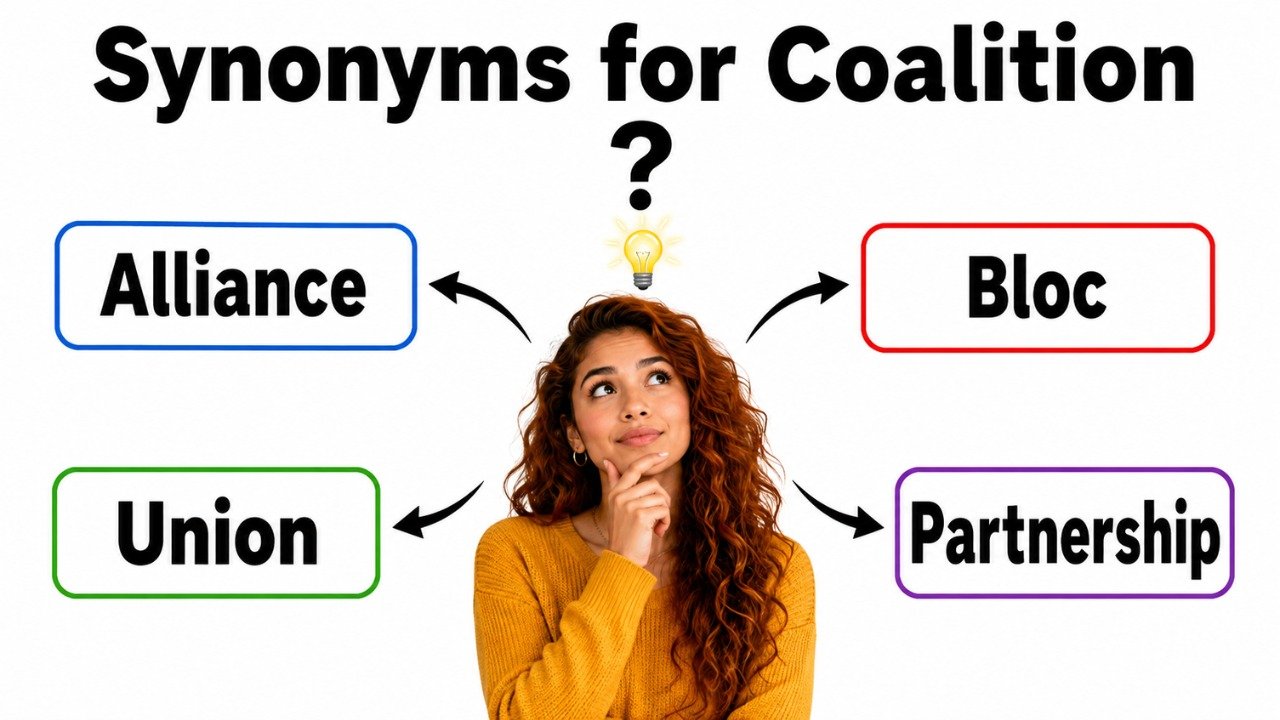
Quick Answer: The best synonyms for coalition include alliance, union, partnership, bloc, federation, consortium, league, association, united front, and pact. Use alliance for formal political or international cooperation, partnership for business or practical teamwork, and bloc for a group acting together in politics or trade. Federation suits organized groups with shared authority, while consortium is best for businesses or institutions. Use united front when separate groups publicly support one cause and pact when the focus is an agreement rather than the group itself.
Pronunciation and Word Details
Word: Coalition.
Pronunciation: /ˌkoʊ.əˈlɪʃ.ən/
Part of Speech: Noun.
Meaning: A group formed by different people, organizations, or political parties that agree to work together for a shared purpose.
US Pronunciation:
UK Pronunciation:
What Does “Coalition” Mean?
A coalition is a group of separate people, political parties, nations, or organizations that temporarily or permanently work together toward a common goal.
Coalition is a countable noun. Its plural form is coalitions. The word commonly describes political cooperation, military coordination, public campaigns, business projects, and community action.
In politics, a coalition may be formed when one political party does not have enough support to govern alone. Two or more parties may then combine their influence and create a coalition government.
In international affairs, countries may form a coalition to address a security threat, provide aid, support peace, or coordinate military action.
In community settings, charities, local groups, professionals, and residents may create a coalition to solve a shared problem.
Political Context: Several parties formed a coalition to establish a stable government.
International Context: The countries created a coalition to coordinate humanitarian assistance.
Community Context: Local organizations joined a coalition to improve public safety.
Business Context: The companies formed a coalition to promote common industry standards.
Meaning, Tone, and Context of “Coalition”
Coalition has a formal and generally neutral tone. It is common in political reporting, government documents, academic writing, international relations, business communication, and public policy discussions.
The word usually suggests cooperation between groups that remain separate but agree to act together. Members of a coalition do not necessarily become one permanent organization.
Coalition may carry a positive meaning when it represents cooperation, unity, and shared responsibility. However, it can also have a neutral or critical tone when members disagree, compete for influence, or form an alliance only for political advantage.
Formal Tone: The word is suitable for reports, essays, policy documents, and professional communication.
Political Tone: It often refers to parties joining together to govern or support legislation.
Strategic Tone: It may describe groups combining their influence to achieve a specific result.
Temporary Context: Some coalitions exist only until a particular goal has been achieved.
Long Term Context: Other coalitions continue working together across several campaigns or projects.
Positive Context: The coalition brought community leaders together to address homelessness.
Critical Context: The coalition began to weaken because its members could not agree on spending priorities.
When and How to Use “Coalition”
For Political Cooperation
Use coalition when different political parties agree to govern, campaign, or vote together.
Example: Three political parties formed a coalition after the election.
For Government Formation
Use coalition when no single party has enough seats or support to form a government independently.
Example: The parties negotiated for several days before announcing a coalition government.
For International Action
Use coalition when several countries coordinate diplomatic, humanitarian, economic, or military efforts.
Example: A coalition of nations agreed to deliver emergency supplies to the affected region.
For Community Action
Use coalition when local organizations and individuals work together to solve a social or public problem.
Example: The neighborhood coalition launched a campaign to improve road safety.
For Advocacy
Use coalition when groups support the same law, reform, cause, or public policy.
Example: A coalition of educators and parents called for greater investment in schools.
For Business Cooperation
Use coalition when independent companies cooperate to protect shared interests or achieve an industry goal.
Example: The business coalition developed new standards for responsible production.
For Public Health
Use coalition when professionals, institutions, and community groups coordinate awareness or prevention efforts.
Example: The health coalition organized free educational workshops across the city.
For Temporary Unity
Use coalition when groups with different beliefs cooperate for one limited purpose.
Example: The rival organizations created a coalition to oppose the proposed development.
Best Synonyms for Coalition
Alliance
Alliance: A relationship in which separate groups agree to support one another.
Example: The two parties formed an alliance before the national election.
Alliance is the strongest general synonym for coalition, especially in political, military, and international contexts.
Union
Union: A combination of people, groups, or regions joined by a shared purpose.
Example: The organizations created a union to defend their common interests.
Union often suggests a closer or more permanent connection than coalition.
Partnership
Partnership: A cooperative relationship between people or organizations.
Example: The project succeeded because of a strong partnership between local agencies.
Partnership works well in business, community, educational, and professional settings.
Bloc
Bloc: A group of countries, parties, or representatives that act together.
Example: The regional bloc supported the new trade agreement.
Bloc is common in political, economic, parliamentary, and international writing.
Federation
Federation: An organized union of groups that retain some independence.
Example: Several local associations joined a national federation.
Federation usually describes a structured and lasting organization.
Consortium
Consortium: A group of businesses or institutions cooperating on a major project.
Example: A consortium of universities funded the research program.
Consortium is especially suitable for business, education, finance, research, and construction.
League
League: A group of people, organizations, or countries united for mutual support.
Example: The nations created a league to encourage regional cooperation.
League can describe political, commercial, civic, or international cooperation.
Association
Association: An organized group formed around a shared profession, activity, or interest.
Example: The association represents independent business owners.
Association is often more permanent and formally organized than a coalition.
United Front
United Front: A public display of cooperation by groups that may otherwise disagree.
Example: Community leaders presented a united front against the proposed cuts.
United front emphasizes visible unity in response to a challenge.
Pact
Pact: A formal agreement between groups, parties, or nations.
Example: The parties signed a pact to support the reform plan.
Pact refers mainly to the agreement that creates cooperation, while coalition refers to the cooperating group.
50 Synonyms for Coalition with Short Meanings
- Alliance: A relationship formed for mutual support.
- Union: A group joined by a shared purpose.
- Partnership: A cooperative relationship between separate parties.
- Bloc: A group that acts or votes together.
- Federation: An organized union whose members retain some independence.
- Confederation: A union of groups connected for common action.
- Consortium: A group of institutions or businesses working together.
- League: An association created for mutual support.
- Association: An organized group with a common interest.
- United Front: Groups showing public unity for one purpose.
- Pact: A formal agreement to cooperate.
- Accord: An official agreement between parties or nations.
- Compact: A formal promise or agreement between groups.
- Affiliation: A connection between organizations or groups.
- Alignment: Cooperation based on similar goals or positions.
- Collaboration: The act of working together on a shared task.
- Cooperation: Joint effort toward a common result.
- Combination: Separate groups brought together for one purpose.
- Combine: A group of organizations joined for commercial or strategic action.
- Grouping: A collection of people or organizations placed together.
- Network: A connected group that shares information or support.
- Caucus: A political group organized around common interests.
- Camp: A group supporting the same position or leader.
- Merger: The joining of separate organizations into one body.
- Amalgamation: The process of combining groups into a larger whole.
- Joint Venture: A shared project managed by separate organizations.
- Collective: A group acting together for mutual benefit.
- Confederacy: A league of groups or regions working together.
- Entente: A friendly understanding between countries or political powers.
- Common Front: Groups cooperating openly against a shared challenge.
- Political Alliance: Parties cooperating for political influence or power.
- Governing Alliance: Parties working together to run a government.
- Electoral Alliance: Parties cooperating during an election.
- Parliamentary Alliance: Representatives or parties voting together in parliament.
- Military Alliance: Countries coordinating their defense or military actions.
- Defense Alliance: Nations promising mutual security support.
- Trade Alliance: Countries or businesses cooperating on trade interests.
- Civic Alliance: Community groups working together on public issues.
- Advocacy Alliance: Organizations supporting the same cause or reform.
- Business Consortium: Companies cooperating on a commercial project.
- Partnership Network: Connected organizations sharing resources and responsibilities.
- Umbrella Group: A broad organization representing several smaller groups.
- Working Group: People or organizations assigned to address a shared issue.
- Task Force: A temporary group formed to complete a specific task.
- Joint Campaign: A coordinated effort by separate groups.
- Cooperative Group: Members working together for shared benefits.
- United Body: Separate members acting together as one group.
- Combined Force: Groups joining their strength or influence.
- Governing Partnership: Parties sharing responsibility for government.
- Power Sharing Alliance: Groups agreeing to divide authority or leadership.
Read Also:
Synonyms for Fearless

Synonyms for Coalition by Context
When Coalition Means a Political Alliance
Alliance, bloc, caucus, camp, governing partnership, political alliance, and parliamentary alliance are useful when discussing political cooperation.
Alliance: Best for a general agreement between political parties.
Example: The smaller parties created an alliance before the election.
Bloc: Best for representatives or countries that regularly vote or act together.
Example: The reform bloc supported the proposed legislation.
Caucus: Best for a political group organized around a particular interest or policy.
Example: The environmental caucus introduced a new proposal.
Governing Partnership: Best for parties sharing responsibility for running a government.
Example: The governing partnership announced its first budget.
When Coalition Means International Cooperation
Alliance, league, confederation, entente, defense alliance, and united front fit international contexts.
Alliance: Use when countries promise political, military, or diplomatic support.
Example: The neighboring countries strengthened their regional alliance.
League: Use for a formal group of nations pursuing shared goals.
Example: The league promoted peaceful cooperation between its members.
Entente: Use for a diplomatic understanding between countries.
Example: The agreement created a stronger entente between the two governments.
Defense Alliance: Use when countries cooperate mainly for security.
Example: The nations established a defense alliance to improve regional stability.
When Coalition Means Business Cooperation
Consortium, partnership, joint venture, business alliance, network, and combine work well in commercial contexts.
Consortium: Best when several businesses or institutions cooperate on a major project.
Example: The construction consortium submitted a proposal for the new railway.
Partnership: Best for direct and practical cooperation between organizations.
Example: The partnership allowed both companies to enter new markets.
Joint Venture: Best when separate businesses jointly own or manage a project.
Example: The companies created a joint venture to develop the technology.
Network: Best when organizations remain independent but exchange resources or information.
Example: The supplier network helped smaller businesses reduce costs.
When Coalition Means Community Cooperation
Association, civic alliance, advocacy alliance, collective, umbrella group, and working group suit local or social action.
Civic Alliance: Best for community organizations addressing public concerns.
Example: The civic alliance proposed improvements to local transportation.
Advocacy Alliance: Best for groups supporting a shared cause or policy.
Example: The advocacy alliance called for stronger protections for children.
Umbrella Group: Best for one broad body representing several smaller organizations.
Example: The umbrella group coordinated the work of local charities.
Working Group: Best for a focused team addressing a practical issue.
Example: The working group developed recommendations for safer streets.
When Coalition Means Temporary Unity
United front, common front, task force, joint campaign, and combined force describe groups joining for a limited purpose.
United Front: Emphasizes visible unity despite internal differences.
Example: The organizations presented a united front during the negotiations.
Task Force: Refers to a temporary group formed to solve a defined problem.
Example: The agencies created a task force to investigate the incident.
Joint Campaign: Describes coordinated public action toward a shared objective.
Example: Several charities launched a joint campaign against food waste.
Combined Force: Emphasizes the strength created by joining resources.
Example: Their combined force placed greater pressure on decision makers.
When Coalition Means Formal Agreement
Pact, accord, compact, alignment, and affiliation are useful when the focus is the relationship or agreement rather than the group.
Pact: A formal promise to cooperate.
Example: The parties signed a pact before forming the government.
Accord: An official agreement that resolves differences or establishes cooperation.
Example: The nations reached an accord on regional trade.
Compact: A serious and often formal agreement between groups.
Example: The organizations entered into a compact to share resources.
Alignment: Agreement in goals, values, or policies.
Example: Their policy alignment made cooperation easier.
Another Word for Coalition
Alliance is usually the best single replacement for coalition. Both words describe separate groups working together for a common purpose.
However, the best alternative depends on the context. Use bloc for political voting groups, consortium for businesses or institutions, partnership for practical cooperation, and united front for public unity.
Original: The parties formed a coalition to contest the election.
Better Option: The parties formed an alliance to contest the election.
Original: Several universities created a coalition to fund the research.
Better Option: Several universities created a consortium to fund the research.
Original: Local charities joined a coalition to support families.
Better Option: Local charities formed a partnership to support families.
Original: The organizations created a coalition against the proposed rule.
Better Option: The organizations presented a united front against the proposed rule.
When Not to Use “Coalition”
Coalition is not always the most accurate word. It may sound too formal for ordinary teamwork, too temporary for a permanent organization, or too broad when the sentence refers only to an agreement.
When Referring to a Small Team
Use team or group when a few people are working together inside one organization.
Weak: A coalition of four employees prepared the presentation.
Better: A team of four employees prepared the presentation.
When Referring to a Permanent Organization
Use association, federation, or union when the members belong to a stable and formally structured body.
Weak: The national coalition has represented engineers for more than eighty years.
Better: The national association has represented engineers for more than eighty years.
When Referring to a Business Project
Use consortium or joint venture when companies cooperate on a specific commercial project.
Weak: Three companies created a coalition to build the airport.
Better: Three companies created a consortium to build the airport.
When Referring Only to an Agreement
Use pact, accord, or compact if the sentence focuses on the agreement rather than the members.
Weak: The countries signed a coalition on border security.
Better: The countries signed a pact on border security.
When Referring to a Complete Organizational Combination
Use merger or amalgamation when separate organizations become one organization.
Weak: The coalition of the two banks created a single company.
Better: The merger of the two banks created a single company.
When Referring to Informal Support
Use supporters, camp, or group when the relationship is casual and not officially organized.
Weak: A coalition of friends helped her organize the event.
Better: A group of friends helped her organize the event.
Words Commonly Confused With Coalition
Coalition vs Alliance: A coalition is often formed for a specific or temporary purpose. An alliance can be broader, stronger, and more lasting.
Coalition vs Union: A coalition allows members to remain separate. A union often suggests a closer and more permanent connection.
Coalition vs Federation: A coalition may operate informally, while a federation usually has an established structure, rules, and shared authority.
Coalition vs Partnership: A coalition often includes several groups, while a partnership commonly involves two or a small number of parties working closely together.
Coalition vs Bloc: A coalition describes the cooperating group generally. A bloc often refers to members that vote, trade, or act together as one unit.
Coalition vs Consortium: A coalition may be political, military, social, or commercial. A consortium is usually formed by businesses, universities, banks, or institutions.
Coalition vs Pact: A coalition is the group that cooperates. A pact is the agreement that establishes or guides that cooperation.
Coalition vs Merger: Coalition members remain separate organizations. A merger combines separate organizations into one organization.
Coalition vs Caucus: A coalition can include separate parties or organizations. A caucus is usually a political group operating within a party, legislature, or larger institution.
Which Synonym Should You Choose?
Choose alliance for formal political, international, diplomatic, or military cooperation.
Choose partnership for business projects, professional cooperation, community programs, and practical teamwork.
Choose bloc for countries, political parties, or representatives that vote or act together.
Choose federation when independent groups belong to a permanent and formally structured organization.
Choose consortium when companies, universities, banks, or institutions cooperate on a large project.
Choose united front when groups publicly show unity despite having different views.
Choose union when the relationship is close, organized, and intended to last.
Choose association when members share a profession, activity, interest, or industry.
Choose pact when the sentence focuses on a formal promise or agreement.
Choose accord when the parties have reached an official understanding after negotiation.
Choose task force when the group is temporary and has been created to solve one defined problem.
Choose working group when people or organizations are studying an issue or preparing recommendations.
Choose caucus when describing a political group organized around a particular concern or policy.
Choose coalition in reports and essays when several independent parties are coordinating action without becoming one organization.
Choose group or team in casual conversation when coalition would sound unnecessarily formal.
Real Life Examples of “Coalition” in Sentences
Original: The political parties formed a coalition after the election.
Better Option: The political parties formed a governing alliance after the election.
Original: A coalition of local charities opened a new support center.
Better Option: A partnership of local charities opened a new support center.
Original: The countries created a coalition to protect regional security.
Better Option: The countries created a defense alliance to protect regional security.
Original: Several universities joined a coalition to conduct the study.
Better Option: Several universities joined a consortium to conduct the study.
Original: The coalition voted against the proposed law.
Better Option: The political bloc voted against the proposed law.
Original: Community leaders formed a coalition to improve public transport.
Better Option: Community leaders formed a civic alliance to improve public transport.
Original: The organizations built a coalition around environmental reform.
Better Option: The organizations built an advocacy alliance around environmental reform.
Original: The agencies created a coalition to respond to the emergency.
Better Option: The agencies created a task force to respond to the emergency.
Original: The coalition presented its demands to government officials.
Better Option: The united front presented its demands to government officials.
Original: The businesses formed a coalition to develop common safety standards.
Better Option: The businesses formed an association to develop common safety standards.
Synonym Groups and Usage Differences
Political Cooperation Group
Alliance, bloc, caucus, camp, governing partnership, and electoral alliance belong to this group.
Alliance is the broadest choice. Bloc emphasizes members acting or voting together. Caucus describes a political group with a shared interest. Camp is more informal and often refers to supporters of one leader or position.
Example: The reform bloc supported the proposal, while the opposing camp requested further debate.
International Cooperation Group
Alliance, league, entente, confederation, defense alliance, and common front describe cooperation between countries or regions.
Alliance is suitable for general cooperation. Entente emphasizes diplomatic understanding. Defense alliance focuses on security. League and confederation suggest a more organized group of members.
Example: The countries strengthened their alliance through a new defense agreement.
Business Cooperation Group
Consortium, partnership, joint venture, network, combine, and business alliance fit commercial or institutional contexts.
Consortium is ideal for a large shared project. Partnership suggests direct cooperation. Joint venture describes shared ownership of a project or business operation. Network emphasizes connections and information exchange.
Example: The research consortium brought several universities and technology firms together.
Community Action Group
Civic alliance, advocacy alliance, association, collective, umbrella group, and working group describe organized public or social cooperation.
Civic alliance suits local public issues. Advocacy alliance focuses on policy change. Collective often emphasizes shared responsibility. Umbrella group represents several smaller organizations.
Example: The civic alliance gathered residents, teachers, and business owners to discuss road safety.
Temporary Action Group
Task force, joint campaign, united front, common front, and combined force describe short term cooperation.
Task force is created to solve a specific issue. Joint campaign focuses on coordinated public action. United front emphasizes visible solidarity.
Example: The agencies formed a task force to manage the emergency response.
Formal Agreement Group
Pact, accord, compact, affiliation, and alignment describe agreements or relationships that support cooperation.
Pact is a serious promise. Accord is an official understanding. Compact is a formal agreement. Alignment refers to similar goals or positions.
Example: The two parties signed a pact that established the terms of their cooperation.
Organizational Unity Group
Union, federation, confederation, merger, and amalgamation describe stronger forms of combination.
Union and federation usually suggest lasting structures. Confederation allows members to retain substantial independence. Merger and amalgamation involve creating one combined organization.
Example: The local associations joined a federation but continued managing their own activities.
Antonyms of Coalition
The opposite of coalition depends on whether the word refers to unity, cooperation, political partnership, or shared action.
Division: Separation caused by disagreement.
Disunity: A lack of agreement or cooperation.
Separation: The act of moving or remaining apart.
Fragmentation: The breaking of a group into smaller parts.
Split: A division within a group or organization.
Rivalry: Competition between opposing individuals or groups.
Opposition: Organized resistance to another group or proposal.
Conflict: Serious disagreement or struggle.
Isolation: The state of remaining separate from others.
Independence: Acting without support or control from another group.
Disagreement: A difference of opinion that prevents unity.
Dissolution: The formal ending of a partnership or organization.
Withdrawal: The act of leaving an agreement or cooperative group.
Defection: The act of abandoning one group to join another.
Hostility: Unfriendly or aggressive opposition.
Comparison: Coalition vs Related Words
Coalition vs Alliance
A coalition is commonly formed to achieve a specific political, social, military, or strategic purpose. An alliance may be broader and can continue for a longer period.
Example With Coalition: Several parties formed a coalition to pass the budget.
Example With Alliance: The two countries maintained a security alliance for decades.
Coalition vs Union
A coalition joins separate groups for coordinated action. A union often creates a closer, more permanent organization.
Example With Coalition: The charities formed a coalition to address poverty.
Example With Union: The regional associations created a national union.
Coalition vs Federation
A coalition may have limited rules and temporary goals. A federation usually has a constitution, leadership structure, and established membership.
Example With Coalition: Local groups created a coalition to oppose the development plan.
Example With Federation: The clubs belong to a national federation.
Coalition vs Bloc
A coalition emphasizes cooperation between separate members. A bloc emphasizes members acting, trading, or voting as one unit.
Example With Coalition: The parties formed a coalition to establish a government.
Example With Bloc: The voting bloc supported the education proposal.
Coalition vs Partnership
A coalition often contains several independent organizations. A partnership usually describes closer cooperation between two or a few parties.
Example With Coalition: A coalition of community groups organized the campaign.
Example With Partnership: The school developed a partnership with a local charity.
Coalition vs Consortium
Coalition can be used in political, social, international, or business settings. Consortium mainly refers to businesses or institutions cooperating on a major project.
Example With Coalition: The organizations formed a coalition to promote legal reform.
Example With Consortium: The banks created a consortium to finance the project.
Coalition vs Pact
Coalition names the cooperating group. Pact names the formal agreement between the members.
Example With Coalition: The coalition included five political parties.
Example With Pact: The five parties signed a pact before the election.
Coalition vs Merger
A coalition allows members to maintain their separate identities. A merger combines organizations into one legal or operational body.
Example With Coalition: The companies formed a coalition to support industry reform.
Example With Merger: The two companies completed a merger and began operating under one name.
Coalition vs Caucus
A coalition may unite separate organizations or political parties. A caucus is generally a group within a political party, legislature, or institution.
Example With Coalition: Three parties joined the coalition.
Example With Caucus: The rural caucus requested additional funding for farmers.
Common Phrases and Expressions With “Coalition”
Coalition Government: A government formed by two or more political parties.
Governing Coalition: The group of parties currently sharing political power.
Political Coalition: A group of political parties or movements cooperating for a common goal.
Broad Coalition: A group containing members from many different backgrounds or positions.
Grand Coalition: A government alliance between major political parties that usually compete against one another.
Ruling Coalition: The parties that jointly control or manage a government.
Coalition Partner: A party or organization that belongs to a coalition.
Coalition Agreement: A document explaining how coalition members will cooperate.
Coalition Talks: Negotiations about creating or maintaining a coalition.
Coalition Building: The process of bringing different groups together for a common purpose.
Military Coalition: A group of countries coordinating military action.
Coalition Forces: Military forces supplied by several cooperating countries.
Community Coalition: Local organizations and residents working together on public issues.
International Coalition: A group of nations cooperating on a global or regional matter.
Coalition Member: A person, party, nation, or organization belonging to a coalition.
Common Mistakes to Avoid
Using Coalition for Any Group
Not every group is a coalition. A coalition must contain separate parties, organizations, or groups that have chosen to cooperate.
Incorrect: The five students sitting together were a coalition.
Better: The five students sitting together were a group.
Confusing a Coalition With an Agreement
A coalition is the group created through cooperation. An agreement is the arrangement accepted by its members.
Incorrect: The parties signed a coalition.
Better: The parties signed a coalition agreement.
Confusing Coalition With Merger
Coalition members remain separate. Organizations involved in a merger become one organization.
Incorrect: The two companies completed a coalition and became one company.
Better: The two companies completed a merger and became one company.
Choosing an Overly Formal Word
Coalition may sound unnatural when describing casual or ordinary cooperation.
Unnatural: My neighbors formed a coalition to organize a picnic.
Natural: My neighbors formed a group to organize a picnic.
Repeating Coalition Too Often
Repeated use can make a paragraph sound mechanical. Replace it with alliance, partnership, bloc, group, or the members when the meaning remains clear.
Repetitive: The coalition met after the coalition approved the coalition agreement.
Better: The coalition met after its members approved the agreement.
Using a Weak Synonym
Some related words do not carry the same meaning. Team, crowd, and audience are not suitable replacements when separate organizations are cooperating strategically.
Weak: A crowd of political parties formed the government.
Better: A coalition of political parties formed the government.
Ignoring the Context
Choose a synonym that accurately reflects the type of cooperation.
Less Accurate: A union of universities funded the temporary research project.
More Accurate: A consortium of universities funded the temporary research project.
Using Coalition Without Identifying Its Members
The sentence may become vague if readers do not know who belongs to the coalition.
Vague: The coalition announced a new plan.
Clear: The coalition of local charities and health agencies announced a new plan.
Using the Wrong Preposition
Coalition is commonly followed by of when identifying its members. With and between may be used when describing relationships, but of is usually the clearest choice for group membership.
Awkward: A coalition between several charities launched the program.
Better: A coalition of several charities launched the program.
Forgetting Subject Verb Agreement
Coalition is grammatically singular when referring to one group. Coalitions is plural.
Incorrect: The coalition have announced its decision.
Correct: The coalition has announced its decision.
Correct Plural: The coalitions have announced their decisions.
Conclusion
The best synonyms for coalition include alliance, partnership, bloc, federation, consortium, league, association, and united front. Alliance is the strongest general replacement, while bloc suits political voting groups and consortium fits business or institutional projects. Partnership works well for practical cooperation, and pact is better when the focus is a formal agreement. Choosing among synonyms for coalition depends on whether the group is political, commercial, international, temporary, or permanent. The right word makes the relationship between the members clearer and more accurate.
FAQs About Synonyms for Coalition
What Is the Best Synonym for Coalition?
Alliance is the best general synonym for coalition. It works especially well for political, military, diplomatic, and strategic cooperation.
Is Alliance the Same as Coalition?
The words are similar, but not always identical. A coalition is often created for a particular goal, while an alliance may be broader and more lasting.
What Is Another Word for a Political Coalition?
Political alliance, governing alliance, bloc, caucus, electoral alliance, and governing partnership are useful alternatives.
What Is a Business Synonym for Coalition?
Consortium, partnership, joint venture, business alliance, and network are suitable business alternatives.
Can Union Be Used Instead of Coalition?
Union can replace coalition when the groups are closely connected. However, union often suggests a stronger or more permanent relationship.
What Is the Difference Between a Coalition and a Partnership?
A coalition usually includes several independent groups working toward a common goal. A partnership often involves closer cooperation between two or a small number of parties.
What Is the Opposite of Coalition?
Common opposites include division, disunity, separation, rivalry, opposition, fragmentation, and conflict.
