
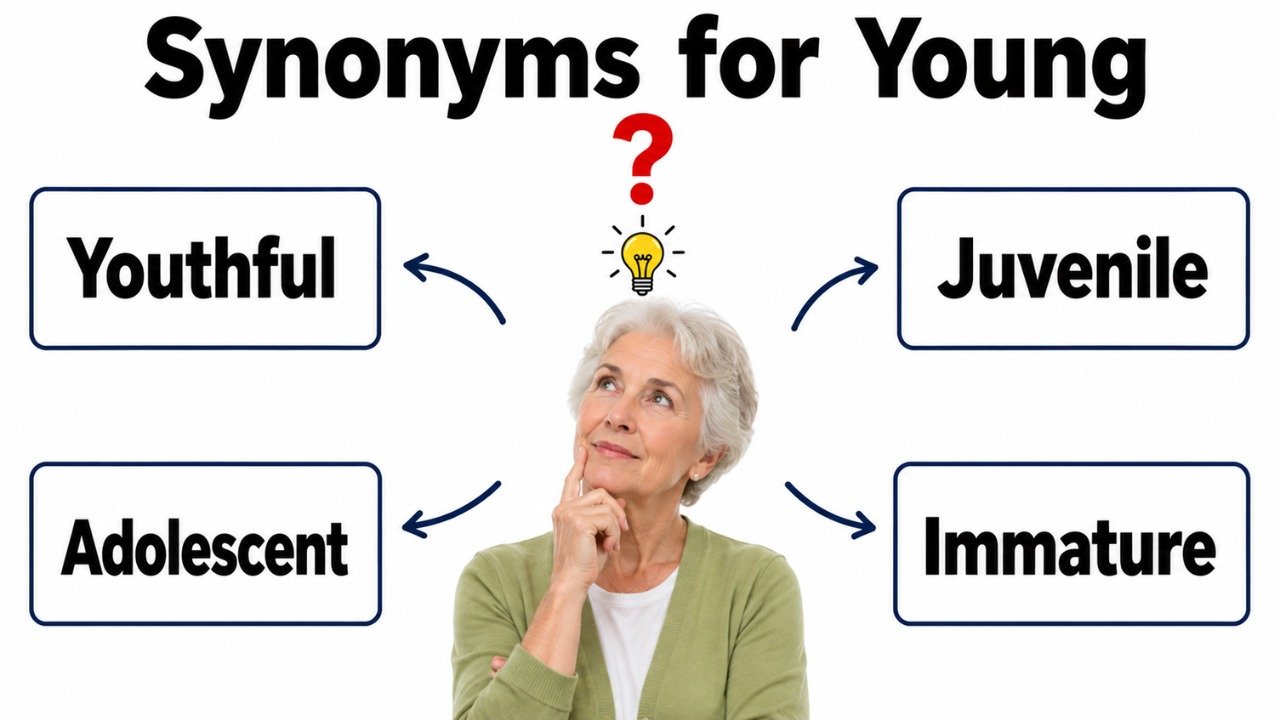
Quick Answer: The best synonyms for young include youthful, juvenile, adolescent, teenage, junior, immature, inexperienced, fledgling, fresh, and new. Use youthful for an attractive or energetic quality, adolescent for a person between childhood and adulthood, and teenage for someone aged thirteen to nineteen. Junior works for lower age or rank, while inexperienced describes limited knowledge. Fledgling suits a new person or organization, and fresh or new works best for recently created ideas, businesses, products, or experiences.
Pronunciation and Word Details
Word: Young.
Pronunciation: /jʌŋ/.
Part of Speech: Adjective and noun.
Meaning: Having lived or existed for only a short time, or being in an early stage of life, growth, or development.
US Pronunciation:
UK Pronunciation:
What Does “Young” Mean?
Young means having lived, existed, or developed for only a short period of time.
As an adjective, young commonly describes a person, animal, plant, organization, idea, or object that is at an early stage of life or development. It can also describe someone who has little experience in a role, career, or activity.
As a noun, young can refer collectively to young people or the offspring of animals.
Age Meaning: A young person is not yet old or fully mature.
Development Meaning: A young plant is still in an early stage of growth.
Experience Meaning: A young professional may have limited career experience.
Newness Meaning: A young organization has existed for only a short time.
Appearance Meaning: A person may look young even if their actual age is higher.
Energy Meaning: Young can suggest liveliness, freshness, curiosity, or enthusiasm.
The exact meaning depends on what the word describes. A young child refers to age, a young company refers to recent establishment, and a young writer may refer to age, experience, or both.
Meaning, Tone, and Context of “Young”
Young is a common, neutral, and conversational word. It appears naturally in everyday speech, formal writing, academic discussion, descriptions, reports, stories, and professional communication.
The tone of young changes according to context.
Neutral Tone: Young is usually a straightforward description of age.
Example: The young student entered the classroom.
Positive Tone: Young may suggest energy, potential, freshness, or promise.
Example: The young artist showed remarkable creativity.
Affectionate Tone: Adults may use young warmly when speaking about children or family members.
Example: Their young daughter enjoys reading.
Formal Tone: In reports, young can identify an age group, although a more exact term may sometimes be better.
Example: The program supports young adults entering employment.
Negative Tone: Young can sound dismissive when it implies that someone is incapable because of age.
Example: Calling an employee too young without considering ability may sound unfair.
Academic Tone: Academic writing often replaces young with more precise words such as adolescent, juvenile, infant, minor, or early stage.
Professional Tone: In workplace writing, inexperienced or junior may be clearer than young when discussing skill or rank.
Young is generally polite, but context matters. Describing someone as young can be complimentary when referring to appearance or energy. However, it can sound patronizing when used to question an adult’s knowledge or authority.
When and How to Use “Young”
For a Person’s Age
Use young when someone is in an early stage of life or is younger than another person.
Example: She was a young child when her family moved.
For Children and Teenagers
Use young as a broad term when an exact age group is unnecessary.
Example: The library offers activities for young readers.
For Animals
Use young when referring to animals that have not reached full maturity.
Example: The young horse stayed close to its mother.
For Plants
Use young when a plant, tree, or crop is still developing.
Example: Protect the young plants from extreme heat.
For Limited Experience
Use young when someone is at an early point in a profession, skill, or activity.
Example: He is a young researcher with several promising ideas.
For a New Organization
Use young when a company, institution, or group has existed for a short time.
Example: The young organization is still developing its procedures.
For a New Idea or Field
Use young to describe a subject, industry, or area of study that is not yet fully established.
Example: The technology is part of a relatively young field.
For Youthful Appearance
Use young when someone appears younger than expected.
Example: Her bright smile made her look young.
For Energy and Spirit
Use young when describing enthusiasm, curiosity, liveliness, or openness to new experiences.
Example: His adventurous attitude kept him feeling young.
For Family Relationships
Use young when distinguishing younger family members from older ones.
Example: Their youngest son is still in school.
Best Synonyms for Young
Youthful
Synonym: Having the appearance, energy, or qualities associated with youth.
Example: Her youthful enthusiasm encouraged the entire group.
Juvenile
Synonym: Relating to children or young people, especially in formal, legal, or scientific contexts.
Example: The center provides educational support for juvenile learners.
Adolescent
Synonym: Being in the stage between childhood and adulthood.
Example: Adolescent students often experience rapid physical and emotional development.
Teenage
Synonym: Aged between thirteen and nineteen.
Example: The program was created for teenage readers.
Junior
Synonym: Younger, lower in rank, or less experienced than another person.
Example: He joined the office as a junior assistant.
Immature
Synonym: Not fully developed physically, emotionally, or mentally.
Example: The immature fruit was not ready to eat.
Inexperienced
Synonym: Having limited knowledge or practical experience.
Example: The inexperienced driver needed more practice.
Fledgling
Synonym: New, developing, and not yet fully established.
Example: The fledgling business attracted several early customers.
Fresh
Synonym: New, recent, lively, or not previously used.
Example: The designer brought a fresh perspective to the project.
New
Synonym: Recently created, discovered, obtained, or introduced.
Example: The new organization opened its first office this year.
50 Synonyms for Young with Short Meanings
- Youthful: Having the appearance, energy, or qualities of youth.
- Juvenile: Relating to children or young people.
- Adolescent: Being between childhood and adulthood.
- Teenage: Being between thirteen and nineteen years old.
- Teenaged: Belonging to the teenage years.
- Junior: Younger or lower in rank or experience.
- Immature: Not yet fully developed.
- Inexperienced: Lacking practical knowledge or experience.
- Unseasoned: Not yet experienced or skilled.
- Green: Informally describing someone who lacks experience.
- Fledgling: New and still developing.
- Budding: Beginning to develop skill, talent, or success.
- Emerging: Starting to become known, important, or developed.
- Developing: Still growing or becoming more advanced.
- Growing: Increasing in size, maturity, or ability.
- Early: Belonging to the beginning of a period or process.
- New: Recently created, born, or introduced.
- Recent: Having happened or begun not long ago.
- Fresh: New, lively, or recently produced.
- Nascent: Beginning to exist or develop.
- Newborn: Recently born.
- Infant: A very young child or animal.
- Infantile: Relating to infancy or behaving in an immature way.
- Childlike: Having innocent or simple qualities associated with children.
- Boyish: Having an appearance or manner associated with a young boy.
- Girlish: Having an appearance or manner associated with a young girl.
- Youngish: Somewhat young or appearing fairly young.
- Underage: Too young to meet a legal age requirement.
- Minor: A person who has not reached legal adulthood.
- Preteen: A child approaching the teenage years.
- Pubescent: Reaching or experiencing physical maturity.
- School age: Old enough to attend school but still a child.
- Of tender age: Very young and still developing.
- Tender: Young, delicate, or not fully developed.
- Early stage: Existing near the beginning of development.
- Formative: Relating to an important early period of growth.
- Beginning: Existing at the start of a process.
- Newly formed: Created or organized only recently.
- Newly established: Started or founded a short time ago.
- Newly created: Produced or developed recently.
- Fresh faced: Looking healthy, innocent, and young.
- Baby faced: Having facial features that make someone appear young.
- Lively: Full of energy and activity.
- Sprightly: Energetic and active in a youthful way.
- Vigorous: Strong, healthy, and energetic.
- Energetic: Showing active and enthusiastic behavior.
- Young at heart: Having a lively and youthful attitude regardless of age.
- In one’s youth: During the earlier years of life.
- In the bloom of youth: At a healthy and attractive young age.
- Inexperienced newcomer: A person who is new to an activity or position.
Read Also:
Synonyms for Commitment

Synonyms for Young by Context
When Young Means Not Old
When young describes age in a broad and neutral way, useful alternatives include youthful, junior, juvenile, adolescent, teenage, and youngish.
Youthful: Best when describing appearance, energy, or behavior.
Example: Her youthful appearance surprised the visitors.
Junior: Best when comparing age, position, or rank.
Example: The junior members attended a separate training session.
Youngish: Best in informal conversation when someone is fairly young but not extremely young.
Example: A youngish man answered the door.
When Young Means a Child
When young refers specifically to childhood, suitable alternatives include juvenile, infant, minor, preteen, school age, and of tender age.
Juvenile: Common in formal, legal, biological, or scientific writing.
Example: The study examined juvenile development.
Infant: Best for a baby or very young child.
Example: The infant slept peacefully.
Minor: Best in legal contexts for someone below the age of adulthood.
Example: A parent must sign the form for a minor.
Preteen: Best for a child who is approaching adolescence.
Example: The book was written for preteen readers.
When Young Means Adolescent
When describing the period between childhood and adulthood, use adolescent, teenage, teenaged, or pubescent.
Adolescent: Best in formal, medical, educational, or academic contexts.
Example: Adolescent development can involve major emotional changes.
Teenage: Best when the person is between thirteen and nineteen.
Example: Teenage athletes attended the weekend event.
Pubescent: Best when discussing physical development.
Example: Pubescent children may experience rapid changes in height.
When Young Means Inexperienced
When young refers to limited experience rather than age, better choices include inexperienced, unseasoned, green, junior, fledgling, or developing.
Inexperienced: Clear and neutral in most contexts.
Example: The inexperienced employee asked for additional guidance.
Unseasoned: Suitable for someone who has not yet gained practical experience.
Example: The unseasoned speaker appeared nervous at first.
Green: An informal term for someone who is new to an activity.
Example: The new assistant was still green but eager to learn.
Junior: Best for a lower professional rank.
Example: A junior analyst prepared the first draft.
When Young Means Newly Established
When young describes a new organization, industry, movement, or system, use fledgling, emerging, nascent, newly formed, or newly established.
Fledgling: Suggests something new that needs time and support to grow.
Example: The fledgling organization depended on local volunteers.
Emerging: Suggests that something is beginning to gain attention or influence.
Example: The report examined an emerging area of research.
Nascent: A formal word for something that has only recently begun to exist.
Example: The nascent industry faced several early challenges.
Newly Established: A clear choice for a recently founded organization.
Example: The newly established school welcomed its first students.
When Young Means Early in Development
When discussing plants, animals, skills, ideas, or processes, use developing, growing, immature, budding, formative, or early stage.
Developing: Best for something actively becoming more advanced.
Example: The developing plant needs regular sunlight.
Immature: Best for something not yet fully grown or ready.
Example: The immature fruit remained firm and bitter.
Budding: Best for talent, ability, or success that is beginning to appear.
Example: The budding musician performed confidently.
Formative: Best for an early period that shapes later development.
Example: Her formative years influenced her interest in science.
When Young Means New or Recent
When young refers to something recently created or introduced, use new, fresh, recent, newly created, or beginning.
New: The simplest and most direct replacement.
Example: The new project requires careful planning.
Fresh: Suggests originality, energy, or recent creation.
Example: The writer offered a fresh interpretation.
Recent: Focuses on time rather than development.
Example: Recent research has changed the discussion.
When Young Describes Appearance
When someone looks younger than expected, use youthful, fresh faced, baby faced, boyish, or girlish.
Youthful: A positive and respectful description of appearance.
Example: His youthful appearance made him seem energetic.
Fresh Faced: Suggests a healthy, bright, and innocent appearance.
Example: The fresh faced performer greeted the audience.
Baby Faced: Describes features that make an adult look unusually young.
Example: His baby faced appearance often caused people to underestimate his age.
When Young Describes Energy or Spirit
When young refers to attitude rather than actual age, use youthful, lively, energetic, vigorous, sprightly, or young at heart.
Lively: Best for active and cheerful behavior.
Example: The lively group filled the room with conversation.
Energetic: Best when someone has a high level of physical or mental energy.
Example: The energetic instructor kept everyone involved.
Young at Heart: Best for an older person with a youthful attitude.
Example: Although retired, she remained young at heart.
Another Word for Young
Youthful is often the best general alternative for young when describing appearance, energy, or positive qualities associated with youth.
However, the best replacement depends on context. Adolescent is more precise for a person between childhood and adulthood. Inexperienced is better when the sentence refers to limited skill. New or fledgling works better for organizations, ideas, or industries.
Original: She has a young and energetic appearance.
Better Option: She has a youthful and energetic appearance.
Original: The young employee needed more training.
Better Option: The inexperienced employee needed more training.
Original: The young organization is still creating its policies.
Better Option: The fledgling organization is still creating its policies.
Original: The program supports young people between thirteen and seventeen.
Better Option: The program supports adolescent students between thirteen and seventeen.
When Not to Use “Young”
Young should not be used when a more exact word would improve clarity, respect, or accuracy.
When an Exact Age Group Matters
Young is too broad for research, medical writing, legal documents, and educational reports.
Weak: The study focused on young people.
Better: The study focused on adolescents aged fourteen to seventeen.
When Experience Is the Real Issue
A person can be young and highly skilled. Use inexperienced when limited experience is the intended meaning.
Weak: The young technician made several errors.
Better: The inexperienced technician made several errors.
When Describing a New Organization
Young may sound informal when describing a recently founded institution.
Weak: The young organization is expanding quickly.
Better: The newly established organization is expanding quickly.
When the Word Sounds Patronizing
Calling an adult young may seem dismissive when discussing authority, intelligence, or ability.
Weak: She is too young to understand the issue.
Better: She has limited experience with this particular issue.
When Legal Age Matters
Use minor or underage when the sentence involves legal permission or restrictions.
Weak: Young people cannot sign the agreement alone.
Better: Minors cannot sign the agreement without the required approval.
When Describing Emotional Behavior
Do not use young when immature is the intended meaning. Age and emotional maturity are not the same.
Weak: His young behavior annoyed the group.
Better: His immature behavior annoyed the group.
When Describing a Newly Created Idea
New, recent, emerging, or nascent may be more natural.
Weak: This is a young method of analysis.
Better: This is a relatively new method of analysis.
Words Commonly Confused With Young
Young vs Youthful: Young usually describes actual age or early development. Youthful describes appearance, energy, or qualities associated with youth. An older person can be youthful without being young.
Young vs Juvenile: Young is broad and neutral. Juvenile is more formal and often refers to children, young animals, legal classifications, or immature behavior.
Young vs Adolescent: Young can describe anyone who is not old. Adolescent specifically refers to the period between childhood and adulthood.
Young vs Teenage: Young covers many ages. Teenage refers specifically to ages thirteen through nineteen.
Young vs Immature: Young describes age or development. Immature means not fully developed and may criticize behavior, judgment, or emotional control.
Young vs Junior: Young refers mainly to age. Junior can refer to age, rank, status, education level, or professional experience.
Young vs Inexperienced: Young describes age, while inexperienced describes limited knowledge or practice. A young person may be experienced, and an older person may be inexperienced.
Young vs New: Young is most natural for living things and developing institutions. New is broader and can describe recently obtained, created, introduced, or discovered things.
Young vs Childlike: Young refers to age. Childlike describes innocent, curious, trusting, or simple qualities associated with children.
Young vs Underage: Young is general. Underage means below a legally required age for a particular activity.
Which Synonym Should You Choose?
Choose youthful when describing appearance, energy, enthusiasm, or a positive attitude.
Choose juvenile for formal, scientific, biological, or legal references to children or young animals.
Choose adolescent in academic, educational, medical, or developmental writing about the stage between childhood and adulthood.
Choose teenage when the person is specifically between thirteen and nineteen years old.
Choose junior when describing a lower rank, younger family member, or less senior employee.
Choose immature when something is not fully developed or when behavior lacks emotional maturity.
Choose inexperienced when skill, knowledge, or practice is limited.
Choose unseasoned when describing someone new to a profession or activity in formal or descriptive writing.
Choose green in casual conversation for someone who lacks experience.
Choose fledgling for a new business, organization, movement, or professional.
Choose budding when a skill, talent, interest, or career is beginning to develop.
Choose emerging when something is becoming visible, influential, or important.
Choose nascent in formal writing for an industry, idea, system, or movement that has only just begun.
Choose new for recently created objects, ideas, experiences, or organizations.
Choose fresh when emphasizing originality, liveliness, or a new perspective.
Choose minor in legal writing for someone who has not reached adulthood.
Choose underage when someone has not reached the legal age required for an activity.
Choose fresh faced or baby faced when describing someone who appears younger than their actual age.
Choose young at heart when describing an older person with youthful energy or interests.
Real Life Examples of “Young” in Sentences
Original: The young teacher was still learning how to manage the class.
Better Option: The inexperienced teacher was still learning how to manage the class.
Original: She has a young appearance for her age.
Better Option: She has a youthful appearance for her age.
Original: The young business opened only six months ago.
Better Option: The fledgling business opened only six months ago.
Original: The young boy waited outside the classroom.
Better Option: The school age boy waited outside the classroom.
Original: The young students discussed changes they were experiencing.
Better Option: The adolescent students discussed changes they were experiencing.
Original: The young actor showed great promise.
Better Option: The budding actor showed great promise.
Original: The young plant needs protection from cold weather.
Better Option: The developing plant needs protection from cold weather.
Original: This is still a young area of scientific study.
Better Option: This is still an emerging area of scientific study.
Original: He looked young because of his round facial features.
Better Option: He looked baby faced because of his round facial features.
Original: My grandfather remains young despite his age.
Better Option: My grandfather remains young at heart despite his age.
Synonym Groups and Usage Differences
Age Group
This group includes youthful, juvenile, adolescent, teenage, teenaged, youngish, and junior.
Youthful often describes appearance or energy. Juvenile is more formal. Adolescent identifies a developmental stage. Teenage gives a specific age range. Junior indicates younger age or lower rank.
Example: The adolescent participants completed a survey about school life.
Childhood Group
This group includes infant, newborn, preteen, minor, school age, and of tender age.
Infant and newborn refer to the earliest period of life. Preteen describes a child approaching adolescence. Minor is a legal term. School age refers to children old enough to attend school.
Example: The program provides free books to school age children.
Development Group
This group includes immature, developing, growing, budding, formative, and early stage.
Immature means not fully developed. Developing and growing suggest active progress. Budding usually describes emerging talent. Formative refers to an early period that shapes future growth.
Example: The budding writer submitted her first short story.
Experience Group
This group includes inexperienced, unseasoned, green, junior, fledgling, and newcomer.
Inexperienced is clear and neutral. Unseasoned is slightly more descriptive. Green is informal. Junior often refers to professional rank. Fledgling suggests early growth and potential.
Example: The junior designer worked under the guidance of a senior colleague.
Newness Group
This group includes new, fresh, recent, nascent, newly formed, newly established, and emerging.
New is the broadest option. Fresh suggests originality or energy. Recent focuses on time. Nascent is formal and refers to something just beginning. Emerging suggests increasing importance.
Example: The emerging field attracted researchers from several disciplines.
Appearance Group
This group includes youthful, fresh faced, baby faced, boyish, girlish, and youngish.
Youthful is usually positive and respectful. Fresh faced suggests health and innocence. Baby faced describes facial features that create a younger appearance. Boyish and girlish describe qualities traditionally associated with boys or girls.
Example: His youthful appearance contrasted with his extensive experience.
Energy Group
This group includes lively, energetic, vigorous, sprightly, youthful, and young at heart.
These words describe behavior, strength, movement, and attitude rather than actual age.
Example: The sprightly older man walked through the park each morning.
Antonyms of Young
The opposite of young depends on whether the word refers to age, development, experience, freshness, or establishment.
Old: Having lived or existed for a long time.
Elderly: Being in a later stage of life.
Aged: Old or having existed for many years.
Mature: Fully developed physically, mentally, or emotionally.
Adult: Fully grown or legally recognized as no longer a child.
Senior: Older or higher in rank and experience.
Experienced: Having gained knowledge through practice.
Seasoned: Highly experienced and skilled.
Veteran: A person with long experience in a field or activity.
Established: Firmly developed, recognized, or accepted.
Longstanding: Having existed for a long period.
Ancient: Extremely old or belonging to a distant past.
Fully Grown: Having reached complete physical development.
Developed: Having reached an advanced or mature stage.
Matured: Having completed or progressed through development.
Weathered: Showing the effects of age or long experience.
Comparison: Young vs Related Words
Young vs Youthful
Young usually describes actual age or early development. Youthful describes appearance, energy, behavior, or qualities associated with youth.
Example With Young: A young woman entered the office.
Example With Youthful: Her youthful energy improved the mood of the group.
Young vs Juvenile
Young is neutral and broad. Juvenile is formal and may refer to children, young animals, legal matters, or immature behavior.
Example With Young: The young fox followed its mother.
Example With Juvenile: The researchers observed juvenile foxes in the wild.
Young vs Adolescent
Young can describe babies, children, teenagers, adults, animals, or organizations. Adolescent specifically describes the developmental stage between childhood and adulthood.
Example With Young: Young people attended the community event.
Example With Adolescent: Adolescent students attended a workshop about emotional health.
Young vs Teenage
Young gives no exact age. Teenage refers to someone between thirteen and nineteen years old.
Example With Young: The young athlete won the race.
Example With Teenage: The teenage athlete competed in the regional event.
Young vs Junior
Young mainly relates to age. Junior often describes lower rank, less senior status, or a younger family member.
Example With Young: The young employee introduced herself.
Example With Junior: The junior employee reported to the department manager.
Young vs Immature
Young refers to age or early development. Immature means not fully developed and may carry a negative judgment about behavior.
Example With Young: The young child asked many questions.
Example With Immature: His immature response made the disagreement worse.
Young vs Inexperienced
Young refers to age, while inexperienced refers to limited knowledge or practice.
Example With Young: The young doctor spoke with the patient.
Example With Inexperienced: The inexperienced doctor requested advice from a colleague.
Young vs New
Young often describes living things, institutions, and developing fields. New describes anything recently created, obtained, introduced, or discovered.
Example With Young: The young tree requires additional support.
Example With New: The new computer was installed yesterday.
Young vs Fresh
Young describes age or development. Fresh often suggests newness, originality, recent production, or energy.
Example With Young: The young artist displayed her paintings.
Example With Fresh: The artist brought a fresh approach to traditional subjects.
Young vs Minor
Young is a general descriptive word. Minor is a precise legal term for someone below the age of adulthood.
Example With Young: The event attracted many young visitors.
Example With Minor: A minor must have permission to participate.
Common Phrases and Expressions With “Young”
Young Person: Someone who is in an early stage of life.
Example: The scholarship supports each young person’s educational goals.
Young Child: A child in the earlier years of childhood.
Example: A young child may need help understanding complex instructions.
Young Adult: A person who has recently entered adulthood.
Example: The novel follows a young adult beginning university.
Young People: A general collective term for children, teenagers, or younger adults.
Example: The center offers career guidance for young people.
Young Generation: People belonging to the most recent age group.
Example: The young generation often adapts quickly to change.
Young at Heart: Having youthful energy, interests, or attitudes despite being older.
Example: She remained young at heart throughout her life.
Young Talent: A young person showing strong ability or potential.
Example: The event introduced several examples of young talent.
Young Family: Parents with young children or a family in its early stages.
Example: The neighborhood is popular with young families.
Young Mind: A developing mind that is curious and open to learning.
Example: Reading can inspire a young mind.
Young Love: Romantic affection experienced at an early age.
Example: The story explores the excitement and uncertainty of young love.
Common Mistakes to Avoid
Using Young When the Exact Age Is Important
Young is vague. Use child, preteen, adolescent, teenager, young adult, or an exact age when precision matters.
Vague: The course is designed for young learners.
Better: The course is designed for learners aged ten to twelve.
Assuming Young Means Inexperienced
Age and ability are not the same. A young person may have considerable skill and knowledge.
Incorrect: She is young, so she cannot manage the project.
Better: She has limited project management experience, so additional support may help.
Using Immature as a Neutral Synonym
Immature often sounds critical when describing a person. Use adolescent, young, or developing when no criticism is intended.
Harsh: The immature students attended the event.
Better: The adolescent students attended the event.
Using Young for Every New Thing
Young sounds natural for people, animals, plants, organizations, and fields of study. New is usually better for objects, clothing, equipment, and purchases.
Unnatural: I bought a young laptop.
Better: I bought a new laptop.
Confusing Younger With More Young
The correct comparative form is younger, not more young.
Incorrect: My sister is more young than I am.
Better: My sister is younger than I am.
Confusing Youngest With Most Young
The correct superlative form is youngest.
Incorrect: He is the most young member of the group.
Better: He is the youngest member of the group.
Using The Young With a Singular Verb
The young is a collective expression referring to young people in general, so it normally takes a plural verb.
Incorrect: The young is adapting to change.
Better: The young are adapting to change.
Using Young in a Dismissive Way
Avoid suggesting that age alone makes someone incapable, careless, or uninformed.
Dismissive: You are too young to have a useful opinion.
Better: I would like to understand the experience behind your opinion.
Repeating Young Too Often
Use precise alternatives to make writing more natural.
Repetitive: The young teacher helped the young students prepare for the young writers event.
Better: The junior teacher helped the adolescent students prepare for the emerging writers event.
Confusing Childlike With Childish
Childlike is often positive and suggests innocence, wonder, or curiosity. Childish is usually negative and describes immature behavior.
Incorrect: Her childish curiosity made the lesson enjoyable.
Better: Her childlike curiosity made the lesson enjoyable.
Conclusion
The most useful synonyms for young depend on age, development, experience, appearance, and newness. Youthful is ideal for energy or appearance, while adolescent and teenage describe specific life stages. Inexperienced, unseasoned, and junior suit limited professional experience. Fledgling, emerging, and nascent work well for new organizations or fields. Fresh and new describe recent ideas or creations. Choosing the right alternative makes descriptions clearer, more respectful, and more precise.
FAQs About Synonyms for Young
What Is the Best Synonym for Young?
Youthful is the best general synonym when describing appearance, energy, or qualities associated with youth. A more precise word may be needed for age or development.
What Is a Formal Synonym for Young?
Juvenile, adolescent, nascent, and junior are formal alternatives. The correct choice depends on whether the subject is a person, organization, animal, or developing idea.
What Is Another Word for a Young Person?
Youth, adolescent, teenager, minor, junior, or young adult may work. The best term depends on the person’s age and the context.
What Is a Positive Word for Young?
Youthful is usually positive because it suggests energy, freshness, health, enthusiasm, or an attractive appearance.
What Is a Synonym for Young and Inexperienced?
Inexperienced, unseasoned, green, junior, fledgling, and newcomer are suitable choices. Green is informal, while inexperienced is neutral.
Can New Replace Young?
New can replace young when describing an organization, field, idea, or system that began recently. It does not normally replace young when describing a person’s age.
What Is the Opposite of Young?
Common opposites include old, elderly, aged, mature, adult, senior, experienced, seasoned, and established. The best antonym depends on the intended meaning.
