
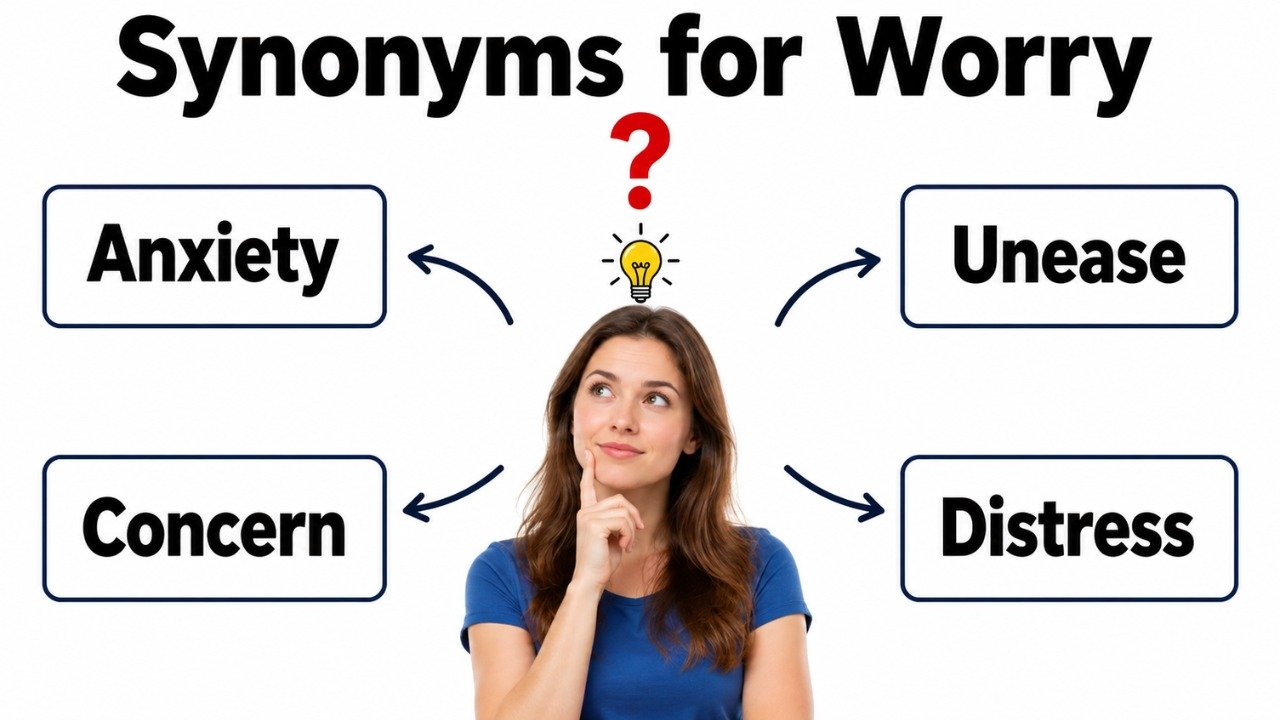
Quick Answer: The best synonyms for worry include concern, anxiety, unease, apprehension, nervousness, stress, dread, distress, fret, and brood. Use concern in formal, professional, or polite writing. Anxiety describes stronger or continuing emotional unease, while apprehension fits uncertainty about a future event. Stress refers to mental pressure, and dread expresses intense fear about what may happen. In casual conversation, fret means to worry repeatedly, while brood suggests thinking about a problem for a long time.
Pronunciation and Word Details
Word: Worry.
Pronunciation: /ˈwɜːri/
Part of Speech: Noun and verb.
Meaning: To feel troubled, nervous, or concerned about a real or possible problem.
US Pronunciation:
UK Pronunciation:
What Does “Worry” Mean?
Worry means feeling troubled or uneasy because something bad, difficult, or uncertain may happen. It can describe a feeling, a repeated thought, or the action of thinking anxiously about a problem.
As a noun, worry refers to the concern or anxiety itself.
Example: Money was her greatest worry during the move.
As a verb, worry means to think repeatedly about a problem or possible negative result.
Example: He tends to worry about small mistakes.
The word can also describe something that causes concern.
Example: The rising cost is a worry for many families.
In another verbal use, worry can mean to disturb, trouble, or make someone anxious.
Example: The unexplained delay worried the passengers.
Worry may refer to a mild concern, such as arriving late, or a stronger emotional state involving fear, uncertainty, and repeated negative thoughts.
Meaning, Tone, and Context of “Worry”
Worry is a common and emotionally expressive word. It is neutral enough for everyday speech but may also appear in professional, academic, and formal writing.
Conversational Tone: Worry is frequently used in ordinary conversations about family, work, money, health, travel, or future plans.
Example: Do not worry about being a few minutes late.
Emotional Tone: The word often communicates nervousness, uncertainty, or fear.
Example: Her voice showed how much worry she was carrying.
Formal Context: Worry can appear in professional communication, although concern is often more polished.
Example: The continued decline is a serious worry for the organization.
Academic Context: In essays or reports, words such as concern, anxiety, apprehension, and uncertainty may communicate a more precise meaning.
Strong Context: Worry can describe a serious emotional burden when combined with words such as constant, deep, growing, or overwhelming.
Example: Constant worry made it difficult for him to concentrate.
Polite Context: The phrase no need to worry can reassure someone without sounding overly formal.
Example: There is no need to worry because the issue has been resolved.
When and How to Use “Worry”
For Personal Concerns: Use worry when someone feels uneasy about a personal problem or possible outcome.
Example: She began to worry when her brother did not answer the phone.
For Future Uncertainty: Use worry when a person is thinking about something that may happen later.
Example: Many students worry about their final results.
For Repeated Thoughts: Use worry when someone continues thinking about the same problem.
Example: He worried about the decision throughout the night.
For Emotional Distress: Use worry when concern begins to affect a person’s mood or concentration.
Example: Financial worry prevented her from enjoying the holiday.
For Reassurance: Use worry in phrases intended to calm or comfort someone.
Example: Do not worry because everything is under control.
For Causing Concern: Use worry as a verb when a situation makes someone feel anxious.
Example: The sudden change in his behavior worried his family.
For Professional Issues: Use worry for a serious matter, although concern may sound more formal.
Example: The lack of preparation is a growing worry for the project leaders.
For Minor Problems: Use worry for ordinary concerns that are not extremely serious.
Example: Finding a parking space was our only worry.
Best Synonyms for Worry
Concern: A feeling of interest, care, or unease about a possible problem.
Example: The decline in attendance is a major concern for the school.
Anxiety: A strong or continuing feeling of nervousness and uncertainty.
Example: She experienced anxiety before speaking to the large audience.
Unease: A mild feeling that something may be wrong.
Example: The unexplained silence filled him with unease.
Apprehension: Nervousness or fear about something expected in the future.
Example: The employees felt apprehension before the important announcement.
Nervousness: An uncomfortable feeling caused by fear, excitement, or uncertainty.
Example: His nervousness disappeared once the interview began.
Stress: Mental or emotional pressure caused by difficult circumstances.
Example: The heavy workload created unnecessary stress.
Dread: Strong fear or worry about something that may happen.
Example: She felt dread as the examination date approached.
Distress: Serious emotional suffering, sadness, or worry.
Example: The missing documents caused considerable distress.
Fret: To worry repeatedly, especially about a minor or uncertain matter.
Example: There is no reason to fret over one small error.
Brood: To think unhappily about a problem for a long time.
Example: He continued to brood over the criticism for several days.
50 Synonyms for Worry with Short Meanings
- Concern: Uneasiness about a possible problem.
- Anxiety: Strong nervousness about an uncertain situation.
- Unease: A mild feeling of discomfort or concern.
- Apprehension: Fear or nervousness about the future.
- Nervousness: Emotional tension caused by uncertainty.
- Fear: An unpleasant feeling caused by expected danger.
- Distress: Serious emotional pain or worry.
- Agitation: A troubled or restless emotional state.
- Tension: Mental strain caused by pressure or uncertainty.
- Stress: Emotional or mental pressure.
- Dread: Intense fear of an expected event.
- Disquiet: A feeling of anxiety or lack of calm.
- Alarm: Sudden fear or concern about danger.
- Trepidation: Noticeable fear about something approaching.
- Restlessness: Inability to remain calm because of concern.
- Uncertainty: Lack of confidence about what will happen.
- Preoccupation: Continued attention to a troubling matter.
- Rumination: Repeated thinking about upsetting concerns.
- Overthinking: Thinking about a problem more than necessary.
- Misgiving: A feeling of doubt about a decision or situation.
- Doubt: Uncertainty about truth, success, or safety.
- Foreboding: A feeling that something bad may happen.
- Panic: Sudden and intense fear.
- Anguish: Severe emotional suffering or anxiety.
- Torment: Extreme mental or emotional pain.
- Bother: A matter that causes annoyance or concern.
- Trouble: A difficulty that creates worry or distress.
- Vexation: Annoyance mixed with concern or frustration.
- Strain: Pressure that affects mental or emotional comfort.
- Pressure: A demanding situation that causes tension.
- Upset: Emotional unhappiness caused by a problem.
- Discomfort: An uneasy or unsettled feeling.
- Insecurity: Lack of confidence or emotional safety.
- Care: Serious thought or concern about something.
- Solicitude: Attentive concern for another person’s welfare.
- Fret: To worry repeatedly about a matter.
- Agonize: To worry deeply while making a decision.
- Brood: To think unhappily about a problem.
- Dwell: To keep thinking about an upsetting matter.
- Obsess: To think about something excessively.
- Fear for: To feel concerned about someone’s safety.
- Be anxious: To feel nervous about an uncertain result.
- Feel uneasy: To experience mild concern or discomfort.
- Be concerned: To feel troubled about a situation.
- Lose sleep: To worry so much that rest becomes difficult.
- Be troubled: To feel emotionally disturbed by something.
- Stew: To worry or remain upset for a long time.
- Sweat: To worry about something in an informal context.
- Discomposure: Loss of emotional calm or control.
- Perturbation: A formal term for anxiety or disturbance.
Read Also:
Synonyms for Genuine

Synonyms for Worry by Context
When Worry Means Concern About a Problem
Concern, unease, disquiet, misgiving, and doubt describe awareness that something may be wrong. These alternatives are useful when the feeling is serious but not overwhelming.
Example With Worry: The falling sales figures are a worry for the business.
Example With Concern: The falling sales figures are a concern for the business.
Concern is usually the strongest general replacement in formal communication. Unease is better when the person senses a problem but cannot clearly identify it.
When Worry Means Anxiety About the Future
Anxiety, apprehension, nervousness, trepidation, dread, and foreboding describe feelings about events that have not happened yet.
Example With Worry: She felt worry about the upcoming operation.
Example With Apprehension: She felt apprehension about the upcoming operation.
Use nervousness for a common event such as a test, meeting, or presentation. Use dread when the expected event causes intense fear.
When Worry Means Repeated Thinking
Fret, brood, dwell, obsess, ruminate, and overthink describe repeatedly thinking about a problem.
Example With Worry: He worried about the comment all weekend.
Example With Brood: He brooded over the comment all weekend.
Fret often refers to repeated concern about a relatively small issue. Brood suggests unhappy thinking that continues for a longer period.
When Worry Means Mental Pressure
Stress, tension, strain, pressure, agitation, and distress describe the emotional effect of demanding situations.
Example With Worry: The deadline caused a great deal of worry.
Example With Stress: The deadline caused a great deal of stress.
Stress works well when a difficult responsibility creates mental pressure. Distress is stronger and suggests serious emotional suffering.
When Worry Means to Trouble Someone
Trouble, bother, disturb, upset, alarm, and agitate can replace worry when something causes concern.
Example With Worry: Her sudden silence worried me.
Example With Alarm: Her sudden silence alarmed me.
Alarm is stronger and suggests a sudden reaction. Bother is milder and often refers to a small concern or irritation.
Another Word for Worry
Concern is usually the best single replacement for worry because it works naturally in formal writing, conversation, professional communication, and descriptions of personal feelings. However, the best alternative depends on the intensity, cause, and duration of the emotion.
Original: The delay is becoming a serious worry.
Better Option: The delay is becoming a serious concern.
Original: She felt worry before the interview.
Better Option: She felt nervousness before the interview.
Original: He could not stop worrying about the decision.
Better Option: He could not stop agonizing over the decision.
Original: The approaching storm filled them with worry.
Better Option: The approaching storm filled them with dread.
When Not to Use “Worry”
Avoid worry when a more precise word can explain the type or intensity of the feeling.
In formal reports, worry may sound personal or conversational. Concern, risk, uncertainty, or apprehension may provide a clearer meaning.
Weak: Falling demand is a worry for the industry.
Better: Falling demand is a significant concern for the industry.
Do not use worry repeatedly in the same paragraph. Repetition can make the writing sound basic and emotionally unclear.
Weak: She worried about work, worried about money, and worried about the future.
Better: She felt stressed about work, concerned about money, and anxious about the future.
Avoid worry when describing intense fear. Dread, panic, terror, or anguish may communicate the strength of the emotion more accurately.
Weak: He felt worry when he heard the emergency alarm.
Better: He felt panic when he heard the emergency alarm.
Do not use worry when the real meaning is ordinary thought or planning.
Weak: We worried about which color to choose.
Better: We considered which color to choose.
Avoid using worry when a problem causes pressure rather than fear.
Weak: The long working hours created worry.
Better: The long working hours created stress.
Words Commonly Confused With Worry
Worry vs Concern: Worry usually suggests emotional uneasiness and repeated thought. Concern can express thoughtful interest or formal awareness of a problem without suggesting intense anxiety.
Worry vs Anxiety: Worry often focuses on a particular problem. Anxiety may be stronger, broader, or more persistent, even when the exact cause is unclear.
Worry vs Fear: Worry involves thoughts about a possible negative result. Fear is a direct emotional response to expected or immediate danger.
Worry vs Stress: Worry is the thought or feeling of concern. Stress is the mental or physical pressure created by demands, responsibilities, or difficult conditions.
Worry vs Apprehension: Worry may relate to present or future problems. Apprehension usually describes nervousness about something expected to happen.
Worry vs Dread: Worry can be mild or serious. Dread is stronger and refers to intense fear of an approaching situation.
Worry vs Nervousness: Worry often involves repeated thoughts about a problem. Nervousness is usually a temporary emotional reaction before an event.
Worry vs Care: Worry expresses uneasiness about a possible problem. Care can express affection, responsibility, attention, or thoughtful concern.
Which Synonym Should You Choose?
Choose concern for formal writing, professional emails, workplace discussions, and polite statements about a problem.
Choose anxiety for strong, persistent, or emotionally difficult uneasiness.
Choose unease for a mild feeling that something is wrong.
Choose apprehension when describing nervousness about a future event.
Choose nervousness for interviews, examinations, presentations, meetings, or unfamiliar situations.
Choose stress when responsibilities or pressure create mental strain.
Choose dread when someone strongly fears an approaching event.
Choose distress for serious emotional suffering caused by troubling news or circumstances.
Choose fret in casual speech when someone repeatedly worries about a relatively small matter.
Choose brood when a person thinks unhappily about a problem for a long period.
Choose misgiving when someone doubts whether a choice, plan, or action is right.
Choose foreboding when a person feels that something bad is likely to happen.
Choose alarm when troubling information causes sudden fear or concern.
Choose rumination in academic or psychological discussions about repeated thinking.
Choose overthinking in casual conversation when someone analyzes a problem more than necessary.
Real Life Examples of “Worry” in Sentences
Original: I worry about arriving late for important meetings.
Better Option: I feel anxious about arriving late for important meetings.
Original: The damaged roof is a major worry for the family.
Better Option: The damaged roof is a major concern for the family.
Original: She worried before her first day at the new job.
Better Option: She felt nervous before her first day at the new job.
Original: He worries about every small mistake he makes.
Better Option: He frets over every small mistake he makes.
Original: The unexpected message filled her with worry.
Better Option: The unexpected message filled her with unease.
Original: They worried about the approaching deadline.
Better Option: They felt stressed about the approaching deadline.
Original: I worry that the weather will ruin our plans.
Better Option: I fear that the weather will ruin our plans.
Original: The thought of speaking publicly caused him great worry.
Better Option: The thought of speaking publicly caused him great apprehension.
Original: She continued to worry about the argument.
Better Option: She continued to brood over the argument.
Original: The dark clouds made the hikers worry about the journey.
Better Option: The dark clouds made the hikers feel uneasy about the journey.
Synonym Groups and Usage Differences
Mild Concern Group
Concern, unease, misgiving, discomfort, and doubt describe mild or moderate worry. These words work well when a person is uncertain but not overwhelmed.
Example: She expressed concern about the lack of clear instructions.
Future Fear Group
Apprehension, nervousness, trepidation, dread, and foreboding refer to worry about something that may happen later.
Example: He approached the difficult conversation with apprehension.
Mental Pressure Group
Stress, tension, strain, pressure, and agitation describe the mental burden created by responsibilities or difficult circumstances.
Example: Tight deadlines placed considerable strain on the entire team.
Repeated Thinking Group
Fret, brood, dwell, obsess, ruminate, and overthink describe continuing to think about a problem.
Example: Try not to dwell on a mistake that you cannot change.
Strong Emotional Distress Group
Anguish, distress, torment, panic, and dread communicate severe emotional discomfort.
Example: The uncertainty caused considerable distress among the passengers.
Sudden Reaction Group
Alarm, agitation, upset, and perturbation describe an immediate emotional response to troubling information.
Example: The unexpected warning caused alarm throughout the building.
Formal Concern Group
Concern, apprehension, disquiet, solicitude, and perturbation are useful in formal or literary writing.
Example: The committee expressed disquiet about the proposed changes.
Casual Worry Group
Fret, stew, sweat, bother, and overthink are suitable for informal speech and relaxed writing.
Example: Do not sweat the small details before the event.
Antonyms of Worry
The opposite of worry may describe emotional calm, confidence, certainty, reassurance, or freedom from concern.
Calm: A peaceful state without nervousness.
Confidence: Belief that something will succeed or work well.
Reassurance: Information or support that removes worry.
Ease: Freedom from difficulty, tension, or concern.
Peace: A state of emotional quiet and comfort.
Composure: The ability to remain calm and controlled.
Certainty: Complete confidence about a fact or outcome.
Relief: Comfort felt when a worry disappears.
Trust: Belief in the safety, honesty, or reliability of someone or something.
Serenity: A deeply peaceful and untroubled state.
Optimism: Hopeful confidence about the future.
Security: A feeling of safety and protection.
Contentment: Quiet satisfaction without anxiety.
Assurance: Confidence that something is true or will happen.
Fearlessness: A state of being free from fear.
Comparison: Worry vs Related Words
Worry vs Concern
Worry is more emotional and often involves repeated thoughts. Concern is more neutral and can describe thoughtful attention to an issue.
Example With Worry: She worried that the project would fail.
Example With Concern: She expressed concern about the project’s progress.
Worry vs Anxiety
Worry usually relates to a specific problem or possible outcome. Anxiety can be broader, stronger, and harder to connect to one clear cause.
Example With Worry: He worried about missing the train.
Example With Anxiety: He experienced anxiety throughout the journey.
Worry vs Fear
Worry involves thoughts about what might go wrong. Fear is a stronger emotional reaction to danger or a threatening possibility.
Example With Worry: She worried that the dog might escape.
Example With Fear: She feared the aggressive dog standing near the gate.
Worry vs Stress
Worry is concerned thinking about a problem. Stress is the pressure or strain caused by demanding circumstances.
Example With Worry: He worried about completing the assignment.
Example With Stress: The heavy workload caused him significant stress.
Worry vs Apprehension
Worry can refer to present, past, or future concerns. Apprehension mainly describes nervous anticipation of a future event.
Example With Worry: She worried about the condition of the house.
Example With Apprehension: She entered the unfamiliar house with apprehension.
Worry vs Nervousness
Worry usually involves thoughts about a possible problem. Nervousness is often a temporary feeling before a particular activity.
Example With Worry: He worried about the interview result.
Example With Nervousness: He felt nervous as the interview began.
Worry vs Dread
Worry can range from mild concern to serious anxiety. Dread expresses intense fear about something expected.
Example With Worry: She worried about the long journey.
Example With Dread: She dreaded making the dangerous journey alone.
Worry vs Fret
Worry is a general term for anxious thought. Fret often suggests repeated concern about small details or matters outside one’s control.
Example With Worry: He worried about the event.
Example With Fret: He fretted over every detail of the event.
Common Phrases and Expressions With “Worry”
Worry About: To feel concerned about a person, event, or problem.
Cause for Worry: A situation that provides a genuine reason for concern.
No Need to Worry: A reassuring expression meaning that the situation is safe or manageable.
Not to Worry: An informal expression used to tell someone that a problem is not serious.
Worry Over: To spend time thinking anxiously about something.
Worry Oneself Sick: To become extremely distressed through continuous worry.
Constant Worry: Concern that continues for a long time.
Growing Worry: Concern that gradually becomes stronger.
Financial Worry: Anxiety related to money, expenses, debt, or income.
A Source of Worry: A person, matter, or situation that causes concern.
Worry Too Much: To think about possible problems more than necessary.
Without Worry: In a calm manner, without feeling concerned.
Common Mistakes to Avoid
One common mistake is repeating worry too often. Use specific alternatives to show whether the feeling is mild, temporary, repeated, or intense.
Repetitive: He worried about work and worried about money because he worried about the future.
Improved: He felt stressed about work, concerned about money, and anxious about the future.
Another mistake is using a synonym with the wrong level of intensity. Panic is much stronger than ordinary worry, while unease is usually milder.
Unnatural: She panicked about choosing a shirt.
Improved: She worried about choosing the right shirt.
Do not confuse worry with stress. Worry is usually a thought or feeling about a possible problem, while stress is pressure caused by difficult demands.
Incorrect: The workload gave her worries in her shoulders.
Correct: The workload caused stress and tension in her shoulders.
Avoid using worry when concern would sound more professional.
Less Formal: We have a worry about the accuracy of the report.
More Formal: We have a concern about the accuracy of the report.
Do not use worried when you mean interested or curious.
Incorrect: I am worried to know what happened.
Correct: I am curious to know what happened.
Remember that worry is commonly followed by about, that, or over.
Natural: She worries about her children.
Natural: He worries that the plan may fail.
Natural: They worried over the missing payment.
Avoid vague usage when the exact cause can be identified.
Vague: There is a lot of worry.
Clear: There is growing concern about the safety of the building.
Conclusion
The best synonyms for worry depend on the cause, strength, and duration of the feeling. Concern is the most flexible choice for formal and general writing. Anxiety describes stronger or continuing uneasiness, while apprehension and nervousness fit future events. Use stress for mental pressure, dread for intense fear, and distress for emotional suffering. In casual language, fret, brood, and overthink describe repeated thoughts. Understanding these synonyms for worry helps you communicate emotions with greater accuracy, variety, and clarity.
FAQs About Synonyms for Worry
What Is the Best Synonym for Worry?
Concern is the best general synonym because it works in formal writing, professional communication, and everyday conversation.
What Is a Stronger Word for Worry?
Anxiety, dread, anguish, distress, and torment are stronger alternatives. The best choice depends on how serious the feeling is.
What Is a Formal Synonym for Worry?
Concern, apprehension, disquiet, perturbation, and solicitude are formal alternatives. Concern is the most natural choice in reports and professional communication.
What Is a Casual Synonym for Worry?
Fret is a common casual synonym. Stew, sweat, and overthink can also describe worrying in informal conversation.
What Is the Difference Between Worry and Anxiety?
Worry usually focuses on a particular problem. Anxiety may be more intense, persistent, or difficult to connect to one specific cause.
Can Stress Be a Synonym for Worry?
Stress can be a close alternative when the meaning involves mental pressure. However, stress describes the strain created by demands, while worry describes concerned thoughts.
What Word Describes Worrying About the Future?
Apprehension is an excellent choice for nervousness about a future event. Trepidation, dread, anxiety, and foreboding are also useful depending on intensity.
