
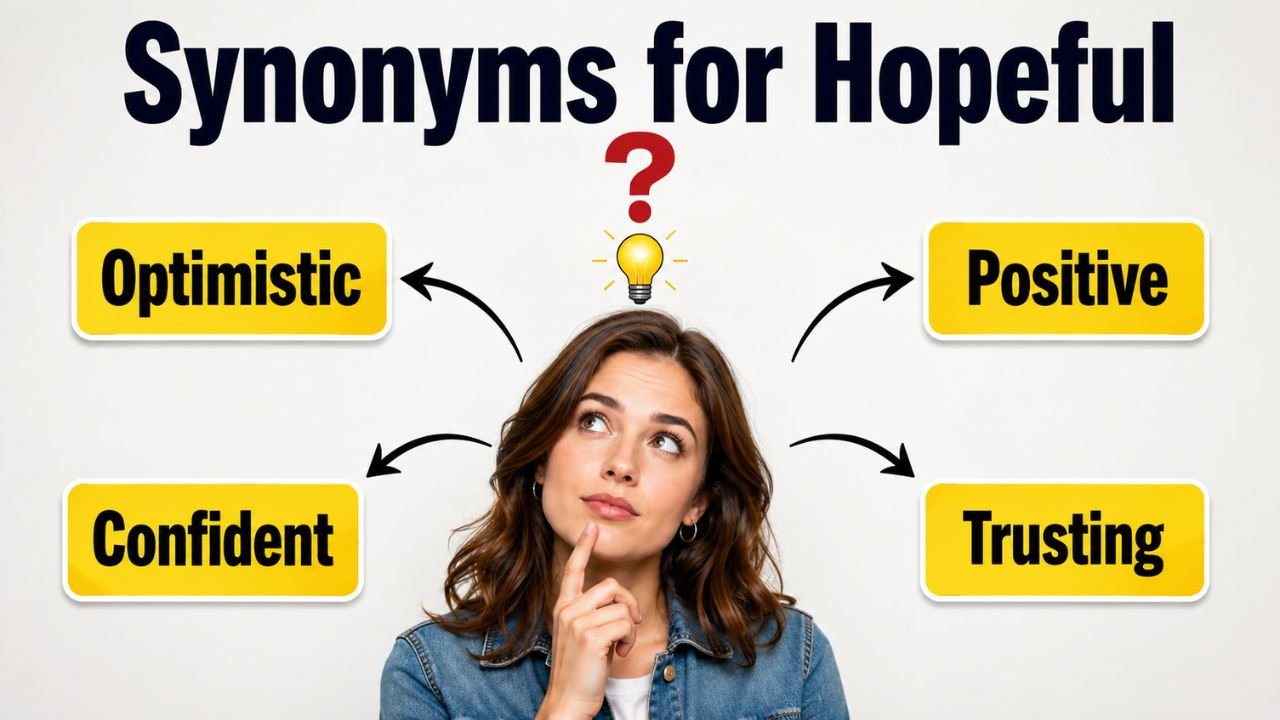
Quick Answer: The best synonyms for hopeful include optimistic, positive, encouraged, confident, expectant, sanguine, upbeat, buoyant, heartened, and reassured. Use optimistic for a general belief that things will improve, confident when success seems likely, and encouraged after receiving good news or seeing progress. Expectant suggests waiting for a desired result, while sanguine is a formal choice for essays and reports. Upbeat and positive sound natural in casual speech, while buoyant and heartened emphasize improved emotions.
Pronunciation and Word Details
Word: Hopeful.
Pronunciation: /ˈhoʊp.fəl/.
Part of Speech: Adjective and noun.
Meaning: Feeling that something good will happen or showing signs of a positive outcome.
US Pronunciation:
UK Pronunciation:
What Does “Hopeful” Mean?
Hopeful means believing, expecting, or wishing that something good will happen. As an adjective, it describes a person’s positive feelings, an encouraging situation, or a sign that suggests future success.
Example: She remained hopeful about finding a new job.
In this sentence, hopeful describes a person who believes that a positive result is possible.
Hopeful can also describe a situation, sign, development, or prediction that creates confidence about the future.
Example: The early results are hopeful.
Here, the word means that the results appear encouraging or promising.
Hopeful can also function as a noun. In this use, it describes someone who wants to achieve a particular position or become successful in a competitive field.
Example: Several young hopefuls attended the audition.
The word can express strong confidence, cautious expectation, emotional encouragement, or simple desire. Its exact meaning depends on whether it describes a person, feeling, sign, opportunity, or candidate.
Meaning, Tone, and Context of “Hopeful”
Hopeful usually has a positive, warm, and encouraging tone. It expresses belief in a desirable future without claiming that success is certain.
The word is neutral enough for both formal and casual use. It appears naturally in conversation, personal writing, professional messages, news reports, academic discussions, and emotional descriptions.
In casual speech, hopeful often describes a person’s mood or expectations.
Example: I am hopeful that everything will work out.
In formal writing, hopeful may describe an outlook, forecast, development, or possibility.
Example: The researchers remain hopeful about the long term results.
In emotional contexts, the word can suggest courage during uncertainty.
Example: Despite the difficulties, the family stayed hopeful.
In professional communication, hopeful may politely express an expected outcome.
Example: We are hopeful that the project will be completed on time.
Hopeful is less certain than confident. A hopeful person wants or expects a good result, but still recognizes that the result is uncertain.
The word may also sound cautious when used with words such as cautiously, quietly, or reasonably.
Example: The doctors are cautiously hopeful about her recovery.
When and How to Use “Hopeful”
For Positive Expectations
Use hopeful when someone believes that a future event may have a good result.
Example: He is hopeful about receiving a positive response.
For Emotional Encouragement
Use hopeful when a person feels emotionally stronger because of progress, support, or good news.
Example: The recent improvement made everyone feel hopeful.
For Uncertain Situations
Use hopeful when success is possible but not guaranteed.
Example: We are hopeful that the weather will improve before the event.
For Future Plans
Use hopeful when discussing goals, opportunities, applications, or personal ambitions.
Example: She is hopeful about starting a new career.
For Encouraging Signs
Use hopeful when a sign, result, or development suggests that conditions may improve.
Example: The first test results offer a hopeful sign.
For Formal Predictions
Use hopeful in reports, essays, and professional communication when describing a positive but uncertain outlook.
Example: The current figures provide a hopeful picture of future growth.
For Recovery and Improvement
Use hopeful when discussing healing, progress, repair, or a return to better conditions.
Example: His steady recovery has made the medical team hopeful.
For Candidates and Aspirants
Use hopeful as a noun for someone seeking success, recognition, selection, or a position.
Example: Each hopeful presented a short speech to the judges.
Best Synonyms for Hopeful
Optimistic: Expecting that future events will have a positive result.
Example: She remained optimistic despite the slow progress.
Positive: Thinking about a situation in a confident and constructive way.
Example: He has a positive attitude toward the upcoming changes.
Encouraged: Feeling more hopeful because of progress, support, or good news.
Example: The team felt encouraged by its recent improvement.
Confident: Feeling certain or strongly convinced that success is likely.
Example: She is confident that the plan will succeed.
Expectant: Waiting with hope or excitement for something to happen.
Example: The expectant crowd watched the stage closely.
Sanguine: Calmly optimistic about a difficult or uncertain situation.
Example: The director remained sanguine about the final outcome.
Upbeat: Cheerful and positive about present or future conditions.
Example: He sounded upbeat after the interview.
Buoyant: Emotionally cheerful, lively, and confident.
Example: Strong results left the team in a buoyant mood.
Heartened: Made more confident or hopeful by something encouraging.
Example: We were heartened by the generous response.
Reassured: Feeling less worried and more confident after receiving comfort or information.
Example: Her explanation left the parents reassured.
50 Synonyms for Hopeful with Short Meanings
- Optimistic: Expecting good things to happen.
- Positive: Having a constructive and favorable outlook.
- Confident: Strongly believing that success is likely.
- Encouraged: Feeling hopeful because of progress or support.
- Expectant: Waiting with hope for a future event.
- Sanguine: Calmly optimistic in an uncertain situation.
- Upbeat: Cheerful and positive about the future.
- Buoyant: Lively, cheerful, and emotionally confident.
- Heartened: Made more hopeful by good news or support.
- Reassured: Comforted and made less worried.
- Cheerful: Noticeably happy and positive.
- Enthusiastic: Showing strong interest and positive energy.
- Eager: Excited and ready for something desired.
- Inspired: Filled with motivation, hope, or purpose.
- Trusting: Willing to believe in a positive person or outcome.
- Assured: Calmly confident about a result.
- Believing: Accepting that a desired result is possible.
- Undiscouraged: Not losing hope despite difficulty.
- Resilient: Able to recover and continue with confidence.
- Determined: Strongly committed to achieving a goal.
- Motivated: Ready to act because success seems possible.
- Ambitious: Having a strong desire to achieve something.
- Aspiring: Hoping and working to reach a position or goal.
- Forward Looking: Focused on future opportunities and improvement.
- Future Focused: Thinking positively about what lies ahead.
- Full of Hope: Strongly expecting a favorable result.
- Looking Forward: Feeling pleased about a future event.
- Confident of Success: Believing that a goal will be achieved.
- Expecting the Best: Anticipating the most favorable result.
- Open to Possibility: Willing to believe improvement can happen.
- Promising: Showing signs of future success.
- Bright: Likely to be successful or favorable.
- Favorable: Supporting or suggesting a good result.
- Auspicious: Suggesting that future success is likely.
- Encouraging: Giving someone a reason to feel hopeful.
- Reassuring: Reducing worry and increasing confidence.
- Heartening: Making someone feel more hopeful or cheerful.
- Rosy: Appearing highly positive or successful.
- Propitious: Creating conditions that favor success.
- Likely: Having a good chance of happening.
- Possible: Capable of happening or being achieved.
- Potential: Able to develop into something successful.
- Prospective: Expected or likely to happen in the future.
- Contender: A person with a realistic chance of success.
- Candidate: A person seeking a position, prize, or opportunity.
- Aspirant: Someone who hopes to achieve a particular status.
- Prospect: A person or possibility with future potential.
- Well Placed: In a favorable position to succeed.
- In With a Chance: Having a reasonable possibility of success.
- Likely to Succeed: Showing a strong possibility of achieving a goal.
Read Also:
Synonyms for Manipulate

Synonyms for Hopeful by Context
When Hopeful Means Optimistic
Optimistic, positive, sanguine, upbeat, and buoyant describe a person who expects favorable results.
Optimistic is the strongest general alternative. It works in formal and casual settings.
Example: She is optimistic about the future of the project.
Positive emphasizes a constructive attitude rather than a specific prediction.
Example: He remained positive throughout the difficult process.
Sanguine is more formal and often describes calm confidence during uncertainty.
Example: The analysts are sanguine about the long term outlook.
Upbeat and buoyant are more emotional. They suggest cheerful energy as well as hope.
Example: The team sounded upbeat after the productive meeting.
When Hopeful Means Encouraged
Encouraged, heartened, reassured, inspired, and buoyed describe hope that develops because of support, progress, or new information.
Encouraged is useful when someone sees signs of improvement.
Example: The students felt encouraged by their higher scores.
Heartened suggests that something has restored confidence or emotional strength.
Example: She was heartened by the messages of support.
Reassured emphasizes reduced fear or doubt.
Example: The clear explanation left us reassured.
Inspired suggests that hope has also created motivation or purpose.
Example: The volunteers felt inspired by the community’s response.
When Hopeful Means Confident
Confident, assured, trusting, believing, and certain of success describe stronger levels of expectation.
Confident is stronger than hopeful because it suggests a firmer belief in success.
Example: The athlete is confident that her preparation will produce results.
Assured suggests calm and controlled confidence.
Example: He appeared assured about the decision.
Trusting focuses on faith in a person, process, or promise.
Example: She remained trusting that the agreement would be respected.
Believing has an emotional or personal quality.
Example: They kept believing that conditions would improve.
When Hopeful Means Expecting Something Good
Expectant, eager, enthusiastic, looking forward, and expecting the best describe anticipation.
Expectant means waiting for something important or desirable.
Example: An expectant audience filled the hall.
Eager adds excitement and readiness.
Example: The children were eager to begin the trip.
Enthusiastic suggests visible energy and interest.
Example: The group was enthusiastic about the new opportunity.
Looking forward is a natural conversational alternative.
Example: We are looking forward to seeing the final result.
When Hopeful Describes a Promising Situation
Promising, encouraging, favorable, bright, auspicious, propitious, and rosy describe signs, circumstances, or possibilities rather than a person’s feelings.
Promising means showing clear potential for success.
Example: The early results are promising.
Encouraging means giving people a reason to feel hopeful.
Example: Attendance figures have been encouraging.
Auspicious and propitious are formal words for conditions that appear favorable.
Example: The negotiations began under auspicious circumstances.
Bright often describes prospects or a future that appears successful.
Example: Her career prospects look bright.
When Hopeful Describes a Candidate
Candidate, aspirant, contender, prospect, and aspiring describe someone hoping to gain a position, prize, role, or opportunity.
Candidate is the most neutral choice.
Example: Every candidate completed the interview.
Aspirant emphasizes desire and ambition.
Example: The young aspirant trained daily for the competition.
Contender suggests a realistic chance of winning.
Example: She is considered a serious contender for the award.
Prospect describes someone with future potential.
Example: The coach identified him as a promising prospect.
Another Word for Hopeful
Optimistic is usually the best single replacement for hopeful when describing a person who expects a favorable result. However, the best alternative depends on whether the sentence refers to a feeling, a prediction, an encouraging sign, or a person seeking success.
Original: She is hopeful about her interview.
Better Option: She is optimistic about her interview.
Original: The early results make us hopeful.
Better Option: The early results are encouraging.
Original: He felt hopeful after hearing the news.
Better Option: He felt reassured after hearing the news.
Original: The company has a hopeful future.
Better Option: The company has a promising future.
When Not to Use “Hopeful”
Hopeful can sound vague when a more exact word explains why someone expects a good result.
Weak: The team is hopeful after reviewing the figures.
Better: The team is encouraged by the improved figures.
Do not use hopeful when the speaker feels almost certain about the outcome. Confident may be more accurate.
Weak: She is hopeful that she can complete a task she has already mastered.
Better: She is confident that she can complete the task.
Hopeful may be less suitable when describing a situation that shows measurable potential.
Weak: The trial produced hopeful results.
Better: The trial produced promising results.
Avoid using hopeful repeatedly within the same paragraph.
Weak: We are hopeful about the plan because the hopeful results created a hopeful mood.
Better: We are optimistic about the plan because the encouraging results created a positive mood.
Hopeful can sound too formal in relaxed speech when looking forward expresses the idea more naturally.
Weak: I am hopeful about seeing you tomorrow.
Better: I am looking forward to seeing you tomorrow.
Do not use hopeful for a guaranteed result. The word includes uncertainty.
Weak: The sun will definitely rise, so we are hopeful that morning will arrive.
Better: We know that morning will arrive.
Hopeful is also less precise when the real meaning is eager or excited.
Weak: The children were hopeful to open their gifts.
Better: The children were eager to open their gifts.
Words Commonly Confused With Hopeful
Hopeful vs Optimistic: Hopeful means wanting or expecting a good result. Optimistic describes a broader tendency to expect positive outcomes.
Hopeful vs Confident: Hopeful includes uncertainty. Confident suggests a stronger belief that success will occur.
Hopeful vs Positive: Hopeful focuses on a desired future result. Positive may describe a constructive attitude, favorable statement, or beneficial condition.
Hopeful vs Expectant: Hopeful describes belief in a good outcome. Expectant emphasizes waiting and anticipation.
Hopeful vs Promising: Hopeful usually describes a person or emotional outlook. Promising usually describes a sign, result, person, or situation with future potential.
Hopeful vs Encouraged: Hopeful describes the feeling itself. Encouraged often suggests that progress, evidence, or support caused that feeling.
Hopeful vs Eager: Hopeful relates to expectation. Eager describes strong desire, interest, and readiness.
Hopeful vs Idealistic: Hopeful means believing a positive outcome is possible. Idealistic means guided by high principles or perfect expectations that may not be practical.
Hopeful vs Wishful: Hopeful can be supported by reasonable possibility. Wishful often suggests desire without enough evidence.
Which Synonym Should You Choose?
Choose optimistic for a general belief that future events will turn out well.
Choose positive when describing a constructive attitude in casual speech, workplace communication, or personal advice.
Choose encouraged when progress, evidence, or support has increased someone’s hope.
Choose confident when the chance of success seems strong and the speaker has little doubt.
Choose expectant when someone is waiting for an important event, result, or arrival.
Choose sanguine in formal essays, reports, analysis, or professional writing when describing calm optimism.
Choose upbeat when describing a cheerful tone, mood, conversation, or message.
Choose buoyant when emphasizing lively confidence and emotional energy.
Choose heartened when good news or kindness has restored someone’s hope.
Choose reassured when information or support has reduced worry.
Choose promising for results, signs, opportunities, careers, ideas, and future developments.
Choose encouraging for evidence or progress that gives people a reason to remain hopeful.
Choose bright when discussing prospects, careers, futures, or opportunities in an expressive way.
Choose auspicious or propitious in formal writing about favorable conditions or beginnings.
Choose eager when excitement and readiness are more important than expectation.
Choose aspiring when describing a person working toward a position, career, or achievement.
Choose contender when a candidate has a realistic chance of winning.
Choose looking forward in everyday conversation, friendly messages, and personal writing.
Real Life Examples of “Hopeful” in Sentences
Original: She felt hopeful after completing the final interview.
Better Option: She felt optimistic after completing the final interview.
Original: The doctors are hopeful about his recovery.
Better Option: The doctors are encouraged by his recovery.
Original: He is hopeful that his careful preparation will lead to success.
Better Option: He is confident that his careful preparation will lead to success.
Original: The early test results are hopeful.
Better Option: The early test results are promising.
Original: We remain hopeful despite the recent delay.
Better Option: We remain positive despite the recent delay.
Original: The hopeful audience waited for the announcement.
Better Option: The expectant audience waited for the announcement.
Original: Her kind words made me feel hopeful again.
Better Option: Her kind words left me feeling heartened again.
Original: The team sounded hopeful during the meeting.
Better Option: The team sounded upbeat during the meeting.
Original: He is a hopeful young musician seeking his first opportunity.
Better Option: He is an aspiring young musician seeking his first opportunity.
Original: The latest figures present a hopeful picture.
Better Option: The latest figures present an encouraging picture.
Synonym Groups and Usage Differences
Optimism Group
Optimistic, positive, sanguine, upbeat, and buoyant describe a favorable attitude toward the future. Optimistic is neutral and versatile. Sanguine is formal, while upbeat and buoyant emphasize cheerful energy.
Example: The director remained sanguine about the project despite the delay.
Encouragement Group
Encouraged, heartened, reassured, inspired, and comforted describe hope created by progress, support, or information. Encouraged often follows evidence, while reassured follows an explanation or promise.
Example: The latest improvement left the family encouraged.
Confidence Group
Confident, assured, trusting, and believing suggest different levels of faith in success. Confident is stronger than hopeful, while trusting may focus on faith in another person.
Example: She felt confident that her experience would help her succeed.
Anticipation Group
Expectant, eager, enthusiastic, and looking forward describe positive feelings about something that has not happened yet. Expectant emphasizes waiting, while eager adds strong desire and readiness.
Example: The eager students entered the classroom early.
Promising Outlook Group
Promising, bright, favorable, encouraging, auspicious, propitious, and rosy describe conditions that suggest success. Promising and encouraging are common, while auspicious and propitious are more formal.
Example: The business has a promising outlook after several months of steady growth.
Perseverance Group
Undiscouraged, resilient, determined, and motivated describe people who continue to hope and act despite difficulty. These words emphasize strength and effort rather than expectation alone.
Example: The resilient community continued rebuilding after the storm.
Aspirant Group
Aspiring, ambitious, candidate, contender, aspirant, and prospect describe people seeking success or recognition. Contender suggests a strong chance of winning, while aspirant emphasizes desire.
Example: Several aspiring writers entered the competition.
Antonyms of Hopeful
The opposite of hopeful depends on whether the word describes an emotion, an outlook, a prediction, or a promising situation.
Hopeless: Having no expectation of improvement or success.
Pessimistic: Expecting negative events or unfavorable results.
Discouraged: Having lost confidence or motivation.
Doubtful: Feeling uncertain that something will succeed.
Despairing: Experiencing a complete loss of hope.
Gloomy: Expecting an unhappy or unsuccessful future.
Negative: Focused on problems, failure, or unfavorable possibilities.
Defeated: Feeling unable to continue or succeed.
Disheartened: Having lost courage or confidence.
Dejected: Feeling deeply unhappy and disappointed.
Unpromising: Showing little possibility of success.
Unfavorable: Not supporting a positive result.
Bleak: Offering little hope for improvement.
Uncertain: Not clearly likely to succeed.
Dismal: Very discouraging or lacking positive possibilities.
Comparison: Hopeful vs Related Words
Hopeful vs Optimistic
Hopeful describes a desire or expectation that a particular result will be good. Optimistic may describe a person’s general habit of expecting positive outcomes.
Example With Hopeful: She is hopeful that the application will be accepted.
Example With Optimistic: She is optimistic about her future career.
Hopeful vs Confident
Hopeful allows room for doubt. Confident expresses a stronger belief that success is likely.
Example With Hopeful: He is hopeful that he performed well in the interview.
Example With Confident: He is confident that his experience impressed the interviewers.
Hopeful vs Encouraged
Hopeful names a positive expectation. Encouraged suggests that something specific has created or increased that expectation.
Example With Hopeful: We are hopeful about the final result.
Example With Encouraged: We are encouraged by the steady progress.
Hopeful vs Promising
Hopeful often describes a person’s feeling. Promising usually describes a person, result, sign, plan, or situation that has potential.
Example With Hopeful: The students are hopeful about their results.
Example With Promising: The students produced promising early results.
Hopeful vs Expectant
Hopeful emphasizes belief in a favorable outcome. Expectant emphasizes waiting for something that is about to happen.
Example With Hopeful: The family is hopeful that good news will arrive.
Example With Expectant: The expectant family waited beside the telephone.
Hopeful vs Positive
Hopeful focuses on the future. Positive can describe an attitude, statement, result, quality, or condition.
Example With Hopeful: She feels hopeful about the coming year.
Example With Positive: She maintains a positive attitude during difficult periods.
Hopeful vs Eager
Hopeful means expecting or wanting a good result. Eager means strongly wanting to do or experience something.
Example With Hopeful: He is hopeful that he will receive an invitation.
Example With Eager: He is eager to attend the event.
Hopeful vs Sanguine
Hopeful is common in everyday and formal language. Sanguine is a more formal term for remaining calmly optimistic during uncertainty.
Example With Hopeful: The manager is hopeful about the next quarter.
Example With Sanguine: The manager remains sanguine despite the temporary decline.
Common Phrases and Expressions With Hopeful
Remain Hopeful: Continue expecting a positive outcome despite uncertainty.
Feel Hopeful: Experience confidence or optimism about the future.
Cautiously Hopeful: Feel positive while recognizing possible difficulties.
Quietly Hopeful: Feel hopeful without showing strong excitement.
Increasingly Hopeful: Become more optimistic as conditions improve.
Hopeful Outlook: A positive view of future events.
Hopeful Sign: Evidence that suggests improvement or success.
Hopeful Future: A future that appears promising or positive.
Hopeful Candidate: A person seeking a role, position, or opportunity.
Hopeful About the Outcome: Expecting that a result may be favorable.
Common Mistakes to Avoid
One common mistake is treating hopeful and confident as exact synonyms. Hopeful includes uncertainty, while confident expresses stronger belief.
Less Accurate: She is hopeful that two plus two equals four.
Improved: She is certain that two plus two equals four.
Another mistake is using hopeful to describe a result when promising would sound more natural.
Awkward: The experiment produced hopeful findings.
Natural: The experiment produced promising findings.
Avoid confusing hopeful, an adjective or noun, with hopefully, an adverb.
Incorrect: She spoke hopeful about the future.
Correct: She spoke hopefully about the future.
Correct: She sounded hopeful about the future.
Use natural prepositions with hopeful. A person may be hopeful about a situation, hopeful for a result, or hopeful that something will happen.
Natural: We are hopeful about the new plan.
Natural: They are hopeful for a peaceful solution.
Natural: She is hopeful that conditions will improve.
Do not use hopeful when the intended meaning is excited.
Unclear: The children were hopeful to visit the park.
Clear: The children were excited to visit the park.
Avoid repeating hopeful too frequently when several more precise alternatives are available.
Repetitive: The hopeful team shared a hopeful update about the hopeful results.
Improved: The optimistic team shared an encouraging update about the promising results.
Do not use optimistic for an object, result, or sign when promising or encouraging is more accurate.
Unnatural: The test results are optimistic.
Natural: The test results are promising.
Be careful with overly strong alternatives such as certain or guaranteed. Hopeful does not mean that success is assured.
Incorrect Meaning: We are guaranteed that the plan will work.
Accurate Meaning: We are hopeful that the plan will work.
Conclusion
The best synonyms for hopeful change according to the person, feeling, sign, or situation being described. Optimistic is the strongest general alternative, while encouraged and heartened show that progress has created hope. Confident expresses greater certainty, and expectant emphasizes anticipation. For situations and results, promising, encouraging, bright, and favorable are more precise. Sanguine suits formal writing, while upbeat, positive, and looking forward sound natural in conversation. Choosing the right alternative makes writing clearer, more expressive, and better matched to the intended level of confidence.
FAQs About Synonyms for Hopeful
What Is the Best Synonym for Hopeful?
Optimistic is the best general synonym for hopeful. It describes someone who expects a positive result or believes that conditions will improve.
What Is a Formal Synonym for Hopeful?
Sanguine is a formal synonym for hopeful. Encouraged, confident, auspicious, and propitious can also suit formal writing depending on the context.
What Is a Casual Synonym for Hopeful?
Positive, upbeat, encouraged, and looking forward are natural casual alternatives. The best choice depends on whether the speaker feels optimistic, excited, or reassured.
Is Confident the Same as Hopeful?
Not exactly. Hopeful includes uncertainty, while confident suggests a stronger belief that the desired outcome will happen.
Can Promising Replace Hopeful?
Promising can replace hopeful when describing results, signs, plans, careers, or situations. It usually does not describe a person’s emotional state.
What Is the Opposite of Hopeful?
Common opposites include hopeless, pessimistic, discouraged, doubtful, gloomy, bleak, and despairing.
What Word Describes Someone Who Never Loses Hope?
Undiscouraged, resilient, determined, and optimistic can describe someone who continues to hope despite difficulty.
