
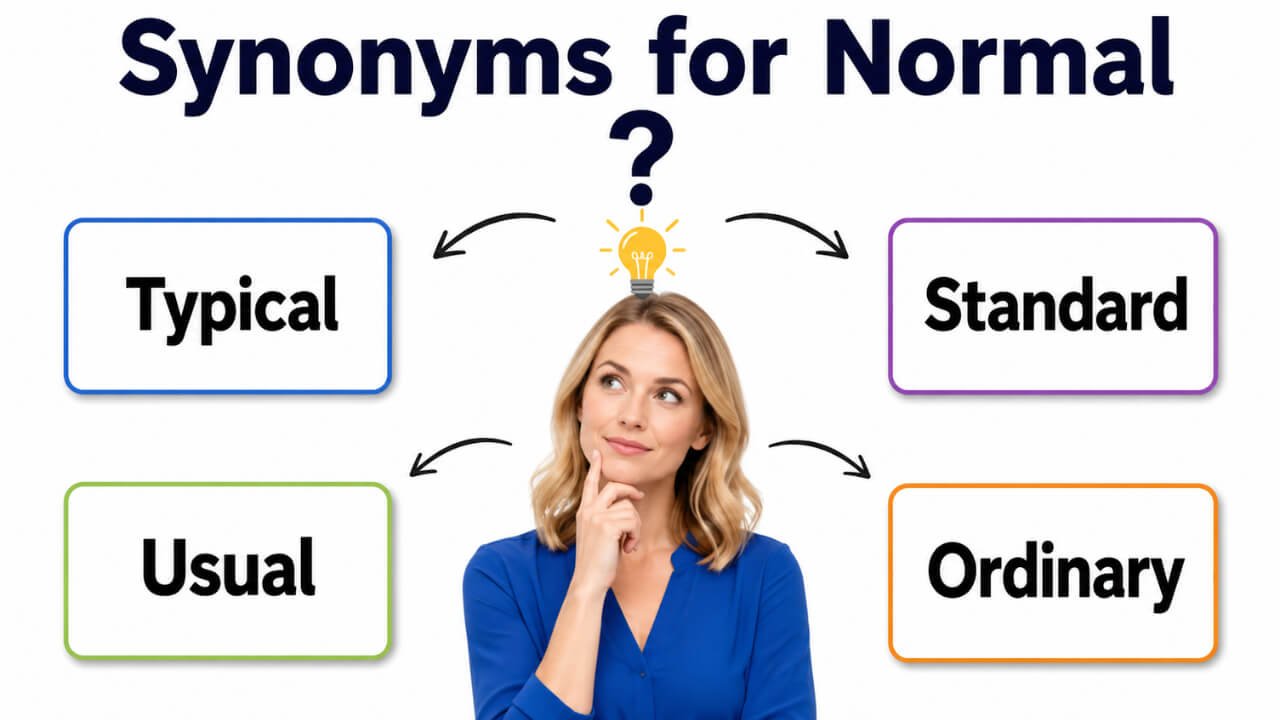
Quick Answer: Synonyms for normal include usual, typical, regular, standard, ordinary, common, average, routine, conventional, customary, and expected. Choose usual for everyday situations, typical for patterns, standard for rules or quality, regular for repeated actions, ordinary for simple descriptions, common for frequent things, average for general level, conventional for accepted behavior, and customary for traditions or habits.
Pronunciation and Word Details
Word: Normal
Pronunciation: /ˈnɔːrməl/
Part of Speech: Adjective
Meaning: Normal means usual, expected, standard, or not unusual in a particular situation.
US Pronunciation:
UK Pronunciation:
What Does “Normal” Mean?
Normal means usual, expected, or standard in a certain situation. It is most often used as an adjective to describe something that fits a common pattern, accepted rule, regular condition, or ordinary level. A normal day is not unusual. A normal result matches what is expected. A normal reaction is one that many people would understand in the same situation.
The word normal can describe behavior, routines, conditions, standards, health, feelings, data, weather, work, school, and daily life. In grammar, it usually comes before a noun, as in normal behavior, normal temperature, or normal rules. It can also appear after linking verbs, as in everything seems normal or the results look normal.
Meaning, Tone, and Context of “Normal”
Normal is a neutral and widely used word. It is not highly formal or highly casual, which makes it useful in everyday speech, school writing, reports, explanations, and professional communication. It often means something is usual, regular, or expected, without strong emotion.
In casual conversation, normal can mean ordinary or not surprising. In academic or technical writing, it may refer to a standard range, expected pattern, or accepted condition. In workplace writing, normal can describe usual procedures, standard hours, regular operations, or common expectations.
The tone of normal depends on context. It can sound helpful and clear when describing facts, but it can sound judgmental when used to describe people, identities, cultures, or personal choices. In those cases, words like typical, common, usual, expected, or standard may be more precise and respectful.
When and How to Use “Normal”
For Everyday Situations: Use normal when something is usual, regular, or not unusual in daily life.
Example: It was a normal morning at the office.
For Expected Results: Use normal when a result matches what is commonly expected.
Example: The test results are normal.
For Regular Conditions: Use normal when describing a condition that is stable or within an expected range.
Example: The machine is working at a normal speed.
For Common Behavior: Use normal when describing behavior that many people would recognize or understand.
Example: Feeling nervous before a big exam is normal.
For Standard Procedures: Use normal when something follows the usual process or accepted method.
Example: Please follow the normal application process.
For Routine Events: Use normal when an event happens in the usual way.
Example: The meeting continued at the normal time.
Best Synonyms for Normal
Usual: Means what happens most often or is commonly expected.
Example: We will meet at the usual place.
Typical: Means showing the common qualities of a person, thing, or situation.
Example: This is a typical response to stress.
Regular: Means repeated, consistent, or following a pattern.
Example: She returned to her regular schedule.
Standard: Means accepted as the usual rule, level, or model.
Example: The company follows standard safety procedures.
Ordinary: Means simple, common, or not special.
Example: It was an ordinary day with no major surprises.
Common: Means often found, seen, or experienced.
Example: Headaches are a common problem after lack of sleep.
Average: Means around the usual level, amount, or quality.
Example: The score was close to the average result.
Routine: Means part of a regular habit, process, or schedule.
Example: The doctor performed a routine checkup.
Conventional: Means based on accepted customs, habits, or traditional methods.
Example: He chose a conventional style for the formal event.
Customary: Means usual because of tradition or repeated practice.
Example: It is customary to greet guests politely.
50 Synonyms for Normal with Short Meanings
- Usual: Happening or done most often.
- Typical: Showing the expected pattern or quality.
- Regular: Happening repeatedly or consistently.
- Standard: Accepted as the usual rule or level.
- Ordinary: Common and not special or unusual.
- Common: Often seen, found, or experienced.
- Average: Near the usual level or amount.
- Routine: Done as part of a regular process.
- Conventional: Following accepted customs or methods.
- Customary: Usual because of tradition or habit.
- Expected: Likely or reasonably predicted.
- Familiar: Well known through repeated experience.
- Everyday: Common in daily life.
- Natural: Expected in the situation.
- Habitual: Done regularly as a habit.
- Established: Accepted through long use.
- Prevalent: Common in a place or group.
- Commonplace: Very ordinary or frequently seen.
- Unremarkable: Not unusual or surprising.
- Accepted: Generally approved or recognized.
- Traditional: Based on long standing customs.
- Mainstream: Commonly accepted by most people.
- Prevailing: Most common or widely accepted at a time.
- Standardized: Made to follow the same usual form.
- Normalized: Made usual, accepted, or regular.
- Ordinarily: In the usual way.
- Generally: In most cases or situations.
- Typically: In the usual or expected manner.
- Usually: Most often or under common conditions.
- Regularly: At repeated or expected times.
- Commonly: Often or by many people.
- Normally: In the usual way.
- Naturally: In a way that seems expected.
- Predictable: Happening as expected.
- Stable: Not changing in an unusual way.
- Balanced: Even, steady, or not extreme.
- Moderate: Not excessive or extreme.
- Reasonable: Fair, sensible, or within expected limits.
- Proper: Correct or suitable for the situation.
- Appropriate: Fitting the situation or need.
- Usable: Suitable for ordinary use.
- Functional: Working in the expected way.
- Sound: Healthy, safe, or reliable.
- Healthy: In good physical or general condition.
- Sane: Mentally sound or reasonable.
- Orderly: Arranged or behaving in a regular way.
- Consistent: Staying the same in pattern or quality.
- Usualness: The quality of being normal or common.
- Regularity: The state of following a steady pattern.
- Conformity: Agreement with accepted rules or patterns.
Read Also:
Synonyms for Possible

Synonyms for Normal by Context
When Normal Means Usual
When normal means what usually happens, use usual, regular, typical, or everyday. These words work well for schedules, habits, routines, and daily situations.
Example: She went back to her usual routine after the holiday.
Example: It was a typical day at school.
Example: The shop opened at its regular time.
When Normal Means Standard
When normal means accepted as a rule, level, or model, use standard, established, accepted, or conventional. These synonyms work well in business, education, instructions, and formal writing.
Example: The form must follow the standard format.
Example: These are the established rules for the exam.
Example: The team used the accepted method.
When Normal Means Ordinary
When normal means not special, strange, or unusual, use ordinary, common, everyday, commonplace, or unremarkable. These words fit simple descriptions and casual explanations.
Example: It was an ordinary weekend at home.
Example: Minor delays are common during busy hours.
Example: The event was unremarkable but well organized.
When Normal Means Healthy or Stable
When normal means physically fine, mentally steady, or working as expected, use healthy, sound, stable, balanced, or functional. These words are useful for health, systems, emotions, and machines.
Example: The patient’s breathing is stable.
Example: The device is functional again.
Example: Her response was balanced and calm.
When Normal Means Expected
When normal means not surprising, use expected, predictable, natural, or reasonable. These words work well when explaining reactions, results, or outcomes.
Example: A little confusion is natural at the start.
Example: The delay was expected because of heavy traffic.
Example: His concern was reasonable in that situation.
Another Word for Normal
Another word for normal is usual. It is the best general replacement because it fits daily routines, common habits, expected events, and ordinary situations. However, the best alternative depends on context. Use standard for rules, typical for patterns, ordinary for simple things, and healthy when normal means physically or mentally fine.
Original: It was a normal day at work.
Better Option: It was a usual day at work.
Original: The results were normal.
Better Option: The results were within the standard range.
Original: Her reaction was normal.
Better Option: Her reaction was understandable and expected.
Original: They followed the normal process.
Better Option: They followed the standard process.
When Not to Use “Normal”
Do not use normal when a more precise synonym would make the meaning clearer. Normal can sometimes sound vague because it may mean usual, healthy, standard, ordinary, expected, or acceptable. Choose the synonym that matches your exact meaning.
Weak: The report shows normal numbers.
Better: The report shows average numbers.
Weak: We used the normal method.
Better: We used the standard method.
Weak: His behavior was normal.
Better: His behavior was typical for someone under stress.
Weak: The room looked normal.
Better: The room looked ordinary and unchanged.
Avoid using normal to judge people, lifestyles, cultures, or personal choices. In sensitive contexts, use clearer and kinder words like common, typical, expected, familiar, or widely accepted.
Weak: Their family is not normal.
Better: Their family structure is different from the most common one in that area.
Words Commonly Confused With Normal
Normal vs Usual: Normal means expected or standard, while usual means what happens most often.
Normal vs Typical: Normal describes what is expected, while typical describes what represents a common pattern.
Normal vs Ordinary: Normal means not unusual, while ordinary often means plain or not special.
Normal vs Average: Normal describes expected condition or behavior, while average describes a middle level, number, or amount.
Normal vs Standard: Normal can be general, while standard is stronger for rules, measurements, quality, or official procedures.
Normal vs Common: Normal means expected or acceptable, while common means frequent or widely found.
Normal vs Healthy: Normal can mean usual, while healthy specifically means physically, mentally, or functionally well.
Which Synonym Should You Choose?
Choose usual when writing about daily routines, repeated habits, or common events.
Choose typical when describing a pattern, reaction, behavior, or example that represents a larger group.
Choose standard when writing about rules, procedures, formats, measurements, or accepted quality.
Choose ordinary when describing something simple, plain, or not special.
Choose common when something happens often or is widely experienced.
Choose average when discussing numbers, scores, levels, performance, or general amount.
Choose routine when writing about repeated tasks, checkups, schedules, or processes.
Choose conventional when describing accepted styles, manners, methods, or social behavior.
Choose customary when writing about traditions, greetings, ceremonies, or cultural habits.
Choose healthy, stable, or sound when normal means physically fine, emotionally steady, or working properly.
Real Life Examples of “Normal” in Sentences
Original: It is normal to feel tired after a long trip.
Better Option: It is common to feel tired after a long trip.
Original: We returned to our normal schedule.
Better Option: We returned to our regular schedule.
Original: The normal price is listed on the form.
Better Option: The standard price is listed on the form.
Original: Her answer was normal for that situation.
Better Option: Her answer was typical for that situation.
Original: The weather is normal for this season.
Better Option: The weather is usual for this season.
Original: He wanted a normal life after years of travel.
Better Option: He wanted an ordinary life after years of travel.
Original: The machine made a normal sound.
Better Option: The machine made a familiar sound.
Original: The results look normal.
Better Option: The results look stable.
Original: The team followed the normal steps.
Better Option: The team followed the standard steps.
Original: It was a normal response to pressure.
Better Option: It was an expected response to pressure.
Synonym Groups and Usage Differences
Usual Group
This group includes usual, regular, customary, habitual, and everyday. These words describe actions, routines, and situations that happen often.
Example: Morning tea is part of her usual routine.
Standard Group
This group includes standard, established, accepted, conventional, and standardized. These words describe rules, formats, methods, and systems.
Example: The office uses a standard approval process.
Ordinary Group
This group includes ordinary, common, commonplace, familiar, and unremarkable. These words describe things that are not rare, special, or surprising.
Example: The building had an ordinary entrance.
Expected Group
This group includes expected, predictable, natural, reasonable, and typical. These words describe results, reactions, or events that make sense in context.
Example: A short delay was expected during the repair work.
Healthy and Stable Group
This group includes healthy, stable, sound, balanced, and functional. These words describe people, systems, emotions, conditions, and machines that are working well or staying steady.
Example: The patient remained stable throughout the night.
Antonyms of Normal
Normal has different opposites depending on meaning. If normal means usual, the opposite may be unusual. If it means standard, the opposite may be irregular. If it means ordinary, the opposite may be extraordinary.
Unusual: Not common or expected.
Abnormal: Different from what is considered usual or expected.
Irregular: Not following a regular pattern or rule.
Rare: Not often found or experienced.
Atypical: Not typical or not representative of the usual pattern.
Exceptional: Unusually good, rare, or different.
Extraordinary: Very unusual or remarkable.
Strange: Odd, unfamiliar, or unexpected.
Uncommon: Not frequently seen or experienced.
Remarkable: Noticeable because it is unusual or special.
Comparison: Normal vs Related Words
Normal vs Usual
Normal means expected or standard in a situation. Usual means something happens most often.
Example With Normal: It is normal to feel nervous before an interview.
Example With Usual: She arrived at her usual time.
Normal vs Typical
Normal describes what is expected or not unusual. Typical describes a common example of a larger pattern.
Example With Normal: His reaction was normal after the surprise.
Example With Typical: His reaction was typical of a careful person.
Normal vs Ordinary
Normal means acceptable, expected, or standard. Ordinary means plain, simple, or not special.
Example With Normal: The doctor said the reading was normal.
Example With Ordinary: The meal was ordinary but filling.
Normal vs Standard
Normal is broader and can describe many everyday situations. Standard is more exact for rules, formats, procedures, and quality levels.
Example With Normal: We followed the normal steps.
Example With Standard: We followed the standard safety steps.
Normal vs Average
Normal describes what is expected or usual. Average describes a middle level based on numbers, performance, or general comparison.
Example With Normal: A normal response time is under one hour.
Example With Average: The average response time is forty minutes.
Normal vs Common
Normal means expected or acceptable in context. Common means frequent or widely found.
Example With Normal: It is normal to ask questions during training.
Example With Common: Mistakes are common during the first week.
Common Phrases and Expressions With Normal
Normal Life: A regular or ordinary way of living.
Normal Routine: A usual daily pattern or schedule.
Normal Condition: A usual or expected state.
Normal Range: An accepted set of values or limits.
Normal Behavior: Behavior that is expected in a certain situation.
Normal Reaction: A response that is understandable or expected.
Normal Procedure: The standard method or process.
Normal Working Hours: The usual hours of work.
Back to Normal: Returned to the usual state.
Perfectly Normal: Completely usual, acceptable, or expected.
Common Mistakes to Avoid
One common mistake is using normal too often when a sharper synonym would improve the sentence. Instead of repeating normal in every line, choose usual, typical, standard, common, or ordinary based on the meaning.
Another mistake is using normal when discussing people in a way that sounds judgmental. Normal can sometimes suggest that anyone different is wrong, strange, or unacceptable. Use more respectful and exact words like common, typical, expected, familiar, or widely accepted.
Writers also confuse normal with average. Average usually refers to numbers or levels, while normal refers to what is expected or usual. Standard is better for official rules or procedures. Healthy is better when talking about physical or mental condition.
Conclusion
Synonyms for normal help you write with more accuracy, clarity, and natural style. Use usual for daily habits, typical for patterns, standard for rules, ordinary for simple situations, common for frequent things, average for levels, and routine for repeated processes. Normal is a useful word, but it can become vague when the context needs detail. The best synonym depends on whether you mean usual, healthy, expected, standard, or ordinary.
FAQs About Synonyms for Normal
What are the best synonyms for normal?
The best synonyms for normal are usual, typical, regular, standard, ordinary, common, average, routine, conventional, and expected.
What is another word for normal in formal writing?
Standard is often the best formal synonym for normal when discussing rules, procedures, formats, or accepted levels.
What is a better word than normal?
A better word than normal depends on meaning. Use typical for patterns, usual for routines, standard for rules, and healthy for physical or mental condition.
Is ordinary the same as normal?
Ordinary and normal are close, but not always the same. Ordinary means plain or not special, while normal means expected, usual, or standard.
Can normal mean healthy?
Yes, normal can mean healthy or within an expected range, especially in health, test results, emotional condition, or body functions.
What is the opposite of normal?
The opposite of normal can be unusual, abnormal, irregular, rare, atypical, strange, extraordinary, or uncommon, depending on context.
Which synonym for normal is best for everyday speech?
Usual, regular, common, and ordinary are the best synonyms for normal in everyday speech because they sound natural and easy to understand.
