
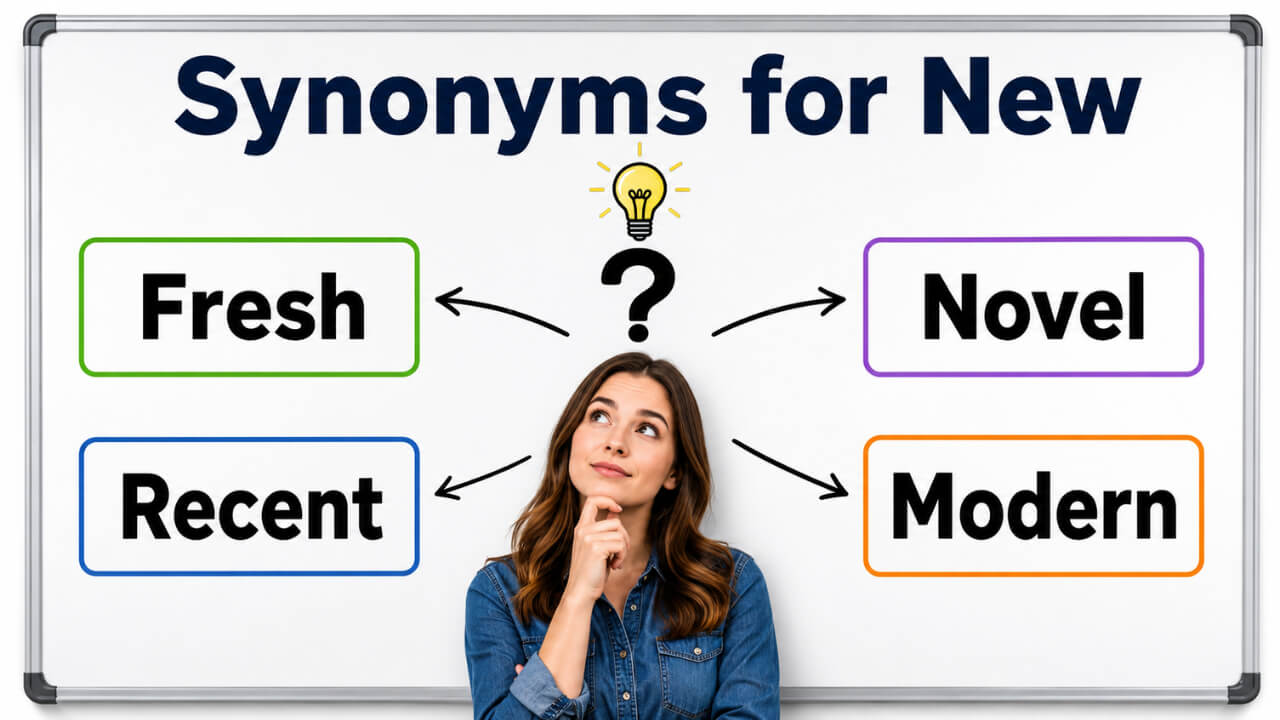
Quick Answer: The best synonyms for new include fresh, recent, modern, novel, original, latest, current, unused, innovative, and unfamiliar. Use fresh for something clean, renewed, or recently made. Use recent for time. Use modern for style, design, or technology. Use novel for original ideas. Use unused for objects that have not been used before. These synonyms for new help you choose a clearer word based on meaning and context.
Pronunciation and Word Details
Word: New
Pronunciation: /nuː/ or /njuː/
Part of Speech: Adjective
Meaning: New means recently made, recently discovered, not used before, different from the old one, or unfamiliar to someone.
US Pronunciation:
UK Pronunciation:
What Does “New” Mean?
Direct Answer: New means something has recently appeared, started, been made, been discovered, or has not been used before.
The word new is usually an adjective. It can describe objects, ideas, people, places, experiences, systems, methods, designs, and situations. For example, a new phone may mean an unused phone, while a new idea may mean an original or different thought.
New can also describe time. A new policy may be recently introduced. A new student may have recently joined a class. A new experience may be unfamiliar to a person.
Meaning, Tone, and Context of “New”
Tone: New is neutral, simple, and common in both spoken and written English.
Formality: New works well in casual speech, formal writing, academic sentences, business writing, product descriptions, reports, and everyday conversation.
Context: The meaning changes based on what it describes. New can mean recent, fresh, modern, unused, original, unfamiliar, updated, or improved.
Common Use: People use new when talking about time, change, discovery, replacement, innovation, fashion, technology, learning, and personal experiences.
Writing Value: New is clear and easy to understand, but it can become vague if repeated too much. In stronger writing, a more specific synonym can make the sentence sharper.
When and How to Use “New”
For Recent Time: Use new when something has just appeared, started, or happened.
Example: The school introduced a new rule this morning.
For Unused Objects: Use new when something has not been used before.
Example: He bought a new notebook for class.
For Fresh Starts: Use new when describing a beginning, chance, plan, or phase.
Example: Moving to another city gave her a new start.
For Modern Style: Use new when something belongs to the present time or feels updated.
Example: The office has a new design with brighter rooms.
For Original Ideas: Use new when an idea, method, or solution feels different from the usual one.
Example: The team suggested a new way to solve the problem.
For Unfamiliar Experiences: Use new when someone has not seen, used, or experienced something before.
Example: Driving in heavy traffic was new to him.
Best Synonyms for New
Fresh: Recently made, renewed, clean, or full of energy.
Example: She brought a fresh idea to the discussion.
Recent: Happening or made not long ago.
Example: The recent changes improved the system.
Modern: Belonging to the present time or current style.
Example: The room has a modern look.
Novel: Original, unusual, or not seen before.
Example: The writer used a novel approach in the story.
Original: Created in a unique way and not copied.
Example: His original plan solved the issue quickly.
Latest: The most recent version or update.
Example: Please check the latest report before the meeting.
Current: Existing or happening now.
Example: The current method is easier to follow.
Unused: Not used before.
Example: She opened an unused box of pens.
Innovative: Introducing a fresh and useful idea.
Example: The teacher used an innovative method for learning.
Unfamiliar: Not known or experienced before.
Example: The new environment felt unfamiliar at first.
50 Synonyms for New with Short Meanings
- Fresh: Recently made, clean, or renewed.
- Recent: Happening not long ago.
- Modern: Belonging to the present time.
- Latest: Most recent or newest in order.
- Current: Existing or used now.
- Novel: Original, unusual, or fresh in idea.
- Original: Unique and not copied.
- Innovative: Introducing a useful fresh idea.
- Unused: Not used before.
- Untouched: Not handled, changed, or used.
- Unworn: Never worn before.
- Unopened: Still closed and not used.
- Untried: Not tested or attempted before.
- Untested: Not yet checked or proven.
- Newly made: Recently created or produced.
- Newly built: Recently constructed.
- Newly created: Recently formed or designed.
- Newly released: Recently made available.
- Newly arrived: Recently reached a place.
- Newly formed: Recently established or shaped.
- Newly discovered: Found for the first time recently.
- Newly developed: Recently improved, produced, or created.
- Contemporary: Belonging to the present period.
- Updated: Changed to include newer details.
- Revised: Improved after changes.
- Improved: Made better than before.
- Renewed: Made fresh or active again.
- Refreshed: Given new energy or a cleaner form.
- Reborn: Given a fresh life or identity.
- Revived: Brought back with new strength.
- Emerging: Beginning to appear or develop.
- Nascent: Just beginning to exist.
- Initial: Happening at the beginning.
- First: Coming before all others.
- First time: Happening for the first occasion.
- Introductory: Used at the beginning of learning or experience.
- Beginner: Related to someone just starting.
- Inexperienced: Lacking previous practice or knowledge.
- Unfamiliar: Not known or recognized.
- Unknown: Not known before.
- Strange: Different because it is not familiar.
- Different: Not the same as before.
- Alternative: Offering another choice.
- Replacement: Taking the place of an older one.
- Added: Included recently or additionally.
- Additional: Extra or newly included.
- Young: Early in life, growth, or development.
- Early: Near the beginning of a process.
- Advanced: More modern, developed, or improved.
- State of the art: Using the most modern level of design or development.
Read Also:
Synonyms for Cold
Synonyms for New by Context
When New Means Recent
Use these words when new means something happened, appeared, or changed not long ago.
Recent: The recent update made the instructions clearer.
Latest: The latest version includes better examples.
Current: The current plan is easier to understand.
Newly released: The newly released guide explains the process simply.
When New Means Fresh or Unused
Use these words when new means clean, unused, untouched, or recently made.
Fresh: She made a fresh copy of the notes.
Unused: He gave me an unused notebook.
Unopened: The unopened package sat on the table.
Untouched: The untouched room looked neat and clean.
When New Means Modern or Updated
Use these words when new means present day, improved, or changed for current needs.
Modern: The building has a modern design.
Updated: The updated list includes clearer terms.
Contemporary: The room has a contemporary style.
Advanced: The advanced tool saves more time.
When New Means Original or Different
Use these words when new means not ordinary, not copied, or different from previous ideas.
Novel: Her novel idea made the lesson more interesting.
Original: The artist created an original design.
Innovative: The innovative method helped students learn faster.
Different: We need a different plan for this problem.
When New Means Unfamiliar
Use these words when new means not known, not experienced, or not recognized before.
Unfamiliar: The unfamiliar road made him drive slowly.
Unknown: They entered an unknown area.
Strange: The strange sound came from outside.
First time: It was her first time speaking in public.
When New Means Renewed or Restored
Use these words when new means made fresh again, improved again, or brought back.
Renewed: He returned with renewed confidence.
Refreshed: The room looked refreshed after cleaning.
Revived: The old tradition was revived with new energy.
Reborn: The project felt reborn after careful planning.
Another Word for New
Direct Answer: The best single replacement for new is often fresh, but the right choice depends on context.
Use fresh for ideas, beginnings, energy, design, food, or renewed feeling. Use recent for time, modern for style or technology, unused for objects, and novel for original ideas.
Original: She wants a new start.
Better Option: She wants a fresh start.
Original: I read the new report yesterday.
Better Option: I read the recent report yesterday.
Original: The house has a new design.
Better Option: The house has a modern design.
Original: They suggested a new solution.
Better Option: They suggested an innovative solution.
When Not to Use “New”
Avoid new when a more exact word would make the meaning clearer. New can sound vague if the reader does not know whether you mean recent, unused, modern, original, updated, or unfamiliar.
Weak: I bought a new coat from a secondhand shop.
Better: I bought an unworn coat from a secondhand shop.
Weak: The writer shared a new idea.
Better: The writer shared an original idea.
Weak: The company changed to a new system.
Better: The company changed to an updated system.
Weak: The study includes new information.
Better: The study includes recent information.
Weak: The room looks new after painting.
Better: The room looks refreshed after painting.
Words Commonly Confused With New
New vs Fresh: New means recently made, started, or introduced. Fresh often adds the feeling of cleanliness, energy, or renewal.
New vs Recent: New can describe unused objects, modern styles, or unfamiliar things. Recent mainly refers to time.
New vs Modern: New means recently made or introduced. Modern means current in style, design, method, or technology.
New vs Novel: New is a general word. Novel means original, unusual, or not seen before.
New vs Original: New may simply mean recent. Original means unique and not copied.
New vs Unused: New can mean many things. Unused only means something has not been used before.
New vs Latest: New can describe anything recently made or unfamiliar. Latest means the most recent in a series.
Which Synonym Should You Choose?
Choose fresh when writing about a start, idea, look, feeling, or renewed energy.
Choose recent when writing about time, news, changes, studies, reports, or events.
Choose modern when writing about design, style, tools, buildings, methods, or technology.
Choose latest when writing about the newest version, update, edition, result, or model in a sequence.
Choose current when writing about what is happening, accepted, or used now.
Choose novel when writing about a creative, unusual, or original idea.
Choose original when you want to show that something is unique and not copied.
Choose unused when writing about an object that has not been used before.
Choose innovative when writing about a useful idea, method, process, or solution.
Choose unfamiliar when writing about something a person does not know or has not experienced.
Real Life Examples of “New” in Sentences
Original: She bought a new dress for the dinner.
Better Option: She bought an unworn dress for the dinner.
Original: We need a new plan for this project.
Better Option: We need a fresh plan for this project.
Original: The teacher explained the new rule.
Better Option: The teacher explained the recent rule.
Original: He moved into a new apartment.
Better Option: He moved into a recently built apartment.
Original: They used a new method in the lesson.
Better Option: They used an innovative method in the lesson.
Original: The new design looks clean and simple.
Better Option: The modern design looks clean and simple.
Original: She felt nervous in the new environment.
Better Option: She felt nervous in the unfamiliar environment.
Original: I downloaded the new version of the file.
Better Option: I downloaded the latest version of the file.
Original: The writer shared a new opinion.
Better Option: The writer shared an original opinion.
Original: His room looked new after cleaning.
Better Option: His room looked refreshed after cleaning.
Synonym Groups and Usage Differences
Fresh Start Group
Words like fresh, renewed, refreshed, and reborn focus on a clean beginning, better feeling, or renewed energy.
Example: She entered the year with fresh confidence.
Recent Time Group
Words like recent, latest, current, and newly released focus on time and order.
Example: The latest notice explains the new rules clearly.
Modern Style Group
Words like modern, contemporary, updated, and advanced focus on present day design, technology, and methods.
Example: The office now has a modern layout.
Original Idea Group
Words like novel, original, innovative, and different focus on creativity and uniqueness.
Example: His novel suggestion changed the whole discussion.
Unused Object Group
Words like unused, unopened, unworn, and untouched focus on something that has not been handled or used.
Example: She found an unused journal in the drawer.
Unfamiliar Experience Group
Words like unfamiliar, unknown, strange, and first time focus on something not known or experienced before.
Example: The unfamiliar language made the trip more challenging.
Antonyms of New
Old: Existing for a long time or not recent.
Used: Already handled, worn, or owned before.
Worn: Damaged or changed from use.
Outdated: No longer modern or current.
Obsolete: No longer useful because something better exists.
Ancient: Very old or from the distant past.
Familiar: Known or recognized from previous experience.
Established: Already accepted, known, or in place.
Traditional: Based on older customs, methods, or styles.
Stale: No longer fresh, lively, or interesting.
Conventional: Usual, ordinary, or not original.
Former: Belonging to an earlier time or position.
Comparison: New vs Related Words
New vs Fresh
New is broad and can mean recent, unused, or unfamiliar. Fresh often suggests cleanliness, energy, or renewal.
Example With New: She has a new idea for the lesson.
Example With Fresh: She has a fresh idea for the lesson.
New vs Recent
New can describe time, condition, style, or experience. Recent only focuses on something that happened not long ago.
Example With New: The new policy affects all students.
Example With Recent: The recent policy affects all students.
New vs Modern
New means recently made or introduced. Modern means current in design, technology, or style.
Example With New: They bought new furniture.
Example With Modern: They bought modern furniture.
New vs Novel
New is simple and general. Novel is stronger when describing an original or unusual idea.
Example With New: The scientist tested a new approach.
Example With Novel: The scientist tested a novel approach.
New vs Original
New may mean recently introduced. Original means unique and not copied.
Example With New: He wrote a new song.
Example With Original: He wrote an original song.
New vs Unused
New can describe many meanings. Unused is exact when the object has not been used before.
Example With New: She opened a new pen.
Example With Unused: She opened an unused pen.
New vs Latest
New can describe anything recently made or unfamiliar. Latest means the most recent item in a series.
Example With New: I read the new chapter.
Example With Latest: I read the latest chapter.
Common Phrases and Expressions With New
Brand New: Completely new and not used before.
New Beginning: A fresh start or new stage in life.
New Idea: A fresh or original thought.
New Version: A recently changed or updated form.
New Arrival: A person, product, or item that has recently arrived.
New Look: A changed or refreshed appearance.
New Member: Someone who recently joined a group.
New Experience: Something a person has not experienced before.
New Life: A fresh way of living or a changed condition.
New Direction: A different path, plan, or goal.
Common Mistakes to Avoid
Repeating New Too Often: Using new in every sentence can make writing sound plain. Replace it with recent, fresh, modern, latest, or original when the context is clear.
Choosing the Wrong Synonym: Do not use modern when you only mean recent. Modern is about present style or development, not just time.
Confusing New and Unused: A new idea is not unused. An unused object has not been handled before. Choose the word that matches the noun.
Using Novel in Casual Sentences: Novel can sound formal or academic. It works best for ideas, methods, approaches, and findings.
Using Fresh for Every Meaning: Fresh is useful, but it does not always mean new. Fresh can also mean clean, energetic, or recently prepared.
Writing Vague Sentences: When the meaning matters, choose a precise word. Recent tells time, latest tells order, unused tells condition, and unfamiliar tells experience.
Conclusion
Synonyms for new help you write with more detail, accuracy, and natural variety. Use fresh for beginnings and renewed energy, recent for time, modern for style, latest for updates, unused for objects, novel for original ideas, and unfamiliar for new experiences. The word new is clear and useful, but stronger synonyms can make your sentence more exact. Choose the word that best matches the object, idea, time, feeling, or situation you want to describe.
FAQs About Synonyms for New
What are the best synonyms for new?
The best synonyms for new are fresh, recent, modern, latest, current, novel, original, unused, innovative, and unfamiliar.
What is another word for new in formal writing?
In formal writing, use recent, current, novel, innovative, updated, or contemporary, depending on the sentence.
What is another word for new ideas?
Good synonyms for new ideas include fresh ideas, novel ideas, original ideas, innovative ideas, and different ideas.
What is another word for new products?
For new products, use latest, newly released, unused, modern, updated, or brand new, depending on the product condition.
What is the difference between new and fresh?
New means recently made, introduced, or experienced. Fresh often means clean, renewed, lively, or recently prepared.
What is the opposite of new?
The opposite of new can be old, used, outdated, obsolete, familiar, traditional, or stale, depending on context.
Can new mean unfamiliar?
Yes. New can mean unfamiliar when someone has not experienced, seen, learned, or used something before.
